


How Jib Cranes Enhance Efficiency in Modern Workspaces
In any fast-paced industrial environment, efficiency is the currency of success. Every aspect of the production process is scrutinized for opportunities to eliminate waste, speed up cycle times, and improve output. While large-scale logistics are often managed by massive overhead cranes, a significant portion of lost productivity occurs at the micro-level—at individual workstations where operators are forced to wait for lifting assistance or resort to unsafe manual handling.
This is where localized lifting solutions become a critical component of a truly efficient operation. For decades, the simple, robust, and highly effective jib crane has been the tool of choice for enhancing productivity at the workstation level. These compact cranes are not meant to replace their larger counterparts; they are designed to supplement them, creating a layered and highly efficient material handling ecosystem.
This comprehensive guide will explore the specific ways jib cranes enhance efficiency in modern workspaces. We will break down how they eliminate common bottlenecks, improve worker safety and ergonomics, and provide a rapid return on investment by optimizing workflow right where the work gets done.
The Problem: Hidden Inefficiencies in Material Handling
Before diving into the solution, it’s crucial to understand the problem. In many facilities, a single high-capacity overhead bridge crane services an entire bay. While essential for heavy lifts, this setup creates several hidden inefficiencies:
- The Queueing Effect: If a machinist needs to lift a 300-pound chuck into a lathe, they must call for the main crane. If that crane is already in use by the welding department at the other end of the bay, the machinist waits. This “queueing” for a shared resource leads to significant cumulative downtime for skilled operators.
- Mismatched Capacity: Using a 15-ton capacity bridge crane to lift a 300-pound part is a gross misallocation of a powerful asset. It’s the equivalent of using a sledgehammer to crack a nut. The large crane is tied up on a small task, preventing it from being used for the heavy lifts it was designed for.
- Manual Handling Risks: When the wait for a crane is too long, workers may be tempted to lift moderately heavy objects manually. This dramatically increases the risk of musculoskeletal injuries, leading to lost workdays, increased insurance premiums, and a decline in employee morale.
These small, seemingly minor delays and risks, when multiplied across multiple workstations and shifts, add up to a substantial loss of overall facility efficiency.
The Solution: Dedicated Workstation Lifting
Jib cranes directly address these inefficiencies by providing dedicated, localized lifting power. By placing a compact, right-sized crane at a specific work cell or group of cells, you empower operators to manage their own material handling needs instantly and safely. This simple strategic shift can have a profound impact on your entire operation.
How Jib Cranes Work
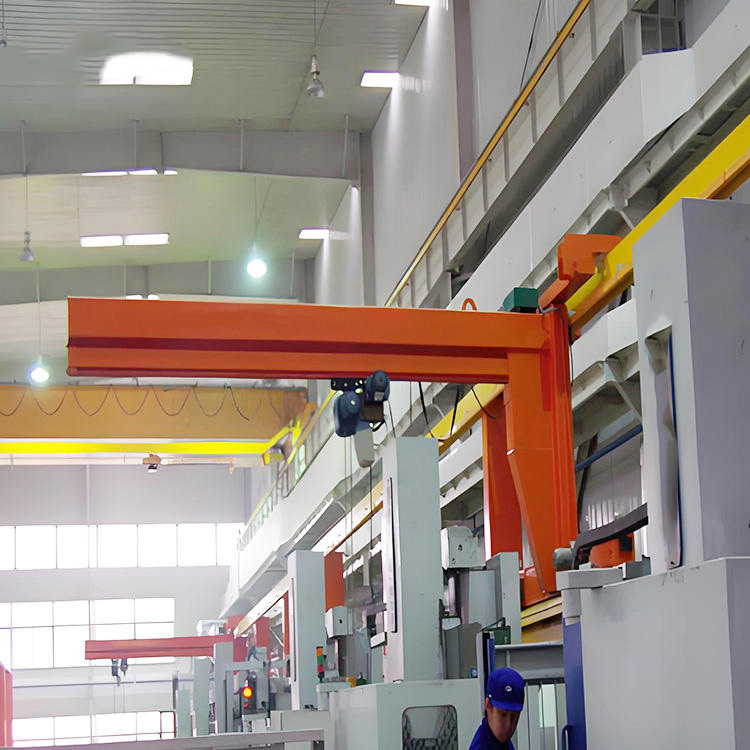
A jib crane features a horizontal boom (the jib) that supports a hoist and trolley. This boom is mounted to a vertical support, allowing it to rotate and provide lifting coverage over a circular or semi-circular area. This focused coverage is perfect for serving one or two adjacent machines, a welding station, or an assembly area.
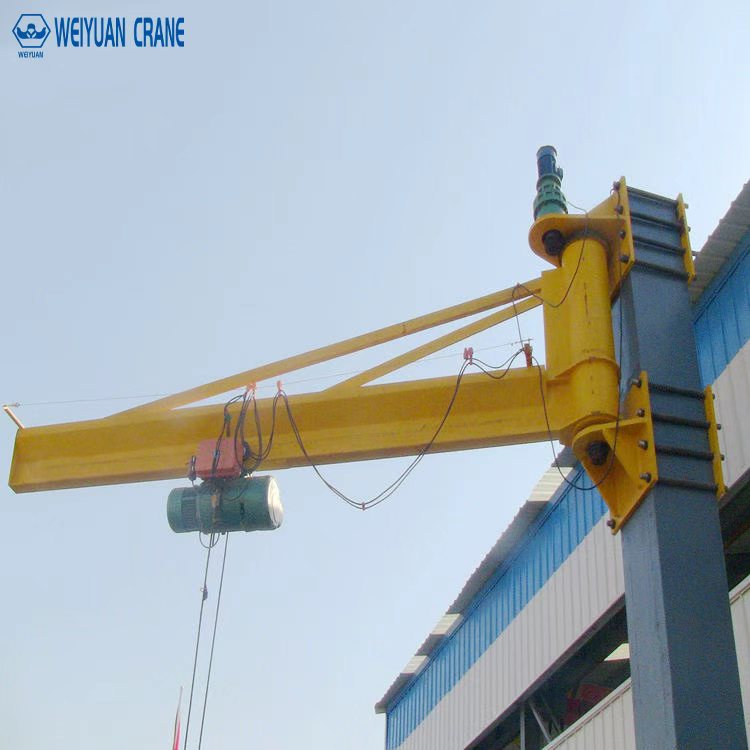
Weiyuan 500kg Wall Mounted Jib Crane
The Weiyuan 500kg Wall Mounted Jib Crane is a compact and efficient lifting solution designed for workshops, assembly lines, and warehouse operations. Mounted directly to a structural wall or column, it saves valuable floor space while providing smooth 180° slewing coverage for precise material handling up to 500 kg.
View Product / Get QuoteKey Ways Jib Cranes Boost Workspace Efficiency
1. Eliminating Operator Downtime
The most immediate and measurable benefit of installing a jib crane is the near-total elimination of waiting. An operator no longer needs to stop work and wait for the main facility crane to become free. They have instant access to lifting power, allowing for a continuous, uninterrupted workflow.
Consider an assembly line where workers need to install a 150-pound component into a larger product. With a dedicated jib at their station, they can lift, position, and install the part in seconds. Without it, the entire line might pause while they wait for assistance. This ability to maintain momentum is a massive driver of throughput.
2. Optimizing the Use of High-Capacity Cranes
Jib cranes create a more logical and efficient material handling hierarchy. They act as “feeder” cranes that complement your larger systems.
A typical workflow might look like this:
- Macro-Movement: A 20-ton overhead bridge crane unloads a massive steel plate from a delivery truck and places it in a staging area.
- Micro-Movement: A 1-ton capacity jib crane then picks up smaller sections cut from that plate and feeds them into a CNC machine for processing.
In this model, each crane is used for its intended purpose. The large, expensive-to-operate bridge crane is reserved for heavy, long-distance moves, while the smaller, more nimble jib cranes handle the high-frequency, low-capacity lifts at the workstation level. This optimizes the use of all your capital equipment.
3. Enhancing Worker Safety and Ergonomics
An efficient workspace is a safe workspace. Repetitive manual lifting, even of objects weighing as little as 50 pounds, can lead to chronic back, shoulder, and neck injuries. These injuries are a significant source of lost productivity and increased operational costs.
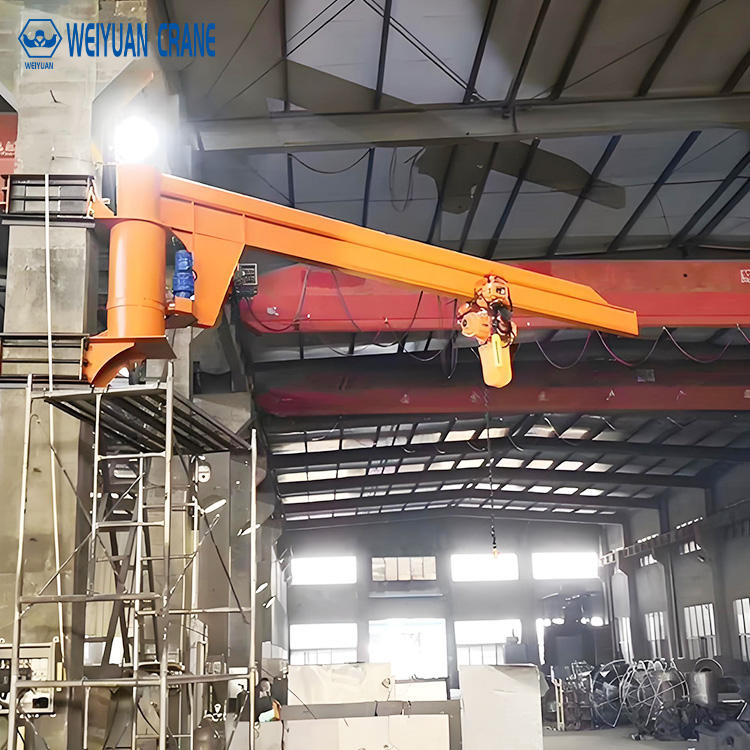
Jib cranes provide an ergonomic solution, transforming a two-person manual lift into a safe, one-person operation. By providing a mechanical means to handle these “in-between” loads—too heavy to lift comfortably but too small to warrant the main crane—you create a safer environment. This reduces the risk of injury, lowers insurance costs, and demonstrates a commitment to employee well-being, which can improve retention and morale.
4. Maximizing Usable Floor Space
Workspace is a premium in any facility. Jib cranes are designed to provide maximum lifting coverage with a minimal footprint. Different mounting options allow them to be integrated efficiently into almost any layout.
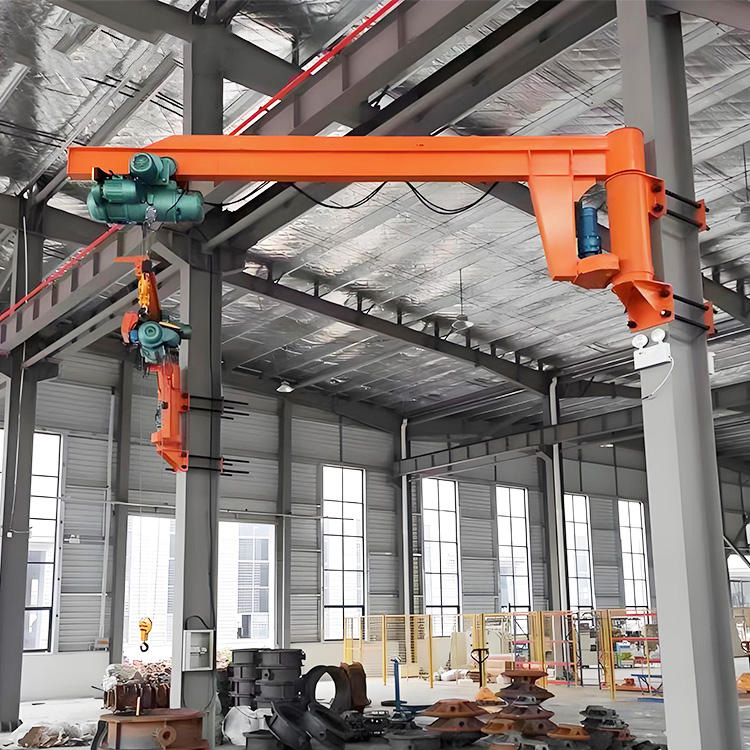
- Wall-Mounted Jib Cranes: These mount directly to a suitable building column or wall, requiring zero floor space. They are perfect for servicing workstations located along the perimeter of a building.
- Foundationless Jib Cranes: These innovative designs use a large steel base plate instead of a poured concrete foundation. They can be installed quickly without excavation and can be easily relocated if your workflow changes, offering incredible flexibility.
- Articulating Jib Cranes: These models have a two-part boom that can “knuckle” around obstacles, allowing them to reach into tight spaces or inside machinery enclosures where a straight boom cannot go.
By choosing the right configuration, you can add significant lifting capability without cluttering your factory floor or impeding the flow of traffic.
Choosing the Right Jib Crane for Maximum Efficiency
To maximize the efficiency gains, you must select the right type of jib crane for the application.
- Capacity: Determine the absolute heaviest load the crane will need to lift and add a 25% safety buffer. Never undersize a crane.
- Span/Reach: Measure the required horizontal reach from the pivot point to cover the intended work area.
- Rotation: Decide if you need 360-degree rotation (only possible with floor-mounted models) or 180-200 degrees (typical for wall-mounted units).
- Mounting Style: Evaluate your facility’s structure. Can your columns support a wall-mounted unit? Do you have space and the ability to pour a concrete foundation for a freestanding model? Or is a portable foundationless model a better fit for your needs?
E-A-T: Ensuring Trustworthy and Authoritative Operation
To operate efficiently and safely, your equipment must be managed with Expertise, Authoritativeness, and Trustworthiness (E-A-T).
- Expertise: Installation must be performed by qualified professionals. Any design that attaches to the building structure must be approved by a licensed structural engineer to verify that the building can handle the imposed loads. Operators must receive expert training on safe lifting practices.
- Authoritativeness: Your lifting program must comply with all relevant safety standards, such as those from OSHA and ASME. This includes regular, documented inspections and load testing to certify the crane’s capacity and structural integrity. Maintaining this authoritative record is crucial for compliance and liability protection.
- Trustworthiness: A trustworthy crane is a well-maintained one. A strict preventive maintenance schedule for all jib cranes, including lubrication, bolt torque checks, and hoist inspections, ensures the equipment is reliable and ready when needed. An unreliable crane that is frequently out of service is a source of inefficiency, not a solution to it.