


How to Choose the Perfect Jib Crane for Your Industrial Needs
Moving heavy materials safely and efficiently dictates the rhythm of your entire production facility. When an operator needs to position a 500-pound steel billet into a CNC machine, relying on manual labor invites severe injury. Relying on a shared overhead bridge crane invites massive production bottlenecks. You need localized, dedicated lifting power. You need a jib crane.
Selecting the right jib crane is a critical engineering decision. Installing the wrong equipment can compromise your building’s structural integrity, endanger your workforce, and throttle your throughput. While large Gantry Cranes handle massive, facility-wide logistics, jib cranes operate as the precision surgical tools of your material handling ecosystem.
This guide provides a comprehensive, step-by-step framework for choosing the exact jib crane configuration your facility demands. You will learn how to calculate precise load requirements, assess your structural limitations, and select a system that guarantees a rapid return on investment.
Understanding the Role of Jib Cranes
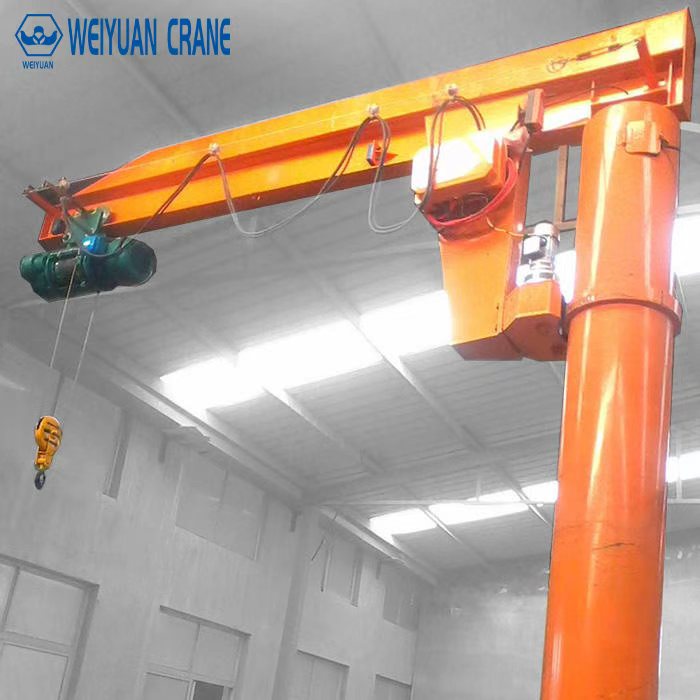
Before specifying technical requirements, you must understand exactly where a jib crane fits into your operation. A jib crane consists of a horizontal boom (the jib) attached to a pivoting vertical support. This allows a hoist to move materials within a localized circular or semi-circular area.
They do not replace your larger lifting infrastructure. Instead, they supplement it. By giving individual workstations their own lifting devices, you eliminate the idle time caused by workers waiting for shared facility cranes. This tiered approach to material handling keeps every machine running and every operator safe.
The Micro-Lifting Advantage
Your facility likely handles both “macro” and “micro” movements. Moving a 10-ton shipping container across an outdoor yard requires heavy-duty Gantry Cranes. However, once that container is unpacked, moving the individual 200-pound components onto an assembly line requires micro-lifting.
Jib cranes excel at this micro-lifting. They offer unparalleled precision, allowing workers to perform highly repetitive tasks without physical fatigue. When you match the crane perfectly to the workstation, productivity naturally skyrockets.
Step 1: Define Your Lifting Parameters
The selection process begins with strict mathematics. You must accurately define the physical dimensions and weight of the materials you intend to lift. Guesswork here leads to catastrophic equipment failure.
Calculating the Working Load Limit (WLL)
The Working Load Limit represents the absolute maximum weight the crane can safely lift. You must calculate this with a built-in safety buffer.
Identify the single heaviest component your workstation will ever handle. Now, add 25 percent to that figure. This crucial safety buffer accounts for the weight of your rigging equipment, such as chains, slings, lifting magnets, and spreader bars. It also prevents operators from running the hoist motor at its maximum threshold during every single lift, which significantly extends the lifespan of the equipment.
Determining Span and Hook Reach
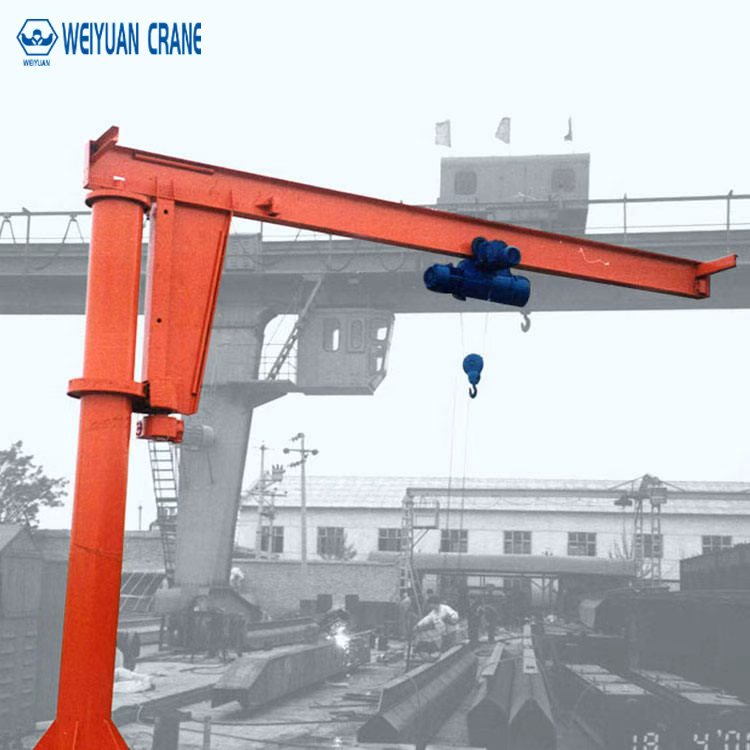
The span is the total horizontal length of the crane’s boom. You want a span long enough to cover your necessary work area, but no longer. Excessively long booms increase the engineering cost and exert unnecessary leverage on your mounting structure.
Remember that “span” and “hook reach” are not the same measurement. The trolley that carries the hoist cannot travel to the absolute edge of the boom, nor can it sit flush against the vertical mast. Your usable hook reach will always be slightly shorter than your total boom span. Plan your workstation layout around the true hook reach.
Calculating Height Under Hook
How high do you need to lift your materials? You must measure the distance from the floor to the lowest overhead obstruction in your facility. Next, subtract the physical height of the hoist unit, the trolley, and your specific rigging equipment.
The remaining distance represents your actual working lift height. If this height is insufficient to clear the machinery on your floor, you will need to specify a low-headroom hoist or a different crane configuration altogether.
Step 2: Evaluate Your Facility’s Structural Architecture
A jib crane acts as a massive lever. When you suspend a heavy load at the very tip of the boom, it generates intense pulling and pushing forces on the anchor point. Your building’s architecture dictates which type of crane you can safely install.
Floor Space and Foundations
Freestanding cranes anchor directly to the floor. However, you cannot simply bolt a heavy-duty mast to a standard four-inch concrete warehouse floor. The leverage generated by a loaded boom will easily rip the anchor bolts straight out of the concrete, causing a catastrophic collapse.
High-capacity freestanding cranes require specialized, deep concrete foundations. You must hire structural contractors to excavate your floor and pour a steel-reinforced concrete block to counteract the overturning moment. You must factor this foundation work into your budget and installation timeline.
Existing Columns and Walls
If you lack the floor space for a freestanding mast, you might consider attaching the boom directly to your building’s existing structure. This approach saves valuable square footage.
However, you must hire a licensed structural engineer to analyze your building columns before pursuing this route. The engineer must verify that the building column can withstand the dynamic, twisting forces generated by the swinging boom. Never bolt lifting equipment to a non-structural wall.
Step 3: Select the Right Jib Crane Configuration
Once you know your load parameters and structural limitations, you can select the mechanical configuration that best serves your workflow. Manufacturers offer several distinct designs to solve specific logistical challenges.
Freestanding Pillar Jib Cranes
This is the most common and robust design in heavy industry. It consists of a vertical tubular mast securely bolted to a dedicated foundation.
This design provides a full 360 degrees of rotation, offering the maximum possible coverage area. Because it does not rely on the building for support, you can place it anywhere on the factory floor or even outdoors. They handle the heaviest loads, routinely managing capacities from 500 pounds up to 15 tons.
Wall-Mounted Jib Cranes
When floor space is an absolute premium, a wall-mounted unit provides an elegant solution. The boom attaches directly to a structurally verified building column via a specialized bracket.
This configuration requires zero floor footprint. Forklifts and automated guided vehicles can drive directly underneath it without obstruction. Because the wall restricts movement, rotation is typically limited to a 200-degree arc. This makes them ideal for workstations positioned along the perimeter of your facility.
Mast-Type Jib Cranes
A mast-type configuration serves as a structural compromise. It looks similar to a freestanding unit, but it utilizes both the floor and an overhead structural beam for support.
By tying into the ceiling, this design distributes the lifting forces. This often eliminates the need for the massive, expensive concrete foundations required by purely freestanding models. It still provides a full 360 degrees of rotation, making it a highly cost-effective choice for facilities with strong overhead architecture.

Weiyuan Column Jib Crane
The Weiyuan Column Jib Crane is a versatile and cost-effective freestanding lifting solution designed for precise material handling in workshops, assembly lines, and maintenance areas. With a full 360-degree slewing range and robust steel structure, this crane delivers smooth rotation, dependable performance and enhanced operational flexibility in confined workspaces. :contentReference
View Product / Get QuoteArticulating Jib Cranes
Standard straight booms can be clumsy when you need to reach around obstacles or into tight enclosures. An articulating jib solves this by incorporating a pivot point in the middle of the boom.
This dual-axis design functions like a human arm. The operator can fold the boom and maneuver the load around building columns or deep inside a complex CNC machine. They typically handle lighter capacities (under one ton) but offer unmatched ergonomic flexibility.
Step 4: Compare Lifting Solutions
You must ensure a jib crane is actually the correct tool for your specific application. Sometimes, alternative lifting systems offer better functionality.
When to Use Overhead Bridge Cranes
If you need to move heavy materials across the entire length and width of your facility, a jib crane is the wrong tool. You need an overhead bridge crane. Bridge cranes travel along parallel runways, providing rectangular coverage over a massive area. Use jib cranes to supplement bridge cranes, not replace them.
When to Use Gantry Cranes Instead
If you operate a large outdoor yard, such as a precast concrete facility or a shipping port, you need lifting power over vast areas without existing building structures. This is where large Gantry Cranes dominate. They are self-supporting structures on legs that run along ground-level tracks. While you can weatherize a freestanding jib crane for outdoor use, Gantry Cranes provide exponentially more capacity and mobility for massive outdoor logistics.
Step 5: Power, Rotation, and Ergonomics
The physical structure is only half the equation. You must also specify how the crane actually moves and lifts the load.
Manual vs. Motorized Rotation
For lighter loads (generally under one ton) and shorter spans, manual rotation is highly effective. The operator simply grabs the load and physically walks it through the arc. It is fast, intuitive, and cost-effective.
For heavier capacities or long booms, motorized rotation becomes a strict safety requirement. Expecting an operator to physically swing a two-ton steel block invites severe strain injuries. Motorized rotation utilizes electric drives to smoothly pivot the boom.
Selecting the Right Hoist
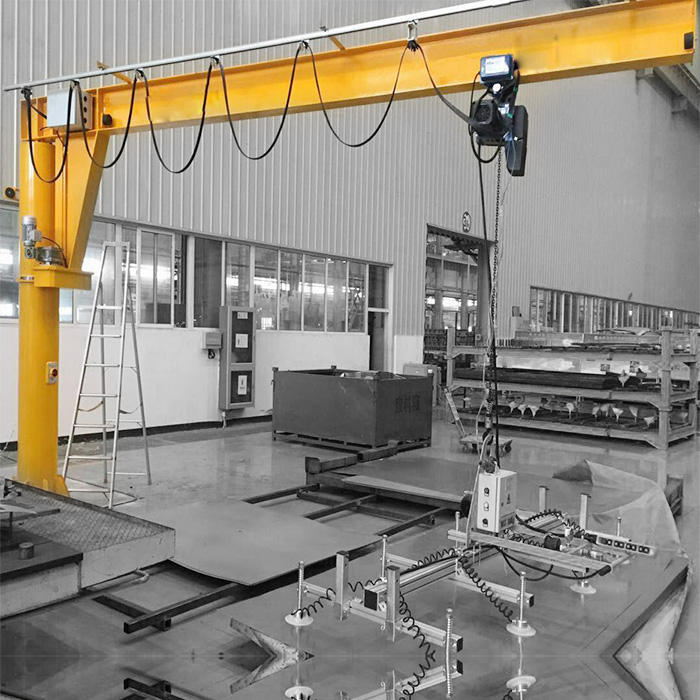
The hoist is the engine of your crane. For most workstation jib applications, an electric chain hoist is the standard choice. They provide a true vertical lift without lateral drift, which is vital for precise assembly tasks.
You must also consider the control system. Modern industrial facilities demand Variable Frequency Drives (VFDs). A VFD allows the operator to infinitely adjust the lifting and rotating speed. This provides a “soft start,” eliminating the sudden, dangerous jerking motions that cause heavy loads to swing like a pendulum.
Step 6: Safety, Compliance, and E-A-T Standards
Purchasing high-quality equipment is useless if you fail to maintain a rigorous safety culture. Authoritative material handling requires strict adherence to international safety standards, such as OSHA in the United States or CE in Europe.
Installation and Auditing
Never attempt to install a jib crane using your internal maintenance staff unless they hold specific lifting equipment certifications. You must use specialized crane technicians to erect the mast, torque the anchor bolts, and perform the initial load tests.
Once operational, the crane requires mandatory daily visual inspections. Operators must check the hoist chain for wear and test the emergency stop mechanisms before every single shift. Furthermore, you must contract certified third-party technicians to perform comprehensive annual audits of the structural welds, brakes, and electrical components.