


How to Choose the Right Jib Crane for Your Facility
Buying a jib crane is not a complicated decision — until you’re standing in front of a catalog with a dozen configurations and no clear criteria for narrowing them down. The wrong choice doesn’t just waste budget; it creates a lifting solution that workers quietly work around instead of rely on, which defeats the purpose entirely.
This guide cuts through the noise. Whether you’re outfitting a single machining station or a full fabrication yard, here’s what actually matters when selecting the right unit for the job.
Start With the Load, Not the Equipment
The single most common mistake facilities make is selecting a crane based on general capacity rather than the actual loads they’ll be moving. Every jib crane has a rated capacity, but that number only tells part of the story.
You need to account for the weight of the hoist itself, any lifting attachments like spreader bars or custom hooks, and any dynamic forces created by swinging or sudden stops. A safe rule of thumb is to select a crane rated at least 25% above your maximum expected load. This buffer extends equipment life and keeps you safely within rated limits during real-world operation.
Also consider load shape, not just weight. Long, unwieldy pieces like steel pipes or I-beams behave differently than compact engine blocks. If your loads are frequently off-center or awkward to rig, you may need a longer boom or a rotating trolley hoist to maintain control during positioning.

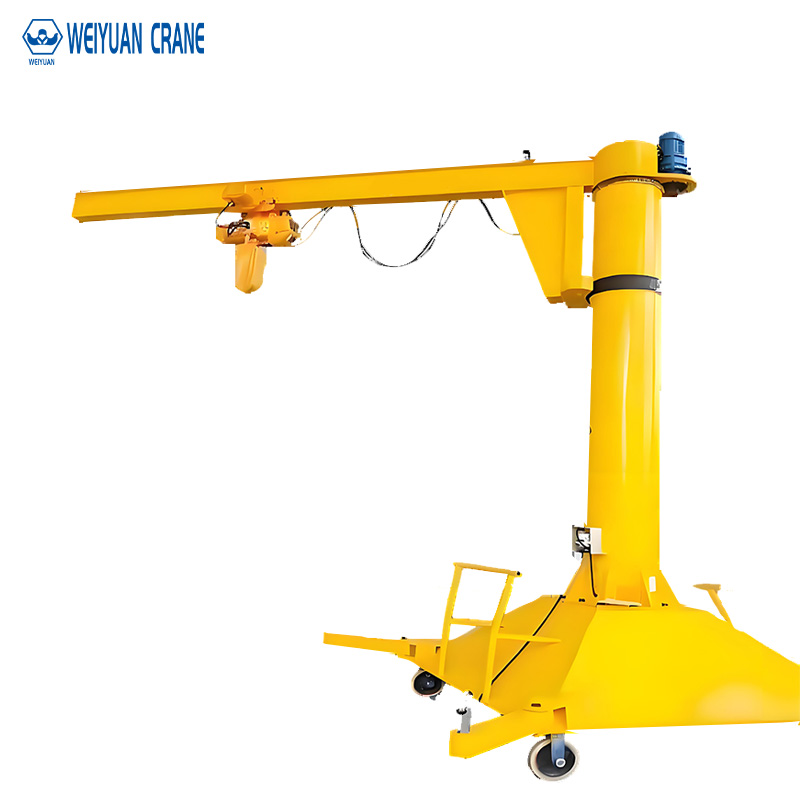
Weiyuan Column Jib Crane
The Weiyuan Column Jib Crane is a versatile and cost-effective freestanding lifting solution designed for precise material handling in workshops, assembly lines, and maintenance areas. With a full 360-degree slewing range and robust steel structure, this crane delivers smooth rotation, dependable performance and enhanced operational flexibility in confined workspaces. :contentReference
View Product / Get QuoteMatch the Mounting Style to Your Space
Jib cranes come in three primary mounting configurations, and each one suits a different physical environment.
Floor-mounted (freestanding) models are the most versatile. They can be positioned anywhere a reinforced concrete foundation exists, making them ideal when no suitable wall or column is nearby. The tradeoff is footprint — the base plate and anchoring hardware require clear floor space, and the concrete specifications must be met precisely for safe operation.
Wall-mounted models attach directly to a structural building column or wall. They free up the floor entirely and are well-suited for workstations along the perimeter of a facility. Before specifying a wall-mounted unit, verify that the building structure can handle the cantilevered load. An engineer’s sign-off is not optional here.
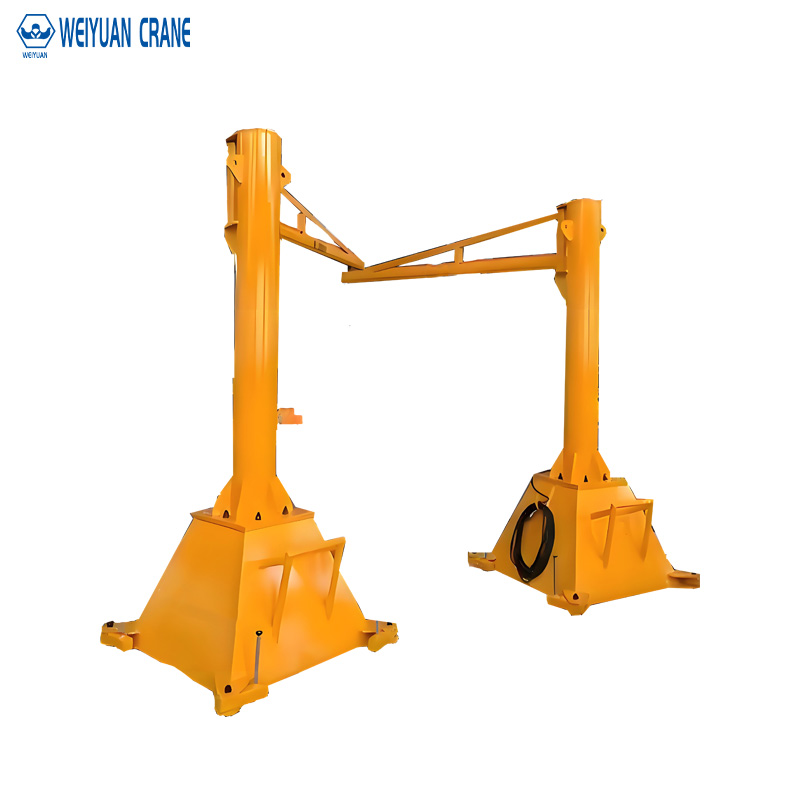
Mast-style models attach to both the floor and ceiling, using the ceiling connection for lateral stability rather than load-bearing support. This allows for greater boom length and smoother rotation compared to freestanding units, which is useful in facilities with high ceilings and long reach requirements.
Think Carefully About Rotation Arc
Most facilities default to ordering a 360-degree rotation crane without stopping to ask whether they actually need it. A full-rotation unit requires unobstructed clearance in every direction, which is rarely available near walls, columns, or neighboring equipment.
A 180-degree or 270-degree boom is often the smarter choice for workstations against a wall or inside a bay. It delivers all the reach you need where work actually happens, without paying for rotation capacity you can never safely use. Mapping out your actual work envelope before spec’ing the crane will save you from costly reinstallations later.
Select the Right Hoist for the Application
The jib crane structure is only half the equation. The hoist — the mechanism that actually lifts and lowers the load — has a direct impact on speed, control, and operator fatigue.
Manual chain hoists are the most economical option and work well for light, infrequent lifts. They require physical effort on every cycle, which adds up quickly in high-repetition environments.
Electric chain hoists are the standard choice for most industrial applications. They reduce operator fatigue dramatically and allow for variable speed control, which matters enormously when you’re lowering a precision component into a tight fixture.
Air-powered hoists are preferred in environments where electricity poses a safety risk — paint booths, chemical processing areas, and certain food production facilities. They’re also valued for their smooth, proportional control during sensitive lifts.
Match the hoist duty cycle to your operation. A hoist rated for intermittent use will fail prematurely in a facility running continuous production shifts.
Don’t Overlook Installation and Certification Requirements
A jib crane that ships to your dock is not a jib crane that’s ready to work. Installation involves foundation preparation, structural assessments, and in many jurisdictions, third-party load testing and certification before the unit can be put into service.
Factor these costs and timelines into your purchasing decision. If you’re working with a tight production schedule, ask suppliers specifically about lead time from purchase to certified, operational installation — not just delivery time.
Also verify that the equipment meets applicable standards for your industry and region. In the US, ASME B30.12 covers jib crane design and operation. Working with a supplier who understands these requirements from the outset prevents compliance surprises after installation.
Evaluate Total Cost of Ownership, Not Just Purchase Price
Entry-level jib cranes carry attractive price tags, but lower-cost units sometimes compromise on bearing quality, structural steel grade, or hoist reliability. In a facility running two or three shifts, a cheaper hoist that requires rebuilding every 18 months will cost far more than a better-specified unit over a five-year horizon.
When comparing quotes, ask about recommended maintenance intervals, available spare parts, and the supplier’s service network in your area. A crane manufacturer with no regional service presence becomes a logistical problem the first time something needs attention.
Frequently Asked Questions
What capacity jib crane do I need for my application? Calculate the maximum weight of your heaviest load, add the weight of the hoist and any rigging hardware, then apply a 25% safety buffer. When in doubt, size up — operating consistently near the rated capacity limit accelerates wear and reduces service life.
Can I install a jib crane on an existing concrete floor? It depends on the slab thickness, concrete strength, and reinforcement. A structural engineer should assess your floor before installation. Underpowered foundations are the leading cause of jib crane failures.
How much maintenance does a jib crane require? Most units require periodic lubrication of the boom pivot and trolley bearings, routine inspection of load hooks and hoist chains, and annual load testing. Maintenance demands are low compared to larger material handling systems, but they should not be deferred.
Is a wall-mounted or floor-mounted jib crane better? Neither is universally better — it depends on your available structure. Wall-mounted units preserve floor space but require a verified structural connection point. Floor-mounted units offer placement flexibility but require a proper concrete foundation.
Do jib cranes need to be certified before use? Yes, in most jurisdictions. New installations require load testing and documentation before entering service. Ongoing annual inspections are also typically required by OSHA and applicable ASME standards. Confirm local requirements with your supplier before purchasing.