


Jib Crane Ergonomics: How the Right Setup Reduces Workplace Injuries & Boosts Productivity
Introduction
Workplace musculoskeletal injuries — strains, sprains, and cumulative trauma disorders from repetitive manual handling — remain the single largest category of occupational injury in U.S. manufacturing and warehousing operations. The Bureau of Labor Statistics consistently reports that material handling injuries account for approximately 32 to 35% of all workplace injuries across these sectors, with the majority traceable to manual lifting, lowering, pushing, pulling, and carrying of loads that exceed safe human capacity limits.
A jib crane, properly specified and configured for ergonomic material handling, directly addresses this problem. It replaces the physical exertion of manual load handling with a mechanically assisted process that keeps forces on the operator within safe ergonomic limits — while simultaneously improving throughput by reducing the fatigue, variability, and cycle time inherent in manual handling.
But a jib crane that is poorly configured — wrong reach, wrong height, wrong control type, or positioned at the wrong location relative to the workstation — can actually create new ergonomic problems while failing to eliminate the ones it was intended to address. The operator may be awkwardly reaching above shoulder height to engage the hook, applying lateral force to swing a stiff boom, or standing in a constrained posture to manage load swing.
This guide covers the ergonomic principles that govern effective jib crane workstation design: how to assess manual handling risk at current workstations, how to configure a jib crane to minimize operator physical demand, what control and assist technologies transform a standard jib crane into a true ergonomic lifting device, and how to measure the productivity and injury-reduction outcomes that justify the investment.
Part 1: Assessing Manual Handling Risk — Where Jib Cranes Deliver the Most Value
Not every workstation needs a jib crane, and not every manual handling task is best addressed by overhead lifting. Identifying the specific tasks and workstations where a jib crane delivers the greatest ergonomic improvement requires a structured risk assessment.
The NIOSH Lifting Equation
The National Institute for Occupational Safety and Health (NIOSH) Revised Lifting Equation is the engineering standard for quantifying manual lifting risk. The equation produces a Recommended Weight Limit (RWL) — the maximum load that 90% of the working population can safely lift under specific conditions — and a Lifting Index (LI) — the ratio of the actual task load to the RWL.
An LI above 1.0 indicates a lifting task that poses elevated risk for musculoskeletal injury for a significant portion of the workforce. An LI above 3.0 represents high risk and is a strong indicator that mechanical assist is required.
The factors that reduce the RWL — and thus increase the LI — are:
- Load weight above approximately 51 lbs (23 kg) at ideal conditions
- Horizontal distance from the body’s center greater than 10 inches
- Lifting height outside the “power zone” (between knuckle and shoulder height)
- Significant lift frequency (more than 1 lift per minute at moderate loads)
- Asymmetric lifts (twisting the trunk while lifting)
- Poor load coupling (difficult to grasp the object firmly)
Any workstation where the NIOSH LI exceeds 1.5 for tasks performed more than a few times per shift is a candidate for jib crane intervention.
Beyond Weight: The Hidden Ergonomic Risks
Weight alone does not capture the full ergonomic risk picture. Several other physical demands at material handling workstations benefit from jib crane intervention even when the load weight is within manual handling guidelines:
Awkward postures: Reaching into deep machine enclosures, bending over to lift from floor level, or extending overhead to position a part into an elevated assembly fixture all create high spine and shoulder loading regardless of the load weight. A jib crane that positions the load at the right height and reach eliminates these posture demands.
Repetition and cumulative loading: A task that involves lifting a 20-lb part 200 times per shift may not exceed the instantaneous NIOSH RWL, but the cumulative spinal loading across 200 repetitions creates real injury risk over months and years. For high-frequency tasks, even loads below individual NIOSH limits can be addressed productively by jib crane assist.
Force to move loads horizontally: Pushing or pulling loads on carts, conveyors, or across surfaces to reach different positions within a workstation imposes horizontal force demands that are not captured by the NIOSH equation. For loads that must be moved both vertically and horizontally, a jib crane with a motorized trolley and rotating boom provides both motions mechanically.
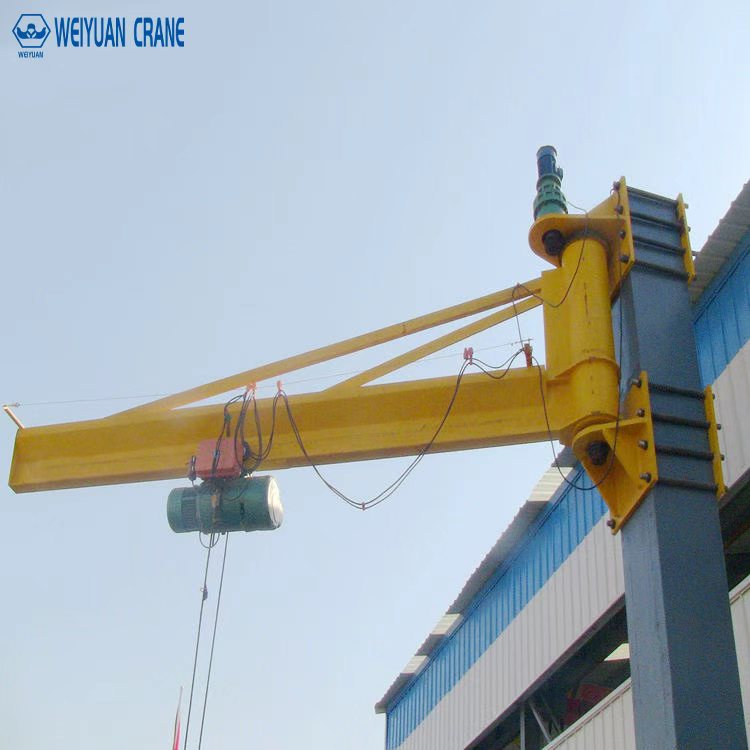
Weiyuan 500kg Wall Mounted Jib Crane
The Weiyuan 500kg Wall Mounted Jib Crane is a compact and efficient lifting solution designed for workshops, assembly lines, and warehouse operations. Mounted directly to a structural wall or column, it saves valuable floor space while providing smooth 180° slewing coverage for precise material handling up to 500 kg.
View Product / Get QuotePart 2: Ergonomic Jib Crane Configuration Principles
Once the workstations and tasks that need jib crane intervention have been identified, the crane configuration must be designed to actually eliminate the ergonomic demands rather than simply shifting them to different body parts.
Principle 1: Position the Crane to Eliminate Horizontal Reach
The most common ergonomic configuration error is placing the jib crane pivot point (mast or wall mount) too far from the work point. This forces the operator to extend the loaded hook to the far end of the boom, maximizing the moment arm and requiring significant force to swing the boom — creating a new shoulder loading problem.
The correct positioning places the crane’s pivot point close enough to the primary work area that the most frequent lifts occur at 50 to 75% of the boom’s maximum reach, not at the extreme tip. This reduces the effective moment arm on the boom during most lifts and reduces the force required to swing the boom to the positioning point.
Principle 2: Set Boom Height at the Ergonomic Hook Zone
The boom elevation determines the range of hook heights available to the operator. For ergonomic material handling, the hook should be accessible within the “ergonomic lifting zone” — between waist height (approximately 30 inches from the floor) and shoulder height (approximately 52 to 60 inches from the floor for an average worker). Hooks that must be engaged above shoulder height, or that require the operator to crouch to attach the load, eliminate the ergonomic benefit of the crane.
For workstations where loads are picked from floor level and placed at table height (or vice versa), the hoist’s lift height must accommodate the full travel range while keeping the hook at a natural working height during attachment and detachment.
Principle 3: Match Boom Rotation Force to the Task Frequency
Standard jib cranes with manual push rotation require the operator to physically push the boom to rotate it. For infrequent use with light loads, this is acceptable — the operator applies force to a loaded boom for a few seconds several times per shift. For high-frequency production tasks, pushing a loaded boom repeatedly creates shoulder fatigue and a new source of musculoskeletal loading.
For tasks involving more than 20 to 30 boom rotations per shift, motorized rotation — or at minimum, a balanced boom with low-friction slewing bearing — should be specified. The goal is that rotating the loaded boom requires no more force than rotating an empty one, and that the force required falls well below the NIOSH-recommended limit for push/pull forces (typically 35 lbs or less for sustained forces).
Principle 4: Select the Right Hoist Control for the Application
Standard push-button pendant controls are adequate for many jib crane applications. However, for high-precision placement or for tasks where the operator must maintain contact with the load during positioning, advanced control options significantly improve ergonomics:
Ergonomic pendant design: Pendants with large, clearly labeled buttons require less visual focus and reduce the possibility of control errors when the operator’s attention is on the load. Pendant cord tension should be minimal — heavy pendant assemblies hanging from the operator’s control hand create forearm fatigue over a full shift.
Load-sensing intelligent assist: These systems use a force sensor between the hoist hook and the load to detect the operator’s push/pull intent. When the operator pushes the load upward, the hoist raises; when pushed down, it lowers. This gives the operator direct, intuitive control over load positioning with minimal applied force — typically reducing the force required to manage the load to less than 2 to 5 lbs. This technology transforms the jib crane from a lifting device into an extension of the operator’s own movement, dramatically reducing cycle time and physical demand simultaneously.
Radio wireless remote: For applications where the operator must stand in a fixed position relative to the load (such as inspecting a part being lowered to a fixture), wireless remote control eliminates the constraint of pendant cord length and allows optimal operator positioning without compromising control.
Part 3: Measuring Ergonomic Improvement — Before and After
Investing in jib crane ergonomics improvements without measuring their impact misses the opportunity to quantify the ROI and build the business case for further investment. The following metrics should be measured before installation and at 6-month and 12-month intervals after:
OSHA Recordable Musculoskeletal Injury Rate at the Target Workstation:
Track the number of OSHA recordable musculoskeletal injuries (strains, sprains, cumulative trauma) at the workstation per 200,000 hours worked. A well-implemented jib crane intervention at a high-risk workstation typically reduces this rate by 50 to 80% within the first year.
Workers’ Compensation Claim Frequency and Cost:
Musculoskeletal injuries from manual handling are among the most expensive workers’ compensation claims — average costs of $15,000 to $40,000 per claim are common. Tracking claim frequency and cost at the target workstation before and after crane installation quantifies the financial return of the ergonomic investment.
Cycle Time at the Workstation:
For production tasks, measure the time from task start to task completion before and after jib crane installation. For ergonomic lifts in the 50 to 200 lb range, well-configured jib crane assist typically reduces cycle time by 15 to 35% compared to two-person manual handling.
Operator-Reported Exertion (BORG Scale):
Ask operators to rate their perceived exertion at the target workstation using the Borg CR-10 scale before and after installation. A well-designed ergonomic jib crane workstation should reduce perceived exertion ratings by 2 to 4 points on the 0-10 scale.
Part 4: Common Jib Crane Ergonomic Configuration Mistakes
Understanding what not to do is as important as understanding best practice.
Specifying maximum reach without analyzing actual work point:
Many buyers specify the maximum boom reach needed for any possible lift at the workstation — then discover that 80% of actual lifts occur at half that reach or less. The result is a heavy, expensive boom that is harder to swing and creates more shoulder loading than a correctly sized unit would.
Installing the crane without adjusting boom height:
A jib crane installed at a standard boom height (set during order entry) without field verification against the actual workstation dimensions may require operators to work at awkward heights. Field-adjustable boom height (if available) or a custom boom height specified based on actual workstation dimensions is the correct approach.
Specifying a light-duty hoist for a high-cycle ergonomic application:
Ergonomic material handling workstations often have high lift frequencies — 50 to 150 lifts per shift in production environments. A light-duty (M3 class) hoist in an M5-class application will fail prematurely and defeats the purpose of the ergonomic investment.
Not training operators on the correct use of the crane:
A jib crane at a workstation that operators do not use — because they were not trained, because the crane is positioned inconveniently, or because the procedure does not specify crane use — provides no ergonomic benefit. Standard work documentation must specify jib crane use as the default process, not an option.
Part 5: ROI Framework for Jib Crane Ergonomic Investments
The financial case for ergonomic jib crane investment is consistently compelling when the analysis captures the full scope of benefits:
Direct cost reduction:
- Workers’ compensation claims prevented: $15,000 to $40,000 per claim × expected annual claim reduction
- Reduced overtime required to cover injured workers
- Reduced training and onboarding cost from lower injury-related turnover
Productivity improvement:
- Cycle time reduction at the workstation × production volume × labor cost per unit time
- Reduction in two-person manual handling operations: for tasks that currently require two workers, one jib crane operator replaces both workers, freeing one person for other productive tasks
Quality improvement:
- Parts handled with a jib crane are less likely to be dropped, impacted, or scratched than parts handled manually. Reduced rework and scrap from handling damage is a real benefit in precision manufacturing environments.
For a typical 1-ton jib crane installation with total installed cost of $12,000 to $18,000 serving a workstation that currently generates one to two OSHA recordable musculoskeletal injuries per year and involves two-person manual handling for multiple lifts per shift, simple payback periods of 6 to 18 months are common. The crane then generates positive ROI for the remaining 20+ years of its service life.
Frequently Asked Questions
Q: At what load weight should I consider a jib crane for ergonomic purposes?
A: The NIOSH guidelines suggest that loads above 50 lbs (23 kg) in non-ideal conditions should be evaluated for mechanical assist. In practice, the decision also depends on frequency, posture, and reach — a 30-lb part lifted 100 times per shift in an awkward posture may warrant a jib crane as much as a 75-lb part lifted 5 times per day from an ideal posture.
Q: Can a jib crane be added under an existing overhead crane?
A: Yes, and this is a very common configuration in manufacturing facilities. A floor-mounted jib crane positioned beneath an overhead bridge crane serves individual workstations with precision lifting while the overhead crane handles inter-station material movement. The jib crane boom elevation must be planned to clear the overhead crane’s lowest travel position.
Q: What is the difference between an ergonomic assist jib crane and a standard production jib crane?
A: An ergonomic assist crane is specifically configured for low-force, high-precision load control — typically using load-sensing intelligent assist controls, a lightweight boom design, a low-friction slewing bearing, and a VFD hoist that responds to very light operator input. A standard production jib crane uses conventional push-button pendant control. The ergonomic assist configuration is more expensive (typically 40 to 80% premium over a comparable standard crane) but delivers superior outcomes for high-cycle, precision-handling applications.