


Jib Crane for Loading Dock & Warehouse
Introduction
Most warehouses have the same quiet problem at the loading dock. A truck backs in with a load too heavy for two people and too awkward for a forklift to reach cleanly, so the forklift edges in, lifts high, backs out, turns, and sets down — a slow, tight dance repeated dozens of times a shift. Every one of those moves burns time, risks a dropped load, and puts a forklift where a person is standing.
The frustrating part is that the overhead crane serving the rest of the building often cannot help here. Its runway stops short of the dock, the ceiling drops over the door, and the loads at the dock are too small to justify tying up a bridge crane anyway. So the dock stays under-served — the one spot where lifts happen most often gets the least lifting support.
Here is how it plays out on the floor. One warehouse leaves the dock to forklifts alone, and the loading bay becomes the slowest, most congested part of the operation — trucks waiting, forklifts queuing, and the occasional damaged load. Another warehouse fits a jib crane at each dock position, and the same loads swing out over the truck bed, set down on the dock, and clear in a fraction of the time, with the forklift freed for what it does best. Same building. Same loads. The jib crane decided which dock ran smoothly.
This first article in the series shows you how to specify a jib crane for a loading dock or warehouse. You will learn:
- Why jib cranes suit docks in ways an overhead crane cannot match.
- The key specs for dock applications — clearances, outreach, capacity, and duty class.
- The truck loading configurations — wall-mounted versus pillar-mounted, working radius, and approach limits.
- The space-saving design choices that fit a jib into a tight bay.
- The installation errors that quietly wreck a good specification, and what a jib crane costs in 2026.
Part 1: Why Jib Cranes Suit Loading Docks
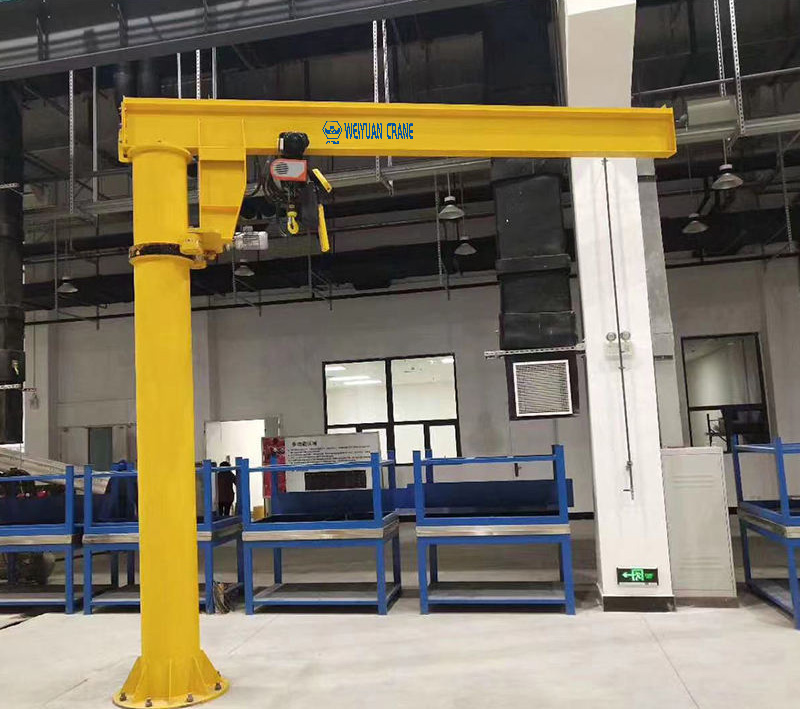
A jib crane rotates a boom around a single fixed point, carrying a hoist that travels along that boom. That simple motion — pivot and reach — is exactly what a loading dock needs, and it is where the jib beats the overhead crane at its own job.
It reaches out over the truck. An overhead crane can only lift what sits under its runway. A jib crane’s boom swings out beyond the dock edge and over the truck bed, so the load is picked where it sits and swung back onto the dock — no forklift shuffle required. This single ability is why jib cranes belong at docks: the lift happens where the truck is, not where the runway ends.
It serves one station cheaply. A dock position is a localized workspace — the same few pickup and set-down points, over and over. A jib crane covers exactly that arc and nothing more, so you buy lifting capacity precisely where you need it, at a fraction of the cost of extending an overhead crane’s runway to the door.
It fits where an overhead crane cannot. Docks sit at the building edge, often under a dropped header, a mezzanine, or a roof line that leaves no room for a bridge crane. A wall-mounted or pillar-mounted jib tucks into that edge, using the wall or a single column instead of a full runway and support structure.
It frees the forklift. With a jib handling the heavy, awkward, or repetitive lifts at the dock, the forklift goes back to moving pallets — the work it is actually good at. Fewer high lifts, fewer tight turns with a load raised, and fewer near-misses in the busiest part of the building.
The practical takeaway: a jib crane suits a loading dock because it reaches out over the truck, serves one station affordably, fits the tight building edge, and takes the dangerous lifts off the forklift. Where an overhead crane stops at the runway, the jib starts at the truck bed.
Part 2: Key Specs for Dock Applications
Getting a dock jib right comes down to a handful of numbers. Miss any one and the crane either cannot reach the load, cannot clear the door, or wears out early. Here are the specs that decide the specification, all governed by ASME B30.11 for jib crane construction and use and rated by CMAA/FEM duty class for the cycle count.
Dock Height and Clearance
The dock is a tight vertical space, so clearance drives everything.
- Under-boom clearance: measure from the floor to the underside of the boom, then subtract the hoist and the lifted load’s height. Confirm the hook can still reach the truck bed — typically 1.2 to 1.5 m above dock level for a standard trailer — with the load attached.
- Header and door clearance: the boom must swing clear of the dropped header above the dock door and any door hardware. Measure the lowest obstruction, not the ceiling.
- Low-headroom hoist: where clearance is tight, an ultra-low-headroom hoist (Part 4) recovers precious lift height by minimizing the space the hoist itself consumes.
Outreach (Boom Length)
Outreach is the horizontal reach from the pivot to the hook, and it sets how far over the truck you can lift.
- Measure from the pivot point to the far edge of the truck bed you must reach, and add margin so the hook is not working at the very boom tip.
- Standard dock jibs run 2 to 6 m of outreach; longer booms reach further but demand a stronger mount and foundation.
- Remember that a longer boom multiplies the overturning moment on the mount — reach is never free.
Capacity Range
Size to the heaviest routine load, including the hoist, hook, and any lifting attachment — not just the payload.
- Dock and warehouse jibs commonly run 250 kg to 5,000 kg; heavier loads move toward pillar-mounted designs with substantial foundations.
- Add a sensible margin so the crane is not working at its rated limit on every lift.
Duty Class
Dock work is repetitive, so the duty class matters as much as the capacity.
- A dock jib on a busy shipping bay cycles constantly — match the CMAA/FEM duty class (light A–B through severe E–F) to the real lifts per hour, not the average.
- Under-rate the duty to save money and the hoist, bearing, and motor wear out early on exactly the high-cycle work a dock demands.
The practical takeaway: confirm the under-boom clearance against the truck bed and the header, set the outreach to the far edge of the truck with margin, size the capacity to the heaviest real load, and match the duty class to the dock’s true cycle count. Those four numbers, checked against ASME B30.11, define a dock jib that works.
Part 3: Truck Loading Configurations
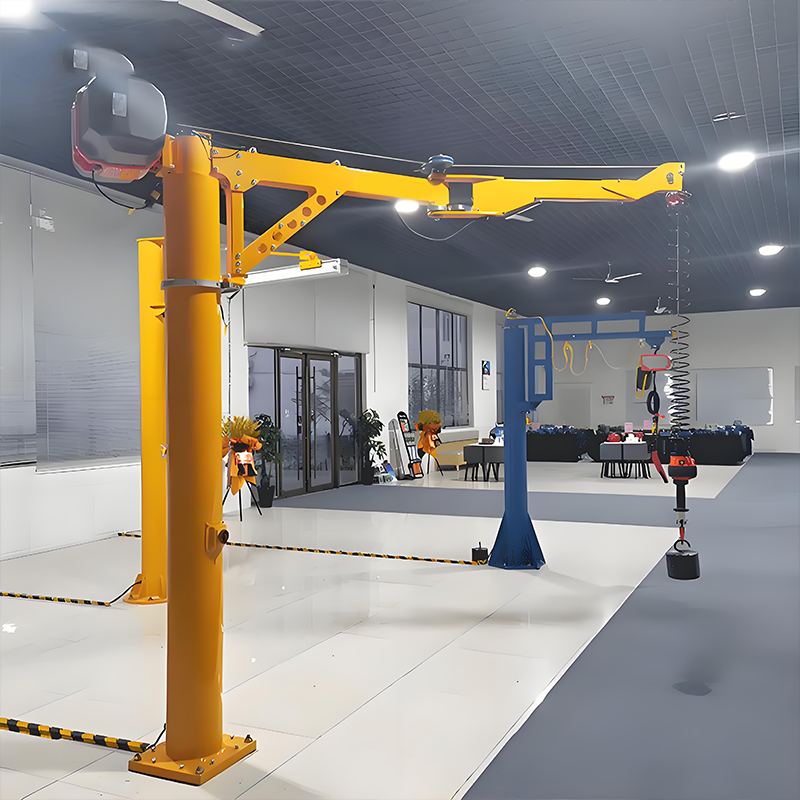
How you mount the jib decides its reach, its swing, and where it can and cannot serve the truck. Two configurations cover almost every dock, and the choice hinges on your building and how far you need to reach over the trailer.
Wall-Mounted (Wall Bracket) Jib
The jib bolts to the building’s structural wall or column through a bracket, with no floor column of its own.
- How it works: the boom pivots on brackets fixed to the wall, transferring the load and the overturning moment into the building structure.
- Working radius: typically a swing arc up to around 180°, limited by the wall behind it — which is exactly the arc a dock needs, sweeping from the truck bed to the dock floor.
- Strengths: saves all the floor space a column would take, keeps the dock clear, and costs less because there is no foundation.
- Best for: docks where a sound structural wall or column exists at the right point, and a half-circle of coverage serves the truck.
- The constraint: the building structure must be verified to carry the jib’s loads — this is not a bracket you hang on any wall (see Part 5).
Pillar-Mounted (Freestanding) Jib
The jib stands on its own steel column, anchored to a dedicated foundation in the floor.
- How it works: the boom rotates on a column bolted to a reinforced concrete foundation that carries the full vertical load plus the overturning moment.
- Working radius: a full 360° rotation, so the crane can pick from the truck and swing to any point around the column — staging area, conveyor, or scale.
- Strengths: independent of the building structure, higher capacities and longer outreach, and complete rotational coverage.
- Best for: docks needing full rotation, heavier loads, or where no suitable wall exists to mount to.
- The constraint: it needs floor space and a substantial foundation sized to the capacity and outreach.
Working Radius and Truck Approach Limits
Whichever mount you choose, plan the geometry around the truck.
- Position the pivot so the boom’s working arc covers the full length of the trailer bed you must reach, not just the tail.
- Respect the approach limit — the hoist cannot travel all the way to the pivot, so there is a dead zone of 0.5 to 1.0 m near the column where the hook cannot reach. Keep set-down points outside it.
- Check swing clearance against parked trucks, dock levelers, and door frames through the full arc.
The practical takeaway: a wall-mounted jib gives up to ~180° of coverage while saving floor space where a sound wall exists; a pillar-mounted jib gives full 360° coverage and higher capacity at the cost of floor space and a foundation. Set the pivot so the working arc covers the trailer, and keep set-down points clear of the near-pivot dead zone.
Part 4: Space-Saving Design Considerations
A loading dock is tight in every direction, so a good dock jib is judged as much on the space it saves as the loads it lifts. A few design choices let a jib do full-capacity work without stealing the floor and headroom a busy dock cannot spare.
360° vs. Limited-Swing Rotation
More rotation is not always better — sometimes a limited swing is the smarter fit.
- A 360° pillar jib gives full coverage but needs clear space all the way around the column, which a dock edge rarely has.
- A limited-swing (stop-limited) jib confines rotation to the arc you actually use — say 180° or 270° — with mechanical stops that keep the boom out of the door frame, a neighboring dock, or a walkway.
- Matching the swing to the real work keeps the boom from sweeping into space you need for other things.
Low-Headroom and Ultra-Low-Headroom Hoists
At a dock, every centimeter of lift height counts.
- A standard hoist eats into the space between the boom and the load; a low-headroom or ultra-low-headroom hoist minimizes that loss, recovering lift height under a low header or dropped door.
- This is often the difference between clearing the truck bed with the load and coming up short.
Compact Footprint and Articulating Booms
The mount and boom style shape how much floor the jib consumes.
- A wall-mounted jib takes essentially zero floor space, leaving the dock clear for pallet traffic.
- An articulating (knuckle) boom folds at a joint, letting the hook reach around obstructions, into a trailer, or behind a post — useful where a straight boom cannot follow the load.
- A compact pillar on a tight foundation footprint suits docks where a wall mount is not possible but floor space is still scarce.
VFD Control for Tight Spaces
Smooth motion is a space-saver in its own right.
- VFD control on the hoist and the rotation gives gentle starts and stops and a slow spotting speed, so loads place precisely in a confined bay without swinging into racking, trucks, or people.
- Less swing means less clearance needed around the load — a real space advantage where every meter is spoken for.
The practical takeaway: match the swing arc to the real work, recover lift height with a low-headroom hoist, choose a wall mount or compact pillar to protect floor space, and add VFD control so loads place precisely without needing swing clearance. A dock jib earns its keep by saving space as much as by lifting.
Part 5: Common Installation Errors
A well-specified dock jib still fails if it is installed wrong — and the errors below are the ones that turn a good crane into a safety problem or an early replacement. Every one traces back to skipping a check that the mounting structure, the geometry, or the standard demanded.
Error 1: Mounting to Structure That Cannot Carry the Load
A wall-mounted jib is bolted to a wall or column that was never verified for the crane’s loads.
What goes wrong: a jib transfers a large overturning moment into its mount, and a wall or column designed only for building loads can crack, deflect, or pull its anchors under that cyclic moment. Prevention: have a qualified engineer verify the building structure for the jib’s combined vertical load and overturning moment before mounting, and reinforce it where the check falls short. Never hang a jib on convenient steel without this verification.
Error 2: Undersized or Wrongly Cured Foundation
A pillar jib is anchored to a foundation too small, too shallow, or not fully cured for the capacity and outreach.
What goes wrong: the overturning moment from a loaded boom tries to tip the column; an inadequate foundation lets it rock, cracks the concrete, and loosens the anchors. Prevention: size the foundation to the manufacturer’s specification for the exact capacity and outreach, respect the concrete cure time before loading, and confirm the anchor bolts are set and torqued correctly.
Error 3: Ignoring the Overturning Moment of Outreach
The capacity is checked but the moment created by a long boom at full reach is not.
What goes wrong: the same load at the boom tip creates far more overturning moment than close to the pivot, and a mount or foundation sized for capacity alone can be overloaded by reach. Prevention: size the mount and foundation to the load × outreach moment at full extension, not just the rated capacity.
Error 4: Swing Path Not Cleared Through the Full Arc
The jib is installed without checking the boom’s swing against everything around it.
What goes wrong: the boom fouls a door frame, a parked truck, dock equipment, or a walkway partway through its arc — damaging the crane or the obstruction, or striking a person. Prevention: map the full working arc during layout, fit swing stops to confine rotation to the safe arc, and keep the path clear of the door and neighboring stations.
Error 5: Skipping the Load Test and ASME B30.11 Commissioning
The crane is put to work without the proof load test and inspection the standard requires.
What goes wrong: an installation fault — a weak anchor, a mis-set bracket — stays hidden until a heavy load finds it. Prevention: commission the jib per ASME B30.11, including the rated load test and a documented initial inspection, before the first working lift.
The practical takeaway: most dock jib failures are installation failures — an unverified mount, an undersized foundation, an ignored outreach moment, an uncleared swing path, or a skipped load test. Every one is prevented by a check made before the first lift, not after the first problem.
Part 6: 2026 Indicative Price Reference
Use these indicative 2026 figures to budget a dock or warehouse jib crane. Actual prices vary with capacity, outreach, duty class, control type, and site conditions — but the relationships between them guide the specification decision.
Jib Crane by Type and Capacity
| Jib type | Capacity / outreach | Indicative 2026 price (USD) |
|---|---|---|
| Wall-mounted jib | 250 – 1,000 kg, 2 – 4 m | $1,200 – $4,500 |
| Wall-mounted jib | 1,000 – 3,000 kg, 3 – 5 m | $3,500 – $9,000 |
| Pillar-mounted (freestanding) jib | 250 – 1,000 kg, 3 – 5 m | $2,500 – $7,500 |
| Pillar-mounted (freestanding) jib | 1,000 – 5,000 kg, 4 – 6 m | $6,000 – $20,000 |
| Articulating (knuckle) boom jib | 250 – 2,000 kg | $4,000 – $16,000 |
Options and Site Costs
| Item | Scope | Indicative 2026 cost (USD) |
|---|---|---|
| VFD control (hoist + rotation) | Smooth, precise motion | +$800 – $4,000 |
| Low / ultra-low-headroom hoist | Recover lift height | +$500 – $3,000 |
| Pillar foundation | Reinforced concrete + anchors | $1,500 – $8,000 |
| Structural verification / reinforcement | Wall-mount engineering check | $500 – $5,000 |
| Load test and commissioning | ASME B30.11 proof test + inspection | $400 – $1,800 |
Budget Notes
- The foundation or structural check is a real line item, not an afterthought. A pillar jib’s foundation and a wall jib’s structural verification are part of the true installed cost — budget them from the start.
- Outreach costs more than it looks. A longer boom raises the overturning moment, which drives up the mount and foundation cost, not just the boom price.
- Match duty class to real cycles. A dock is high-cycle work; paying for the correct duty class up front is far cheaper than replacing a hoist worn out early.
- VFD pays back at a busy dock. Its premium is recovered through faster, safer placement and longer component life on high-cycle work.
Frequently Asked Questions
Q: What size jib crane do I need for a loading dock?
A: Start with three numbers, all measured from your real work rather than a catalogue. First, capacity: size to the heaviest routine load including the hoist, hook, and any lifting attachment, with a sensible margin so the crane is not working at its rated limit on every lift — most dock and warehouse jibs fall in the 250 kg to 5,000 kg range. Second, outreach: measure horizontally from where you can place the pivot to the far edge of the truck bed you must reach, and add margin so the hook is not working at the very boom tip, which typically lands dock jibs between 2 and 6 m of boom. Third, clearance: confirm the under-boom height, minus the hoist and the load, still lets the hook reach the truck bed (usually about 1.2 to 1.5 m above dock level for a standard trailer) while the boom swings clear of the dropped header above the door. Then match the CMAA/FEM duty class to how many lifts per hour the dock actually does at its busiest, because a dock is repetitive work and an under-rated hoist wears out early. Confirm the whole specification against ASME B30.11, and where the numbers are tight, a low-headroom hoist recovers lift height. If you are unsure, share your truck bed height, your heaviest load, and your reach requirement with an engineer and let them size it against the moment the boom creates at full reach.
Q: Should I choose a wall-mounted or freestanding pillar jib crane for my dock?
A: It depends on your building structure, the coverage you need, and the load. A wall-mounted jib bolts to an existing structural wall or column, takes essentially no floor space, costs less because it needs no foundation, and gives a swing arc up to around 180° — which is exactly the half-circle a dock usually needs, sweeping from the truck bed to the dock floor. It is the right choice when you have sound building structure at the correct point and a qualified engineer confirms that structure can carry the jib’s vertical load and overturning moment. A freestanding pillar jib stands on its own column and foundation, gives a full 360° of rotation so it can serve the truck plus a staging area, conveyor, or scale, and supports higher capacities and longer outreach — at the cost of floor space and a substantial reinforced foundation. Choose the pillar jib when you need full rotation, heavier loads, or when no suitable wall exists to mount to. The practical rule: if a good wall is available and half-circle coverage serves the truck, the wall mount is cheaper and clears the floor; if you need full rotation, more capacity, or have no wall, go freestanding and budget the foundation.
Q: What standards and safety checks apply to a loading dock jib crane?
A: The governing standard for jib crane construction, installation, inspection, testing, and use is ASME B30.11, and it should frame your whole specification and commissioning. Before the crane ever lifts a working load, it must pass a rated load test and a documented initial inspection to confirm the mount, foundation, and mechanism carry the load safely — skipping this is one of the most common and most dangerous installation shortcuts, because an unverified anchor or bracket stays hidden until a heavy load finds it. The crane’s duty rating should follow the CMAA/FEM duty class system, matched to your real lift frequency, so the hoist and rotation bearing are built for the cycle count a dock actually sees. Two structural checks are critical and often skipped: for a wall-mounted jib, a qualified engineer must verify the building structure can carry the combined vertical load and overturning moment; for a pillar jib, the foundation must be sized, cured, and anchored to the manufacturer’s specification for the exact capacity and outreach. Beyond commissioning, put the jib on a periodic inspection schedule — checking the rotation bearing, the hoist, the brake, the hook and its latch, and the structural connections — and keep the swing path mapped and clear through its full working arc so the boom never fouls a door, a truck, or a walkway.
Conclusion
A loading dock is the one place in a warehouse where lifts happen most often and support is usually thinnest — and a jib crane is the tool built for exactly that spot. It reaches out over the truck where an overhead crane stops at the runway, serves the station affordably, fits the tight building edge, and takes the dangerous lifts off the forklift. Specify it well and the busiest, most congested part of your operation becomes one of the smoothest.
Here is the quick specification guide to carry into your next dock project:
- Match the mount to the building — a wall-mounted jib saves floor space and gives ~180° coverage where sound structure exists; a pillar jib gives full 360° and higher capacity at the cost of a foundation.
- Set the four numbers from real work — under-boom clearance against the truck bed and header, outreach to the far edge of the trailer, capacity to the heaviest real load, and duty class to the true cycle count.
- Respect the overturning moment — size the mount and foundation to load × outreach at full reach, not capacity alone.
- Save space by design — limit the swing to the arc you use, recover lift height with a low-headroom hoist, and add VFD control so loads place precisely without extra clearance.
Your next step is straightforward: measure your truck bed height, your heaviest load, and your required reach, then match the mount, capacity, outreach, and duty class to those real numbers and commission the crane per ASME B30.11. Do that, and you avoid the two costliest dock jib mistakes — a crane that cannot reach or clear the truck, and a mount that was never verified for the loads it carries.
This is Article 1 of 3 in the WEIYUAN Jib Crane Applications series. Article 2 will cover coordinating a jib crane working beneath an overhead bridge crane; Article 3 will cover matching jib crane duty class to your actual lift frequency.
For a free loading dock jib crane assessment — including capacity, outreach, clearance, duty class, and mount analysis matched to your dock, trucks, and building structure — contact the WEIYUAN engineering team. Visit chengduweiyuan.com, email 2025chengduweiyuan@gmail.com, or message us on WhatsApp at +86 138 8043 6174 for a response within 24 hours.