


Jib Crane for Sale: Wall, Floor & Articulating Types
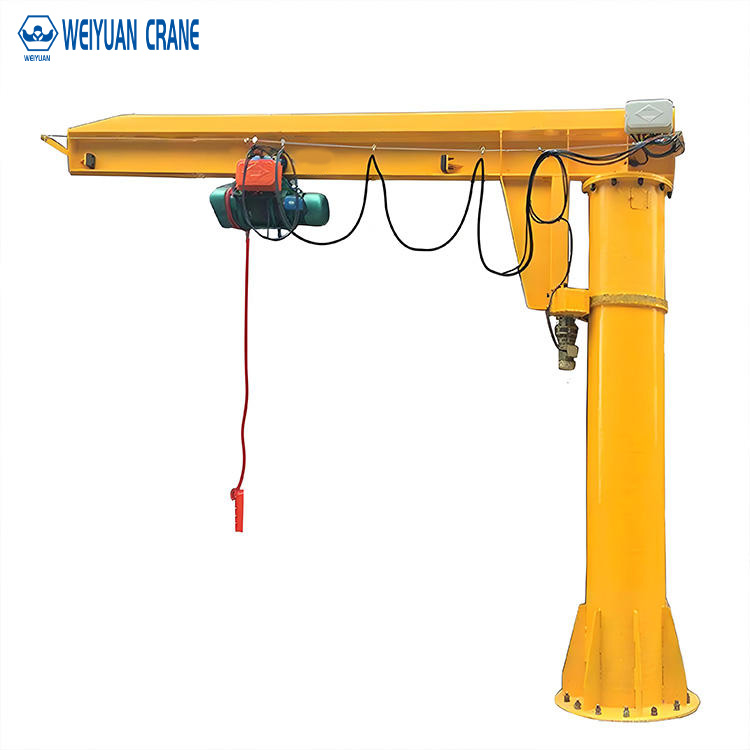
Moving heavy materials safely requires targeted equipment. Relying on shared overhead bridge systems often creates severe production bottlenecks. Workers waste valuable time waiting for shared machinery to become available. Forklifts present another challenge, requiring wide driving lanes that consume expensive floor space.
When you need precise, localized lifting, a dedicated swing-arm system offers the most efficient solution. These units rotate around a fixed pivot point, serving a specific work area with minimal infrastructure investment. They empower your workforce to handle heavy components immediately, keeping your assembly lines moving smoothly.
This comprehensive guide serves facilities managers, industrial engineers, and procurement professionals. We will break down the three dominant configurations available on the market today. You will learn how to evaluate capacity specifications, select the right hoist, and spot critical supplier red flags before you request a single quote.
Evaluating Wall-Mounted Systems
Wall-bracket lifting systems anchor directly to your existing building structure. The horizontal boom extends outward from the mounting point, keeping the factory floor completely clear. The hoist travels along the length of this boom to cover a semicircular work envelope.
The mounting bracket transfers all suspended weight and dynamic loads directly into your building columns. You can choose units that rotate on a fixed wall plate or mast-style units that utilize upper and lower brackets. Because they rely on the building for support, they typically offer a rotation arc of up to 200 degrees.
Ideal Applications
These bracket-mounted units excel in congested areas where floor space remains at an absolute premium. Loading dock positions utilize them frequently to process arriving materials at a fixed transfer point. They also work perfectly along linear assembly lines where production workstations sit against a perimeter wall.
Maintenance bays use these systems to service heavy equipment parked in fixed locations. Machine tool operators benefit heavily from wall-mounted units. The operator can easily swing raw materials directly into a CNC machine without blocking the main warehouse aisles.
Pricing and Structural Considerations
Capacity for standard wall-mounted units typically ranges from 250 pounds up to 5 tons. However, you must never assume your building can handle these forces automatically. A one-ton load suspended ten feet away from a wall imposes massive bending forces on your building columns.
Always require a licensed structural engineer to review your mounting columns before installation. Suppliers who skip this critical step put your entire facility at risk. Estimated equipment prices (excluding installation and hoists) generally fall into these ranges:
- 500 lb capacity (8-foot reach): $1,200 – $2,800
- 1 ton capacity (10-foot reach): $2,500 – $5,500
- 2 ton capacity (12-foot reach): $5,000 – $10,000
- 3 ton capacity (15-foot reach): $9,000 – $18,000
Evaluating Floor-Mounted Pillar Systems
Freestanding pillar systems anchor directly to your concrete floor. A heavy-duty vertical mast provides the primary structural support. The horizontal boom attaches to the top of this mast, allowing it to swing freely through a complete 360-degree rotation arc.
You can permanently embed the mast into a poured concrete foundation. Alternatively, you can bolt a base plate directly to a prepared anchor bolt pattern in your existing concrete slab. Because these units support their own weight independently, you can place them virtually anywhere in your facility.
Ideal Applications
Freestanding systems perform best in wide-open shop floor areas away from supporting walls. They serve as excellent central lifting hubs for complex production cells. Workers can stage raw materials on one side of the mast, process them, and swing the finished parts to an outbound pallet on the opposite side.
These units also adapt well to outdoor environments. Shipping yards and heavy equipment repair depots frequently install galvanized freestanding units on dedicated concrete pads. Standard catalog configurations comfortably handle loads ranging from 250 pounds up to 10 tons.
Pricing and Foundation Requirements
The concrete foundation represents the most critical element of a freestanding installation. You cannot simply bolt a high-capacity mast to a standard four-inch warehouse floor. The equipment’s capacity, the boom length, and the concrete’s compressive strength determine your foundation requirements.
Reputable manufacturers will provide specific foundation engineering drawings. These documents detail the required concrete depth, dimensions, anchor bolt patterns, and minimum concrete strength. Estimated equipment prices for the structural steel generally look like this:
- 500 lb capacity (8-foot reach): $1,800 – $3,500
- 1 ton capacity (10-foot reach): $3,000 – $6,500
- 2 ton capacity (12-foot reach): $6,000 – $13,000
- 5 ton capacity (15-foot reach): $15,000 – $30,000
Evaluating Articulating Boom Systems
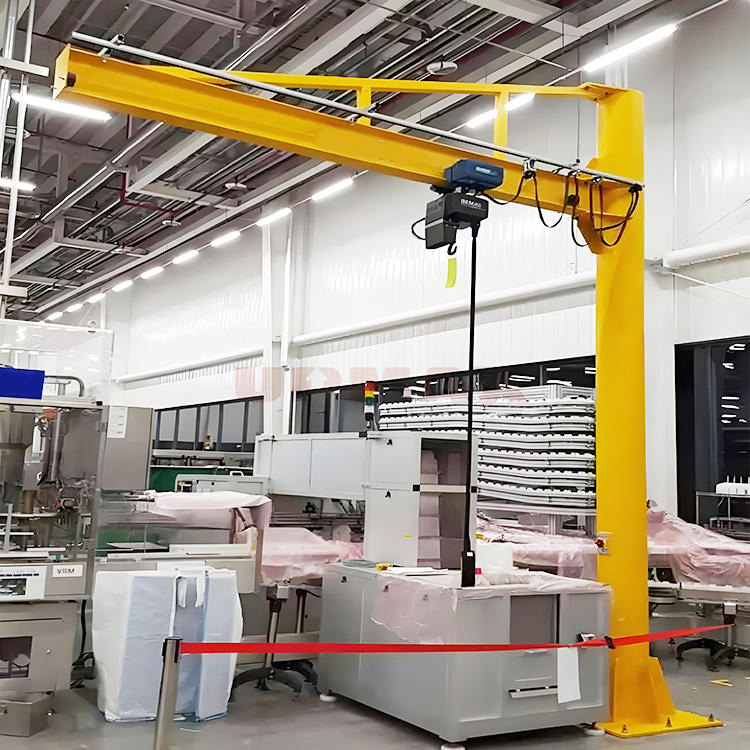
Articulating arms feature a unique jointed design with two or more pivot points. This knuckle-boom configuration allows the arm to fold back on itself. The inner arm rotates from the primary mast, while the outer arm pivots independently from the tip of the inner arm.
This flexible design allows the operator to reach around obstacles that a straight boom simply cannot navigate. You can position the hoist within a highly complex, three-dimensional work envelope. Operators can easily reach into confined spaces, dodge structural columns, or bypass large machine enclosures.
Ideal Applications
Knuckle-boom units shine in highly congested manufacturing environments. They handle machine loading tasks beautifully when the hoist must reach over large safety guards or complex tooling setups. Workers in tight production cells use them to navigate multiple physical obstructions smoothly.
Precision assembly teams also favor this articulated design. It allows them to approach a workpiece from multiple different angles to ensure perfect hardware alignment. Most catalog articulating models support capacities ranging from 250 pounds up to 2 tons.
Pricing Expectations
Articulating designs require complex pivot bearings and specialized structural engineering. Consequently, they carry a higher initial price tag than standard straight-arm systems. Estimated equipment pricing for articulating structural units includes:
- 500 lb capacity: $800 – $1500
- 1 ton capacity: $1500 – $2500
- 2 ton capacity: $2500 – $4000
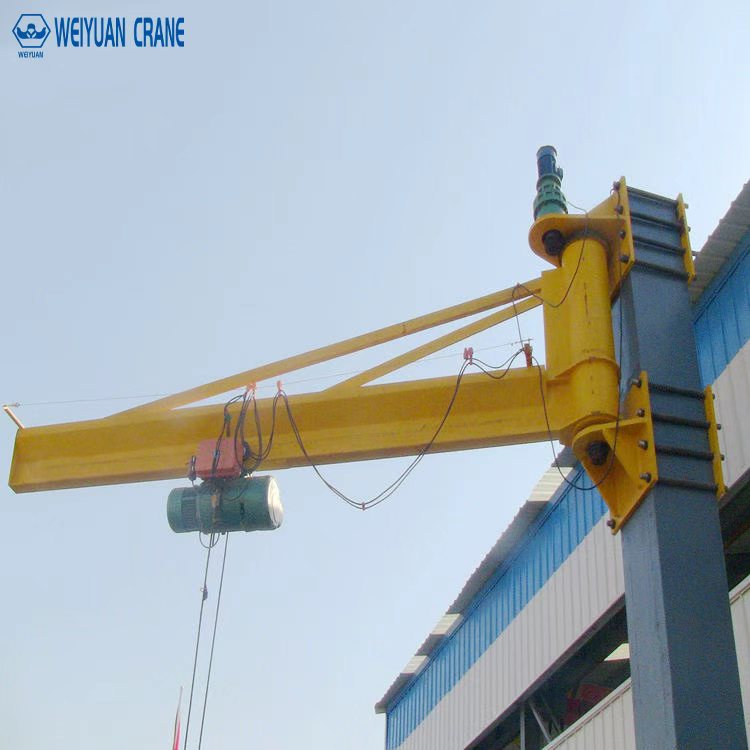
Weiyuan 500kg Wall Mounted Jib Crane
The Weiyuan 500kg Wall Mounted Jib Crane is a compact and efficient lifting solution designed for workshops, assembly lines, and warehouse operations. Mounted directly to a structural wall or column, it saves valuable floor space while providing smooth 180° slewing coverage for precise material handling up to 500 kg.
View Product / Get QuoteSelecting the Right Hoist Accessory
The structural frame only represents half of your lifting system. You must select the appropriate hoist accessory to perform the actual work. Your choice depends heavily on your daily lifting frequency, capacity requirements, and need for precision.
Electric chain hoists remain the most popular choice for loads under five tons. They offer reliable, fast performance and require minimal daily maintenance. If your team only lifts components a few times per week, a manual hand-chain hoist offers significant cost savings.
Wire rope hoists work best for capacities exceeding three tons or applications requiring very long vertical lifts. They generally feature longer service intervals than chain hoists operating under similar duty cycles.
For maximum precision, invest in Variable Frequency Drive (VFD) hoist controls. VFD technology provides incredibly smooth, shock-free starts and stops. This precise control reduces dangerous load swings, minimizes wear on your rigging, and prevents operators from damaging delicate components during assembly.
Defining Your Critical Specifications
You must document several key metrics before requesting quotes from equipment suppliers. Start by calculating your maximum lifting capacity. You must account for the heaviest load you will move, plus the dead weight of the hoist, the trolley, and any heavy rigging hardware.
Next, define your required boom reach. This measures the horizontal distance from the center of the mast to the farthest point the hoist must service. Do not buy an excessively long boom, as it may strike nearby machinery or interfere with existing overhead bridge systems.
You must also determine your required hook height. Measure the vertical distance from your floor to the bottom of the hoist hook at its highest required elevation. Ensure this height remains achievable within your building’s existing ceiling clearances.
Finally, evaluate your expected duty cycle. Count how many lifts your team will perform per shift. Heavy, continuous usage requires a higher CMAA duty class rating than equipment used occasionally for basic maintenance tasks.
Spotting Supplier Red Flags
The manufacturer you select matters just as much as the steel you purchase. Always demand complete structural documentation upfront. If a supplier ships equipment without providing specific foundation requirements or wall-mounting structural analysis, walk away immediately.
Ensure the equipment complies fully with ASME B30.12 standards and meets all OSHA requirements. Ask the manufacturer to provide a certified load test document proving the equipment was tested at 125 percent of its rated capacity.
Look for suppliers who offer robust after-sales support. You need reliable access to replacement bearings, spare electrical contactors, and technical troubleshooting. A cheap purchase price loses its value quickly if your production line sits idle for weeks waiting on a replacement part.