


Jib Crane for Welding & Fabrication: Boom Positioning, Fume Extraction Integration & Shop Layout Tips
Published by: [Your Brand] Engineering Team | Last Updated: March 2026 | Reading Time: 8 min
Introduction
Welding and metal fabrication shops are among the most demanding workstation environments for jib cranes — and among the environments where jib cranes deliver some of their clearest productivity and safety benefits. The combination of heavy weldments that must be precisely positioned for each weld pass, the need to rotate and reposition assemblies repeatedly during fabrication, the ergonomic demands on welders who otherwise manually manipulate heavy parts, and the critical importance of keeping the welding torch in the optimal position for weld quality all create lifting requirements that a well-specified jib crane directly addresses.
Yet jib cranes in welding and fabrication shops are also more commonly misspecified, misapplied, and neglected than in most other industrial settings. The arc spatter, metal dust, heat, and chemical exposure of the welding environment impose maintenance demands that generic crane specifications fail to anticipate. The integration with welding fume extraction systems — now a compliance requirement in many jurisdictions for enclosed welding operations — creates installation considerations that are specific to this application. And the workflow demands of a fabrication shop — parts coming in at variable weights, being worked at multiple stations, going out as finished assemblies — require crane configurations that serve the shop’s actual production sequence rather than just providing generic overhead coverage.
This guide covers the complete jib crane application framework for welding and fabrication: the specific tasks where jib cranes transform productivity and ergonomics in the welding environment, how to configure cranes for different welding processes and workstation types, how to integrate fume extraction systems with jib crane installations, how to specify cranes that withstand the welding shop environment, and the layout principles that maximize crane utility across the full fabrication workflow.
Part 1: What Jib Cranes Do in a Welding Shop
Part Positioning and Repositioning
The most fundamental jib crane function in welding is positioning the workpiece for each weld pass — and repositioning it between passes. A complex structural weldment may require 10 to 30 individual repositioning moves before all weld joints are accessible and welded in the correct sequence. Each repositioning move without a crane requires at least two people (welder plus assistant), creates ergonomic risk from the awkward positions required to move heavy parts manually, and introduces production delay.
With a jib crane at the weld station, the welder handles all repositioning independently: attach the rigging to the lifting points (designed into the part or provided by purpose-built lifting fixtures), lift, rotate or re-orient, lower to the new position. The crane converts a two-person, slow, physically demanding operation into a one-person, fast, controlled one.
Loading and Unloading the Weld Fixture or Positioner
Welding positioners — the motorized rotating tables that hold weldments in the optimal welding position — must be loaded and unloaded with components that can range from 50 to several hundred pounds. Loading a positioner manually for anything above 30 to 40 pounds creates ergonomic risk; for parts above 80 to 100 pounds, manual loading creates genuine injury risk every cycle.
A jib crane with the boom centered over the positioner allows the welder to pick the part from the staging rack, position it over the positioner table, and lower it precisely onto the fixture locating pins — alone, safely, in under two minutes. The same crane unloads the finished weldment to the inspection or assembly area.
Fit-Up and Tacking Operations
Before welding begins, fabricators must fit up components — bringing heavy plates, beams, and brackets into precise alignment and tacking them in position before the full weld sequence. Fit-up on complex assemblies involves manipulating multiple heavy components simultaneously, and the crane plays a critical role in holding one component in position while the second is aligned and tacked.
For fit-up operations, crane control precision is particularly important — the component must be held motionless at the correct height and orientation while the second component is brought into contact and aligned. VFD hoist control that provides smooth hold-at-position is essential for fit-up work on heavy assemblies.
Material Handling Through the Fabrication Sequence
In a complete fabrication workflow — raw material in, cut, fit, tack, weld, grind, inspect, finish — each workstation handoff involves moving partially fabricated assemblies that grow heavier as they accumulate weld metal, brackets, and components. A jib crane at each major workstation (or a bridge crane covering multiple stations) handles these handoffs without requiring personnel to carry progressively heavier assemblies to the next station.
Part 2: Jib Crane Configurations for Welding Workstations
Configuration for Single-Position Weld Stations
A welder who works at a fixed position — seated at a bench welder station, working at a positioner at a fixed floor location — benefits from a jib crane with boom length adequate to reach from the raw part staging area to the positioner center, and hook height adequate to lift the heaviest planned part off the staging rack and position it on the positioner.
Recommended configuration:
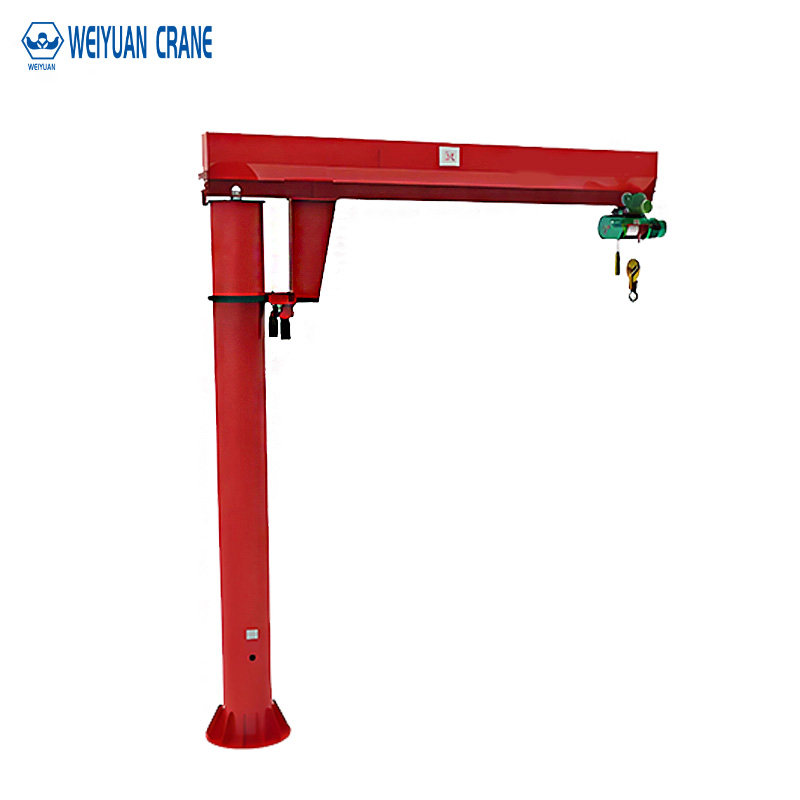
- Type: Floor-mounted pillar jib crane (360-degree rotation) or wall-mounted jib (180 degrees if the station is against a wall)
- Capacity: 500 pounds to 1 ton for most fabrication work up to medium-sized assemblies; 2 to 5 tons for heavy structural fabrication
- Boom length: Minimum reach from staging rack to positioner center plus 12 to 18 inches of margin
- Hoist: VFD-controlled electric chain hoist — smooth speed control for precise positioner loading; lower first cost than wire rope hoist at capacities to 1 to 2 tons
Configuration for Mobile Welding Operations
Fabricators who weld large assemblies that are too heavy to move to a fixed station — shipbuilding blocks, structural steel frames, large pressure vessels — work at the assembly rather than bringing the assembly to them. In these environments, a bridge crane covering the full floor area is the appropriate large-scale handling system, but jib cranes serve the individual welder’s positioning needs at the work face.
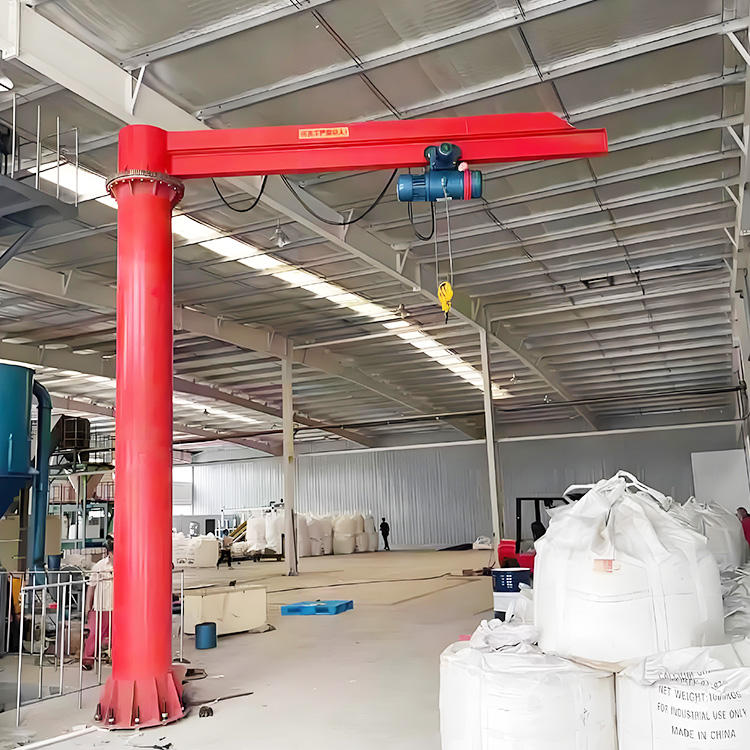
Column-mounted jib cranes installed at building columns throughout the fabrication floor give individual welders crane access without requiring the bridge crane to move to their position for every lift. For heavy structural fabrication buildings, a column-mounted jib crane at every other bay column — with each jib providing 180-degree coverage and adjacent jibs overlapping at their boundaries — gives nearly complete floor coverage for welder-positioning tasks without the traffic conflict that bridge crane access creates when multiple welders are working simultaneously.
Configuration for Robotic and Semi-Automated Welding Cells
Robot welding cells require part loading and unloading that must be fast (to keep cycle time competitive), precise (to place parts on fixture locating pins accurately), and ergonomically sound (to protect the loading operator from repetitive lifting injury). A jib crane serving the robot cell loading zone is the standard solution in high-volume robot welding facilities.
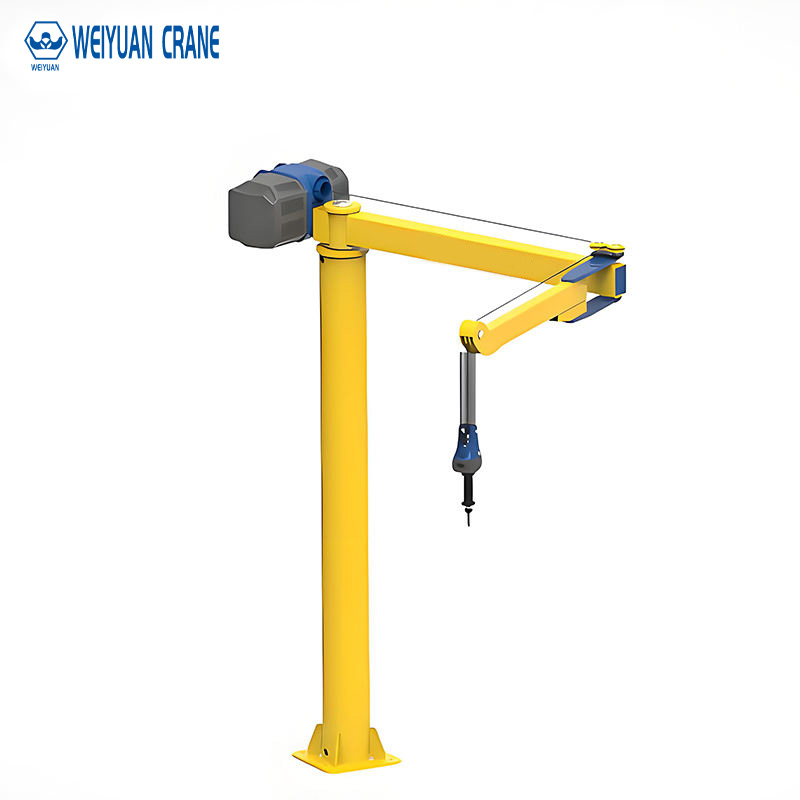
For robot cell loading, the articulating jib crane is particularly valuable where the fixture is mounted inside the cell enclosure and the loading access is through the guarding door — requiring the crane to reach past the door threshold into the cell to position the part.
Part 3: Fume Extraction Integration with Jib Cranes
Why Fume Extraction Integration Matters
Welding fume extraction is both an occupational health requirement and, in many jurisdictions, a regulatory compliance requirement. OSHA’s permissible exposure limits (PELs) for manganese (a component of carbon steel welding fume) and hexavalent chromium (present in stainless steel welding fume) are sufficiently strict that engineering controls — not just respirators — are required in many welding operations.
The most effective engineering control for welding fume is a local exhaust ventilation (LEV) system — a fume extraction arm or extraction nozzle that captures fume at the source before it enters the welder’s breathing zone. In a jib crane-equipped welding station, integrating the fume extraction arm with the crane boom provides significant advantages over a separate freestanding extraction system.
Integrated Crane-Mounted Fume Extraction Arm
A fume extraction arm mounted along the underside of the jib crane boom travels with the boom as it rotates and as the hoist positions the workpiece. This means the extraction nozzle can always be positioned close to the welding arc regardless of where the welder positions the work — an advantage that freestanding extraction systems positioned at fixed points in the welding area cannot match.
Implementation options:
Track-mounted extraction arm: The extraction arm slides along a track attached to the bottom of the jib boom, allowing it to be repositioned along the boom length independently of the hoist. The extraction hose runs along the boom to a flexible connection at the mast and then down to the extraction unit at floor level.
Separate extraction arm on boom: A dedicated fume extraction arm (from a specialist fume extraction supplier — Nederman, Plymovent, Lincoln Electric, and others supply purpose-designed units) is mounted on a bracket at the end of the jib boom. The extraction arm articulates independently to position the capture nozzle.
Electrical and Mechanical Integration Considerations
Adding fume extraction to a jib crane boom increases the boom’s weight and changes its balance. The jib crane must be specified with the extraction arm weight included in the design load — do not add extraction equipment to an existing crane without verifying with the manufacturer that the additional weight is within the boom’s rated capacity.
The extraction hose must be routed along the boom without interfering with the hoist trolley’s travel range. Hose management systems (clips, saddles, or channel guides along the boom) must keep the hose clear of the trolley at all hoist positions.
The electrical supply for the extraction fan motor must be coordinated with the crane’s festoon system or provided via a separate festoon track on the boom. Running extraction equipment power through the crane’s control circuit (rather than a separate circuit with its own disconnect) creates a hazardous situation where de-energizing the crane also de-energizes the extraction — potentially leaving the welder without fume protection while work continues.
Part 4: Specifying Jib Cranes for the Welding Environment
Protection Against Weld Spatter
Arc weld spatter — small globules of molten metal ejected from the weld pool — can deposit on crane structural surfaces, hoist mechanisms, electrical components, and wire rope or load chain. Accumulated spatter on wire rope creates abrasive surface contamination that accelerates wire fatigue. Spatter on electrical enclosures can penetrate gaps in covers and create short circuits. Spatter on hoist chain guides can cause chain binding.
Specification requirements for welding environments:
- Wire rope hoist: Specify rope with galvanized or coated surface to reduce spatter adhesion. Use nylon rope guides (if not standard) to prevent metal-on-metal contact at guides.
- Electrical enclosures: IP54 minimum (IP65 preferred) for all hoist electrical components and crane control boxes. Specify stainless steel enclosure hardware in severe spatter environments.
- Hook block: Specify a hook block with a cover plate or shroud over the sheave and bearing area to prevent spatter accumulation in the moving parts.
Protection Against Heat and Infrared Radiation
High-heat welding processes — MIG on heavy plate, submerged arc welding, and oxy-fuel cutting — create significant radiant heat loads on equipment positioned near the work area. Sustained exposure to elevated temperatures accelerates lubricant degradation in the hoist gearbox and hoist chain.
For cranes positioned within 3 to 5 meters of high-heat processes:
- Specify a high-temperature gear lubricant rated for the elevated ambient temperature (obtain from the hoist manufacturer based on expected ambient temperature at the crane position)
- Reduce hoist lubrication intervals from standard 3-month to monthly in high-heat environments
- Consider heat shielding on the hoist body for cranes positioned directly over gas cutting or plasma cutting operations
Protection Against Metal Dust and Grinding Media
Abrasive grinding — the finishing process that follows welding in virtually every fabrication shop — generates clouds of metal dust and abrasive particles that deposit on all crane surfaces. This contamination:
- Clogs hoist gearbox breather vents, increasing internal pressure and causing seal failure
- Contaminates brake surfaces, causing erratic brake performance
- Provides a conductive path between electrical terminals if enclosures are not adequately sealed
- Abrades wire rope surfaces when embedded in the rope lubricant layer
Prevention: IP65 protection on all electrical enclosures, sealed bearings throughout, and increased inspection frequency (monthly rather than quarterly) for brake surface condition and rope condition in heavy grinding environments.
Part 5: Shop Layout Principles for Maximum Jib Crane Productivity
One Crane Per Weld Station
The single most common jib crane layout mistake in fabrication shops is sharing cranes between stations — expecting two or three welders to share access to one jib crane. In practice, sharing creates constant interference: one welder needs the crane at the same time as another, the crane is in the wrong position when the second welder needs it, and both welders spend time waiting for or repositioning the crane rather than welding.
The rule: one dedicated jib crane per primary weld station. For shops with 6 weld stations, budget for 6 jib cranes. The productivity gain from dedicated access — eliminating the crane-sharing delays that compound across an entire shift — consistently justifies the capital cost of the additional cranes within 6 to 12 months.
Position the Crane for the Primary Workflow Direction
The jib crane’s mast position should be located so that the most frequent lift — part from staging rack to positioner, or from one workstation to the next — requires the minimum boom rotation. A crane positioned so that the primary lift requires a 270-degree boom rotation is consistently used less than a crane positioned so the same lift requires 90 degrees.
Spend time watching the actual workflow at each station before finalizing the mast location. The optimal position is often not the geometrically centered position — it is the position that minimizes travel for the dominant lift direction.
Integration with Material Flow
Staging racks, completed work storage, and material flow paths in and out of the weld station should all be positioned within the jib crane’s boom reach. A common layout failure: the staging rack is positioned outside the crane’s arc, requiring the welder to manually move parts to a position where the crane can reach them — defeating the purpose of the crane for every single cycle.
Frequently Asked Questions
Q: What capacity jib crane do I need for a general fabrication shop?
A: For most general steel fabrication work (weldments up to 1,000 to 1,500 pounds), a 1-ton jib crane adequately serves most lift cycles. A 2-ton capacity provides meaningful growth margin for larger weldments without a significant cost premium. For structural steel shops handling large beams, columns, and frames, 3 to 5-ton capacity is appropriate. Obtain the weights of the heaviest 10% of weldments you regularly produce, add 25% margin, and specify to that capacity.
Q: Can the same jib crane serve both the weld station and the adjacent grinding station?
A: Physically possible but operationally problematic for any station with meaningful lift frequency. If grinding and welding happen simultaneously (which is common — one welder grinding while another is welding), a shared crane creates interference. If one person performs both operations sequentially on the same part at the same station, a single crane is appropriate — but position it for both operations, not just one.
Q: How do I protect wire rope from weld spatter on a crane that works directly above the weld area?
A: The most effective protection for wire rope in a direct-spatter environment is to raise the hoist to its maximum height during the welding operation, keeping the rope as far from the arc as possible, and only lowering to pick the part when welding is complete. Installing a rope guard — a tubular or channel shield around the rope path between the drum and the hook block — protects the most exposed rope section. Rope replacement intervals should be shortened to quarterly inspection and annual replacement (versus standard 4 to 6-year intervals) in direct spatter exposure.