


Jib Cranes in Practice: How to Select, Configure, and Get the Most Out of Your Lifting System
Most facilities ask the wrong question when evaluating lifting equipment. “How much can it lift?” matters, but it’s rarely the question that determines whether a system actually works for your operation. The better questions are: Where exactly does the load need to go? How often? And what happens to your workflow when the crane isn’t available?
This guide cuts past the basics and focuses on the judgment calls that separate a well-configured lifting system from one that creates new problems while solving old ones.
Start With the Work Envelope, Not the Capacity Rating
Before you look at a single spec sheet, map out your actual work envelope on the floor.
A jib crane covers a swept arc—the radius equals the boom length, and the angle depends on how the unit is mounted. Wall-mounted systems typically give you 180 to 200 degrees of rotation. Freestanding pillar models give you a full 360. That difference sounds straightforward until you realize that your building columns, overhead obstructions, and adjacent equipment will eat into that theoretical arc in ways that aren’t obvious until installation day.
Walk your workstation with a tape measure. Mark the farthest point the load needs to reach. Then mark every obstacle between the crane’s intended mounting point and that target. What looks like a clean 15-foot radius on paper often shrinks to 11 usable feet once you account for a support column, a conveyor line, or a row of cabinets.
There’s a second geometry issue that frequently gets ignored: boom length and rated capacity are not a fixed pair. The same crane rated for 2 tons at the pillar may only be rated for 1.5 tons at the boom’s full extension. If your heaviest loads happen to be the ones you need to place at the farthest reach, you may need to upsize the entire system—or reconfigure your workstation layout.
The Foundation Question That Determines Everything
Floor-mounted jib cranes are deceptively simple from the outside. A pillar, a boom, a hoist—it looks like a piece of equipment you bolt down and use. What’s invisible is the engineering requirement underneath it.
When a crane lifts a load at full reach, it doesn’t just push straight down on the floor. It creates a bending moment that tries to rotate the entire mast at its base. The longer the boom and the heavier the load, the more violent that rotational force becomes. A 2-ton crane with a 12-foot boom generates a base moment that surprises most facility managers when they first see the numbers.
Standard warehouse or factory slab is often not enough. Many installations require a dedicated concrete footer that extends significantly below the existing slab—sometimes 4 to 5 feet deep, depending on soil conditions and load ratings. If your facility has in-floor utilities, heating elements, or existing sub-slab structures, discovering this during installation is an expensive surprise.
The practical takeaway: get a structural engineer to assess your floor before you finalize a purchase. This step costs a few hundred dollars and can prevent a retrofit that costs several thousand. If you’re evaluating multiple workstation locations, assess all of them upfront rather than one at a time.
Choosing Between Manual and Motorized: It’s a Duty Cycle Decision
The choice between a manual push-pull system and a motorized drive is often framed as a capacity question. It isn’t. It’s a duty cycle question.
A manual system works well when lifts are infrequent, loads are moderate, and operators have enough physical clearance to swing the boom and position the trolley by hand. In these conditions, manual systems are faster to install, cheaper to maintain, and have fewer components to fail.
The math changes when you look at repetition. An operator moving a 600-pound component twice an hour is manageable. The same operator doing it 15 times an hour, across an eight-hour shift, accumulates an enormous amount of cumulative physical effort—even if each individual motion feels light. This is where musculoskeletal strain builds quietly over weeks and months, well before it shows up as a workers’ compensation claim.
Motorized trolleys and motorized rotation remove that cumulative load from the operator entirely. The tradeoff is installation complexity, a higher upfront cost, and the need to route power to a moving hoist. For high-cycle applications, this tradeoff pays for itself quickly—both in reduced injury risk and in the consistency and speed of the lifting operation itself.
A useful rule of thumb: if your operators are performing more than 10 to 12 assisted lifts per hour on a sustained basis, motorized drives are worth serious consideration regardless of the load weight.

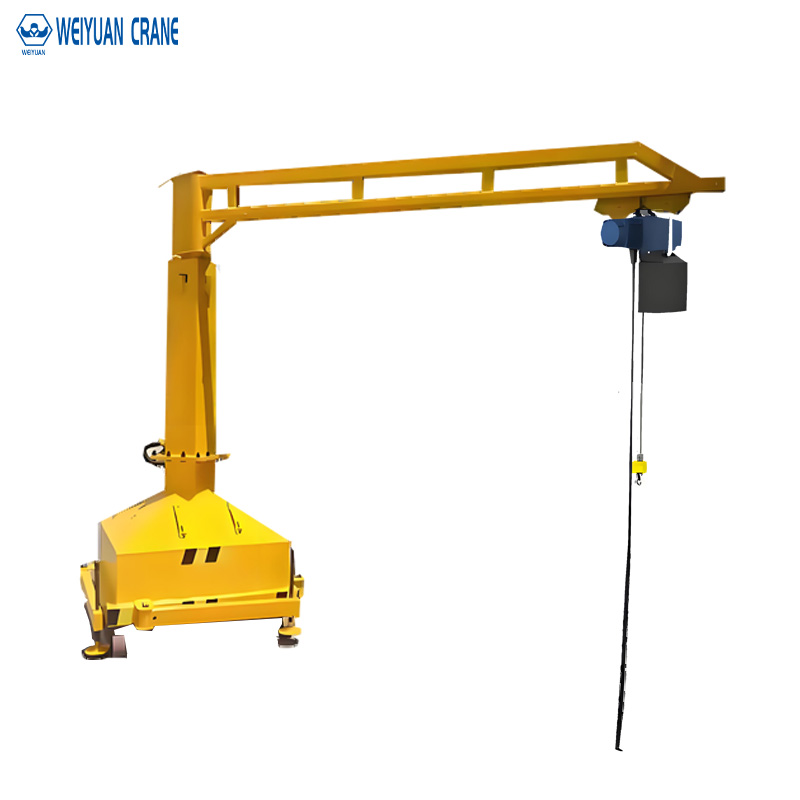
Weiyuan Column Jib Crane
The Weiyuan Column Jib Crane is a versatile and cost-effective freestanding lifting solution designed for precise material handling in workshops, assembly lines, and maintenance areas. With a full 360-degree slewing range and robust steel structure, this crane delivers smooth rotation, dependable performance and enhanced operational flexibility in confined workspaces. :contentReference
View Product / Get QuoteHoist Selection: Where Most of the Performance Lives
The boom and pillar are structural. The hoist is where your actual operational performance is determined.
Electric wire rope hoists are the standard choice for heavy, frequent lifting. They offer high line pull, long service life under demanding conditions, and the ability to handle precise positioning with variable speed controls. The tradeoff is size and weight—wire rope hoists are bulkier, and their added weight reduces the effective payload of your system.
Electric chain hoists are more compact and better suited for moderate capacities and environments where headroom is limited. They’re also generally easier to service. For most shop-floor and assembly applications in the 1- to 3-ton range, a quality electric chain hoist is the right call.
One factor that rarely appears in product brochures: the FEM or ASME duty class rating of the hoist. This classification describes how many lifting cycles the hoist is engineered to perform over its service life. A hoist rated for light-duty service installed on a heavy production line will wear out years ahead of schedule—not dramatically, but gradually, through increased maintenance costs and reduced reliability. Match the duty class to your actual cycle count, not to the maximum load.
Integrating the Jib Into Your Broader Material Flow
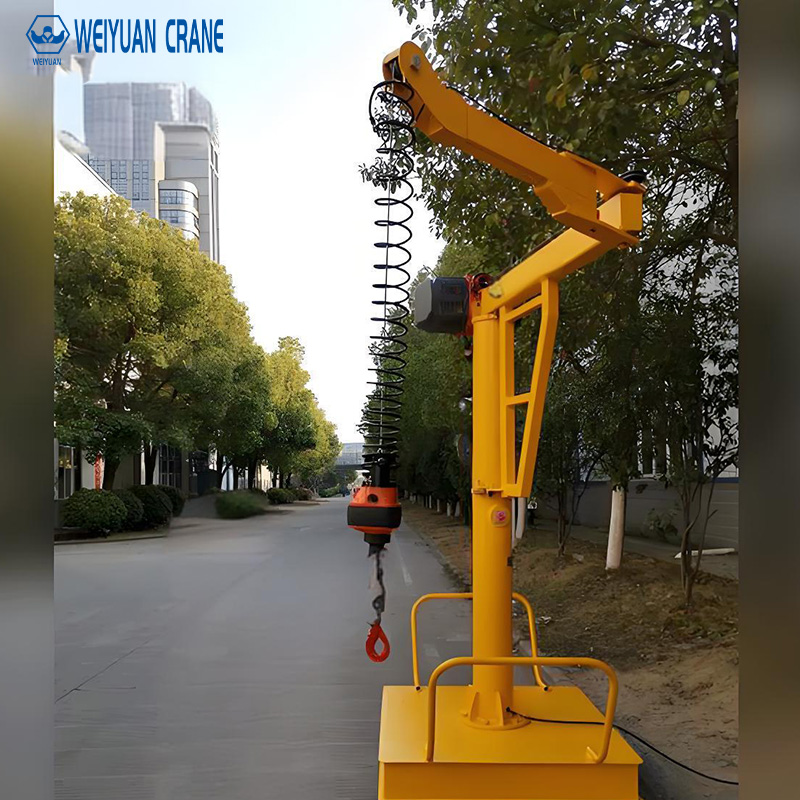
A jib crane works best when it’s treated as one node in a larger material handling network rather than a standalone solution.
The most efficient facilities use a tiered approach: an overhead bridge crane or monorail handles long-distance transport across the facility, delivering materials to a general staging zone. At each workstation, a dedicated jib crane picks up individual pieces and positions them precisely into machines, assembly fixtures, or inspection stations. Neither system tries to do the other’s job.
This handoff point—where bridge crane ends and jib crane begins—deserves deliberate design. The two systems need overlapping coverage so operators aren’t forced to manually carry or drag loads through the gap. A few feet of shared reach between systems can eliminate a significant daily ergonomic burden.
Consider also the direction of approach. If your bridge crane runs east-west and your jib crane’s most frequently used position is directly north of the pillar, think about whether the natural swing path of the boom creates any conflict with overhead structures or adjacent equipment. These interactions are much easier to resolve on paper than in the field.
What Maintenance Actually Looks Like in Practice
Regulatory inspections are a legal requirement, but the facilities that get the most service life from their equipment don’t wait for annual certification visits to catch problems.
Operator-level inspection before each shift should be a genuine habit, not a checkbox. Operators who use the equipment daily will notice changes—a hoist that sounds slightly different, a trolley that feels stiffer than yesterday, a pendant control button that requires a firmer push. These are early indicators, and catching them early almost always means a minor adjustment rather than a parts replacement.
Lubrication is the most consistently neglected maintenance item on jib cranes. The rotation bearings at the mast pivot, the trolley wheel axles, and the hoist chain all have lubrication intervals specified by the manufacturer. Missing these intervals doesn’t cause immediate failure; it causes accelerated wear that shortens service life across multiple components simultaneously.
Keep a simple maintenance log. Record every inspection, every lubrication, every repair. This log becomes valuable when you’re troubleshooting a problem, demonstrating regulatory compliance, or making a case for equipment replacement versus repair.
FAQ
What’s the realistic service life of a well-maintained jib crane? A properly specified, correctly installed, and regularly maintained jib crane can remain in productive service for 20 to 30 years. The hoist typically requires rebuilding or replacement before the structural components, often after 10 to 15 years of heavy use. Foundation integrity and structural steel condition are the factors most likely to determine the upper limit of service life.
Can I mount a jib crane to a building column instead of a dedicated pillar? Sometimes, but it requires a structural assessment of the column itself. Building columns are designed for vertical compressive loads, not the lateral bending forces that a jib crane imposes. Many columns cannot handle the added stress without reinforcement. Never assume a column is suitable based on visual inspection alone—this is a calculation, not a judgment call.
How do I determine the right boom length for my workstation? Measure the maximum horizontal distance between your crane’s intended mounting point and the farthest position you need to place a load. Add 10 to 15 percent to account for approach angle and any obstacles. Then verify that the capacity at that extended reach still meets your heaviest load requirement. If it doesn’t, you may need a longer boom at a lower capacity rating or a repositioned mounting location.
What’s the difference between a festoon cable system and a conductor bar for power delivery? A festoon system uses flat cables clipped to small trolleys that travel along the boom as the hoist moves. It’s flexible, cost-effective, and easy to inspect. A conductor bar system uses a rigid electrified rail mounted along the boom, with a collector shoe on the hoist. Conductor bars handle higher current loads better and are more suitable for harsh or wet environments, but they cost more and require more careful installation. For most standard applications, a properly configured festoon system is perfectly adequate.
Is wireless remote control worth the additional cost? For many applications, yes. A wireless pendant eliminates the physical cable management issues of a traditional hanging pendant and allows the operator to position themselves optimally relative to the load rather than relative to the cord. The benefit is most pronounced in tight workspaces and in applications where the operator needs to be on the far side of the load during placement. The reliability of modern industrial wireless systems has improved substantially—concerns about signal interference that were valid a decade ago are largely resolved with current-generation equipment.
What’s the most common installation mistake to avoid? Underestimating the foundation requirement. This is by far the most frequent and most expensive mistake in jib crane installations. The visual simplicity of the equipment leads many facilities to treat it as a straightforward anchor-and-use process. The bending moments at the base are significant, and an inadequate foundation creates safety risks that worsen gradually and invisibly until something fails. Commission the structural assessment before you order the equipment, not after.