


Low Headroom Electric Hoist Guide: Hook Approach Dimensions, European vs Standard Design & When You Need It
Introduction
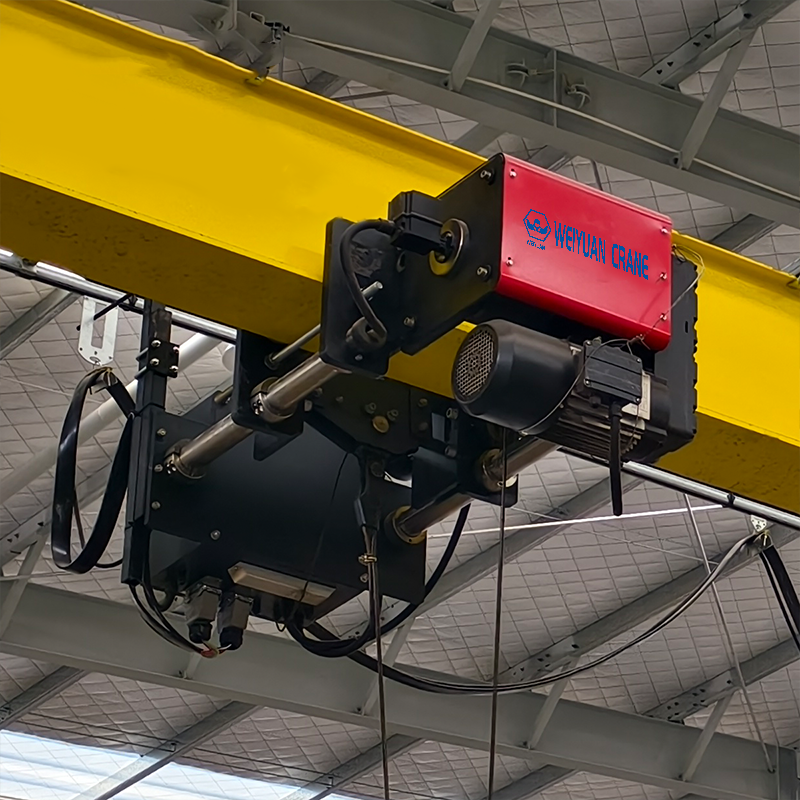
Headroom is one of the most frequently overlooked variables in electric hoist and crane system selection — and one of the most consequential when it is overlooked. A hoist that is physically installed in a facility, fully functional, and correctly rated for the application can still fail to serve the facility’s needs if it cannot raise the hook high enough to perform the required lifts within the building’s available clear height.
The problem emerges most often in two scenarios: existing buildings being retrofitted with crane systems that were not part of the original building design, and applications where maximum hook height is critical — lifting components to mezzanine levels, loading overhead machinery from below, or stacking material in storage systems that use nearly all of the available height. In both scenarios, the difference between a standard hoist and a low headroom configuration can determine whether a workstation or production cell actually functions as designed.
This guide provides the complete technical reference for low headroom electric hoists: what headroom means in crane engineering terms, how to calculate the headroom requirement for any installation, the specific design differences between standard and low headroom hoist configurations, how European (FEM) hoist designs achieve lower headroom than equivalent-capacity standard designs, and the selection framework that identifies when a low headroom or European-design hoist is genuinely needed versus when a standard configuration is adequate.
Part 1: Headroom Terminology — Understanding the Dimensions
Before comparing standard and low headroom hoists, it is essential to understand the specific dimensional terms used in hoist and crane engineering. Confusion between these terms leads to incorrect specification and installations that don’t achieve the required hook height.
Building Clear Height
The vertical distance from the finished floor to the lowest obstruction in the building — typically the bottom chord of roof trusses, the underside of roof beams, or the underside of mechanical services. This is the total vertical space available for the crane system and all its components.
Runway Beam Depth
The depth of the crane runway beam (the beam on which the end trucks travel). The runway beam occupies vertical space below the building structure and above the crane bridge. For a standard W18 runway beam, this dimension is approximately 450mm (18 inches).
Crane Bridge Depth
The depth of the crane bridge girder (the beam that spans across the building and carries the trolley). This occupies vertical space below the runway beam rail and above the trolley. For a standard single girder crane, this may be 300 to 600mm depending on span and capacity.
Hoist Body Height (C-Dimension)
The vertical distance from the top of the hoist body (or from the runway rail for underhung installations) to the centerline of the hoist drum or to the point where the rope or chain departs the hoist in the lifting direction. This dimension represents the space the hoist mechanism itself consumes above the hook block.
Hook Approach (Also Called Minimum Hook Height or C-Dimension to Hook)
The most practically important headroom dimension: the vertical distance from the bottom of the runway rail (for underhung hoists) or from the bottom of the crane bridge beam (for cranes with top-running trolleys) to the centerline of the hook at its highest position.
A lower hook approach means the hook can be raised closer to the structural beam above it — providing more usable hook height for the same building clear height.
Usable Hook Height
The actual vertical distance from the floor to the hook at its highest position. This is what matters operationally — it must be adequate to lift the tallest load over the highest obstacle in the hoist’s path.
Usable hook height = Building clear height − runway beam depth − crane bridge depth (if applicable) − hook approach
For every millimeter of hook approach that is reduced, the usable hook height increases by one millimeter. This is why hook approach is the critical specification for headroom-constrained applications.
Part 2: Standard Hoist Headroom Dimensions
A standard electric chain hoist hung from its top hook has a hook approach (distance from the suspension point to the hook at maximum height) that is determined by the physical height of the hoist body. For typical standard electric chain hoists:
- 250 kg (1/4 ton) standard electric chain hoist: Hook approach approximately 350 to 450mm
- 500 kg (1/2 ton) standard electric chain hoist: Hook approach approximately 400 to 520mm
- 1,000 kg (1 ton) standard electric chain hoist: Hook approach approximately 480 to 600mm
- 2,000 kg (2 ton) standard electric chain hoist: Hook approach approximately 550 to 700mm
- 5,000 kg (5 ton) standard electric wire rope hoist: Hook approach approximately 700 to 950mm
These dimensions represent the vertical space consumed between the structural support point and the hook at maximum height. In a facility with 6 meters of clear height and a 400mm runway beam, a 1-ton standard chain hoist with 550mm hook approach provides:
Usable hook height = 6,000 − 400 − 550 = 5,050mm (5.05 meters)
If the application requires 5.3 meters of hook height, this standard configuration fails — by 250mm, less than 10 inches — and the only solution is a lower hook approach hoist.
Part 3: Low Headroom Electric Hoist Designs
Low headroom electric hoists achieve reduced hook approach through one of two primary design approaches:
Offset Drum/Motor Configuration
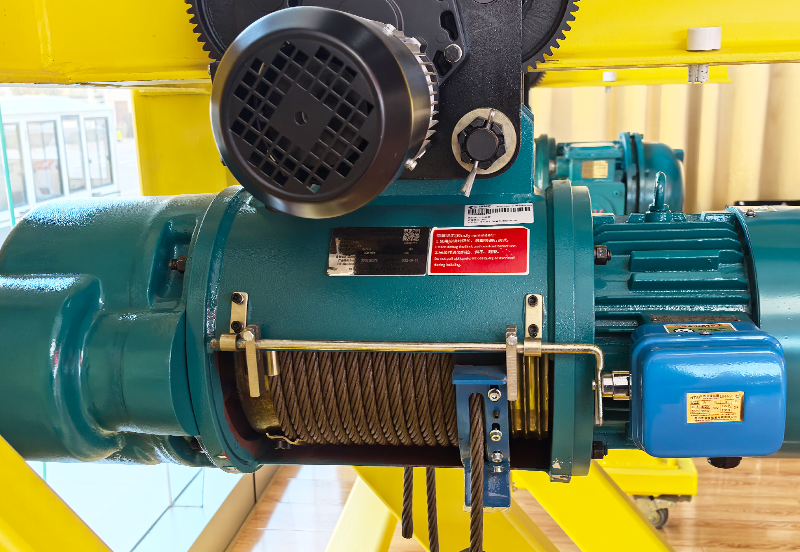
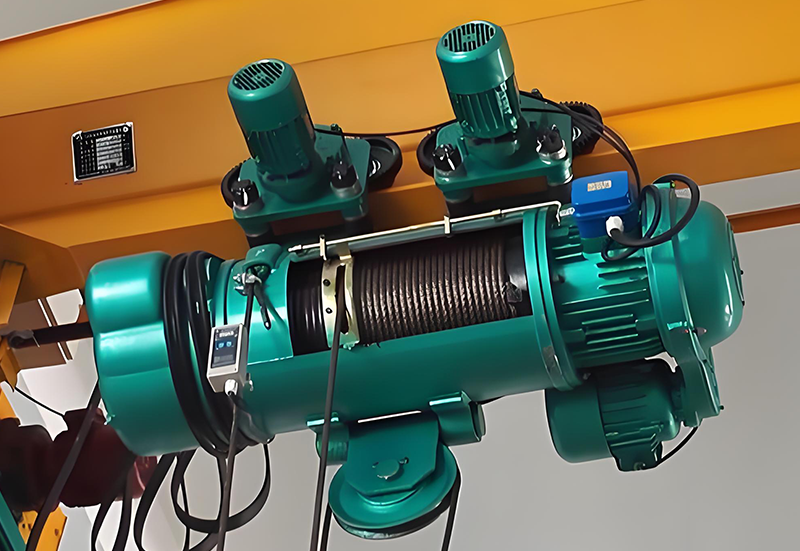
In a standard electric wire rope hoist, the motor and drum are arranged in-line — the motor shaft drives the drum directly, and both are in the same vertical plane. The drum diameter and the rope wrap height above the drum centerline determine how close the bottom of the hoist body can be to the beam above.
Low headroom wire rope hoists use an offset arrangement where the motor is positioned beside the drum rather than in-line with it. This allows the drum to be positioned with its centerline much closer to the support beam — reducing the hook approach by 150 to 300mm compared to equivalent in-line designs.
Typical hook approach for low headroom wire rope hoists:
- 1 ton: 280 to 380mm (versus 480 to 600mm standard)
- 2 ton: 320 to 440mm (versus 550 to 700mm standard)
- 5 ton: 450 to 600mm (versus 700 to 950mm standard)
Twin-Girder (Double-Girder) Crane Crab Configuration
On double-girder overhead cranes, the crab (trolley and hoist assembly) runs on top of the bridge girders rather than below them. The hoist drum and motor are positioned within the crab frame, which sits at bridge girder level. The hook hangs from the crab down through the space between the two bridge girders.
This top-running crab configuration provides the lowest possible hook approach on a crane system — typically 150 to 350mm for most capacities — because the hoist mechanism is positioned at bridge level rather than below it. For headroom-critical applications above 5 tons, the double-girder crane with a purpose-designed low-headroom crab is the solution that provides both high capacity and minimum hook approach.
Part 4: European (FEM) Hoist Design vs Standard Design
European-designed electric hoists — built to FEM (Fédération Européenne de la Manutention) standards and marketed internationally under designations including “European hoist,” “EU hoist,” or “FEM hoist” — consistently achieve lower hook approach dimensions than equivalent-capacity traditional designs. Understanding why helps buyers assess whether the European design is necessary for their application.
Why European Design Achieves Lower Headroom
The hook approach advantage of European hoists comes from fundamental design philosophy differences:
Compact motor and gearbox integration: European hoists use motor and gearbox assemblies engineered specifically for the hoist application — compact, integrated units where the motor is built directly into the gearbox housing. Traditional designs use standard motors from the general industrial catalog adapted for hoist use, which are typically larger for the same power rating than purpose-built hoist motors.
Cylindrical drum vs conical drum: Many European wire rope hoists use a cylindrical drum with precision-spooled grooves that guide the wire rope in perfectly aligned layers. This allows a longer rope length to be stored on a shorter drum — reducing drum length without increasing drum diameter. The shorter drum reduces the hoist body’s overall height and thus the hook approach.
High-pole-count motor: European hoist motors use high-pole-count designs that achieve the required low lift speed directly from the motor speed — without the large gear ratio reduction that increases gearbox size in standard designs. Smaller gearbox = smaller hoist body = lower hook approach.
Hook Approach Comparison: European vs Standard Design
At equivalent capacity and lifting speed:
- 1 ton standard design: Hook approach 480 to 600mm typical
- 1 ton European (FEM) design: Hook approach 220 to 320mm typical
- 2 ton standard design: Hook approach 550 to 700mm typical
- 2 ton European (FEM) design: Hook approach 260 to 380mm typical
- 5 ton standard design: Hook approach 700 to 950mm typical
- 5 ton European (FEM) design: Hook approach 350 to 500mm typical
The hook approach advantage of European design is typically 200 to 400mm across the 1 to 10 ton capacity range. In a headroom-constrained application, this difference can determine whether the required lift height is achievable.
Other Advantages of European Design Beyond Headroom
While headroom is the primary driver for specifying European hoists, several additional design advantages come with the FEM design approach:
Higher duty class ratings: European hoists are typically rated to FEM M5 or M6 as standard — equivalent to CMAA Class D or E. This makes them inherently better suited for production applications than the H2 or H3 ratings of many standard imports.
Lower noise levels: The precision-wound drum, direct-drive motor, and purpose-designed gearbox combine to produce significantly lower noise levels than equivalent-capacity standard designs — typically 65 to 72 dB versus 78 to 85 dB for standard designs. In facilities with noise control requirements, this is a meaningful advantage.
Higher standard travel speeds: European hoists typically offer higher standard lift speeds than equivalent traditional designs because the motor design is optimized for the hoist application rather than adapted from a general-purpose motor.
Cost Premium of European Design
European-design hoists cost 40 to 80% more than equivalent-capacity standard imports from Asia (not FEM-compliant) at the same capacity and duty rating. This premium is justified when: headroom constraints require the lower hook approach, production duty cycles demand the higher FEM duty rating, noise requirements apply, or lifecycle maintenance cost efficiency is the primary specification criterion.
Part 5: When Do You Actually Need a Low Headroom Hoist?
Many facilities purchase low headroom hoists when standard designs would have been entirely adequate — wasting money on equipment features they don’t need. The following framework identifies when low headroom specification is genuinely justified.
Step 1: Calculate the Available Hook Height with a Standard Hoist
Using the building clear height and the dimensions of the intended crane system, calculate the usable hook height that a standard hoist would provide:
Available hook height (standard) = Clear height − runway beam depth − bridge depth (if applicable) − standard hoist hook approach
Step 2: Determine the Required Hook Height
The required hook height is the maximum vertical distance from the floor to the underside of the highest load position in the application:
Required hook height = Floor-to-top-of-load height + rigging height (hook to top of load in highest position)
For a lift where the highest load position is at 4.2 meters with 0.4 meters of rigging above the load top: Required hook height = 4.6 meters.
Step 3: Compare and Decide
If Available (standard) > Required: Standard design is adequate. Do not specify low headroom equipment.
If Available (standard) < Required by less than 300mm: Low headroom hoist design (not necessarily European) closes the gap.
If Available (standard) < Required by more than 300mm: European FEM design or double-girder crab configuration required.
If Available (European) < Required: Building modification or crane system redesign is needed — no standard hoist configuration can serve this application.
Frequently Asked Questions
Q: Is a European hoist always better than a standard hoist?
A: European hoists offer genuine advantages in headroom, duty class, noise, and in some cases service life — but at a significant cost premium. They are the correct specification when these advantages are needed. For applications that don’t require the lower headroom, higher duty class, or other European design advantages, a correctly specified standard hoist delivers equivalent performance at lower cost.
Q: How much does a low headroom hoist cost compared to a standard hoist?
A: Low headroom configurations of standard hoist designs (offset drum, not full European design) typically add 15 to 30% to the hoist cost compared to standard configuration. Full European (FEM) hoist designs add 40 to 80% compared to equivalent-capacity standard imports, reflecting the higher engineering content and manufacturing precision.
Q: Can I retrofit an existing hoist with a low headroom configuration?
A: Generally no — the hook approach is determined by the fundamental hoist body dimensions and motor/drum arrangement, which cannot be modified after manufacture. If an existing hoist provides insufficient hook height, it must be replaced with a low headroom or European design unit. This is one of the strongest arguments for calculating headroom requirements carefully before specifying the original hoist — avoiding a costly replacement.