


Outdoor Gantry Crane: Best Configurations for Yards, Shipyards & Construction Sites
Introduction
Most crane guides treat outdoor applications as a footnote — a brief mention that outdoor cranes need corrosion protection, followed by a return to general specifications. The reality is that outdoor gantry crane applications are a distinct engineering discipline with unique requirements that indoor crane specifications simply do not address.
An outdoor gantry crane operates in an environment that is fundamentally more demanding than a climate-controlled factory floor. It must handle wind loading that can act like a horizontal force multiplier on every structural element. It must resist corrosion from moisture, salt air, and environmental pollutants over decades of service. Its foundation must remain stable through freeze-thaw cycles and seasonal ground movement. Its electrical systems must function reliably through temperature extremes, precipitation, and UV exposure.
Get these requirements right, and an outdoor gantry crane delivers exceptional productivity for 25 years or more with minimal unplanned downtime. Get them wrong, and you have a corrosion problem within three years, foundation movement within five, and a structural integrity concern within a decade.
This guide covers the engineering considerations, configuration options, specification requirements, and application-specific guidance for outdoor gantry crane installations in three of the most demanding environments: storage and fabrication yards, shipyards, and construction sites.
Why Outdoor Gantry Crane Specifications Differ from Indoor
Before diving into application-specific guidance, it is worth clearly establishing how and why outdoor gantry crane specifications differ from indoor equivalents.
Wind loading:
An outdoor gantry crane — particularly a large-span, tall-leg unit in an open yard — presents a significant cross-sectional area to wind. The structural design must account for wind loads per ASCE 7 (Minimum Design Loads and Associated Criteria for Buildings and Other Structures), which specifies design wind speeds by geographic location and exposure category.
For a gantry crane in an open yard with no wind shielding, design wind loads can impose horizontal forces on the crane structure that rival or exceed the vertical loads from the rated lifting capacity. This is particularly critical for large-span high-leg configurations. Structural steel sections, connections, and foundation anchor systems must all be designed for these combined loading conditions.
Storm tie-down anchoring:
Outdoor gantry cranes that are not in use during high-wind events must be physically anchored to prevent travel along their rails or tipping. OSHA 1910.179 requires storm anchors for outdoor overhead cranes. The anchor system must be designed to resist the calculated storm wind load, which is typically greater than the design operational wind load.
Foundation considerations:
Outdoor rail foundations face challenges that indoor slab installations do not. In cold climates, frost heave — the expansion of saturated soil as it freezes — can lift inadequately anchored rail foundations by inches, misaligning the rails and creating dangerous operational conditions. Rails must be anchored below the local frost depth, which ranges from a few inches in warm southern climates to 4 to 6 feet in northern states and Canada.
Surface drainage around outdoor rail foundations is also critical. Standing water accelerates concrete deterioration and promotes frost heave by maintaining saturated soil conditions around the foundation. Proper grading and drainage design are as important as the concrete specification itself.
Corrosion protection:
All structural steel, fasteners, and rail hardware in an outdoor gantry crane is exposed to moisture, oxygen, and often additional corrosive agents (salt air in coastal locations, industrial pollutants in manufacturing environments, and chemical exposure in certain yard applications). The corrosion protection system — primer, topcoat type and thickness, galvanizing where appropriate — must be engineered for the specific environment and planned maintenance interval.
Hot-dip galvanizing is the most durable corrosion protection for structural steel in aggressive outdoor environments. For coastal installations within one mile of tidal water, galvanizing plus an epoxy topcoat is considered minimum adequate protection. Fasteners (bolts, rail clips, anchor bolts) should be hot-dip galvanized or stainless steel — standard zinc-plated hardware corrodes rapidly in outdoor industrial environments.
Electrical system weatherproofing:
All electrical components on an outdoor gantry crane — hoist motor, travel motors, control panel, conductor bar or festoon cable system, limit switches, and pendant or remote control — must be rated for outdoor service. The minimum enclosure rating for outdoor electrical components is IP54 (protected against dust and water splashing from any direction). In wet or washdown environments, IP65 (fully dust-tight, protected against water jets) is required.
Temperature range:
Outdoor cranes in northern climates must operate reliably from well below freezing to summer heat. Motor lubricants, brake materials, and electrical component ratings must all be verified for the full operating temperature range. Standard industrial lubricants may thicken unacceptably at low temperatures, requiring low-temperature grade lubricants for cold-climate installations.
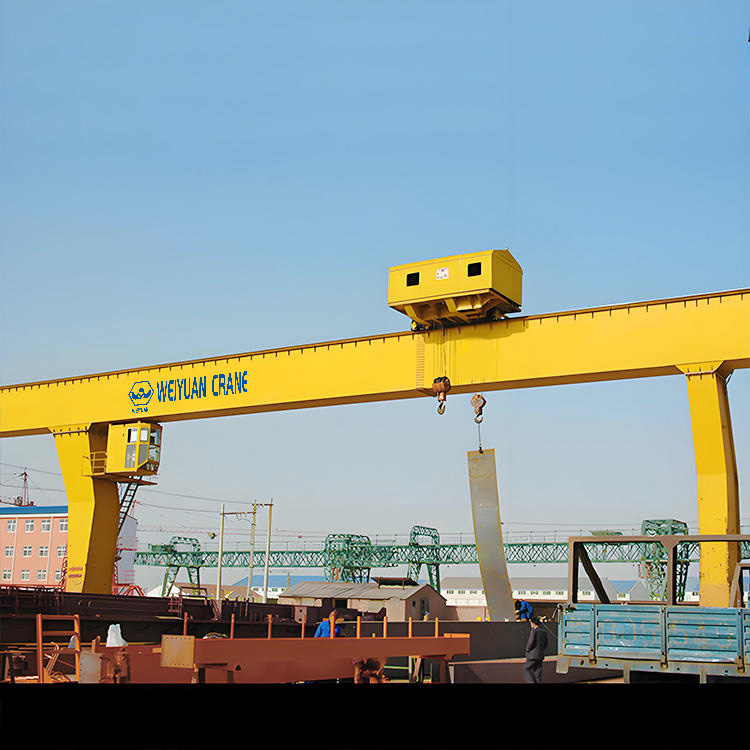
Weiyuan L-Shape Leg Walk Gantry Crane | Manufacturer Direct, Enhanced Mobility
The Weiyuan L-Shape Leg Walk Gantry Crane is a high-performance single-girder gantry crane with a distinctive L-shaped leg design that offers superior clearance for long and oversized loads, and smooth “walk” travel on ground rails — direct from the manufacturer for competitive pricing and reliable quality. :contentReference
View Product / Get QuoteApplication 1: Outdoor Storage and Fabrication Yards
Storage and fabrication yards represent the largest installed base of outdoor gantry cranes in general industry. Steel service centers, precast concrete plants, timber yards, pipe yards, and heavy equipment storage operations all use fixed-rail gantry cranes to serve outdoor storage and processing areas.
Typical configuration:
Full gantry cranes (two full-height legs running on floor-level rails) are the standard choice for yard applications. The rails are typically set flush with or slightly above the finished grade of the yard surface, allowing forklifts, trucks, and other wheeled equipment to cross the rail at grade crossings. This maintains full yard access for motorized traffic while providing overhead crane coverage across the crane’s travel path.
Capacity range: 5 to 50 tons covers the large majority of yard applications. Steel service centers handling plate and structural sections typically specify 10 to 20-ton cranes. Precast concrete producers handling beams and wall panels often specify 20 to 50-ton cranes. Pipe yards vary widely from 5 to 30 tons depending on pipe size and bundle weight.
Span: Yard gantry crane spans are driven by the width of the storage area the crane must serve. Common spans range from 20 to 80 feet. Longer spans above 50 feet typically require double-girder bridge designs to maintain structural rigidity and deflection limits under the rated load.
Bridge design: For heavy yard applications (above 10 to 15 tons) or long spans (above 40 feet), double-girder bridge designs are standard. The double-girder configuration provides greater rigidity, higher usable hook height for a given leg height, and integrated maintenance walkways that simplify hoist and trolley service in a remote outdoor environment.
Hoist selection: Wire rope hoists are standard for yard gantry cranes above 5 tons. The drum-and-rope system handles the long lift heights common in yard applications (where the crane may need to lift material from ground level to well above a stockpile height) more effectively than chain hoist technology.
Specific outdoor requirements for yard applications:
- Hot-dip galvanized structural steel or premium paint system rated for outdoor industrial service
- IP54 minimum (IP65 recommended for wet climates) for all electrical components
- Rail-mounted storm anchor assemblies, engaged whenever the crane is parked during high-wind conditions
- Galvanized or stainless steel hardware throughout
- Oil-bath or sealed gearboxes to prevent moisture ingress
- Low-temperature motor lubricants for cold-climate installations
Application 2: Shipyard Gantry Cranes
Shipyards represent one of the most demanding outdoor gantry crane environments in industry. The combination of salt air corrosion, heavy lifting requirements, large spans, and the criticality of the lifting operations (ship components cannot be dropped or damaged) places shipyard crane applications at the highest tier of specification complexity.
Typical configuration:
Shipyard gantry cranes are typically large double-girder fixed-rail systems with long spans (50 to 150+ feet), tall legs (to clear ship hull sections or provide adequate hook height over drydock structures), and high lifting capacities (20 to 800+ tons for major shipyard applications).
For smaller shipyards and marine service facilities, double-girder cranes in the 10 to 50-ton range with spans of 40 to 80 feet are common. Large naval shipyards and commercial vessel construction facilities use custom-engineered cranes with capacities measured in hundreds of tons.
Corrosion requirements: Shipyard gantry cranes in tidal proximity require the highest level of corrosion protection available. Hot-dip galvanizing of all structural members is the baseline; many shipyard specifications additionally require marine-grade epoxy primer and polyurethane topcoat systems with total dry film thickness of 10 to 16 mils. All fasteners are stainless steel. Electrical enclosures are NEMA 4X (stainless steel, fully sealed) as a minimum.
Wind loading: Shipyards are typically located on waterways where wind exposure is categorized as Exposure Category D under ASCE 7 — the highest exposure category, applicable to open water and adjacent land areas. This produces significantly higher design wind loads than inland or sheltered locations. Structural design for shipyard gantry cranes must explicitly account for this exposure category.
Runway considerations: Shipyard crane rails are often set at the edges of drydocks, piers, or in locations where foundation conditions are complex (near the waterline, on fill, or on structures above water). Foundation engineering for shipyard gantry cranes frequently involves pile foundations rather than conventional spread footings, and requires geotechnical assessment to account for soil conditions and seismic loads in coastal zones.
Safety systems: Shipyard crane operations often involve loads suspended over water, workers on vessel decks below the crane path, and time-critical operations tied to vessel schedules. Anti-collision systems, load monitoring, and radio remote control are standard on shipyard gantry cranes. Many modern shipyard installations also include anemometers (wind speed sensors) that automatically alert operators when wind speed exceeds safe operating limits.
Application 3: Construction Site Gantry Cranes
Construction sites present a distinct set of requirements that differ from both permanent yard installations and shipyard applications. The defining characteristic of construction site crane use is temporality — the crane serves a specific project and must often be relocated or demobilized at project completion.
Typical configuration:
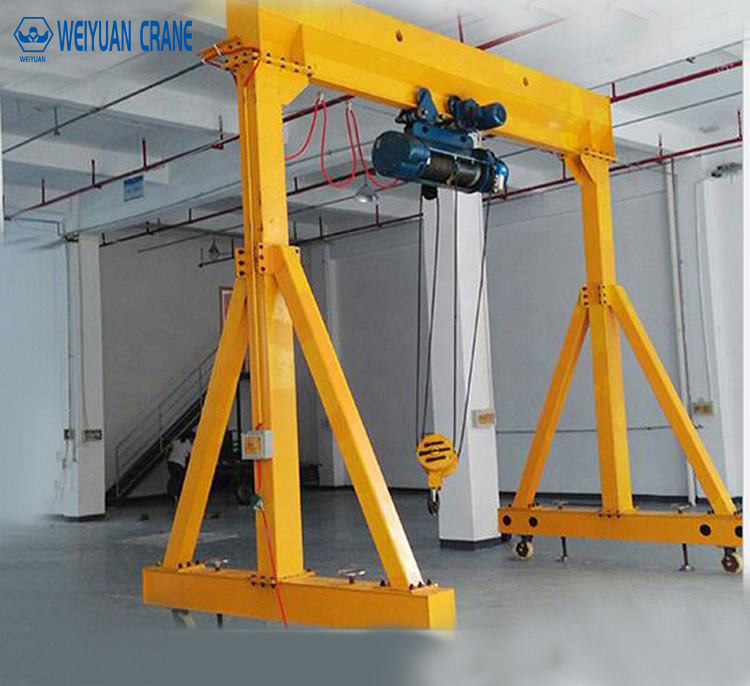
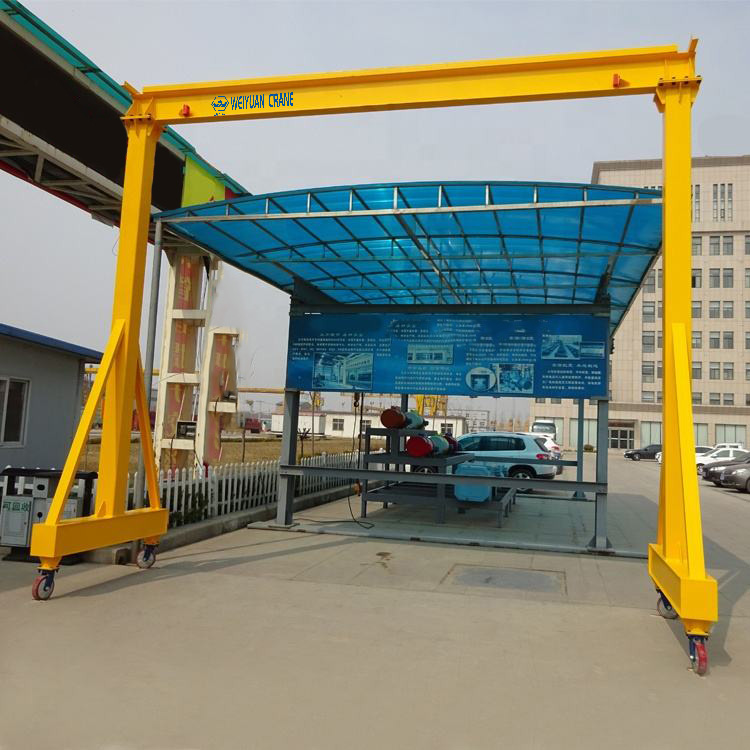
Portable and semi-portable gantry cranes are the most common solution for construction site applications. These units are designed for disassembly and relocation, typically using bolted connections throughout the structure rather than permanent welds.
For bridge construction, precast structure erection, and heavy civil projects, purpose-built launching gantries and erection gantry systems are used. These are highly specialized engineered structures that are beyond the scope of standard catalog crane systems.
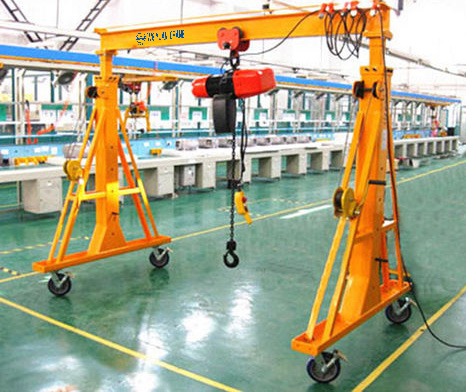
For general construction site lifting — positioning heavy mechanical equipment, handling structural steel sections, or serving temporary assembly areas — portable gantry cranes in the 2 to 20-ton range are commonly deployed on rubber-tired or caster bases.
Ground conditions: Unlike permanent yard installations with engineered rail foundations, construction site gantry cranes must often operate on unprepared or partially prepared ground. Rubber-tired or outrigger-supported configurations are preferred when the ground cannot support the point loads of standard rail systems. Outrigger pads distribute the crane’s leg loads over a larger area, reducing ground bearing pressure to levels that compacted gravel or temporary matting can support.
Portability requirements: A construction site gantry crane should be designed for disassembly by a small crew with standard hand tools in a reasonable time (typically four to eight hours for a medium-capacity unit). All structural connections should use standard bolt sizes to minimize tooling requirements on site.
Temporary power: Construction sites often lack permanent 3-phase electrical service at the crane location. Diesel-powered hoists or generator-supplied electric hoists may be required. Confirm the available power supply before specifying the hoist drive system for any construction site application.
Selecting the Right Outdoor Gantry Crane: Key Decision Points
Before specifying an outdoor gantry crane for any application, work through these decisions in order:
Required lifting capacity and reach: Define the heaviest load (including all below-hook hardware) plus a 25% safety margin. Define the span required to cover the working area.
Permanence of the installation: Is this a permanent installation (fixed rail, engineered foundation) or temporary (portable, relocatable)? This decision drives almost every other specification choice.
Environmental exposure: Coastal salt air, inland industrial atmosphere, extreme cold, high heat and humidity? The corrosion protection specification must match the specific environment — not a generic outdoor standard.
Wind exposure category: Is the site in an open coastal location (Exposure D), open terrain (Exposure C), or a more sheltered industrial environment (Exposure B)? Structural design must reflect the applicable exposure category per ASCE 7.
Frost depth: For permanent rail installations in cold climates, confirm the local frost depth and specify foundations that extend below it.
Duty class: How many lifts per shift? What average load as a percentage of rated capacity? Match the CMAA duty class to actual usage — both overspecifying and underspecifying carry real cost consequences.
Frequently Asked Questions
Q: Can a standard indoor gantry crane be used outdoors temporarily?
A: For very short-term temporary use on a dry day, a standard indoor crane can be operated outdoors with appropriate supervision. However, any extended outdoor use — even days — exposes unpainted surfaces to corrosion and unsealed electrical components to moisture. For any outdoor use beyond a single shift, proper outdoor-rated equipment is the correct specification.
Q: How often does an outdoor gantry crane need to be repainted?
A: This depends heavily on the paint system specification and the environmental exposure. A premium marine-grade epoxy/polyurethane system in a moderate coastal environment typically requires full repaint every 7 to 12 years, with spot touch-up of damaged areas annually. An inland yard installation with standard industrial paint may require repaint every 5 to 8 years. Always clean and inspect painted surfaces annually and touch up damaged areas promptly — small paint failures that are not repaired quickly become large corrosion patches.
Q: What wind speed is an outdoor gantry crane designed for?
A: This varies by design and location. Most standard industrial outdoor gantry cranes are designed for operational wind speeds of 45 to 55 mph (equivalent to the operational wind speed in most ASCE 7 exposure categories for light industrial applications). Storm tie-down anchor systems extend survival wind resistance to 90 to 120 mph in most designs. Confirm design wind speed with the manufacturer and compare to the recorded historical wind speeds at your installation site.