


Overhead Crane for Pharmaceutical & Food Manufacturing: Hygiene Design, Washdown Rating & Contamination Control
Introduction
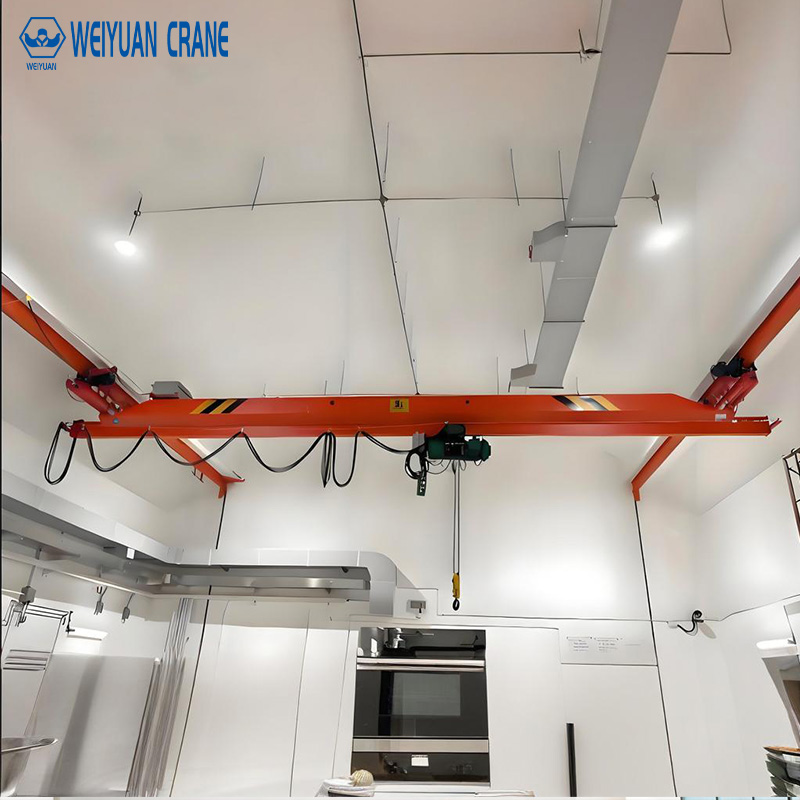
Pharmaceutical and food manufacturing puts a demand on overhead cranes that most factories never face: the crane itself must never become a source of contamination. Every surface, every lubricant, and every hidden pocket where dust or moisture can gather is a potential failure point — and in these industries, a failure shows up as a recalled batch, a failed audit, or a consumer safety incident.
A standard industrial crane is built to lift loads reliably. It is not built to be cleaned daily with high-pressure water, to resist caustic sanitizers, or to avoid shedding particles into a sterile fill line. Its painted surfaces flake. Its grease migrates. Its box-section beams trap water and grow bacteria in seams no brush can reach.
This guide gives you the full specification framework for overhead cranes in pharmaceutical and food manufacturing. You will learn how to match crane design to each production zone, how to specify hygiene and washdown ratings correctly, how to control contamination from lubricants and wheels, and how to hit the precision and cleanroom targets these facilities demand — all with 2026 price references to build a realistic budget.
Part 1: The Production Zones and Their Crane Requirements
Not every area of a pharma or food plant needs the same crane. Specifying one hygiene level across the whole facility wastes money in low-risk zones and under-protects the critical ones. Match the crane to the zone.
Zone 1: Raw Material Handling and Warehousing
This zone receives sealed drums, sacks, and totes before they enter the process. Contamination risk is lower because materials remain packaged.
Crane requirements here are modest: an epoxy-coated or galvanized crane with IP54 electrical protection is usually adequate. Focus the budget instead on capacity and reliable travel — not on full washdown construction.
Zone 2: Processing, Mixing, and Compounding
Here the product is open to the environment. Powders are dispensed, liquids are mixed, and airborne product or spray can settle on every surface above the line — including the crane.
Crane requirements climb sharply:
- Stainless steel or fully coated construction to survive daily cleaning
- IP65 or IP66 electrical protection for washdown areas
- Smooth, crevice-free surfaces that do not trap product residue
- Food-grade or pharma-grade lubricants throughout
Zone 3: Sterile Fill, Finish, and Primary Packaging
This is the most demanding zone. Sterile drug filling and aseptic food packaging run under cleanroom conditions, often ISO Class 5 to 7. Any particle the crane sheds can end up in the final product.
Crane requirements are at their strictest:
- Full stainless 316L construction with electropolished finish
- Enclosed-track or particle-controlled travel systems
- PFPE (perfluoropolyether) lubricants to eliminate mist
- Sealed IP66 or IP69K electrical components
- VFD precision positioning for delicate, accurate placement
Part 2: Hygiene and Washdown Design
The defining feature of a pharma or food crane is that it gets cleaned — often daily, sometimes every shift — with water, foam, and aggressive chemicals. The design must survive this routine for 15 years without corroding or harboring contamination.
Understanding IP Ratings for Washdown
The IP (Ingress Protection) rating tells you how well the crane’s electrical components resist water and dust. Choosing too low a rating guarantees electrical failure within months in a wet environment.
- IP54: dust-protected, splash-resistant. Dry areas only — not for washdown.
- IP65: dust-tight, protected against low-pressure water jets. Suitable for routine wet cleaning.
- IP66: dust-tight, protected against powerful water jets. The standard for regular high-pressure washdown.
- IP69K: dust-tight, protected against high-pressure, high-temperature steam cleaning. Required for sterile zones and any area cleaned with steam.
For processing and fill areas, specify IP66 minimum. Where steam sanitizing is part of the cleaning protocol, IP69K is not optional.
Stainless Steel Construction
Painted carbon steel fails in washdown environments. The coating chips at every impact point, water penetrates the exposed steel, and rust becomes a contamination source that no cleaning removes.
- AISI 304 stainless: adequate for general food processing and most washdown areas.
- AISI 316L stainless: required for pharmaceutical, high-salt, and aggressive-chemical environments. The added molybdenum resists chloride corrosion from sanitizers.
Stainless construction adds cost, but it is the only material that survives daily chemical cleaning while staying contamination-free for the crane’s full service life.
Surface Finish — Where Contamination Hides
The surface finish determines whether bacteria and product residue can cling to the crane. A rough surface holds contamination in microscopic pits; a smooth one lets cleaning water carry it away.
- Standard mill finish: surface roughness around Ra 1.0 µm or higher — inadequate for hygienic zones.
- Ground finish: Ra 0.8 µm, acceptable for general food areas.
- Electropolished finish: Ra 0.4 µm or below — required for sterile pharma and aseptic fill zones.
Design out the hidden traps too:
- Use rounded corners and continuous welds — no lap joints or spot welds that create crevices.
- Slope all horizontal surfaces so water drains rather than pools.
- Avoid open box sections; specify sealed or fully drainable structural profiles.
Part 3: Contamination Control
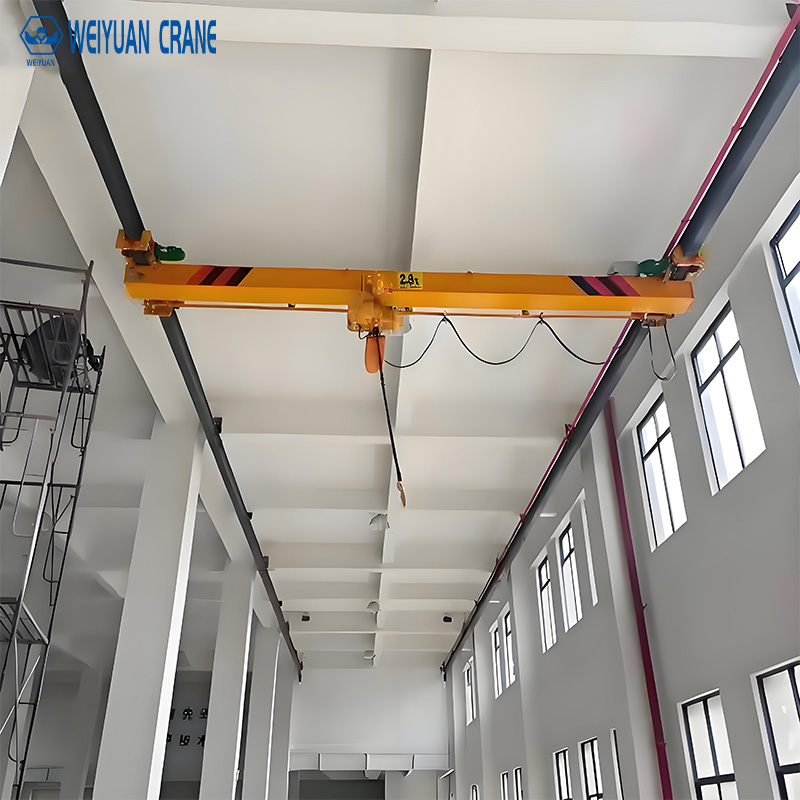
Beyond surviving washdown, the crane must not actively contaminate the product it works above. Two culprits dominate: lubricant migration and particle generation.
Lubricant Selection
A standard petroleum grease that drips or migrates onto a food line is an instant contamination event. Specify certified lubricants everywhere the crane could shed them.
- NSF H1 food-grade lubricants: rated for incidental food contact. The baseline for all food and pharma crane bearings and gearboxes.
- PFPE lubricants: extremely low vapor pressure, no misting. Required for cleanroom and sterile zones where even trace airborne lubricant is unacceptable.
The cost premium is small — roughly $200 to $800 per crane per year — and it is fully justified against the cost of a single contaminated batch.
Particle Generation and Enclosed Track
Steel wheel-on-steel rail contact is the biggest particle source in a standard crane. Every wheel revolution grinds off iron oxide that drifts down onto the line below.
Control it by matching the system to the zone:
- Enclosed-track (KBK-style) systems: the trolley runs inside a closed rail profile, trapping wheel debris inside. Ideal for light-duty cleanroom and sterile cranes.
- Polyurethane-coated wheels: for heavier cranes where enclosed track is impractical. They generate far fewer hard metal particles than steel-on-steel — inspect and replace them before the coating wears through.
Sealing Out Moisture and Bacteria
Water trapped inside a structure becomes a bacterial reservoir. Seal it out entirely.
- Fully seal all electrical enclosures to the required IP rating.
- Use sealed-for-life bearings so no grease path is open to the environment.
- Eliminate fasteners with exposed threads or recesses where residue collects — use domed or sealed hardware instead.
Part 4: Cleanroom Compatibility
Sterile fill and aseptic packaging zones operate as classified cleanrooms. The crane must run inside these spaces without pushing the particle count above the class limit.
ISO Classification by Zone
- Sterile fill and aseptic core: ISO Class 5 to 6 — the strictest, comparable to semiconductor process areas.
- Primary packaging and finish: ISO Class 7.
- General controlled processing: ISO Class 8.
Controlling the Crane’s Particle Footprint
Each particle source needs a specific control:
- Wheel contact: enclosed track or polyurethane-coated wheels, as covered in Part 3.
- Lubricant mist: PFPE lubricants throughout, which produce no detectable mist at normal operating temperatures.
- Electrical arcing: specify brushless induction motors and VFD control to eliminate contactor switching and brush debris.
- Airflow disruption: design a compact, low-profile crane that minimizes interference with the cleanroom’s laminar airflow.
Seal every electrical component to IP65 or better so no internal particle escapes into the classified space.
Part 5: Precision Positioning and VFD Specifications
Pharma and food handling is rarely about brute lifting. It is about placing sensitive equipment, fragile containers, and process modules accurately and gently — without swing, shock, or spillage.
Positioning Requirements
- Process equipment installation: alignment within ±5mm for mixer bowls, tank fittings, and reactor components.
- Delicate container handling: smooth, shock-free movement to protect glass vials, IBCs, and packaged product from impact.
- Repeatable placement: consistent positioning for automated or semi-automated fill and packaging lines.
Why VFD Control Is the Standard
Contactor (on/off) control snaps the load into motion and stops it abruptly, causing swing and shock. In a sterile or fragile-product zone, that swing risks spills, breakage, and collisions.
VFD (variable frequency drive) control solves this:
- Smooth acceleration and deceleration eliminate the jolt that swings the load.
- Micro-speed down to 0.1 m/min allows precise final placement into fixtures and lines.
- Reduced load swing — from around ±200mm with contactor control to ±20mm with VFD plus anti-sway.
Consider a fill line placing 25 equipment modules per shift. Cutting 15 seconds of swing-settling time per cycle recovers over 6 minutes per shift — more than 50 hours of production capacity per year across two shifts. VFD pays for itself in both quality and throughput.
Part 6: 2026 Price Reference
All figures are indicative for standard configurations. Installed cost includes mounting, electrical connection, and commissioning.
Sterile fill / aseptic zone crane (single girder, 1-tonne, 10m span, 316L electropolished, enclosed track, PFPE, IP69K, VFD):
- Crane equipment: $45,000 to $95,000
- Installation and electrical: $12,000 to $25,000
- Total installed: $57,000 to $120,000
Processing / washdown zone crane (single girder, 2-tonne, 12m span, 304 stainless, IP66, food-grade lube, VFD):
- Crane equipment: $30,000 to $65,000
- Installation and electrical: $10,000 to $20,000
- Total installed: $40,000 to $85,000
Raw material / warehouse crane (single girder, 3-tonne, 14m span, epoxy-coated, IP54, standard control):
- Crane equipment: $15,000 to $35,000
- Installation and electrical: $6,000 to $14,000
- Total installed: $21,000 to $49,000
Specification premiums to plan for:
- Full 316L stainless over painted carbon steel: +40 to +70% on equipment price.
- Electropolished finish over standard stainless: +15 to +25%.
- IP69K over IP54: +20 to +35%.
- PFPE lubricants over standard: negligible in absolute terms ($200 to $800 per crane per year) — fully justified by contamination-risk avoidance.
Frequently Asked Questions
Q: Can I use a painted carbon-steel crane in a food processing area if I paint it with food-safe coating?
A: Not reliably. Even food-safe epoxy coatings chip at impact points, weld seams, and wear zones. Once the coating breaks, water reaches the carbon steel underneath, and the resulting rust becomes a contamination source that cleaning cannot remove. For any regular washdown area, stainless steel is the only durable, contamination-free choice. A coated carbon-steel crane belongs in dry raw-material and warehouse zones only — not in areas where the product is exposed.
Q: What washdown IP rating do I actually need for daily high-pressure cleaning?
A: For routine high-pressure water washdown, specify IP66 minimum — it is rated for powerful water jets from any direction. If your cleaning protocol includes steam sanitizing or high-temperature washdown, step up to IP69K, which is built for high-pressure, high-temperature spray. Specifying IP65 or lower for a washdown area guarantees water ingress and electrical failure within months. Match the rating to your actual cleaning method, not to the catalog default.
Q: Is a full cleanroom-spec crane necessary throughout the facility?
A: No — and specifying one everywhere wastes budget. Match the crane to the zone. Raw-material and warehouse areas need only basic protection. Processing and washdown zones need stainless construction and IP66. Only sterile fill and aseptic packaging areas justify full 316L electropolished, IP69K, enclosed-track cleanroom cranes. Zone your facility first, then specify each crane to its real contamination risk. This keeps you compliant where it matters and cost-effective where it does not.