


RTG vs RMG Crane: Which Container Yard Stacking Solution Fits Your Terminal?
Introduction
Two crane technologies dominate container yard stacking, and they make almost opposite promises to the terminal that buys them. Rubber-Tired Gantry cranes (RTG) run on pneumatic tires and can drive between yard blocks. Rail-Mounted Gantry cranes (RMG) run on fixed steel rails set into the yard and stay put for decades. Both stack containers. Both serve the same purpose. Yet each suits a very different kind of terminal.
The RTG promises flexibility. Move it between blocks, adapt as traffic shifts, and expand the yard without rebuilding fixed infrastructure. The RMG promises precision, automation, and energy efficiency — rail guidance gives repeatable positioning and cleaner integration with automated control.
For a procurement decision-maker, this is a capital choice that shapes cost, equipment uptime, and yard efficiency for 20 to 30 years. Pick wrong, and you either overpay for automation you never use or throttle a busy yard with equipment it has outgrown.
This guide will help you:
- Understand how RTG and RMG cranes differ structurally and operationally.
- Compare them across seven procurement-critical dimensions.
- Match the right crane to your terminal type, volume, and automation plan.
Part 1: Structural and Operational Differences
Both cranes straddle rows of containers and stack them. How they are supported and powered is where they split — and that difference drives cost, flexibility, and automation potential.
RTG — Rubber-Tired Gantry
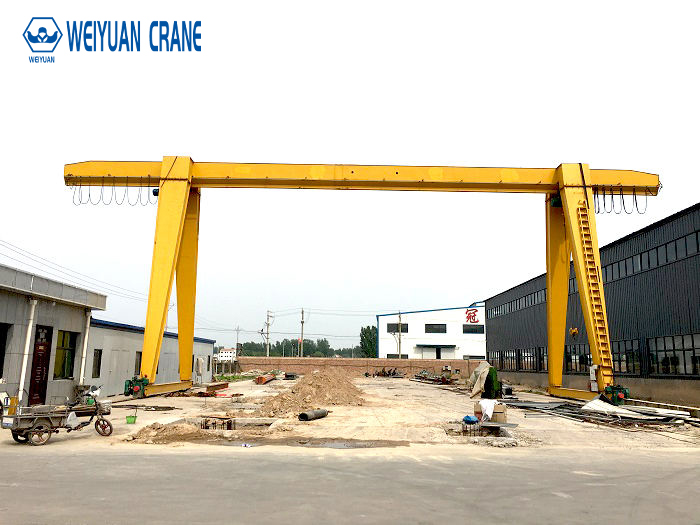
An RTG is a mobile gantry crane on pneumatic rubber tires. It straddles a row of container stacks and travels along the block to reach the correct bay. Its wheel sets can rotate 90 degrees, letting the crane cross from one block to another under its own power.
Key features to know:
- Span: typically 6+1 to 8+1 container rows wide (rows plus one truck lane).
- Stack height: commonly 1-over-5 to 1-over-6 (one container over five or six).
- Lifting capacity under spreader: 40 to 65 tonnes standard.
- Power: diesel generator, diesel-hybrid, or fully electric via cable reel or busbar.
- Travel speed: 130 to 180 m/min along the block.
- Steering: 90-degree wheel turn allows block-to-block transfer.
RMG — Rail-Mounted Gantry
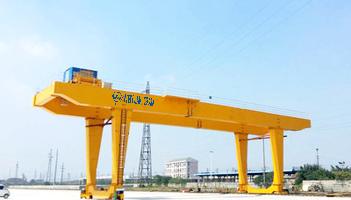
An RMG runs on two fixed steel rails embedded in the yard surface. The rails set the travel path permanently — the crane cannot move to a new position without excavating and relaying the rails.
Key features to know:
- Span: typically 6+1 to 10+1 rows wide; wider spans are practical because the rails give rigid lateral support.
- Stack height: similar to RTG, 1-over-5 to 1-over-6.
- Lifting capacity: 40 to 65 tonnes standard, with higher options available.
- Power: almost always electric, via conductor rail or catenary — no onboard engine.
- Travel speed: 180 to 240 m/min, faster thanks to rigid rail guidance.
- Steering: none; the crane follows the rails only.
Key takeaway: the RTG is a mobile, adaptable stacker; the RMG is a fixed, high-precision machine. That single contrast runs through every dimension below.
Part 2: Seven-Dimension Comparison
Here is how the two cranes measure up on the seven factors that decide most procurement outcomes.
Dimension 1: Flexibility and Repositionability
RTG: drives between blocks under its own power. Moving a crane from one block to another takes minutes. When the yard layout changes, the RTG fleet adapts with no infrastructure spend.
RMG: fixed to its rails. Relocating means excavating foundations, relaying rails, reconnecting power, and recommissioning — commonly $500,000 to $2,000,000 per crane and weeks to months of work.
Winner: RTG — decisively.
Dimension 2: Yard Density and Stacking
RTG: the 90-degree turn needs clearance, so blocks require 5 to 8-metre end aisles. That consumes usable stacking area.
RMG: no turning requirement, so blocks pack tighter. RMG yards typically achieve 5 to 15% higher container density per hectare than equivalent RTG yards.
Winner: RMG — a marginal but real advantage where land is tight.
Dimension 3: Automation Compatibility
RTG: automated operation needs GNSS positioning with differential corrections. Accuracy lands at ±10 to ±20 mm — adequate, but retrofit cost is significant.
RMG: rail guidance gives inherent repeatability. Absolute encoders on the rail wheels provide ±2 to ±5 mm accuracy with no GNSS, integrating more cleanly and cheaply into automated terminals.
Winner: RMG — significant advantage for high-automation terminals.
Dimension 4: Energy Efficiency
RTG (diesel): 12 to 18 litres per operating hour — the highest operating cost of any yard crane.
RTG (electric): 15 to 25 kWh per operating hour.
RMG (electric): 12 to 20 kWh per hour, with regenerative braking returning 15 to 25% of lifting energy. Net consumption drops to 9 to 17 kWh per hour.
Winner: Electric RMG — lower consumption and better energy recovery.
Dimension 5: Infrastructure Investment
RTG: needs only a flat, strong yard surface. Infrastructure per crane position runs $50,000 to $200,000.
RMG: needs embedded rail foundations along the full travel length — $800 to $1,500 per running metre for both rails. A 400-metre block with four RMG cranes carries $640,000 to $1,200,000 in rail foundations alone, before the cranes.
Winner: RTG — significantly lower upfront investment.
Dimension 6: Throughput Performance
RTG: cycle time 90 to 130 seconds; 25 to 35 moves per hour (28 to 32 automated).
RMG: cycle time 75 to 110 seconds; 28 to 38 moves per hour with anti-sway, thanks to faster travel and better positioning.
Winner: RMG — a marginal edge on throughput.
Dimension 7: Total Cost of Ownership Over 20 Years
- RTG (diesel, manual): fuel and operator cost dominate TCO.
- RTG (electric, semi-automated): lower energy cost, moderate operator cost.
- RMG (electric, automated): highest capital cost, near-zero operator cost, lowest energy cost — best TCO at high volume.
The breakeven where RMG TCO drops below RTG TCO sits around 400,000 to 600,000 moves per year per block. Below that, the higher infrastructure and capital cost is not recovered.
Key takeaway: RTG wins on flexibility and low upfront cost; RMG wins on density, automation, and long-term efficiency at high volume.
Part 3: Decision Framework by Terminal Type
Match the crane to your terminal’s real profile — volume, automation plan, and layout commitment — not to the most advanced machine available.
Terminal Type 1: Greenfield High-Volume Automated Terminal
- Throughput: above 600,000 moves per year per block.
- Automation target: fully automated.
- Layout: fixed for 20+ years.
Recommendation: RMG. Automation compatibility, throughput, and energy efficiency justify the higher infrastructure cost at this volume. Nearly all major automated terminals built since 2015 use rail-guided systems.
Terminal Type 2: Existing Terminal Expansion
- Throughput: 200,000 to 600,000 moves per year per block.
- Automation target: semi-automated initially.
- Layout: may evolve as the terminal grows.
Recommendation: Electric RTG with an automation upgrade path. The flexibility to reposition cranes outweighs RMG efficiency at this volume. Specify electric RTG from the start to avoid a costly diesel-to-electric conversion later.
Terminal Type 3: Smaller Regional or Feeder Terminal
- Throughput: below 200,000 moves per year.
- Automation target: mostly manual, with remote operation considered.
- Constraint: limited infrastructure budget.
Recommendation: RTG (diesel-hybrid or electric). The infrastructure saving over RMG is decisive at this scale. Diesel-hybrid lowers fuel cost while avoiding busbar investment.
Terminal Type 4: Inland Container Depot or Rail Terminal
- Throughput: variable, often lower than a port.
- Automation target: varies widely.
- Power supply: often limited.
Recommendation: RTG. Inland layouts shift seasonally, so RTG mobility is essential. Where grid power is limited, diesel-hybrid balances fuel efficiency with independence from fixed electrical infrastructure.
Part 4: Hybrid and Emerging Options
The choice is no longer purely diesel RTG versus electric RMG. Several options sit between them and belong on your shortlist.
E-RTG (Electrified RTG)
A diesel RTG converted to run on cable reel or busbar power, with the diesel generator kept as backup. It runs on grid power in normal operation, cutting fuel cost by 80 to 90%. Conversion runs $150,000 to $350,000 per crane, with payback through fuel savings in 2 to 4 years.
Battery RTG
A fully battery-electric RTG with no diesel and no cable, charged during shift breaks. It keeps full yard mobility with no busbar infrastructure. Trade-offs: charging time, battery capacity limits, and battery replacement after 8 to 14 years. Newer hybrid models charge from a small grid connection — far below the ~400 kW of direct electric operation — cutting electrical infrastructure cost sharply.
Automated RMG (ARMG)
Fully automated RMGs stack containers without an operator, using rail guidance for precise, repeatable positioning. For high-volume terminals committed to automation, they raise throughput, improve safety, and cut labour cost — at the price of full automation and control-system investment.
Frequently Asked Questions
Q: Can an RTG terminal be converted to RMG later as volume grows?
A: Yes, but at substantial cost. Conversion means excavating the yard surface to install rail foundations, laying new rail, buying new RMG cranes, and adding fixed electrical distribution — commonly $5M to $15M per yard block. If you expect to move toward full automation, the smart move is to design your yard block dimensions and surface specifications to be “RMG-ready” from the start. That foresight costs little upfront and cuts the eventual conversion bill significantly, while keeping your RTG fleet earning during the growth years.
Q: Is an RMG crane more expensive than an RTG?
A: The crane itself is similar — roughly $1.5M to $4.5M for both at standard capacities. The real gap is infrastructure. RMG rail foundations, fixed power distribution, and any ground leveling add $800,000 to $2,500,000 per crane position, while an RTG needs only a strong yard surface. So on total installed cost, the RMG is significantly more expensive. That premium only pays back through lower operating cost at high volume — which is why the volume breakeven matters more than the crane price alone.
Q: Which system delivers better equipment uptime and lower maintenance risk?
A: Both reach 20-to-25-year structural lives when correctly specified and maintained, but their maintenance profiles differ. An RTG carries tires that need replacement every 18 to 36 months — an ongoing cost with no RMG equivalent — plus a diesel engine on non-electric models. An RMG has rail maintenance instead (grinding, clip replacement, joint inspection), typically less frequent and lower in unit cost. RMG rails also last 25 to 40 years. For a busy, dedicated block the RMG usually delivers higher sustained uptime; for a flexible yard, the RTG’s ability to cover another block during a stoppage is itself an uptime advantage. Match the choice to how a stoppage would actually affect your operation.