


Single Girder vs Double Girder Gantry Crane: How to Choose the Right Structure for Your Capacity, Span, and Duty Class
Introduction
Two gantry cranes sit side by side in a fabrication shop. Both rated at 20 tonnes, both spanning 22 metres. One cost 40% less than the other and does its job every shift without complaint. The other was the right call for its neighbor’s heavier, higher-cycle work. Same capacity on the nameplate — completely different structures underneath. The difference is a single beam versus two.
Girder configuration is the decision that shapes the whole crane. It sets how much the crane can lift, how far it can span before it sags, how hard it can work across its service life, how much hook height you keep, and — for a procurement budget — what the crane costs to buy and run. Choose single girder when your loads and duty allow it, and you save real capital. Choose double girder when the work demands it, and you avoid a crane that flexes, wears, and fails years early.
The costly mistake runs both ways. Buying a double-girder crane for light, occasional lifting wastes money on steel and headroom you never use. Buying a single-girder crane for heavy, high-cycle production means a structure that deflects too much, wears its running gear fast, and gets replaced long before its time. Both errors come from matching the nameplate capacity without matching the structure to the real work.
This guide gives you a clear framework to make that call. It explains how the two structures differ, the capacity and span each one covers, how CMAA duty class drives the choice, what you gain or lose in hook height, and which control options fit each. You will finish able to specify the right girder configuration before you request a single quote.
Part 1: The Structural Difference
A gantry crane’s girder is the horizontal beam that spans between the legs and carries the hoist across the work area. The whole choice comes down to how many of these beams the crane uses — one or two — and everything else follows from that.
Single Girder Construction
A single-girder gantry uses one main beam spanning between the two legs. The hoist and trolley run along the bottom flange of that beam, hanging beneath it. This is the simpler, lighter, more economical structure.
Because the hoist hangs below the beam, a single-girder crane uses an underslung or bottom-running trolley. The design is clean and uses less steel, which lowers both the crane’s weight and its price. Less weight also means lighter legs, lighter wheels, and a smaller travel drive — savings that ripple through the whole machine and into the rail and foundation work.
Double Girder Construction
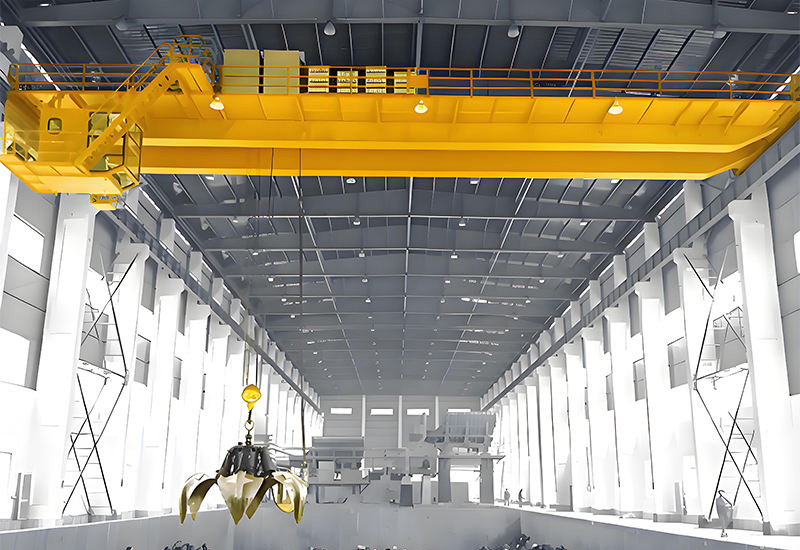
A double-girder gantry uses two main beams running parallel between the legs. The hoist and trolley run on rails mounted on top of the two beams, riding above them rather than hanging below. This is the stronger, stiffer, higher-capacity structure.
With the trolley on top, a double-girder crane uses a top-running trolley that sits between and above the girders. Two beams share the load, so the structure resists both bending and twisting far better than a single beam. That extra strength and stiffness is exactly what heavy loads, wide spans, and high-cycle duty demand — and it is why the double girder costs more in steel, weight, and price.
Why the Difference Matters
The structural choice is not cosmetic. One beam or two decides the crane’s capacity ceiling, its practical span, how much it deflects under load, how much hook height it delivers, and what control and accessory options it can carry. Every section that follows traces back to this one difference — so getting it right first makes every other specification decision easier.
Part 2: Capacity and Span Ranges
Capacity and span are where the two structures separate most clearly. Each configuration has a practical range where it delivers the best value, and pushing past that range is where costs and problems start.
Where Single Girder Fits
- Capacity: typically 1 to 20 tonnes.
- Span: best value from 8 to 25 metres.
A single-girder gantry covers the broad middle of light-to-moderate lifting. Within this range it is the economical choice — enough structure for the job, without paying for steel the work does not need. As capacity climbs toward the top of the range on wide spans, a single beam starts to flex more, and the design either needs a much heavier beam or reaches the point where two girders make more sense.
Where Double Girder Fits
- Capacity: typically 5 to 100+ tonnes.
- Span: comfortable across 12 to 35 metres, and wider with proper design.
A double-girder gantry starts where the single girder begins to strain and continues far into heavy-lifting territory. Two beams carry higher loads over wider spans without excessive deflection, which is why every heavy fabrication, precast, and yard crane above the mid-range is double girder. The extra capacity headroom also means the crane runs comfortably within its limits rather than at the edge of them — a direct contributor to long service life and equipment uptime.
The Overlap Zone — 5 to 20 Tonnes
Between roughly 5 and 20 tonnes, both structures can do the job, and this is where the decision needs the most thought. In this overlap:
- Choose single girder when the span is moderate, the duty is light to medium, and cost is a priority.
- Choose double girder when the span is wide, the duty is heavy, precision matters, or you need the extra hook height and accessory capacity covered later in this guide.
The nameplate tonnage alone will not tell you which to pick in this zone. Span, duty class, and how the crane will actually be used decide it — which is exactly what the next sections address.
Part 3: Duty Class Implications
Capacity tells you how heavy a single lift can be. Duty class tells you how hard and how often the crane works — and it is often the deciding factor between the two structures, especially in the overlap zone.
A Quick Word on CMAA Duty Class
CMAA duty classes rate a crane by load severity and cycle count, running from Class A (infrequent, light) through Class F (severe, continuous). The higher the class, the more lifts the crane makes and the heavier those lifts run over its design life. Specifying the class honestly is the single biggest lever a buyer has on long-term reliability — a crane worked beyond its rated duty wears every component early and fails years before it should.
Single Girder and Duty Class
A single-girder gantry is well matched to CMAA Class A through C — light to moderate duty. This covers maintenance bays, intermittent production, outdoor storage yards with modest cycle counts, and general workshop lifting. Within these classes the single beam handles the cycle count comfortably and delivers dependable service for the lowest capital cost.
Push a single-girder crane into heavy, continuous Class D and above, and the single beam works near its limits every cycle. Deflection, fatigue, and running-gear wear all accelerate. It can be done with a heavier beam design, but at that point the double girder is usually both stronger and better value.
Double Girder and Duty Class
A double-girder gantry is the standard for CMAA Class D through F — heavy production, high cycle counts, and continuous or near-continuous operation. Two beams share every load, so the structure carries relentless duty without the fatigue and deflection problems that would consume a single beam. For any yard, plant, or line that runs hard all shift, the double girder is not an upgrade — it is the correct specification for the duty.
Deflection — The Stiffness Limit That Governs Wide Spans
Deflection is how much the girder sags at its midpoint under load. It matters for two reasons: too much sag makes the trolley feel like it is rolling downhill toward the middle, and repeated flexing fatigues the steel over time. Crane standards cap deflection at a fraction of the span — commonly around span ÷ 600 to span ÷ 800 for gantry girders, depending on duty.
Here is why deflection often forces the double-girder choice on wide spans: a single beam long enough to span 25 or 30 metres must be very deep and heavy to stay within the deflection limit. Two beams reach the same stiffness more efficiently. So even when the capacity could be handled by a single girder, the span and stiffness requirement can tip the decision to double girder — particularly for precision work where a stable, level trolley path is essential.

Part 4: Headroom and Hook Height
Hook height — how high the crane can actually lift the load — is where the two structures differ in a way that directly affects whether the crane suits your building or site. Two cranes with identical leg height can deliver very different usable lift, purely because of where the trolley sits.
Single Girder — Hook Height Trade-Off
On a single-girder crane, the hoist hangs below the beam. That means the top of the load’s travel is limited by the underside of the girder — the hook cannot rise past the beam it hangs from. The result is a lower maximum hook height for a given crane height, because the beam depth and the hoist body both eat into the available lift.
For many applications this is perfectly acceptable. But in a height-constrained building, or where you need to lift loads as high as possible, the single girder’s hanging hoist costs you usable vertical space.
Double Girder — Hook Height Advantage
On a double-girder crane, the trolley runs on top of the two beams. The hook can rise up between the girders, using space that a single-girder design wastes. For the same crane height, a double girder typically delivers meaningfully greater hook height — often enough to be the deciding factor in a building with limited clearance or an application that stacks loads high.
This is one of the most practical, real-world reasons to choose double girder even inside the overlap capacity zone. If usable lift height is tight, the double girder’s top-running trolley recovers vertical space the single girder simply cannot.
The Practical Takeaway
- Choose single girder when hook height is not tight and you want the lowest-cost structure for the duty.
- Choose double girder when you need maximum hook height from a given crane height, or when the building clearance is limited and every metre of lift counts.
Measure your required hook height against your available clearance early. It is a common reason a project that looked like a single-girder job turns out to need a double girder.
Part 5: VFD and Control Options
How the crane starts, stops, and places the load matters as much as how much it lifts. Both girder types can carry modern controls, but the double girder’s structure supports the most demanding precision and accessory options more readily.
Control Options Common to Both
Both single- and double-girder gantries can be specified with the full range of travel and hoist controls:
- Contactor (on/off) control: the basic, lowest-cost option. Full speed or stopped, with the load swinging on every stop. Fine for rough, low-cycle lifting.
- Two-speed control: adds a slow speed for final positioning at modest extra cost — a practical middle ground.
- VFD (variable frequency drive) control: smooth acceleration and deceleration, micro-speed for precise placement, and far less load swing. VFD also extends brake and motor life by removing the shock of on/off starts and stops — a direct contributor to equipment uptime and lower maintenance cost.
For any crane running more than a light, occasional duty, VFD control pays back through smoother operation, longer component life, and fewer stoppages. It is increasingly the default specification on both structures.
Why Double Girder Supports Heavier Control and Accessory Packages
The double-girder structure carries more than just a heavier hoist. The top-running trolley and the two-beam frame provide the room and the strength for accessories a single girder cannot easily support:
- Higher-capacity and dual hoists for heavy or long loads.
- Machinery platforms and walkways mounted between the girders for safe maintenance access at height.
- Magnet, grab, or special below-hook attachments for handling steel coils, scrap, or bulk material.
- Anti-sway and encoder positioning systems for precision placement in precast, steel, and automated yards.
For high-precision and automated work — the kind common in modern precast plants and steel yards — the double girder’s capacity to carry closed-loop positioning, anti-sway, and heavy attachments makes it the practical choice. The single girder, by contrast, keeps things simple and economical for straightforward lifting.
Matching Control to Duty
- Light, occasional lifting: single girder with contactor or two-speed control keeps cost down.
- Moderate production: single or double girder with VFD for smoother, longer-lasting operation.
- Heavy, precise, or automated work: double girder with VFD, anti-sway, and encoder positioning for accuracy and throughput.
Part 6: 2026 Price Reference
Use the figures below to build a realistic budget before you request quotes. All prices are indicative for standard 2026 configurations and cover the crane only — rail and foundation civil work is quoted separately and can add significantly to the total, as covered in Article 3 of this series. Prices vary with capacity, span, duty class, and control type.
Single Girder Gantry (crane only)
| Capacity | Span | Duty class | Indicative 2026 price (USD) |
|---|---|---|---|
| 1 – 5 t | 8 – 15 m | Class A–C | $12,000 – $32,000 |
| 5 – 10 t | 12 – 20 m | Class B–C | $22,000 – $55,000 |
| 10 – 20 t | 15 – 25 m | Class C | $45,000 – $95,000 |
Double Girder Gantry (crane only)
| Capacity | Span | Duty class | Indicative 2026 price (USD) |
|---|---|---|---|
| 5 – 10 t | 12 – 20 m | Class C–D | $40,000 – $90,000 |
| 10 – 32 t | 15 – 30 m | Class D–E | $85,000 – $220,000 |
| 32 – 100 t | 20 – 35 m | Class E–F | $200,000 – $520,000 |
Control Option Premiums (either structure)
| Control option | Premium over contactor base |
|---|---|
| Two-speed | +15 to +25% |
| VFD, open-loop | +35 to +60% |
| VFD with anti-sway and encoder positioning | +70 to +130% |
Budget Notes for Procurement
- In the overlap zone, single girder saves real capital. For a 5–20 t crane on a moderate span at light-to-medium duty, single girder typically runs 30–45% below an equivalent double girder — a meaningful saving when the duty genuinely allows it.
- Do not under-specify to win a lower quote. A single-girder crane pushed into heavy Class D duty wears fast and fails early; the downtime cost dwarfs the upfront saving. Match the structure to the real duty class.
- Budget the civil work separately. Rail and foundations for a gantry can add 20–60% on top of the crane price, depending on span, ground conditions, and rail length. Request the civil scope as an itemized line in every quote.
- VFD pays back through uptime. The control premium is recovered over the crane’s life through longer brake and motor life and fewer stoppages — factor lifetime cost, not just purchase price.
Frequently Asked Questions
Q: In the 5–20 tonne overlap, how do I decide between single and double girder?
A: Look past the tonnage to four things: span, duty class, hook height, and precision. Choose single girder when the span is moderate (up to roughly 20 metres), the duty is light to medium (CMAA Class A–C), hook height is not tight, and cost is the priority — you will save 30–45% and get dependable service for the work. Choose double girder when any of these push harder: a wide span where deflection becomes a concern, heavy or continuous Class D-and-above duty, a need for maximum hook height from limited building clearance, or precision and accessory requirements like anti-sway, encoder positioning, or a magnet attachment. The nameplate capacity alone cannot make this call in the overlap zone — the way the crane will actually be used decides it. When two or more of those factors point to double girder, specify it, because retrofitting the extra capability later means replacing the crane.
Q: Does a single-girder gantry really cost that much less, and where do the savings come from?
A: Yes — for a comparable capacity and span within its suitable range, single girder typically runs 30–45% below double girder, and the savings are structural, not a quality cut. A single beam uses far less steel than two, which makes the whole crane lighter. That lighter crane needs lighter legs, smaller wheels, a smaller travel drive, and — importantly for the total project — less demanding rail and foundation work, since there is less crane weight to carry into the ground. The savings compound down the whole system. The key qualifier is that they only hold when the single-girder structure genuinely suits the duty. Buy single girder for a job that needs double, and the early wear, higher maintenance, and eventual replacement erase the saving many times over. Match the structure to the real duty and the cost advantage is genuine; force it beyond its range and it becomes a false economy.
Q: Why does a wide span sometimes force a double girder even when the load is light?
A: Because of deflection — how much the girder sags at its midpoint under load. Crane standards limit deflection to a small fraction of the span (commonly span ÷ 600 to span ÷ 800), and holding a single beam within that limit over a wide span requires making the beam very deep and heavy. Past a certain span, two beams reach the required stiffness more efficiently and economically than one oversized single beam. So even a modest load over a 25-to-30-metre span can point to a double girder, purely on stiffness grounds. This matters most for precision work: an over-flexing girder makes the trolley path feel like it dips toward the center, which undermines accurate placement. If your span is wide and your placement needs to be precise, evaluate deflection early — it is a common reason a light-load project still calls for a double-girder structure.