


The Complete Guide to Choosing the Perfect Jib Crane for Your Facility
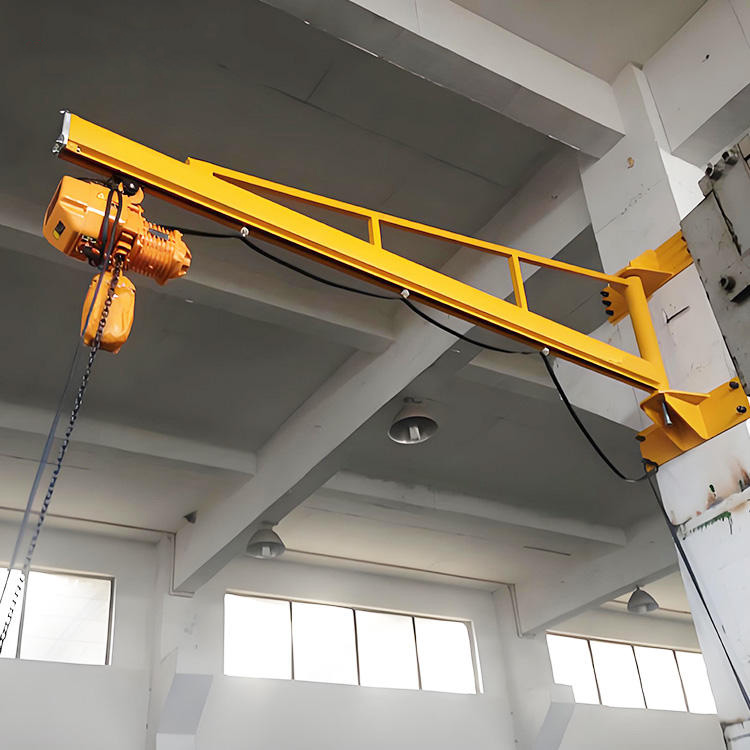
Selecting the right material handling equipment is a critical decision that directly influences your facility’s productivity, safety, and profitability. While large overhead cranes handle heavy, facility-wide loads, much of the daily work involves smaller, repetitive lifts at individual workstations. Choosing the wrong equipment for these tasks leads to bottlenecks and safety risks. Choosing the right one streamlines workflow and empowers your team.
The jib crane is often the perfect solution for localized lifting, but the sheer variety of types, capacities, and configurations can make the selection process feel overwhelming. A mistake in specification can lead to an underpowered crane that can’t do the job or an over-engineered one that drains your budget.
This complete guide is designed to walk you through every step of the selection process. From assessing your core needs to understanding structural requirements and specifying key components, you will gain the knowledge needed to choose the perfect jib crane for your facility, ensuring a safe, efficient, and valuable long-term investment.
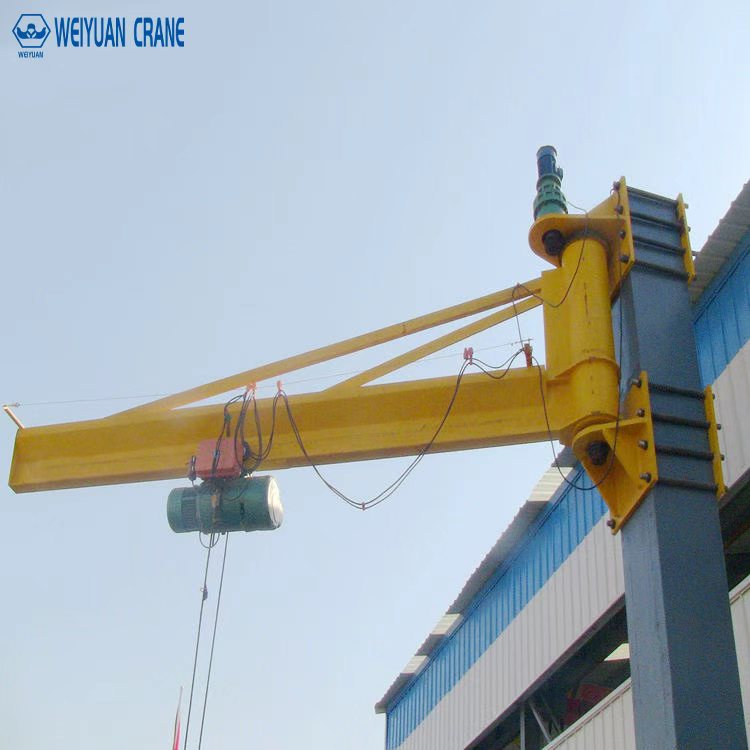
Weiyuan 500kg Wall Mounted Jib Crane
The Weiyuan 500kg Wall Mounted Jib Crane is a compact and efficient lifting solution designed for workshops, assembly lines, and warehouse operations. Mounted directly to a structural wall or column, it saves valuable floor space while providing smooth 180° slewing coverage for precise material handling up to 500 kg.
View Product / Get QuoteStep 1: Conduct a Thorough Needs Analysis
Before you even look at a single product sheet, you must first define exactly what you need the crane to do. This foundational step will guide all subsequent decisions. Ask yourself these critical questions:
What is the Crane’s Primary Task?
- Repetitive Production Lifts: Will the crane be used constantly to move parts along an assembly line or feed a CNC machine? This requires a durable, high-cycle hoist.
- Maintenance and Repair: Will it be used occasionally to pull motors, lift heavy tooling, or service equipment? A simpler, manual, or light-duty electric hoist may suffice.
- Loading/Unloading: Will it be used to move materials from a pallet to a workbench or to load finished goods?
What is Your Required Capacity?
This is the single most important specification. Identify the absolute heaviest load the crane will ever need to lift. Do not estimate. Once you have this maximum weight, add a safety buffer of at least 25%. This buffer is non-negotiable and accounts for the weight of rigging (slings, hooks, spreader beams) and protects the crane from being constantly operated at its absolute limit, which extends its service life.
What is the Required Work Envelope?
Define the three-dimensional space the crane needs to serve.
- Span (or Boom Length): How far does the crane need to reach horizontally from its pivot point? Measure the distance to the furthest point the hook will need to access.
- Height Under Boom (HUB): This is the distance from the floor to the underside of the jib’s boom. This dimension determines your clearance. You must account for the height of the hoist and any attachments to calculate your true effective lifting height.
- Rotation: How much circular coverage do you need? Some applications only require 180 degrees, while others need a full 360 degrees of rotation.
Step 2: Select the Right Jib Crane Type and Mounting Style
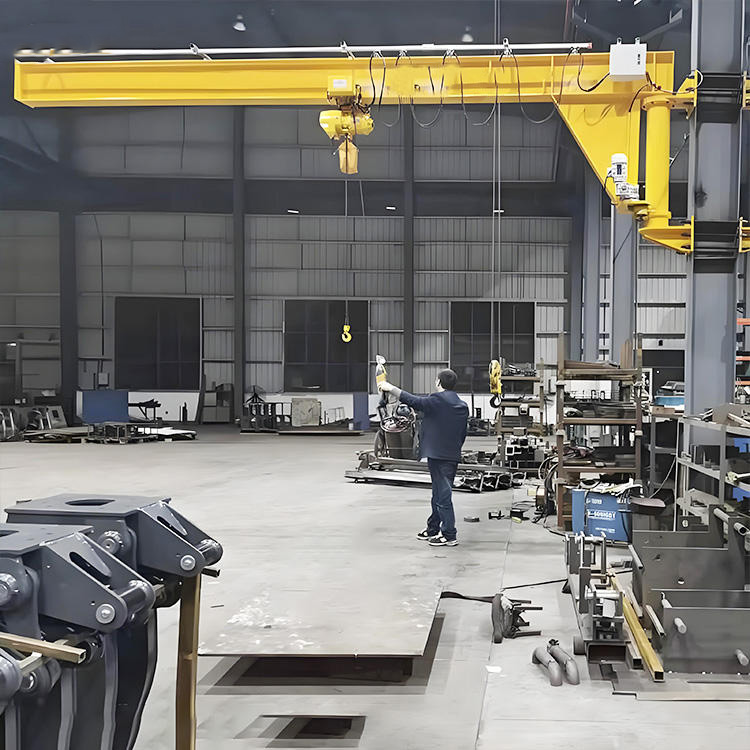
With your needs defined, you can now select the physical configuration that best fits your facility and application. The versatility of jib cranes is reflected in their many designs.
Freestanding Jib Cranes
This is the most popular and versatile design. It consists of a vertical mast bolted to a large, specially engineered concrete foundation.
- Advantages: Completely self-supporting, requires no building structure for support. Can be installed anywhere (indoors or outdoors) with a proper foundation. Typically offers full 360-degree rotation and the highest capacities (up to 15 tons).
- Best For: Open areas, serving multiple workstations, and as the primary lifting device in a work cell.
Foundationless Jib Cranes
A modern, increasingly popular alternative to traditional freestanding models. Instead of a poured concrete foundation, these use a large, heavy steel plate as a portable base.
- Advantages: Extremely fast installation with no excavation or concrete curing time. Can be unbolted and relocated if your facility layout changes. Ideal for leased buildings where permanent foundations are prohibited.
- Best For: Lighter capacity applications (typically under 1 ton) where flexibility and speed of installation are paramount.
Mast-Type Jib Cranes
This design uses a vertical mast that is supported by both the floor and an overhead building support (like a beam or roof truss).
- Advantages: A cost-effective solution that provides 360-degree rotation. Because the top of the mast is stabilized, the concrete foundation can be smaller and less expensive than a full freestanding model.
- Best For: Indoor applications where a suitable overhead steel structure is available for support.
Wall-Mounted Jib Cranes
These cranes save valuable floor space by mounting directly to a structurally sound building wall or column.
- Advantages: They have zero footprint, leaving the floor clear for traffic and machinery. They are a very economical way to provide dedicated lifting at individual workstations.
- Best For: Servicing single work cells along an assembly line or in bays where floor space is at a premium. Rotation is typically limited to 180-200 degrees.
Articulating Jib Cranes
This specialized design features a two-part boom that can “knuckle” or bend in the middle, much like a human arm.
- Advantages: Allows the operator to maneuver loads around corners, under obstructions, or into tight machine enclosures where a standard straight boom cannot reach. Offers exceptional precision.
- Best For: Complex assembly tasks, reaching into crowded spaces, and applications requiring pinpoint positioning.
Step 3: Verify Your Structural Requirements (A Critical E-A-T Step)
This is a step where expertise and authoritativeness are non-negotiable. A jib crane exerts significant forces on its support structure. A failure is catastrophic.
- For Wall-Mounted Cranes: You MUST hire a licensed structural engineer to analyze the building column or wall where you intend to mount the crane. The engineer will verify that the structure can safely handle the thrust and pull forces generated by the crane at its full capacity. Do not ever mount a crane to a building structure without this professional approval.
- For Freestanding Cranes: A qualified engineer must design the concrete foundation based on the crane’s capacity, span, and local soil conditions. An improperly poured foundation can crack or fail, causing the entire crane to collapse.
- For Foundationless Cranes: The concrete floor slab where the crane will be placed must be verified to be thick enough and strong enough to support the weight of the crane, its base, and the maximum load without cracking.
Adhering to these engineering requirements is fundamental to creating a trustworthy and safe lifting environment.
Step 4: Specify the Hoist and Other Key Components
The crane itself is just the structure; the components you choose determine its performance.
Hoist Selection
- Electric Chain Hoist: The most common choice for jib cranes. They are compact, reliable, and cost-effective for capacities up to 5 tons. They are perfect for production environments.
- Manual Chain Hoist (Chain Fall): Used for applications with very infrequent lifts, where speed is not a factor, and where electrical power is not available. They are the most economical option.
- Wire Rope Hoist: Generally used for higher capacity or higher-speed jib crane applications, though less common than chain hoists on these smaller systems.
Rotation Control
- Manual Push/Pull: For lighter capacities and shorter spans, the operator can simply push or pull the boom to rotate it. This is simple and cost-effective.
- Motorized Rotation: For capacities over 2 tons or spans over 20 feet, motorized rotation is highly recommended. An electric motor drives the rotation, allowing for smooth, effortless control, which is essential for precise positioning of heavy loads.
Electrification
How will you get power to the hoist?
- Festoon System: The most common method. A series of looped cables (flat or round) hang from the boom, unfolding as the trolley moves. It’s a simple, reliable, and economical solution.
- Internal Electrification: Power can be run inside the boom for a cleaner appearance, but this is a more expensive, specialized option.
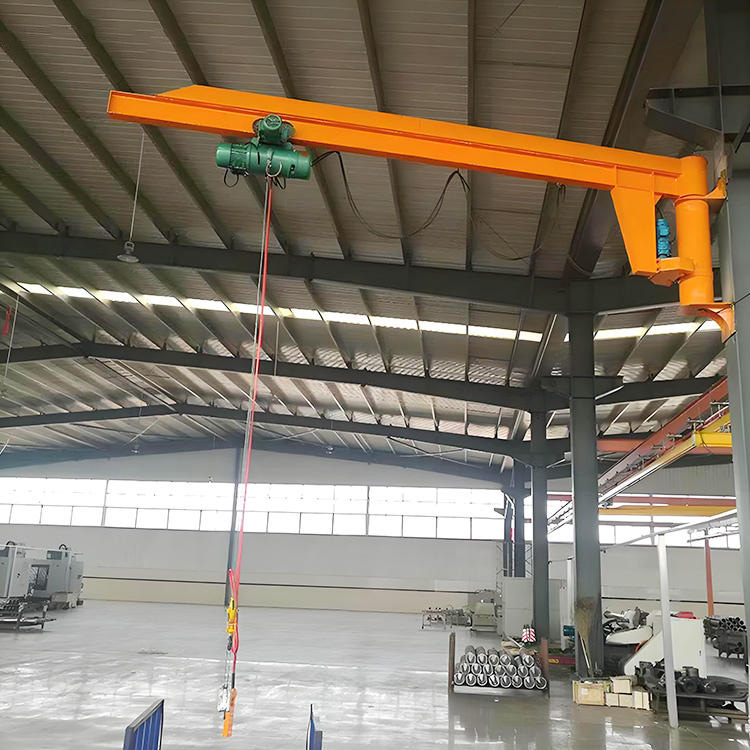
Step 5: Plan for Installation, Testing, and Training
The final step is to bring your crane online safely and efficiently.
- Installation: Jib crane installation should be performed by a qualified and certified crane technician or millwright. They have the expertise to safely assemble the components, anchor the structure correctly, and ensure everything is aligned.
- Load Testing: Before the crane is put into service, it must be officially load tested and certified per OSHA and ASME standards. This typically involves lifting a test weight equal to 125% of the crane’s rated capacity to verify its structural integrity. This is an authoritative step that cannot be skipped.
- Operator Training: Never assume an employee knows how to use a new piece of lifting equipment. Provide professional training that covers pre-operational inspections, safe lifting practices, proper rigging techniques, and the specific controls of the new crane.