


The Ultimate Guide to Jib Cranes: Types, Benefits, and Applications
In any busy manufacturing or assembly environment, productivity hinges on the smooth, efficient movement of materials. While large overhead bridge cranes handle the heavy, cross-bay lifting, they can create significant bottlenecks when multiple workstations need a lift at the same time. This is where the agility and dedicated power of a jib crane become indispensable.
These specialized lifting systems act as the workhorses for individual workstations, providing immediate, ergonomic lifting power exactly where it’s needed most. By eliminating the “waiting game” for shared equipment, Jib Cranes empower operators, boost productivity, and improve overall shop floor safety. This guide provides an in-depth look at the various types, core benefits, and critical applications of these essential material handling tools.
What is a Jib Crane?
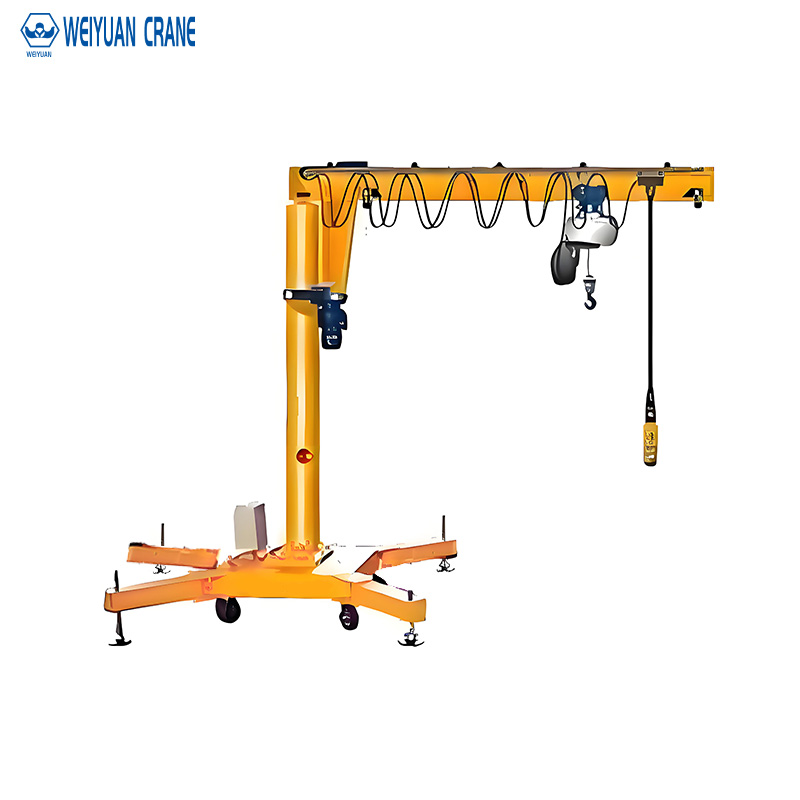
A jib crane is a type of localized lifting device that consists of a horizontal beam, known as the jib or boom, which supports a movable hoist. The boom is mounted to either a vertical floor-standing pillar or a structural wall, allowing it to rotate and provide lifting coverage over a circular or semi-circular area.
Unlike large gantry or bridge cranes designed for facility-wide coverage, jib cranes are built for repetitive, localized tasks. They are perfect for loading a CNC machine, positioning components at an assembly station, or transferring materials within a small work cell. They serve as a crucial link between manual labor and heavy-duty automated systems.
Core Components
The design of a jib crane is simple yet robust, typically including:
- The Boom: The horizontal beam that the hoist trolley travels along.
- The Mast: The vertical column that supports the boom on freestanding models.
- The Hoist: The device that performs the lifting, using either chain or wire rope.
- The Trolley: The unit that moves the hoist horizontally along the boom.
- The Rotation Mechanism: The pivot assembly that allows the boom to swing.

Weiyuan Column Jib Crane
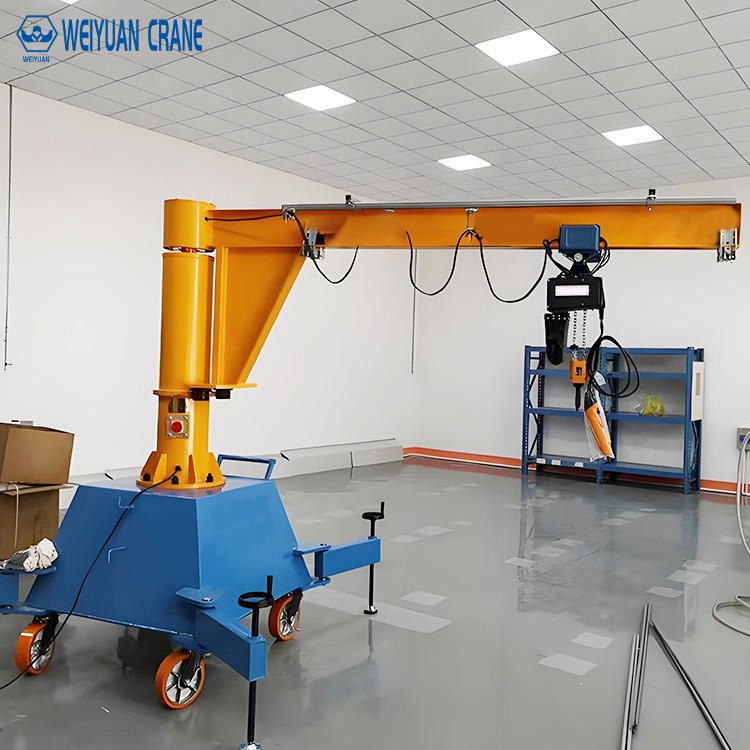
The Weiyuan Column Jib Crane is a versatile and cost-effective lifting solution designed for efficient localized material handling with 360° rotation and robust freestanding structure — ideal for workshops, assembly areas, and maintenance bays.:contentReference
View Product / Get QuoteThe Major Types of Jib Cranes
Choosing the right jib crane depends on your facility’s layout, structural capacity, and specific lifting needs.
1. Freestanding Jib Cranes
This is the most common and versatile type. A vertical mast is bolted to a dedicated, reinforced concrete foundation, allowing it to stand independently of any building structures.
- Best For: Open work areas where 360-degree boom rotation is needed to serve multiple machines or stations.
- Key Advantage: High capacity (often up to 15 tons) and complete structural independence.
2. Wall-Mounted Jib Cranes
These systems save valuable floor space by mounting directly to a sturdy building wall or structural support column.
- Best For: Individual workstations, assembly lines, and areas where floor space is at a premium.
- Key Advantage: They offer a zero-footprint lifting solution, but rotation is typically limited to 180-200 degrees. A structural engineer must verify the mounting surface is strong enough to handle the forces.
3. Mast-Type Jib Cranes
This hybrid design is supported by both the floor and an overhead steel structure. The mast is bolted to the floor but is also stabilized at the top, which reduces the stress on the foundation.
- Best For: Situations where a full 360-degree rotation is needed but pouring a large, expensive foundation is not practical.
- Key Advantage: Less demanding foundation requirements compared to a freestanding model of the same capacity.
4. Articulating Jib Cranes
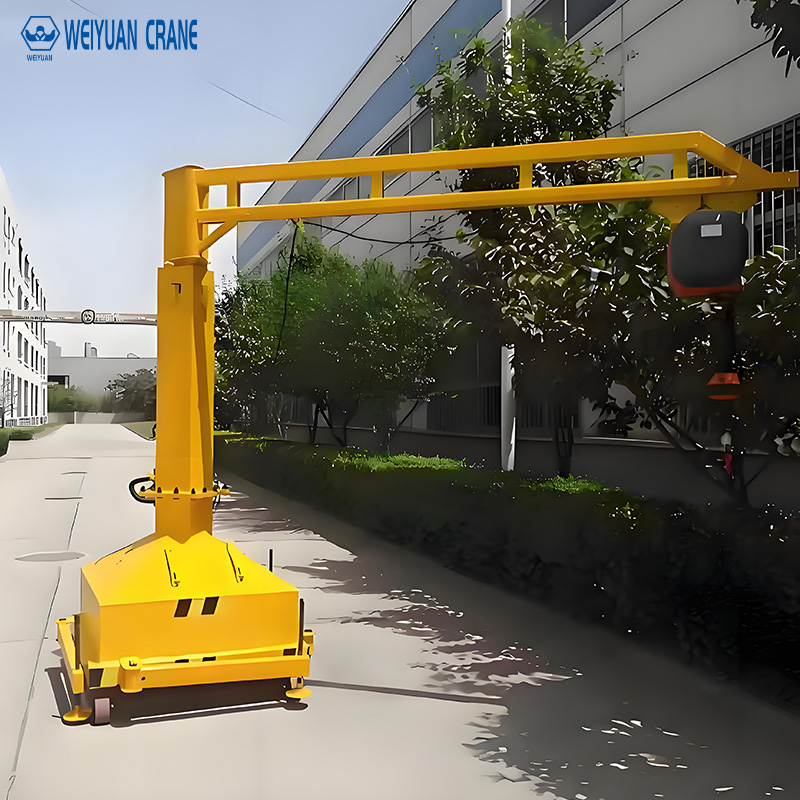
These cranes feature a boom with two arms that pivot, much like an elbow. This design allows the operator to precisely maneuver loads around obstacles.
- Best For: Complex assembly work, reaching into machine enclosures, or navigating around columns and other obstructions.
- Key Advantage: Unmatched positioning flexibility for tight or confined spaces.
Strategic Benefits of Deploying Jib Cranes
Integrating these systems into your workflow delivers a powerful return on investment by addressing key operational challenges.
Boosts Productivity by Eliminating Wait Times
In facilities that rely solely on a single overhead crane, operators often waste valuable time waiting for their turn. This “crane congestion” is a major source of lost productivity. By installing dedicated Jib Cranes at key workstations, you empower each operator with immediate access to lifting power, keeping the workflow moving.
Enhances Workplace Safety and Ergonomics
Musculoskeletal disorders from manual lifting are a leading cause of workplace injuries. A jib crane removes the physical strain from the operator, reducing the risk of fatigue and injury. This not only protects your employees but also reduces costs associated with lost workdays and compensation claims.
Optimizes Valuable Floor Space
Wall-mounted and articulating jib cranes provide significant lifting capacity without occupying any floor space. Even freestanding models have a compact footprint, allowing for a more efficient and less cluttered layout of machinery and work cells.
Critical Selection Criteria for Your Application
To choose the right system, you must conduct a thorough analysis of your lifting requirements.
- Capacity: Determine the maximum weight you need to lift and add a safety buffer of at least 25%. This accounts for the weight of rigging and prevents you from constantly operating the hoist at its absolute limit.
- Span and Reach: The boom’s length must be sufficient to cover your entire work area. Remember that the “hook reach” is always slightly less than the overall boom length due to the trolley’s physical dimensions.
- Height Under Hook: Calculate the required lifting height by considering the height of your tallest load, the length of your rigging, and the clearance needed to move over obstacles.
- Rotation: Decide if you need a full 360-degree rotation (freestanding models) or if a 180-200 degree swing (wall-mounted models) will suffice.
- Foundation Requirements: Do not underestimate the forces a jib crane exerts. A heavy-capacity freestanding unit requires a substantial, engineered concrete foundation. Always consult a structural engineer.
Common Industrial Applications
The versatility of Jib Cranes makes them a staple in nearly every industrial sector.
- Manufacturing and Machining: Loading heavy parts into CNC machines, lathes, and mills.
- Assembly Lines: Positioning heavy components like engine blocks or gearboxes during assembly.
- Maintenance Bays: Lifting motors and other heavy machine parts for repair or replacement.
- Loading Docks: Transferring goods from trucks to staging areas.
Frequently Asked Questions (FAQ)
Q1: What is the main difference between a jib crane and a monorail?
A jib crane provides lifting coverage in a circular area via a rotating boom. A monorail system, on the other hand, consists of a hoist on a trolley that travels along a fixed, straight or curved beam, providing linear lifting coverage.
Q2: Can I install a jib crane myself?
Due to the significant safety risks and structural requirements, installation should always be performed by qualified and experienced professionals. This is especially true for pouring foundations and mounting to building structures.
Q3: Is motorized rotation necessary?
For lighter loads (typically under 1 ton) and shorter booms, manual push/pull rotation is often sufficient and cost-effective. For heavier loads or longer booms, motorized rotation is highly recommended to ensure smooth control and reduce operator strain.
Q4: Can a jib crane be used outdoors?
Yes, but it must be specifically designed for outdoor use. This includes features like weather-resistant paint, sealed electrical enclosures, and covers for the hoist and other components to protect them from the elements.
Q5: How often do jib cranes need to be inspected?
Following safety regulations like those from OSHA, cranes require daily pre-operational visual checks by the operator and documented, in-depth periodic inspections by a qualified technician (typically annually, but more frequently for heavy-use cranes).