


Top Benefits of Jib Cranes: Boosting Efficiency in Material Handling
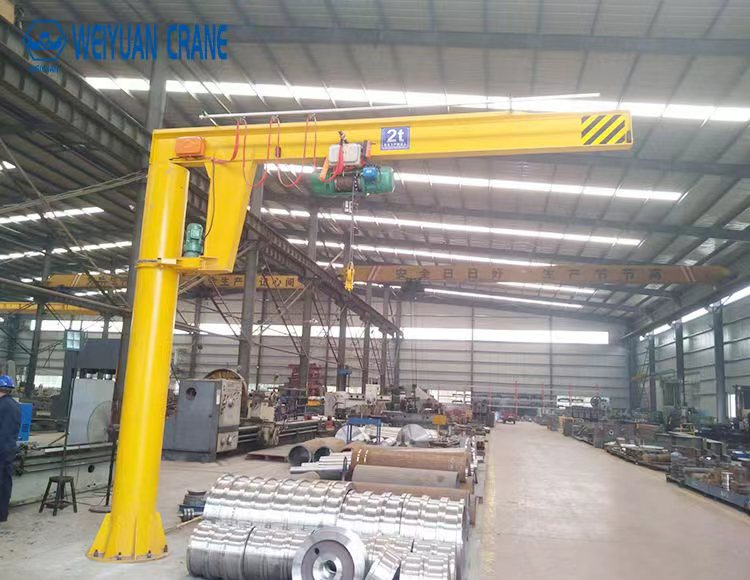
Every minute an operator spends waiting for a shared overhead lifting system is a minute of lost production. In high-output manufacturing and material handling, efficiency isn’t just about moving faster; it is about moving smarter. While large, facility-wide systems handle the heavy, cross-bay transport, the real operational friction often occurs at the individual workstation level.
This is exactly where jib cranes prove their immense value. These localized lifting systems act as dedicated workhorses for specific assembly cells, machining centers, and loading docks. They provide immediate, ergonomic lifting power right where the value is added to your product.
In this comprehensive guide, we will explore why these compact lifting systems are essential for modern industrial operations. We will look at how they optimize floor space, protect your workforce from injury, and deliver a rapid return on investment (ROI).
What is a Jib Crane? (The “Surgical Tool” of Lifting)
A jib crane is a localized material handling system featuring a horizontal boom (the jib) that supports a movable hoist. The boom attaches to either a dedicated floor-standing pillar or an existing structural wall column. This design allows the boom to swing in a circular or semi-circular arc, providing precise lifting coverage over a specific work area.
Think of it as a surgical tool for material handling. To put it in perspective, while massive 【 Gantry Cranes】 handle the “macro” logistics of moving 20-ton steel slabs across an outdoor yard or a massive fabrication bay, a jib crane handles the “micro” logistics. It takes a smaller component from a drop-off point and smoothly maneuvers it into a CNC machine, an assembly jig, or a packing station with a level of precision that larger cranes simply cannot match.
1. Drastic Optimization of Floor Space
Industrial real estate is expensive, and floor clutter is a safety hazard. One of the primary advantages of jib cranes is their incredibly small footprint compared to the lifting capacity they provide.
Utilizing “Dead Space”
Wall-mounted models are the ultimate space-savers. They require zero floor space because they bolt directly to your building’s structural columns. This leaves the floor entirely clear for forklift traffic, pallet storage, and automated guided vehicles (AGVs).
Small Footprint Freestanding Models
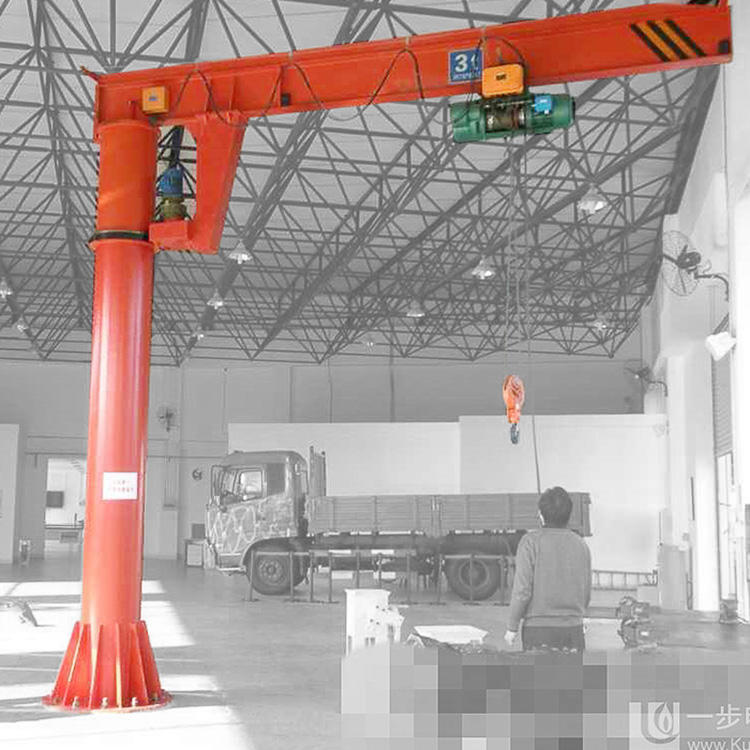
Even freestanding pillar models, which offer a full 360-degree rotation, require only a single, relatively small concrete foundation. By utilizing the vertical “dead space” along walls or in narrow corners, you can add powerful lifting capabilities without cluttering your facility or restricting movement.
2. Ending the Production “Waiting Game”
In many traditional factory setups, four or five different workstations might share a single large overhead bridge crane. When one operator needs to load a heavy part, everyone else has to wait. This crane congestion creates massive bottlenecks that ripple through the entire production schedule.
By installing dedicated jib cranes at key workstations, you eliminate this idle time entirely.
- Immediate Access: Every operator has access to lifting power the moment they need it.
- Workflow Independence: A technician in “Cell A” doesn’t have to wait for “Cell B” to finish using the facility-wide crane.
- Strategic Allocation: The larger bridge or 【 Gantry Cranes】 are freed up to do what they do best: moving heavy raw materials or finished goods across the entire facility, rather than being bogged down by 500-pound repetitive lifts.
3. Superior Ergonomics and Worker Safety
Manual lifting remains a leading cause of workplace injuries in the industrial sector. Asking operators to repeatedly maneuver 50- to 100-pound components manually leads to cumulative strain, back injuries, lost workdays, and high staff turnover.
Removing the Physical Burden
Jib cranes completely remove this physical burden from the human worker. The hoist takes 100% of the weight, allowing the operator to focus solely on safe positioning and precision. This transition from “manual labor” to “machine operation” significantly boosts morale and longevity in the workforce.
Precision Load Control
Safety is also about stability. When an operator is fitting a delicate mold or a heavy engine block into a tight tolerance area, they need stability to prevent sudden, dangerous movements. The smooth rotation and trolley travel of a high-quality jib crane provide exceptional “spotting” accuracy, reducing the risk of dropped loads or crushed fingers.
4. Seamless Integration with Larger Equipment
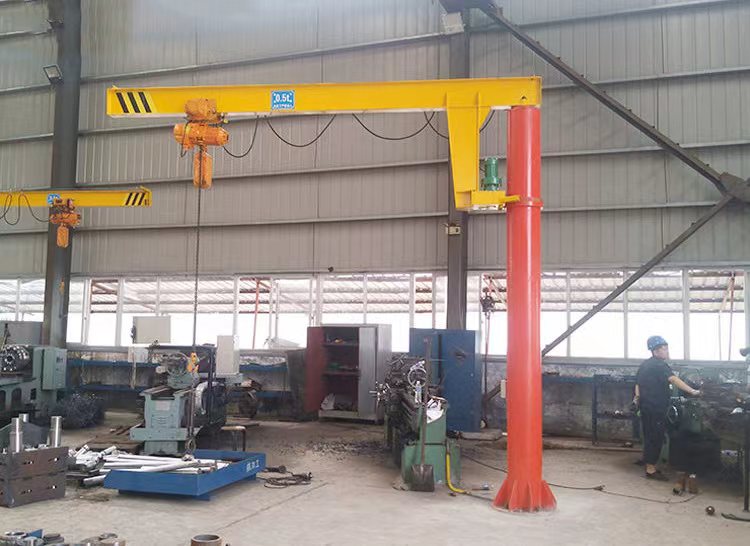
A highly optimized material handling strategy layers different types of equipment based on the task at hand. You do not have to choose between a localized jib and a larger overhead system; they are designed to work in a tiered hierarchy.
For example, in a heavy fabrication plant, large indoor bridge systems or outdoor 【 Gantry Cranes】 handle the bulk transport of raw materials from delivery trucks to the primary storage area. Once the material reaches a specific work cell, the jib crane takes over for the detailed, repetitive lifting required for assembly, welding, or machining. This ensures that your high-capacity (and high-cost-to-operate) equipment is never wasted on small, localized tasks.
5. High ROI and Cost-Effectiveness
Compared to the massive undertaking of designing and installing a facility-wide overhead runway system, jib cranes are remarkably affordable.
- Lower Initial Capital: The cost of a jib crane is a fraction of a full bridge crane system.
- Minimal Maintenance: With fewer moving parts and a simpler mechanical design, the long-term maintenance costs are low.
- Rapid Installation: A standard pillar-mounted unit can often be installed in a single day. This minimizes production downtime and allows the system to begin paying for itself almost immediately through increased throughput.

Weiyuan Column Jib Crane
The Weiyuan Column Jib Crane is a versatile and cost-effective freestanding lifting solution designed for precise material handling in workshops, assembly lines, and maintenance areas. With a full 360-degree slewing range and robust steel structure, this crane delivers smooth rotation, dependable performance and enhanced operational flexibility in confined workspaces. :contentReference
View Product / Get QuoteKey Types of Jib Cranes: Which One Do You Need?
Choosing the right configuration depends on your facility’s architecture and your specific lifting needs.
| Type | Best For… | Key Feature |
| Freestanding Jib | Maximum versatility and heavy loads. | Offers a full 360° rotation; anchors to the floor. |
| Wall-Mounted Jib | Saving floor space in narrow bays. | Attaches to existing columns; 180°-200° rotation. |
| Articulating Jib | Reaching around obstacles or inside machines. | Features an “elbow” joint for complex movement. |
| Wall-Traveling Jib | Serving multiple stations along a single wall. | Moves laterally along a rail system on the wall. |
Technical and Safety Considerations (E-A-T Compliance)
To get the most out of your investment and maintain a safe, authoritative work environment, engineering specifications must be handled with precision.
Load Limits and Buffers
Always select a Working Load Limit (WLL) that provides a 20-25% buffer above your heaviest anticipated load. This accounts for the weight of your rigging (slings, magnets, or vacuum lifters) and prevents you from constantly running the hoist motor at its absolute maximum capacity, which extends the equipment’s lifespan.
Structural Integrity
A jib crane acts as a giant lever. When the boom is fully extended with a maximum load, it exerts tremendous “moment force” on its foundation or the building’s column. Before installation, a structural engineer should verify that your concrete floor or wall columns can handle these specific pulling and pushing forces.
Routine Maintenance
Safety compliance is non-negotiable. Modern standards (such as OSHA in the US or CE in Europe) require:
- Shift Inspections: Operators should check wire ropes/chains and emergency stop buttons daily.
- Annual Audits: Certified technicians must perform in-depth audits of structural welds, anchor bolts, and brake wear patterns.
The Physics of Productivity: Manual vs. Motorized
For lighter capacities (typically under one ton) and shorter boom lengths, manual push/pull rotation is often the superior choice. It allows the operator to move the load quickly and intuitively by hand.
However, as the capacity increases or the boom length extends, the force required to overcome inertia grows. In these cases, motorized rotation is highly recommended. It provides “soft-start” and “soft-stop” capabilities (often via Variable Frequency Drives or VFDs), which prevents the load from swinging dangerously at the end of the movement.
Frequently Asked Questions (FAQ)
Q1: How do jib cranes differ from 【 Gantry Cranes】?
A jib crane features a rotating horizontal boom attached to a single pivot point (a pillar or wall), providing circular lifting coverage over a localized area. In contrast, 【 Gantry Cranes】 are large, self-supporting structures that usually run along ground-level tracks or wheels, providing linear lifting coverage over massive areas, often outdoors or in very large bays.
Q2: Can I install a wall-mounted jib crane on any wall?
No. You must never assume a wall is strong enough. The crane exerts significant “pull” on the top bolts and “push” on the bottom bracket. A structural engineer must evaluate the building’s support columns to ensure they can handle the torque and moment loading.
Q3: What is the main benefit of an articulating jib crane?
Standard straight booms can be difficult to maneuver in tight spaces because they move in a fixed arc. An articulating jib has a pivot point in the middle of the arm (like a human elbow), allowing it to reach around columns, corners, or deep inside specialized machinery enclosures.
Q4: Do jib cranes require specialized foundations?
For freestanding models, yes. They typically require a reinforced concrete foundation of a specific depth and width to prevent the crane from tipping. Wall-mounted and ceiling-mounted models do not require a floor foundation but require a structural integrity check of the mounting surface.
Q5: How often do I need to inspect my jib crane?
Industry safety standards require a visual inspection by the operator before every shift. Additionally, a comprehensive, documented inspection by a certified crane technician must occur at least once a year. If the crane is used in a high-cycle or “severe” environment (like a foundry or chemical plant), these professional inspections should occur quarterly.