


What Is an Overhead Crane? Types, Capacities & How to Choose the Right System
Introduction
Walk through any major manufacturing plant, steel mill, shipyard, or distribution center, and you’ll almost certainly spot an overhead crane moving loads that no forklift or manual system could safely handle. Yet for all their ubiquity in heavy industry, overhead cranes remain poorly understood outside the engineering and operations world.
This guide provides a complete, authoritative answer to the question: what is an overhead crane? We cover the definition, all major types, how capacity is classified, how overhead cranes compare to alternatives like gantry cranes, and exactly how to choose the right system for your application. Whether you’re new to industrial lifting equipment or an experienced engineer looking for a reliable reference, this article gives you the full picture.
What Is an Overhead Crane? (Definition)
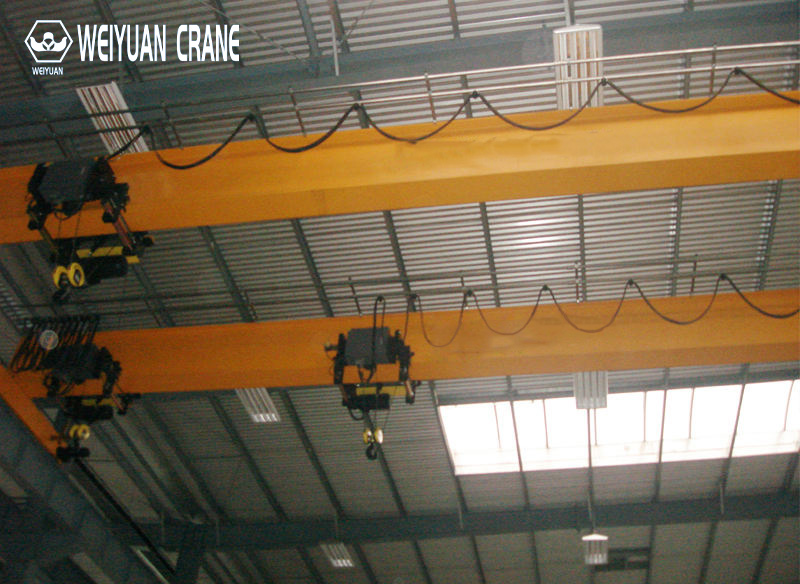
An overhead crane — also called a bridge crane or EOT (Electric Overhead Traveling) crane — is a type of crane in which the lifting mechanism travels along a horizontal beam (called the bridge), which itself travels along elevated runway rails mounted above the working area.
The result is a system that can move a load in three dimensions within a defined rectangular work envelope:
- Left and right: by the bridge traveling along the runway rails
- Forward and backward: by the hoist and trolley traveling along the bridge
- Up and down: by the hoist raising and lowering the load
This three-dimensional coverage over a fixed floor area is what makes overhead cranes fundamentally different from all other lifting solutions. Unlike forklifts (which require clear floor paths) or jib cranes (which rotate around a fixed point), an overhead crane can reach virtually any point within its working envelope without consuming any floor space.
The Core Components of an Overhead Crane
Understanding the components helps clarify how the system works and what to specify:
Bridge: The horizontal structural member (or members, in double girder designs) that spans across the facility. The bridge carries the hoist and trolley and travels along the runway rails via end trucks.
End Trucks: The assemblies at each end of the bridge that contain the wheels running on the runway rails. End trucks allow the bridge to travel the length of the runway.
Runway: The elevated rail system, typically supported by building columns or freestanding columns, along which the bridge travels. The runway defines the crane’s working length.
Hoist: The lifting mechanism — either an electric wire rope hoist or electric chain hoist — that raises and lowers the load via a hook.
Trolley: The carriage that moves the hoist horizontally along the bridge beam, providing coverage across the width of the runway span.
Conductor System: The method by which electrical power is delivered to the moving bridge and trolley — either festoon cable, conductor bars, or cable reels.
Controls: Pendant controls (wired push-button station hanging from the bridge), radio remote controls, or cabin controls for very large cranes.
Types of Overhead Cranes
1. Top-Running Single Girder Overhead Cranes
The most widely installed type for light to medium industrial use. A single bridge beam rides on top of the runway rails via end trucks. The hoist trolley runs underneath the bridge on the lower flange of the I-beam.
Capacity range: 1 to 20 tons (standard configurations)
Span range: Up to approximately 65 feet (20 meters)
Best for: General manufacturing, maintenance operations, warehouse material handling, assembly lines, and any application where capacity and span requirements fall within the single girder range and hook height is not the primary constraint.
2. Top-Running Double Girder Overhead Cranes
Two parallel bridge beams support the hoist trolley between them on a top-running rail. This configuration allows the hook to rise much closer to the underside of the bridge, dramatically increasing usable hook height versus single girder designs.
Capacity range: 5 tons to 500+ tons
Span range: Up to 150+ feet on custom-engineered designs
Best for: Heavy manufacturing, steel processing, shipbuilding, foundries, press rooms, and any application requiring high capacity, long span, or maximum hook height. Double girder cranes can also incorporate maintenance walkways along the bridge structure, which is important for cranes that operate in difficult-to-access locations.
3. Underhung (Underslung) Cranes
In an underhung system, the bridge and end trucks hang below the runway beams rather than riding on top of them. This is common in facilities where the runway structure is the building’s own structural steel rather than a dedicated crane runway.
Capacity range: Typically 1 to 10 tons
Best for: Facilities with existing structural steel that can serve as a runway; lower-headroom applications; multiple crane systems operating on interconnected runway networks.
4. Monorail Systems
A monorail is a simplified version of the overhead crane concept: a single elevated rail along which a hoist trolley travels in one direction. It does not have lateral (cross-travel) capability, so it covers a linear path rather than a rectangular area.
Best for: Linear production flow, assembly lines, part transfer between fixed stations.
5. Workstation Bridge Cranes
Light-duty overhead crane systems designed for individual workstations or production cells. Typically freestanding (self-supporting structure rather than building-mounted), with capacities from 150 lbs to approximately 2 tons.
Best for: Ergonomic assist applications, precision assembly, small-part handling.
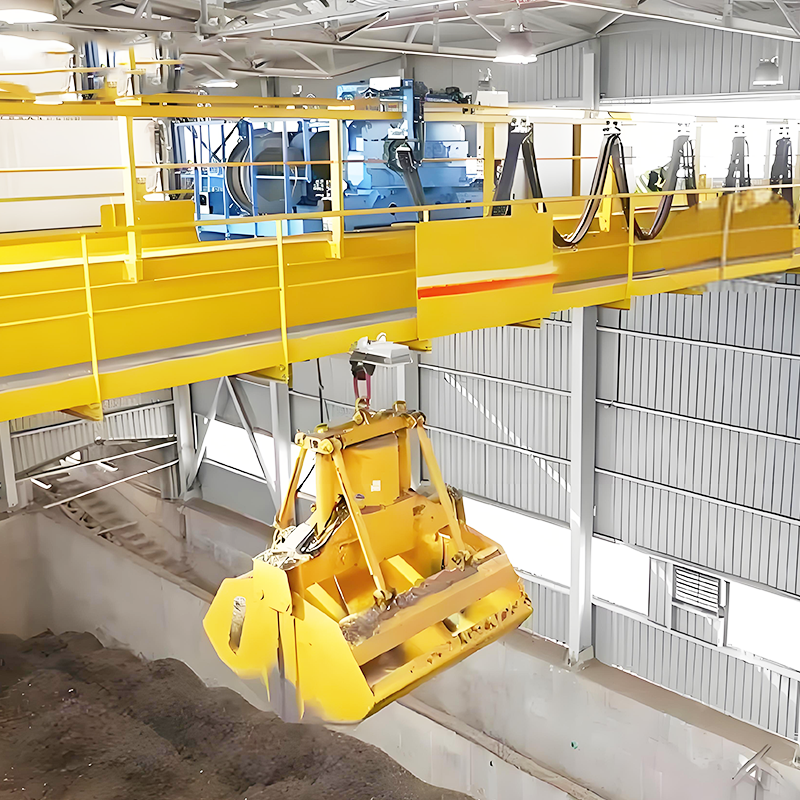
Weiyuan QZ Type Grab Crane for Steel Scrap | 30 Ton, Heavy-Duty, High-Efficiency
The Weiyuan QZ Type 30 Ton Grab Crane is engineered specifically for demanding steel scrap handling operations. Built on a heavy-duty double-girder platform with a high-strength orange peel grab, it delivers reliable performance and high efficiency in continuous scrap yard and foundry material handling environments. :contentReference
View Product / Get QuoteOverhead Crane vs. Gantry Crane: What Is the Difference?
This comparison is one of the most common questions in industrial lifting, and it is worth addressing carefully.
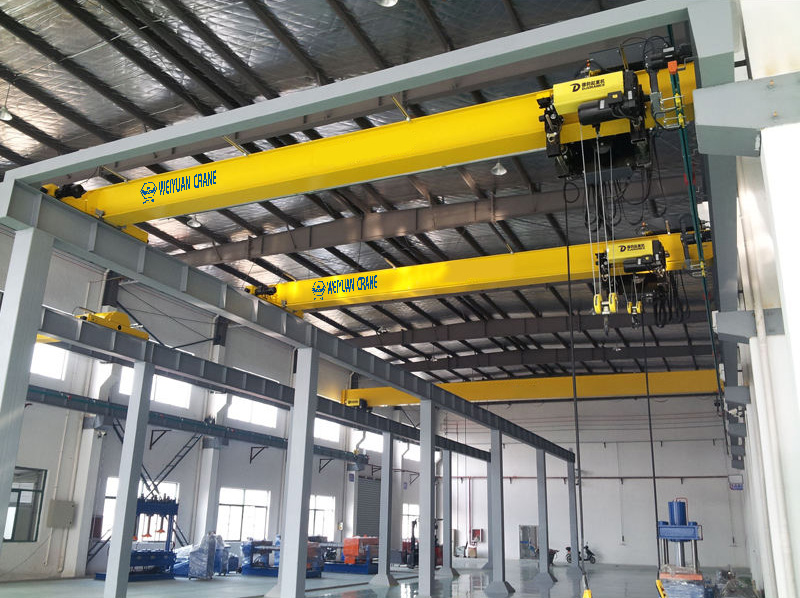
An overhead crane derives its structural support from the building — its runway rails are mounted to the building’s columns or to column-mounted runway beams. This means the building structure must be capable of carrying the crane’s dead weight plus the rated load plus dynamic travel forces.
A gantry crane, by contrast, is self-supporting. Its bridge beam rests on two legs that travel along floor-level rails (or roll on casters for portable models). The gantry crane does not require any building structural support.
The practical implications:
When to choose an overhead crane:
- The building structure can support a runway system
- Permanent, high-frequency production lifting is required
- Maximum hook height is important (overhead cranes consistently achieve greater usable hook height in a given building)
- The highest capacities (beyond what practical gantry designs can achieve) are needed
When to choose a gantry crane:
- The building structure cannot support a crane runway
- The crane needs to be portable or serve multiple facility areas
- The application is outdoors or in an open yard
- Budget constraints favor avoiding runway installation costs
Many sophisticated facilities use both: an overhead crane for primary production lifting and a gantry crane for maintenance, tooling changes, and off-line operations. Overhead cranes and gantry cranes serve complementary roles rather than competing directly.
Overhead Crane Capacity Classifications
Capacity alone does not define a crane’s suitability for an application. The CMAA (Crane Manufacturers Association of America) duty classification system captures the other critical dimension: how hard the crane works.
CMAA Duty Classes:
Class A (Standby or Infrequent Service): Very few lifts per day, always well below rated capacity. Typical for maintenance or emergency service cranes.
Class B (Light Service): Up to two lifts per hour at up to 50% of rated capacity. Typical for light assembly or light storage operations.
Class C (Moderate Service): 2 to 5 lifts per hour at up to 65% of rated capacity. Typical for general machine shops and fabrication.
Class D (Heavy Service): 5 to 10 lifts per hour at up to 75% of rated capacity. Typical for steel service centers, paper mills, machine shops in heavy production.
Class E (Severe Service): More than 10 lifts per hour at up to 85-90% of rated capacity. Typical for continuous production operations, bucket or magnet cranes.
Class F (Continuous Severe Service): Continuous operation at or near rated capacity. Typical for steel mill ladle cranes, hot metal handling.
Selecting a crane with too low a duty class for the actual application is one of the most dangerous and costly errors in crane procurement. A Class B crane used in a Class D application will experience accelerated wear, frequent failures, and potential structural fatigue — all while operating outside the conditions for which it was designed.
Key Parameters to Define Before Specifying an Overhead Crane
Before contacting a supplier or requesting a quote, document the following:
Required lifting capacity: The weight of the heaviest load you will ever lift, including all below-hook devices (hooks, shackles, spreader bars, magnets, etc.). Add a minimum 25% safety margin to this total to establish your minimum crane rated capacity.
Required span: The distance between the centerlines of the runway rails. This must be measured from your actual facility, accounting for building column positions and any clearance requirements.
Required hook height: The distance from the floor to the bottom of the hook at maximum lift. This must accommodate your tallest load plus rigging headroom. Be precise — hook height drives many structural and architectural decisions.
Duty class: Based on honest assessment of lifts per hour and typical load percentage of rated capacity.
Operating environment: Temperature extremes, corrosive atmosphere, explosive atmosphere, outdoor exposure, cleanroom requirements — all affect specification.
Building structural capability: An engineering assessment of the existing runway beams (if any) or column capacity for new runway framing is essential before finalizing crane specifications.
Safety and Compliance Requirements
All overhead cranes installed in U.S. industrial facilities are subject to:
ASME B30.2: Safety standard for overhead and gantry cranes. Governs design, installation, inspection, testing, maintenance, and operation.
CMAA Specification 70: Engineering specification for top-running bridge and gantry cranes.
CMAA Specification 74: Engineering specification for top-running and underhung single girder cranes.
OSHA 29 CFR 1910.179: Workplace safety regulations covering overhead and gantry crane operation, inspection, and maintenance.
OSHA requires operators to conduct a visual pre-use inspection before each shift, a formal frequent inspection at 1- to 3-month intervals, and a thorough periodic inspection annually (or more frequently for heavy-service cranes). Inspection records must be maintained.
Frequently Asked Questions
Q: How high above the floor should an overhead crane runway be?
A: This depends on your required hook height plus the distance from the hook (at maximum height) to the bottom of the hoist, plus the hoist headroom to the bottom of the bridge. Your crane supplier should provide a headroom requirement calculation. Add this total to your highest required load height to establish minimum runway rail elevation.
Q: Can an overhead crane be installed in any building?
A: No. The building structure must be capable of carrying the crane’s dead weight, rated load, and dynamic forces. Many older buildings — particularly those not originally designed for crane service — require structural reinforcement before a runway can be installed. Always obtain a structural engineering review before proceeding.
Q: What is the difference between an EOT crane and an overhead crane?
A: EOT stands for Electric Overhead Traveling crane. It is simply a descriptive term for the standard overhead bridge crane with electric hoisting and travel drives — which is the overwhelming majority of overhead cranes in modern industrial use. The terms are used interchangeably.
Q: How often does an overhead crane need to be serviced?
A: At minimum, overhead cranes require an operator pre-use inspection before each shift, a qualified person inspection every 1 to 3 months, and a thorough annual inspection. In heavy service (Class D and above), more frequent inspections are required. Lubrication, wheel and rail inspection, hoist rope or chain inspection, and brake adjustment are the most common regular maintenance tasks.