


Jib Crane Installation, Operation & Maintenance
Introduction
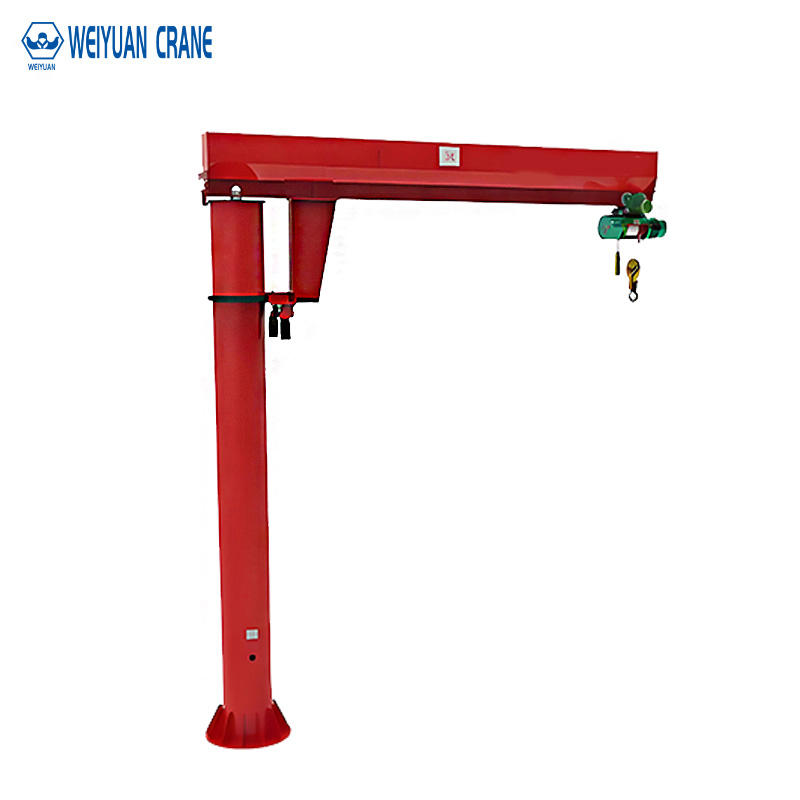
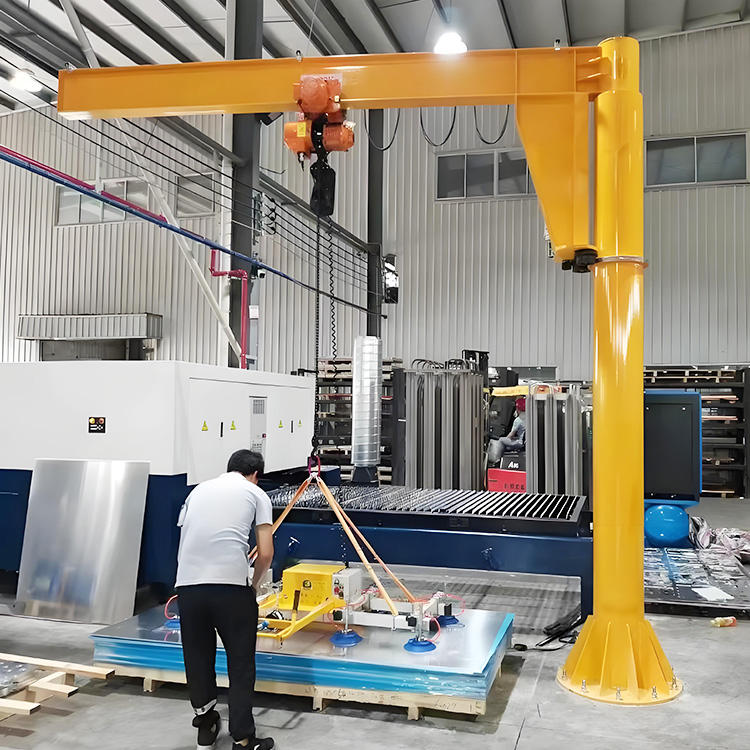
An automotive parts plant I visited ran a 2-tonne pillar jib crane at a busy press-tending station — a good crane, correctly specified, on a properly engineered foundation. The selection and foundation work from the first two articles in this series were done right. What nobody did was maintain the slew bearing.
The crane cycled hundreds of times a shift, rotating a die in and out of a press. The slew bearing that let it rotate needed regreasing on a schedule and a quarterly check for play. It got neither. “It spins fine,” the operators said, and that was the whole inspection program. Over about eighteen months the bearing rollers wore, the raceway pitted, and the boom developed a wobble at the tip that the operators learned to work around. Then one morning the bearing seized mid-rotation with a die on the hook, the boom snapped to a stop, and the shock load cracked a boom-to-pillar weld. The die dropped 300 mm onto the press bed. Nobody was hurt. The station was down eleven days waiting for a replacement bearing and a weld repair — and the plant learned that a jib crane has a wear part a fixed crane doesn’t, and it had never once looked at it.
That’s the pattern behind almost every serious jib failure I’ve seen. The crane degrades slowly and visibly — a wobble here, a new noise there, a bit of grease weeping from a seal — and the operations that catch those signals run their jibs for a full twenty-year service life. The ones that treat a jib as “too simple to need attention” pay for it in a dropped load, a failed audit, or a workstation down the week it can’t afford to stop.
This is the final article in our three-part jib crane series. Part 1 covered types and selection. Part 2 covered foundation design. Here we close the loop on the stage that decides whether all that upfront work pays off: installing the crane correctly, running it safely, and maintaining it faithfully across its whole life.
What you’ll take away:
- The pre-installation checks — plumb, alignment, and proof load test — that verify the crane before it works
- Operator training and safe working practices specific to a slewing jib
- A practical inspection schedule — daily to annual — you can hand straight to your team
- What ASME B30.12 and OSHA actually require of a jib crane
- Slew bearing maintenance and wear criteria — the part the plant ignored
- Wire rope and load chain rejection criteria, and hoist and brake servicing
- A repair-vs-replace framework and a 2026 maintenance cost reference
Part 1: Pre-Installation Checks — Verify Before You Lift
A jib crane isn’t in service the moment it’s bolted down. It’s in service once it’s been verified — plumb, aligned, and proof-tested — against documented tolerances. Skipping this stage is how a small install error survives into years of skewed rotation and uneven bearing wear. These are the checks that turn “it’s installed” into “it’s accepted.”
Plumb and Level
A jib amplifies any base tilt into a large hook drift at full reach, so the pillar has to stand truly vertical and the boom truly horizontal.
- Pillar plumb — verify with a precision level or theodolite to within about 1/500 of the pillar height (roughly 2 mm per metre). A leaning pillar makes the boom drift toward the low side on its own, so loads won’t hold position when the operator lets go.
- Boom level — confirm the boom sits horizontal (or at its designed angle) so the trolley doesn’t run downhill toward the tip under gravity.
   PLUMB CHECK

   ┌─┐  ← pillar must be vertical
   │ │      within ~2 mm per metre
   │ │
   │ │   tilt here →→→ large hook
   │ │                 drift at full reach
   ══╧══
   FOUNDATION
Anchor Bolt Torque and Grout
Confirm the anchor bolts are torqued to the manufacturer’s specification — and only after the non-shrink grout beneath the base plate has fully cured. Hammer-test the grout for voids; a hollow ring means the plate isn’t bearing evenly, and the compression edge will crush under the first heavy moment.
The Proof Load Test
The final acceptance step is a load test, typically at 125% of rated capacity, applied at full boom reach where the overturning moment is worst. This isn’t just a crane check — it’s the foundation’s final exam too.
With the proof load out at the tip, watch for:
- Any tilt of the pillar or movement at the base plate
- Any crack starting in the foundation block
- Any grout distress or anchor bolt slip
- Smooth hoist and slew operation through the full arc, with the brake holding the load with zero drift
A crane or foundation that shows any of these is rejected until corrected. Document the whole acceptance — plumb survey, torque records, and the load test certificate — and tie final payment to it.
Mini-takeaway: verify plumb, level, torque, and grout, then prove the whole system with a 125% load test at full reach. A jib that passes a documented acceptance starts its service life true; one that skips it starts wearing crooked from day one.
Part 2: Operator Training and Safe Working Practices
The best-installed jib in the world fails fast in untrained hands. A jib has one habit ordinary cranes don’t — it slews — and that rotation is where most operator-driven damage and near-misses come from. Training is the cheapest reliability investment on this list.
A competent jib operator should be trained and assessed on:
- Pre-shift inspection and how to log it — the daily checks in Part 3
- Load estimation and rated capacity — never exceeding it, and remembering the trolley’s own weight travels to the tip and adds to the moment at full reach
- Smooth slew control — starting and stopping the rotation gently, because a hard slew stop swings the load and shock-loads the slew bearing and boom welds (exactly the failure from the introduction)
- No side-pulling or dragging — pulling a load sideways to start rotation, or dragging it across the floor, forces the boom and overloads the bearing
- Managing load swing — letting a swinging load settle before placing it, and never snatching a load to start the lift
- Recognizing warning signs — a wobble at the boom tip, a new grinding noise during rotation, grease weeping from the bearing seal, or a hoist brake that drifts — and reporting them
- Correct hook and rigging use — seated slings, closed safety latch, never using the load chain as a sling
- Emergency procedures and safe shutdown — including parking the boom clear of walkways
Do this / not that:
- Do train operators to stop the slew gently and let the load settle before placing — smooth rotation is the single biggest driver of long bearing life.
- Don’t allow side-pulling to “help” the crane rotate; it’s the fastest way to wear a slew bearing and crack a boom connection.
Mini-takeaway: the slew is the jib’s unique risk. Train operators to rotate smoothly, never side-pull, and treat a tip wobble or new noise as a stop-work signal — an operator who spots early bearing wear is a free early-warning system.
Part 3: The Inspection Schedule — Daily to Annual
The single best predictor of jib uptime isn’t the brand on the nameplate. It’s whether an inspection schedule actually runs on time. The best programs layer frequent, shallow checks over rarer, deeper inspections, so problems surface while they’re still cheap to fix.
Here’s a practical structure you can adapt to your crane’s duty class. Higher duty (CMAA Class E–F / FEM M7–M8 from Part 1) tightens every interval; light-duty jibs can stretch them.
Daily / Pre-Shift Checks
An operator handles these in a few minutes before the first lift. No tools — just eyes, ears, and a checklist:
- Test the hoist up/down controls and the emergency stop before lifting
- Confirm the hoist brake holds by raising a load slightly and pausing
- Rotate the boom through its arc and listen for grinding, notching, or catching in the slew bearing
- Watch for wobble or play at the boom tip during rotation
- Visually inspect the visible wire rope or chain for kinks, twists, or broken wires
- Check the hook and safety latch for cracks, wear, spread, and free swivel
- Confirm the rotation stops (end stops) are in place and undamaged
Log the result — even a five-second “all normal” entry. That log is your compliance trail in an audit and your first evidence if something goes wrong.
Weekly Checks
A technician spends 20 to 40 minutes on a closer pass:
- Inspect the full length of rope or chain for wear, corrosion, and diameter loss
- Check the load chain for stretch against a reference length
- Look for grease weeping from the slew bearing seals
- Function-test the hoist overload protection
- Inspect the pendant cable or festoon and strain relief
- Check the boom-to-pillar and boom-to-bearing bolts for visible looseness
Monthly Checks
A deeper mechanical review, usually 1 to 3 hours:
- Measure chain diameter and pitch, or rope diameter, against the rejection threshold
- Check the slew bearing for play using the tilt-clearance method (Part 5) — the jib-specific check
- Inspect and regrease the slew bearing per the schedule
- Check hoist brake lining thickness and adjustment
- Verify all slew bearing bolts are torqued to spec (ties back to Part 1)
- Test all safety devices under load
- Re-check pillar plumb against the Part 1 baseline where tip wobble is suspected
Annual Comprehensive Inspection
The thorough examination — typically by an external qualified inspector, with a written report:
- Full structural inspection of the boom, pillar, and boom-to-pillar welds
- Non-destructive examination (NDT) of the boom connection welds and hook where required
- Complete slew bearing assessment against wear criteria
- Complete rope or chain assessment against rejection criteria
- Load test where regulation or a major repair requires it
- Hoist, brake, and motor electrical inspection
   [Jib Preventive Maintenance Cycle]

   Daily / Pre-Shift     Weekly / Monthly        Annual Structural & NDT
   ├─ Controls + E-stop  ├─ Rope/chain measure   ├─ Boom-weld NDT (MT/PT)
   ├─ Hoist brake hold   ├─ Slew bearing play     ├─ Slew bearing assessment
   ├─ Slew arc listen    ├─ Bearing regrease      ├─ Hook forging NDT
   ├─ Tip wobble check   ├─ Brake lining wear      ├─ Rope/chain full check
   └─ Rope/chain visual  └─ Bearing bolt torque    └─ Load test + full report
Mini-takeaway: daily checks catch the obvious, weekly and monthly checks catch the developing, and the annual inspection catches the hidden — the worn slew bearing and cracked weld that stopped the automotive plant. Skip any layer and you’re running on luck.
Part 4: What ASME B30.12 and OSHA Require
Two frameworks govern jib crane inspection and operation in most markets that reference US standards, and both apply. Knowing what they demand protects you legally, keeps your insurance valid, and — bluntly — keeps people safe.
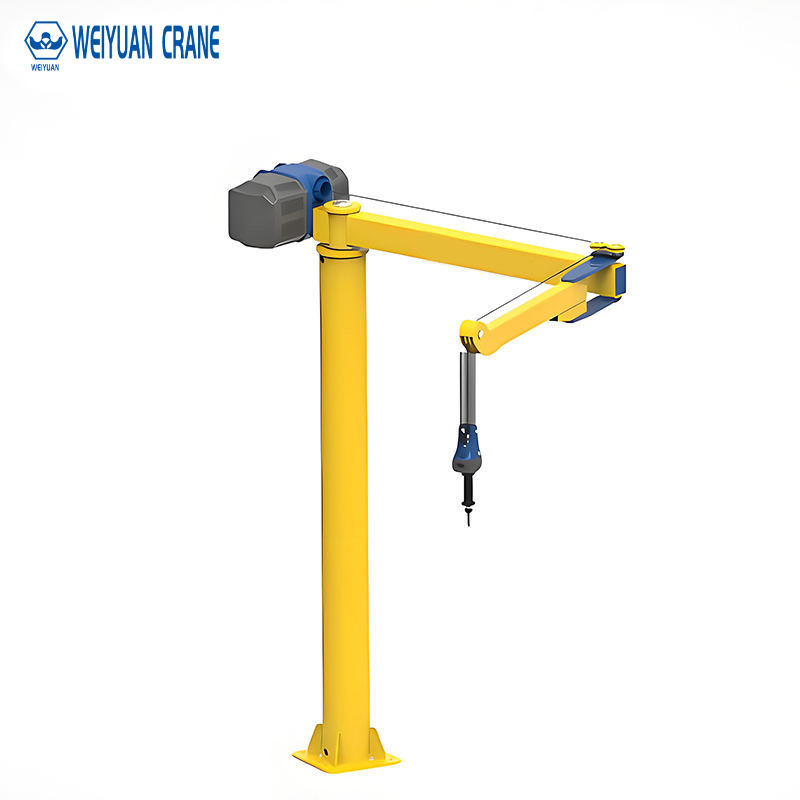
ASME B30.11 and B30.16 cover monorails, underhung cranes, and overhead hoists that jib cranes commonly use, and ASME B30.12 addresses handling loads suspended from crane-type equipment — together they supply the consensus safety detail for jib crane inspection frequencies, component rejection criteria, and testing methods. The hoist mounted on the jib is itself governed by ASME B30.16 (overhead hoists). Confirm which specific volumes your jib’s configuration falls under with your supplier and inspector, and apply them.
OSHA provides the legal backbone. Under the general industry rules, an employer must inspect and maintain lifting equipment, train operators, and keep the equipment in safe working order — non-compliance is a citable violation with real financial consequences, not a guideline.
Both frameworks define two inspection categories that map cleanly onto Part 3:
- Frequent inspections — daily to monthly, covering what operators and technicians check routinely
- Periodic inspections — one to twelve months, more thorough, documented, and covering structure, wear parts, and safety devices
Here’s the connection procurement teams miss: the duty class you specified back in Part 1 directly sets the inspection workload.
| Service level | CMAA / FEM-ISO | Frequent inspection | Periodic inspection |
|---|---|---|---|
| Light / infrequent | A–B / M3–M4 | Daily to monthly | Yearly |
| Moderate | C / M5 | Daily to weekly | 6–12 months |
| Heavy | D / M6 | Each shift to weekly | 3–6 months |
| Severe / continuous | E–F / M7–M8 | Each shift | 1–3 months |
The ownership implication is direct: a higher-duty jib costs more to own, not just to buy. Factor the recurring inspection burden into total cost — a correctly matched duty class from Part 1 keeps that burden proportionate rather than inflated.
Mini-takeaway: the standards set the floor, not the ceiling. Match your inspection frequency to your real duty class, apply the ASME volumes that fit your configuration, and document everything — the paperwork is what turns “we maintain it” into something an auditor can verify.
Part 5: Slew Bearing Maintenance and Wear Criteria
Here’s where jib maintenance differs from every other crane: the slew bearing. It’s the component that lets the boom rotate, it carries the full overturning moment while it turns, and it’s the wear part a fixed crane simply doesn’t have. It’s also the part the automotive plant ignored into a seized failure. Managing it is the maintenance task most specific to a jib.
How the Slew Bearing Works and Wears
The slew bearing is a large ring bearing — rollers or balls running in a raceway — carrying the boom’s vertical load, the overturning moment, and the rotation, all at once. Under a heavy moment cycled thousands of times, the rollers and raceway wear, and the first symptom is play: a small looseness that shows up as a wobble at the boom tip, amplified by the boom’s length.
The Tilt-Clearance Wear Check
The standard way to measure slew bearing wear is the tilt-clearance (tipping-clearance) method — measuring how much the bearing lets the boom tilt under a reversing load.
   SLEW BEARING TILT-CLEARANCE CHECK

        no load          load applied
        │                 │  ← measure tip/edge
   ═════╪═════       ═════╪═════   movement with
   [slew bearing]    [slew bearing]  a dial gauge
        │                 ╲
   Compare the deflection against the
   manufacturer's wear limit (often expressed
   as a tilting-clearance value in mm or as a
   % increase over the as-installed baseline)
Mount a dial gauge to measure the vertical movement at the bearing edge (or a known point on the boom) as the load is applied and reversed. Compare it against the manufacturer’s stated wear limit. The critical discipline: record the as-installed baseline at commissioning, so a later reading tells you the actual increase — wear — rather than an absolute number with no reference. A tilt clearance that has grown past the limit means the bearing is due for replacement before it develops the notching and seizure that cracked the plant’s boom weld.
Regreasing and Bolt Torque
Two routine tasks keep the bearing alive:
- Regreasing — pump fresh grease into the bearing on the manufacturer’s schedule (frequency rises with duty), rotating the boom as you grease so it distributes around the full raceway. Marine-grade or the manufacturer-specified grease for the environment.
- Bolt torque — the slew bearing is bolted to the pillar and to the boom with high-tension bolts that carry the moment. Check their torque on the monthly schedule; a loosening bolt lets the bearing shift, which accelerates wear and can shear the remaining bolts.
Reject / replace the slew bearing when:
- Tilt clearance exceeds the manufacturer’s wear limit
- Rotation feels notchy, gritty, or catches at any point in the arc
- Metal particles appear in the purged grease
- Any bearing bolt is found sheared or persistently loosening
Mini-takeaway: the slew bearing is the jib’s signature wear part — check its play monthly with the tilt-clearance method against a commissioning baseline, regrease and re-torque on schedule, and replace it when tilt clearance exceeds the limit. A tip wobble is not a quirk to work around; it’s the bearing telling you the clock is running.
Part 6: Rope, Chain, Hoist and Brake Servicing
The hoist that rides the jib’s boom carries the same wear items as any hoist — rope or chain, brake, gearbox — but a few checks matter more on a jib because the load swings on a rotating boom. This is the load-path scrutiny that keeps a lift from becoming a drop.
Load Chain Rejection Criteria
Most lighter jibs run a chain hoist. Remove the load chain from service when you find any of these:
- Stretch — elongation beyond the manufacturer’s limit, measured over a defined gauge length. Measure monthly with a caliper and log it; stretch signals overload or fatigue.
- Wear — link material worn below the minimum diameter, usually on the bearing surfaces where links contact.
- Cracks, nicks, or gouges on any link
- Twisted, bent, or seized links that won’t articulate freely
- Corrosion or heat damage — pitting, rust, or discoloration
Wire Rope Rejection Criteria
For wire rope hoists, remove and replace the rope when you find any of these:
- Broken wires — a defined number of randomly distributed broken wires in one rope lay, or several concentrated in a strand
- Diameter reduction beyond the allowed percentage of nominal
- Corrosion — visible pitting or rust, with internal corrosion especially dangerous because it hides
- Structural distortion — kinking, crushing, bird-caging, or core protrusion
- Heat damage — discoloration from heat or an electric arc
Never repair a rope or chain — replace it. Splicing or reusing a rejected chain is one of the most dangerous shortcuts on the floor. Keep the correct replacement in stock, matched to your specific hoist.
Hoist Brake Servicing
The hoist brake’s whole job is holding the load, so any degradation is serious:
- Measure lining thickness against the minimum and replace before it’s reached
- Check and adjust the air gap to the manufacturer’s spec
- Test brake holding under rated load, with zero measurable drift as the pass criterion
- Inspect the brake spring, actuator, and — on DC brakes — the rectifier
There is no acceptable amount of drift on a load brake. Any downward creep during a hold test takes the crane out of service until it’s fixed.
Hoist and Trolley Servicing
- Change the hoist gearbox oil on schedule and inspect the drained oil — metal particles are an early warning of internal wear
- Check the trolley wheels and their travel along the boom; a trolley that binds or drops at the tip points to a boom that’s out of level (Part 1) or worn trolley wheels
- Monitor motor temperature and current draw for a rising trend
If your hoist runs a VFD (specified in Part 1), it reduces mechanical shock on every start and stop — extending brake, gearbox, and chain life, and reducing the shock the slew bearing sees. Keep its cooling and connections clean.
Mini-takeaway: the rope or chain drops the load if it fails, so it earns the strictest scrutiny — measure monthly, replace on the criteria, and never repair. Treat any hoist-brake drift as a stop-work signal, and watch the trolley for the boom-level clues only a jib gives.
Part 7: Repair or Replace — Making the Call on Evidence
Every long-lived jib eventually forces the repair-versus-replace question. The decision gets far easier when you split it by component instead of treating the crane as one all-or-nothing asset.
Repair or Replace the Component
When the boom and pillar are structurally sound, repair or replace the worn part — not the whole crane. The slew bearing, load chain or rope, hoist, brake linings, hook, and controls are all serviceable or replaceable wear items. A worn slew bearing or a relined brake is a routine replacement, not a reason to scrap the jib. If the boom and pillar pass inspection and NDT, refurbishing the bearing and hoist around a sound structure is almost always cheaper than a new crane — and skips the foundation and installation lead time from Parts 1 and 2.
Replace the Whole Crane When:
- The boom or pillar shows fatigue cracks beyond acceptance criteria, or permanent deflection from overload
- The boom-to-pillar or boom-to-bearing connection has cracked and can’t be economically restored
- The crane is obsolete and spare parts — slew bearing, brake kits, hoist components — are no longer available
- Cumulative repair costs over a short period approach the value of a new, correctly specified crane
- The duty class was wrong from the start (the Part 1 mistake) and the crane keeps failing regardless of repairs
- Your operation has outgrown the crane’s capacity or reach
Here’s the discipline that makes this decision defensible to management and a regulator: keep good records. A complete inspection and repair history — the paper trail this whole series builds — lets you decide on evidence rather than guesswork. Operations that kept disciplined records decide with confidence; the ones that didn’t are gambling with a capital asset.
Mini-takeaway: the boom and pillar decide it. Sound structure means the jib is almost always worth refurbishing around; a cracked or fatigued boom connection is where replacement wins. Parts availability — especially a slew bearing you can still source — often settles it before cost does.
Part 8: 2026 Cost Reference for Maintenance and Inspection
Use these as planning figures to build a realistic maintenance budget. Actual costs vary with jib size, capacity, reach, duty class, location, and whether work runs in-house or contracted.
| Program element | Scope | 2026 planning range (USD) |
|---|---|---|
| Annual thorough inspection | External qualified inspector + written report | $500 – $2,500 |
| NDT of boom welds & hook | Certified MT/PT inspection | $600 – $3,000 |
| Slew bearing regrease (routine) | Grease + labor, per service | $150 – $600 |
| Slew bearing replacement | Bearing + labor + re-alignment | $3,000 – $18,000 |
| Load chain replacement | Chain + labor | $400 – $2,500 |
| Wire rope replacement | Rope + labor | $600 – $4,000 |
| Hoist brake service / reline | Lining, air-gap adjustment, hold test | $500 – $2,800 |
| Hoist gearbox service | Oil, seals, inspection | $300 – $1,800 |
| 125% load test | Test weights, rigging, certification | $800 – $4,000 |
| Preventive maintenance contract | Scheduled visits, greasing, adjustments | $1,500 – $7,000 / year |
| Operator training | Certification + periodic re-assessment | $300 – $1,200 per operator |
Two budget realities worth flagging:
- A preventive maintenance contract almost always costs less than reactive repair. A few hundred dollars of routine slew bearing greasing and a monthly tilt-clearance check would have prevented the automotive plant’s eleven-day shutdown, a bearing replacement, and a boom weld repair — a five-figure loss against a routine spend. Planned spend is predictable; emergency spend never is.
- Deferred maintenance scales sharply on the slew bearing. Catching bearing play early sits at the bottom of these ranges — a regrease and a re-torque. Ignoring it until the bearing seizes puts you at the top: a new bearing, a cracked-weld repair, the dropped load’s damage, and lost production combined.
Procurement tip: when you scope a maintenance contract, confirm exactly what’s included — inspections, NDT, slew bearing service, consumables, callout response time, and parts. A cheap contract that excludes the slew bearing and emergency response isn’t a saving; it just moves the cost to your worst possible moment. Weigh response time as heavily as price. Uptime is what you’re actually buying.
Frequently Asked Questions
Q: How often does a jib crane legally need inspection?
A: Under OSHA and the applicable ASME B30 volumes (B30.16 for the hoist, plus the volume matching your jib’s configuration), inspections split into frequent (daily to monthly) and periodic (one to twelve months), with the exact frequency set by the crane’s duty class. A heavy, multi-shift jib needs more frequent periodic inspection than an occasional-use one. At minimum, plan on operator daily checks, a documented monthly inspection, and a thorough annual inspection by a qualified person with a written report. The monthly check must include the slew bearing play measurement, which a general crane checklist often omits. Confirm the rules for your jurisdiction, as local requirements can be stricter.
Q: How do I know when a jib crane’s slew bearing needs replacing?
A: Measure its tilt clearance (tipping clearance) monthly using a dial gauge, applying and reversing a load and reading the movement at the bearing edge or boom, then compare against the manufacturer’s wear limit — and against the as-installed baseline you should have recorded at commissioning, so you’re tracking the actual increase. Replace the bearing when the tilt clearance exceeds the limit, when rotation feels notchy or catches anywhere in the arc, when metal particles show up in the purged grease, or when a bearing bolt is found sheared or persistently loosening. A wobble at the boom tip is the early warning; acting on it while it’s still a bearing swap is far cheaper than waiting for the seizure that shock-loads and cracks the boom connection.
Q: When must I replace a load chain or wire rope on a jib hoist, and can I repair one?
A: Replace — never repair. Remove a load chain at any rejection criterion: stretch beyond the manufacturer’s limit over a gauge length, wear below minimum link diameter, cracks or gouges, twisted or seized links, or corrosion and heat damage. Remove a wire rope for the defined number of broken wires in one lay, diameter reduction beyond the allowed percentage, corrosion, kinking or bird-caging, or heat damage. Splicing or reusing a rejected rope or chain is one of the most dangerous shortcuts on the floor. Measure monthly, log the trend so you can order replacement on your schedule, and keep the correct part in stock matched to your specific hoist.
Q: What’s the most important safety check that’s unique to a jib crane?
A: The slew bearing play check, because the slew bearing is the wear part a fixed crane doesn’t have — it carries the full overturning moment while it rotates, and it fails in a way that’s easy to ignore until it’s dangerous. Beyond that, test the hoist brake for zero drift under load and the emergency stop daily, as on any crane. But the slew bearing is the jib-specific one operations teams most often skip, and a seized bearing under load shock-loads the boom-to-pillar connection — a documented cause of boom-weld cracking and dropped loads. Put the monthly tilt-clearance measurement and the regreasing schedule at the top of your jib-specific maintenance list.
Q: How do I decide whether to repair or replace an aging jib crane?
A: Split the decision by the structure. If the boom and pillar pass inspection and NDT — no fatigue cracks, no permanent deflection — worn items like the slew bearing, chain or rope, brake linings, hook, and controls are routine replacements, and refurbishing around a sound structure costs far less than a new crane and skips the foundation and installation lead time. Replace the whole jib when the boom or pillar is cracked or fatigued, when the boom connection has failed beyond economic repair, when spare parts (especially the slew bearing) are no longer available, when cumulative repair costs approach a new crane’s value, when the original duty class was wrong and it keeps failing, or when you’ve outgrown the capacity or reach. Parts availability often settles it first.