



Cranes
Semi-Gantry Crane Guide: When One-Rail Design Cuts Installation Cost by 40%
Introduction
A full gantry crane has two legs. Both legs travel on ground-level rails. Both legs need foundations. Both legs need ground-level clearance for travel.
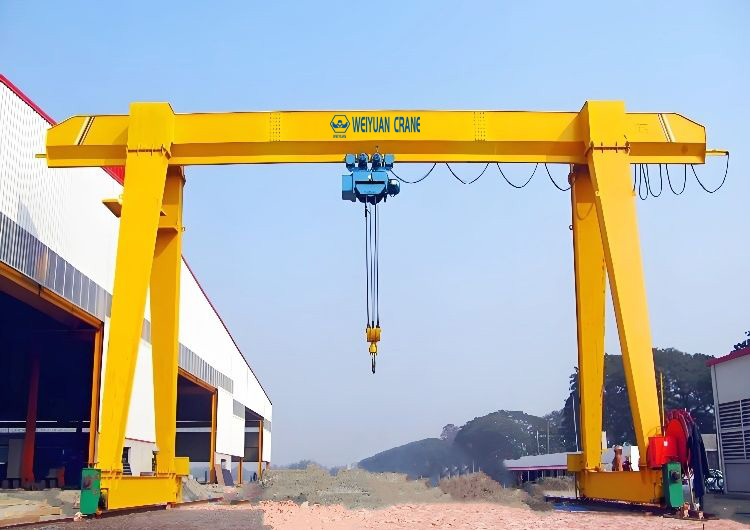
A semi-gantry crane has one leg. It travels on a ground-level rail on one side. On the other side, the crane bridge hangs from a wall-mounted or column-mounted elevated runway — just like one end of a bridge crane.
This asymmetric design eliminates one complete side of the ground infrastructure: one set of rail foundations, one set of ground-level rails, and the ground clearance that a second leg would require on that side.
The result: 30 to 45% lower installation cost compared to an equivalent full gantry crane. And a crane that fits scenarios where a full gantry crane cannot — where one side of the working area is bounded by a structural wall or column row that can carry the elevated runway.
This guide explains the semi-gantry crane’s structure, the three installation configurations, the structural assessment that the wall-mounted runway requires, and the scenarios where semi-gantry is clearly the better choice.
Part 1: Semi-Gantry Crane Structure
The Asymmetric Design
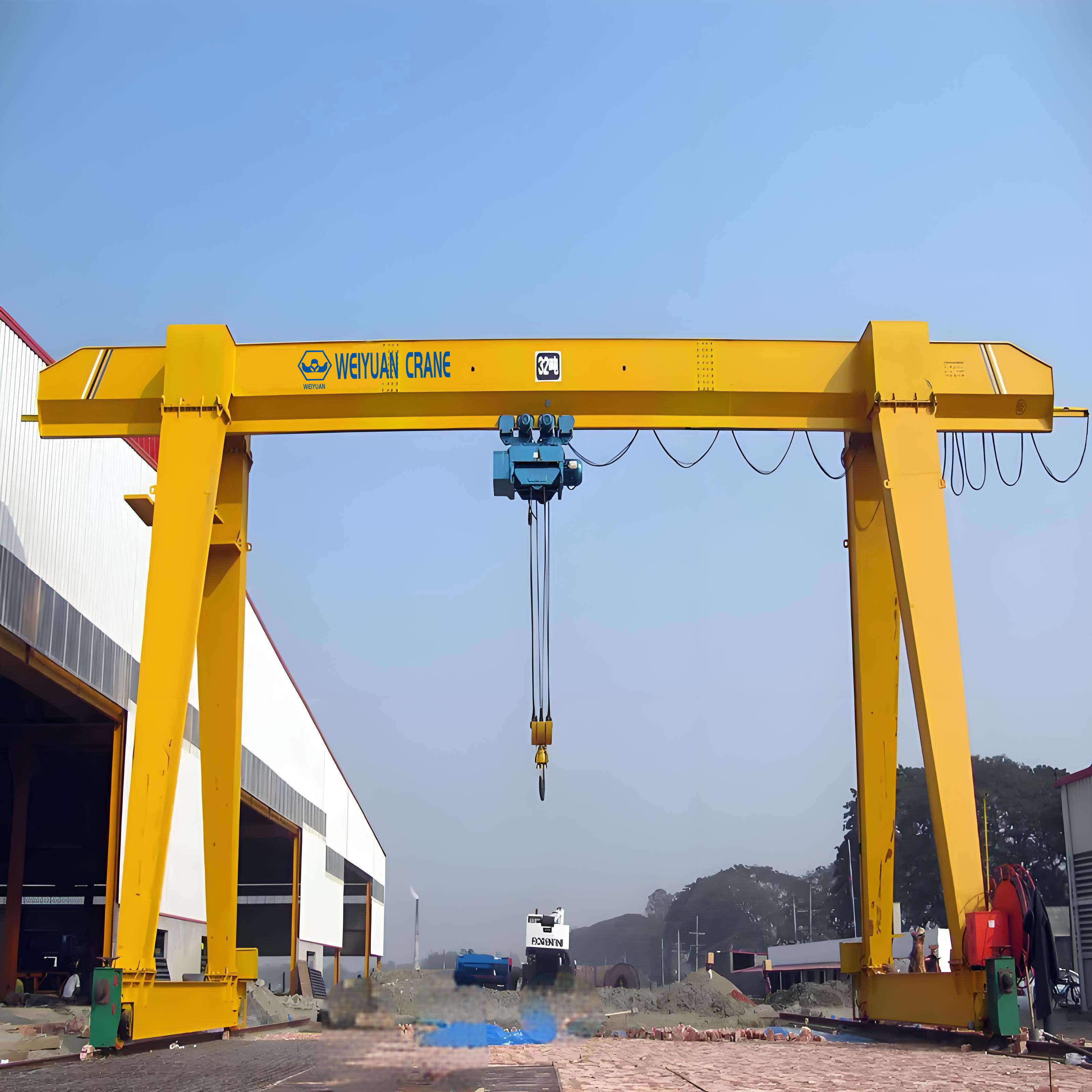
A standard full gantry crane has identical legs on both sides. The bridge girder spans between them at a consistent height. Both end trucks travel on ground-level rails at the same elevation.
A semi-gantry crane has one standard ground-level leg on one side. On the other side, the bridge girder’s end truck runs on an elevated runway — a beam mounted on the facility wall or on structural columns, at the height required to give the bridge girder the correct elevation.
The bridge girder spans from the top of the ground leg to the elevated runway on the wall side. The girder is horizontal. But its two end trucks are at very different structural levels — one at the ground, one elevated.
This creates an asymmetric crane that looks unusual from the end. One end has a tall steel leg reaching to the ground. The other end connects directly to a wall-mounted bracket or column-mounted beam section. No second leg is visible on the wall side.
Why It Works Structurally
The elevated runway on the wall side carries vertical load (the crane bridge’s dead weight and the lifted load’s share) and lateral load (from crane travel acceleration and deceleration). The wall or columns must carry these loads.
The vertical load at the elevated runway end is approximately half the total crane weight plus load under symmetric loading conditions. For asymmetric loading — when the hoist is positioned closer to the wall side — the wall-side runway carries proportionally more.
The structural assessment of the wall-side mounting is the critical engineering step. It is the step that makes semi-gantry feasible or not feasible for a specific building.
Part 2: Three Installation Configurations
Configuration 1: Ground Leg + Wall-Mounted Runway
The most common semi-gantry installation. The elevated runway is bolted to the face of a reinforced concrete wall or masonry wall.
The runway brackets attach at defined intervals along the wall — typically every 3 to 6 metres, matching the crane bridge’s support point spacing. Each bracket carries vertical and horizontal forces from the crane operation.
Requirements for the wall:
Minimum wall thickness: 250mm for light semi-gantry cranes (up to 5 tonnes). 350mm minimum for medium capacity (5 to 20 tonnes).
Wall material: reinforced concrete preferred. Solid brick masonry is acceptable for light cranes with engineering assessment. Lightweight steel framing and hollow block walls are not acceptable.
Anchor capacity: the wall anchors at each bracket must carry both vertical shear and tension simultaneously. Chemical anchors (epoxy or polyester) into reinforced concrete provide the most reliable performance. Expansion anchors are not recommended for crane runway bracket attachments.
Configuration 2: Ground Leg + Column-Mounted Runway
The elevated runway attaches to the flanges or webs of existing structural steel columns. This is the most common configuration in steel-frame industrial buildings.
The crane runway bracket welds to the column flange or bolts through the column web. The bracket design must transfer both the vertical load and the lateral crane travel loads into the column without creating excessive local bending in the column section.
Column requirements for semi-gantry runway attachment:
The column must have adequate capacity for the crane runway loads in addition to the loads it already carries (roof, wall cladding, wind).
A structural engineer must perform this combined load check — it cannot be assumed.
For very lightly loaded columns (common in portal frame buildings with thin-web columns): reinforcing gussets at the bracket attachment points may be required.
Advantage over wall-mounted: column attachment provides better defined load paths. The column’s structural capacity is documented in the original building design. Wall anchor capacity is often estimated from in-situ testing rather than calculated from design drawings.
Configuration 3: Ground Leg + Floor/Mezzanine Edge Beam Runway
In multi-level facilities, the elevated floor slab edge beam serves as the runway support for the wall side of the semi-gantry crane.
The crane’s elevated end truck runs on a runway mounted on or alongside the mezzanine floor edge beam. This configuration is particularly effective in facilities with mezzanine storage floors — the semi-gantry crane can lift from the ground floor to the mezzanine level without requiring a separate hoist mechanism at the mezzanine edge.
Requirements: the mezzanine floor edge beam must be designed for crane runway loads. Many mezzanine floors are designed for storage loads only. If the semi-gantry crane is being added to an existing facility, the mezzanine structure must be assessed by a structural engineer for the additional runway loads before this configuration is used.
Part 3: When Semi-Gantry Outperforms Full Gantry
Scenario 1: One Structural Wall, One Open Side
This is the ideal semi-gantry scenario. The working area is bounded on one side by a solid reinforced concrete wall or a row of structural steel columns. The other side is open floor.
A full gantry crane would require a second row of ground-level rails and foundations parallel to the wall — taking up valuable floor space and adding significant foundation cost.
A semi-gantry crane uses the existing wall or columns as the elevated runway support. No second rail row is needed on the wall side. Floor space is preserved. Foundation cost is approximately half of the full gantry equivalent.
Scenario 2: Budget-Constrained Installation
The full gantry crane’s equipment cost and installation cost fall within the project budget. But the full gantry’s two-sided foundation and rail cost exceeds the available infrastructure budget.
Semi-gantry eliminates one side of the infrastructure — one set of rail foundations, one set of rails, and the ground-level clearance zone for the second leg. The cost saving is real and significant.
For a 10-tonne, 20-metre span semi-gantry versus full gantry:
Full gantry foundation and rail installation: $40,000 to $80,000.
Semi-gantry foundation and rail installation (one side only, plus wall bracket): $22,000 to $50,000.
Saving: $18,000 to $30,000 on installation cost alone.
Scenario 3: Expanding Coverage Into a Wall Zone
An existing facility has overhead bridge cranes serving the main bay. A new work area is being added along one wall — in the crane shadow zone that the existing bridge cranes cannot reach because the runways are set back from the wall.
A semi-gantry crane using the existing wall as its elevated runway support extends crane coverage into the wall-adjacent zone. One ground-level rail is installed in the new work area floor. The existing wall carries the elevated runway. The new semi-gantry crane serves the wall-adjacent zone without any modification to the existing overhead crane system.
Scenario 4: Narrow Bay Without Enough Width for Two Ground Rails
Some production bays are too narrow for a full gantry crane’s two ground-rail configuration — particularly when forklift aisles and production equipment already consume most of the floor width.
A semi-gantry crane requires only one ground-level rail. The wall-side elevated runway takes no floor space. The single ground-level rail can often be positioned at the edge of the forklift aisle without blocking traffic.
Part 4: Wall-Side Runway Structural Load Calculations
Vertical Load at the Elevated Runway
For a crane of total weight W (bridge + end trucks + hoist) with a rated load P, the vertical load at the elevated runway end is approximately:
V_wall = (W + P × 1.15) × (distance from leg to load) ÷ span
At symmetric loading (hoist at span center): V_wall ≈ (W + P × 1.15) × 0.5
At worst-case loading (hoist at maximum approach to wall side): V_wall ≈ (W + P × 1.15) × 0.7 to 0.8 (depending on minimum approach distance)
Example: 10-tonne crane, bridge weight 8 tonnes, hoist weight 0.5 tonne. Total W = 8.5 tonnes.
Rated load P = 10 tonnes.
Maximum V_wall = (8.5 + 10 × 1.15) × 9.81 × 0.75 = (8.5 + 11.5) × 9.81 × 0.75 = 147 kN.
The wall bracket and its anchors must carry 147 kN vertically, plus the horizontal lateral forces from crane travel.
Horizontal Lateral Load
During crane travel (acceleration and deceleration), the bridge creates lateral forces at both end trucks. The lateral force is typically 10 to 15% of the vertical wheel load per CMAA Specification No. 70.
At the wall-side runway: horizontal lateral load = V_wall × 0.10 to 0.15 = 15 to 22 kN for the example above.
The wall bracket must resist both the vertical and horizontal loads simultaneously. Design the bracket and anchors for the combined load vector.
Allowable Differential Settlement
The ground-side rail and the wall-side runway must remain at the same elevation within ±10mm (CMAA Specification No. 70 tolerance for runway elevation difference). If the ground-side rail settles more than the wall-side runway — or vice versa — the crane bridge develops unequal wheel loads and may eventually rack or derail.
For semi-gantry installations on buildings with different foundation types on each side (deep foundation on the building side, shallow foundation on the ground leg side): monitor both rails annually for differential settlement. Address any differential exceeding 5mm before it reaches the 10mm tolerance limit.
Part 5: Capacity and Span Range
Semi-gantry cranes cover essentially the same capacity and span range as full gantry cranes with equivalent structural design. Standard commercial semi-gantry cranes are available from 1 tonne to 32 tonnes. Spans of 10 to 30+ metres are standard.
The primary limitation is the wall-side runway structural capacity. For very heavy semi-gantry cranes (above 20 tonnes), the vertical load at the wall-side runway may exceed what typical industrial building walls or columns can carry without significant reinforcement. In these cases: a structural engineer’s assessment may recommend adding supplementary columns to carry the runway rather than relying on the existing wall structure.
Part 6: Semi-Gantry vs Full Gantry — Decision Guide
Choose semi-gantry when:
One side of the working area has a structural wall or column row confirmed adequate by a structural engineer.
Budget savings of 30 to 45% on installation cost are meaningful to the project.
Floor space on the wall side is at a premium — no room for a second ground-level rail.
The working area is a narrow bay where two ground rails would be impractical.
Choose full gantry when:
No structural wall or column exists on one side — only lightweight cladding or open space.
The structural assessment reveals the available wall or columns cannot carry the elevated runway loads.
The crane capacity is very heavy (above 20 tonnes) and the available wall structure would require extensive reinforcement to serve as the elevated runway support.
The facility layout may change significantly in the future — full gantry’s two-sided infrastructure is more adaptable to layout changes than semi-gantry’s dependency on one fixed structural wall.
Part 7: 2026 Price Reference
Semi-gantry crane equipment (bridge + one leg + elevated end truck, without hoist):
5-tonne, 15m span: $22,000 to $50,000
10-tonne, 20m span: $38,000 to $85,000
20-tonne, 25m span: $70,000 to $160,000
Equivalent full gantry crane equipment (same capacity and span):
5-tonne, 15m span: $28,000 to $65,000
10-tonne, 20m span: $50,000 to $110,000
20-tonne, 25m span: $90,000 to $200,000
Equipment price difference: semi-gantry is typically 15 to 25% less than full gantry at equivalent specification.
Installation cost comparison (10-tonne, 20m span):
Full gantry (two-sided rails + foundations): $40,000 to $80,000
Semi-gantry (one-sided rail + foundation + wall brackets): $22,000 to $50,000
Installation saving: $18,000 to $30,000
Total installed cost saving (equipment + installation): typically 25 to 40%.
Frequently Asked Questions
Q: Can a semi-gantry crane use the same runway as an existing bridge crane on the wall side?
A: Yes — if the existing bridge crane runway is at the correct height and has adequate capacity for the additional semi-gantry crane loads. The combined wheel loads from both the bridge crane and the semi-gantry crane on the same runway must be verified against the runway beam’s capacity. The runway beam was designed for the bridge crane’s loads alone. Adding the semi-gantry’s end truck loads requires a structural check of the runway beam under the combined loading.
Q: Does a semi-gantry crane require a separate power supply on each side?
A: No. The power supply for a semi-gantry crane typically runs along the ground-level rail side — through a conductor bar or festoon cable system on the ground leg side. The elevated wall-side end truck is mechanically synchronized with the ground leg through the rigid bridge structure. No separate power connection on the wall side is required.
Q: What is the minimum wall height required for a semi-gantry crane?
A: The wall must be tall enough to mount the elevated runway at the required height for the crane bridge to clear all obstructions in the working area. For a typical 10-tonne semi-gantry with a 5-metre hook height requirement: the elevated runway sits at approximately 6 to 7 metres above floor level (bridge depth + hook height + minimum clearances). The wall must extend at least 0.5 to 1.0 metre above the runway mounting height to provide adequate anchor embedment depth. Minimum wall height: typically 7 to 8 metres for standard production crane applications.