


Jib Crane Maintenance Guide: Inspection Schedule, Lubrication Tips & ASME B30.12 Compliance
Introduction
A jib crane is one of the most cost-effective and reliable lifting solutions in industrial facilities — but only when it receives consistent, structured maintenance. Properly maintained jib cranes deliver 20 to 25 years of reliable service with minimal unplanned downtime. Neglected ones develop problems quietly: pivot bearings wear unevenly, boom trolley wheels develop flat spots, hoist chains stretch beyond safe limits, and structural welds develop fatigue cracks at highly stressed connections — all while continuing to appear functional until a sudden failure occurs.
The challenge for many facility maintenance teams is that jib cranes receive less maintenance attention than larger, more visible crane systems. An overhead bridge crane that serves the entire production bay gets regular attention because its downtime affects everything. A single jib crane at one workstation is easier to defer — until it fails during a critical production window or, worse, during a lift.
This guide provides the complete jib crane maintenance framework: the ASME B30.12 inspection requirements that govern jib crane compliance, a practical schedule for every level of inspection, the lubrication program that most directly affects crane longevity, the most common maintenance failures and how to prevent them, and the documentation practices that demonstrate compliance to OSHA inspectors and insurers.
Part 1: The Regulatory Framework — ASME B30.12 and OSHA
Understanding which standards apply to jib cranes is the essential starting point for any compliance program, and it is a source of genuine confusion in many facilities.
OSHA 29 CFR 1910.179 — Overhead and Gantry Cranes:
This is the primary federal crane safety standard most facility managers know. However, 1910.179 applies specifically to top-running double-girder overhead bridge cranes and gantry cranes. Standard jib cranes — both floor-mounted (pillar jib) and wall-mounted configurations — are not covered by 1910.179 as primary equipment.
ASME B30.12 — Handling Loads Suspended from Rotary Cranes and Monorails:
This is the primary engineering standard that applies to jib cranes. ASME B30.12 covers the design, installation, inspection, testing, maintenance, and operation of all rotary cranes — including floor-mounted pillar jib cranes, wall-mounted jib cranes, and mast-type cranes.
ASME B30.16 — Overhead Underhung and Stationary Hoists:
The hoist attached to the jib crane is governed by ASME B30.16, which covers inspection, testing, maintenance, and operation of hoists used on jib cranes, monorails, and single-girder cranes.
OSHA General Duty Clause (Section 5(a)(1)):
While jib cranes may not fall under 1910.179 directly, OSHA can and does cite employers under the General Duty Clause when jib crane operations create recognized hazards that the employer knows about and fails to correct. ASME B30.12 is the standard OSHA references when assessing what constitutes adequate jib crane maintenance and inspection.
Practical implication: Operating a jib crane without a structured inspection program that meets ASME B30.12 requirements exposes your facility to OSHA citation under the General Duty Clause and — more importantly — to serious safety risk when developing equipment problems go undetected.
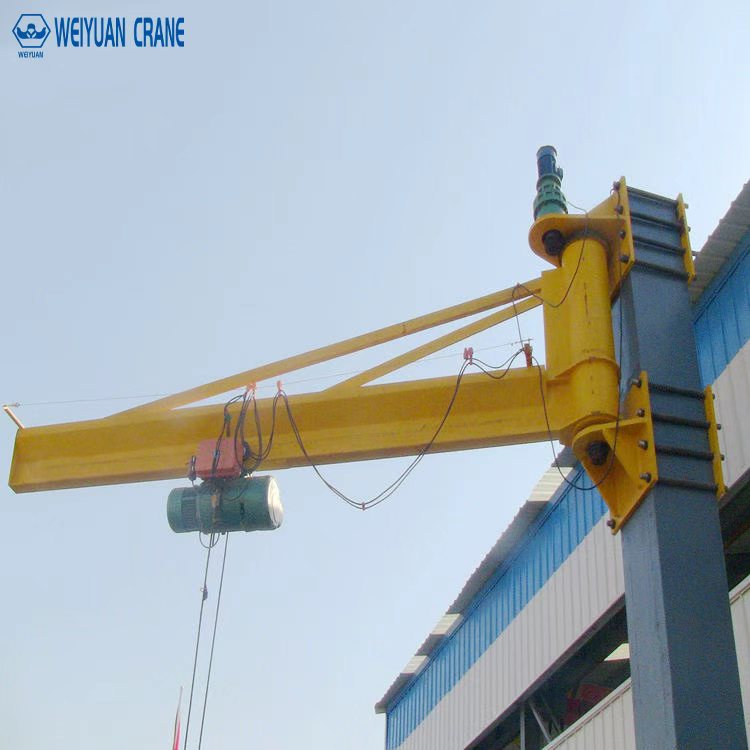
Weiyuan 500kg Wall Mounted Jib Crane
The Weiyuan 500kg Wall Mounted Jib Crane is a compact and efficient lifting solution designed for workshops, assembly lines, and warehouse operations. Mounted directly to a structural wall or column, it saves valuable floor space while providing smooth 180° slewing coverage for precise material handling up to 500 kg.
View Product / Get QuotePart 2: The Three Levels of Jib Crane Inspection
ASME B30.12 defines the same three-tier inspection structure used across all ASME B30 crane standards: initial inspection, frequent inspection, and periodic inspection.
Level 1: Initial Inspection
Required: Before placing a new or significantly modified jib crane in service for the first time.
What it covers:
- Complete structural inspection of boom, mast, and mounting hardware
- Verification that the installation conforms to the manufacturer’s foundation or wall mounting specifications
- All mechanical components: pivot bearing, trolley wheels, hoist, hook, and limit switches
- All electrical components: motor, controls, pendant, wiring, and grounding
- Load test at 125% of rated capacity with the hook and any below-hook devices attached
- Documentation of test date, test weight, and qualified person’s signature
This inspection must be performed and documented before the crane lifts its first production load. No exceptions. Many facilities receive new jib cranes, assemble them, and begin use without conducting the required pre-service inspection and load test — this is both a compliance gap and a safety risk.
Level 2: Frequent Inspections
Required frequency by service level:
- Normal service (infrequent lifting, light loads): Monthly
- Heavy service (frequent lifting, loads near rated capacity): Weekly
- Severe service (continuous operation near rated capacity): Daily
Who performs it: A qualified person or trained, designated operator who can identify the conditions listed in ASME B30.12. Frequent inspections are typically performed by an experienced in-house maintenance person or senior operator.
What the frequent inspection must cover:
Operating mechanisms: Operate the hoist through a full up/down cycle under no load and verify smooth, noise-free operation. Any unusual sounds (grinding, squealing, clicking) require investigation before the crane is returned to service.
Hoist chain or rope condition:
- Chain hoists: Inspect for twisted links, cracked links, corrosion, and chain stretch. Chain stretched more than 2% of original pitch length must be replaced. Check load sheave pockets for wear.
- Wire rope hoists: Inspect full rope length for broken wires (rejection criterion: more than two broken wires in any six-diameter rope length), kinking, crushing, or corrosion. Measure rope diameter and reject if reduced more than 1/3 of the nominal diameter.
Hook condition: Check throat opening against the manufacturer’s rejection criterion (typically more than 15% increase from nominal). Verify the hook safety latch is present, spring-loaded, and closes fully. Inspect for cracks or deformation — use a hook gauge if available.
Hoist brake: With no load, raise the hook approximately 12 to 18 inches, release the pendant, and observe for any downward drift. Any drift indicates brake degradation requiring immediate service.
Limit switches: Slowly raise the unloaded hook to confirm the upper limit switch cuts motor power before the hook block contacts the hoist body. Test the lower limit switch similarly.
Boom and pivot: Visually inspect the boom beam for visible cracks, deformation, or corrosion. Rotate the boom through its full arc and note any binding, rough spots, or unusual noise from the slewing bearing or pivot assembly.
Trolley and wheels: Move the trolley along the boom and verify smooth travel without derailment tendency. Inspect trolley wheels for flat spots or unusual wear.
Mounting hardware: For wall-mounted units, check for loose bolts at mounting brackets. For floor-mounted units, check for any movement of the base plate relative to the foundation — any visible gap between base plate and anchor indicates a serious problem requiring immediate shutdown.
Level 3: Periodic (Annual) Inspection
Required frequency: At least annually for all jib cranes in service. For cranes in heavy or severe service, semi-annually or quarterly is appropriate.
Who performs it: A qualified crane inspector or certified crane service technician. For most facilities, the annual inspection is performed by a third-party crane inspection service.
What the periodic inspection covers in addition to all frequent inspection items:
Complete structural examination: All structural welds inspected for cracks — particularly at the boom-to-pivot connection, the mast-to-base connection (floor-mounted), and the bracket-to-wall connections (wall-mounted). Dye penetrant or magnetic particle testing of suspect areas if visual inspection suggests crack initiation.
Boom deflection measurement: Measure the boom deflection under a known test load (typically 50% of rated capacity at full reach) and compare to the manufacturer’s allowable deflection specification. Excessive deflection indicates structural fatigue or overloading damage.
Slewing bearing condition: Assess slewing bearing play by attempting to rock the boom vertically and laterally at its tip. Excessive play indicates bearing wear requiring replacement. On grease-fitting equipped bearings, verify greasing channels are clear and grease is being delivered to the bearing race.
Foundation/mounting assessment: For floor-mounted units, inspect the concrete foundation for cracking, spalling, or anchor bolt loosening. For wall-mounted units, inspect the mounting structure for cracking, deformation, or corrosion at bracket attachment points.
Full electrical inspection: Complete wiring inspection, motor condition assessment, control contactor inspection, limit switch calibration verification, and grounding continuity.
Load test verification: A load test at 125% of rated capacity is required after installation (initial inspection) and after any significant repair or modification. For ongoing periodic inspections, a functional test under a representative load (50 to 100% of rated capacity) is performed to verify all motions and safety devices under load.
Part 3: Jib Crane Lubrication Schedule
Lubrication is the maintenance activity with the highest direct impact on jib crane longevity and the one most commonly skipped in busy maintenance schedules. The following schedule applies to most standard industrial jib cranes — always consult the manufacturer’s maintenance manual for equipment-specific intervals and lubricant specifications.
Slewing bearing (pivot bearing):
- Interval: Every 3 months under normal service; monthly under heavy service
- Lubricant: High-quality lithium-based grease meeting NLGI Grade 2 specification, or manufacturer-specified equivalent
- Method: Apply through grease fitting until fresh grease appears at the bearing seal. Do not over-grease — excess grease attracts contaminants and can degrade bearing performance.
- Note: Some modern sealed slewing bearings are grease-packed for life. Check manufacturer documentation before attempting to grease — applying grease to a sealed bearing can damage the seal.
Hoist chain (electric chain hoists):
- Interval: Every 3 months under normal service; monthly under heavy, dusty, or wet conditions
- Lubricant: Manufacturer-approved chain lubricant — typically a mineral oil-based product that penetrates chain link interfaces. Do not use heavy greases that attract debris.
- Method: Apply lubricant to the chain during operation so the chain passes through a light film of lubricant. Wipe off excess after application.
Wire rope (wire rope hoists):
- Interval: Every 3 months under normal service; monthly under heavy service or outdoor/wet conditions
- Lubricant: Wire rope lubricant that penetrates to the rope core. Do not use surface-only lubricants that coat the outer strands without penetrating.
- Method: Apply rope lubricant to the full rope length using a brush or rope lubricator tool.
Hook swivel bearing:
- Interval: Every 3 months
- Lubricant: Multi-purpose grease (NLGI Grade 2)
- Method: Apply to swivel bearing surfaces. Verify hook rotates freely without binding.
Trolley wheels and bearings:
- Interval: Every 3 months for unsealed bearings. Sealed bearings may be lubricated-for-life.
- Lubricant: Multi-purpose grease per manufacturer specification.
- Method: Apply to bearing grease fittings if present.
Boom lower flange (trolley running surface):
- Interval: Inspect and clean every 3 months. No lubrication applied to the running surface — lubrication would cause trolley wheel slipping.
- Action: Remove debris, scale, and corrosion from the boom lower flange with a wire brush. A clean, smooth running surface extends trolley wheel life significantly.
Part 4: Most Common Jib Crane Maintenance Failures
Understanding the most frequent failure patterns allows maintenance teams to target inspection effort and catch developing problems early.
Slewing bearing wear:
Signs: Rough rotation when swinging the boom, visible play when attempting to rock the boom tip vertically, grinding or rumbling noise during rotation.
Root cause: Inadequate lubrication, overloading, or end-of-service-life bearing wear.
Action: If lubrication does not restore smooth rotation, replace the slewing bearing. A failed slewing bearing can allow the boom to drop suddenly — this is a critical safety item.
Hoist brake drift:
Signs: Load slowly descends when the hoist control is released.
Root cause: Worn brake lining, contaminated brake surfaces (oil or grease), weak brake spring, or incorrect brake adjustment.
Action: Immediate out-of-service. Inspect brake assembly, replace lining if worn below minimum thickness, clean contaminated surfaces with appropriate solvent, adjust or replace spring. Never return a crane to service with a drifting hoist brake.
Foundation anchor loosening (floor-mounted cranes):
Signs: Visible gap between base plate and concrete surface, audible “clunking” during lifts, base plate movement under side load.
Root cause: Inadequate initial torque, concrete shrinkage at anchor embedment zone, foundation cracking from overloading or dynamic loading.
Action: Immediate out-of-service. Engage a structural engineer to assess the foundation and specify the corrective action — do not simply re-torque anchors without understanding why they loosened.
Wall bracket fastener loosening (wall-mounted cranes):
Signs: Visible gap at bracket-to-wall interface, unusual deflection during lifts, audible sounds from the mounting during operation.
Root cause: Inadequate initial torque, wall material compression creep (particularly in masonry), dynamic load cycles exceeding what the fastener system was designed for.
Action: Out-of-service until a structural engineer assesses the mounting and specifies corrective action.
Trolley wheel flat spots:
Signs: Rhythmic banging or vibration as the trolley moves along the boom; visible flat areas on wheel tread.
Root cause: Hoist brake engaging with trolley in motion (trolley stops suddenly while loaded), or impact loading from rough handling.
Action: Replace worn wheels. Identify and correct the operational practice causing wheel lockup during travel.
Part 5: Maintenance Records and Documentation
ASME B30.12 requires that inspection and maintenance records be maintained for jib cranes. The required documentation includes:
Initial inspection and load test record: Date of inspection, crane identification (serial number or asset tag), test weight used, and qualified person’s signature. This record must be retained for the life of the crane.
Frequent inspection log: Date of each frequent inspection, items checked, findings, and the name of the person performing the inspection. Even when no deficiencies are found, “no deficiencies noted” entries with date and signature are the correct documentation practice.
Periodic inspection report: Full written report from the qualified inspector covering all items in ASME B30.12, findings, corrective actions required, and the inspector’s signature and qualifications.
Maintenance and repair records: All lubrication, adjustments, parts replacements, and repairs documented with date, description of work performed, parts replaced (with part numbers if available), and name of person performing the work.
These records should be stored in a location accessible to maintenance personnel, OSHA inspectors, and — critically — the person responsible for the crane safety program. A missing inspection record is treated by OSHA as equivalent to a missing inspection.
Frequently Asked Questions
Q: How do I know if my jib crane needs replacement versus repair?
A: Key indicators that replacement is the better option include: structural cracks in the boom or mast that have been repaired more than once, slewing bearing replacement more than twice in the crane’s service life (indicating the underlying load or lubrication issue has not been corrected), foundation problems that have required repair more than once, or a crane that has reached or exceeded its design service life (typically 20 to 25 years for a properly maintained unit).
Q: Can I perform jib crane maintenance in-house or do I need a contractor?
A: Routine maintenance tasks — lubrication, pre-use inspections, frequent visual inspections — can be performed by trained in-house personnel. Periodic annual inspections, brake servicing, slewing bearing replacement, and any structural repair should be performed by qualified crane service technicians. Wiring and electrical repairs must be performed by licensed electricians.
Q: What is the cost of an annual jib crane inspection?
A: Third-party annual periodic inspections for a standard 1-ton to 3-ton jib crane typically run $300 to $800 depending on crane size, complexity, and inspector rates in your region. For a fleet of multiple jib cranes inspected in a single visit, per-unit costs are typically lower. This investment in inspection is one of the highest-return maintenance activities available for any lifting equipment.