


Jib Crane Safety Checklist: Pre-Use Inspection, Operator Rules & ASME B30.12 Requirements
Introduction
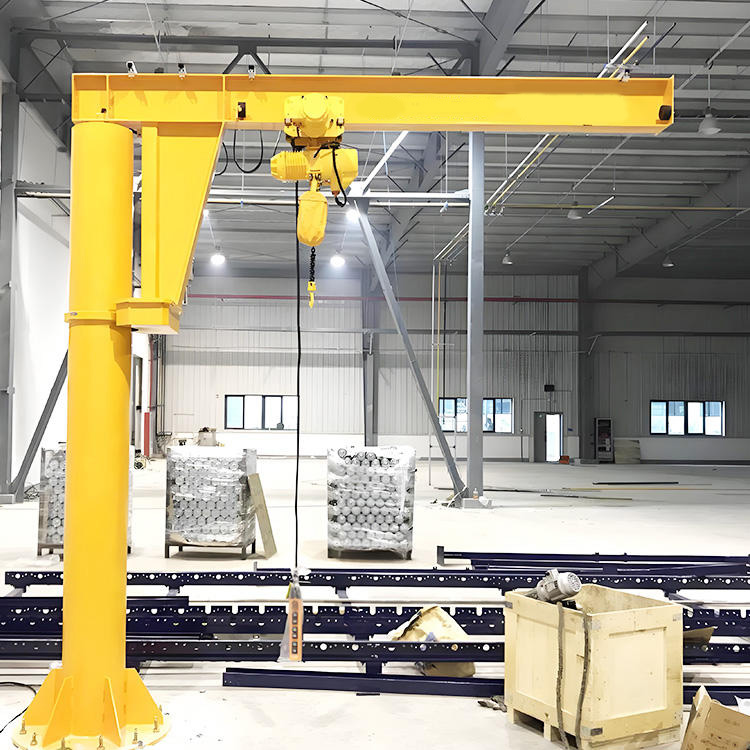
Sixty to seventy percent of jib crane incidents are preventable. They are caused by missed inspections, ignored warning signs, and operators who were never properly trained. Not by structural failures of correctly specified and maintained equipment.
The prevention is not complicated. It is consistent. A pre-shift inspection that takes five minutes. A monthly check that takes thirty minutes. An annual inspection by a qualified person. Operators who know the eight rules that keep them safe.
ASME B30.12 establishes the technical requirements for jib crane safety in North America. OSHA 29 CFR 1910.179 establishes the regulatory requirements. Both apply. Both are cited in enforcement actions and incident investigations.
This guide provides everything needed to build a compliant, effective jib crane safety program. The checklists are ready to use. The rejection criteria are taken directly from ASME B30.12. The operating rules are the specific behaviors that prevent incidents.
Part 1: Regulatory Framework
ASME B30.12 — Jib Cranes
ASME B30.12 is the primary technical standard for jib cranes in North America. It covers: design and construction requirements, installation and testing, inspection requirements (frequent and periodic), operation requirements, and maintenance requirements.
ASME B30.12 is not a regulatory standard — it does not have the force of law in itself. But OSHA cites ASME B30.12 as the standard of care for jib crane safety. When an OSHA inspector assesses a jib crane incident, ASME B30.12 defines what “correct practice” looks like.
Key ASME B30.12 requirements that directly affect operations:
Rated load must be marked on the crane in a location visible to the operator.
The crane must be inspected before initial use (load test at rated capacity).
Frequent inspections (pre-shift minimum) are required for cranes in regular service.
Periodic inspections (annual) must be performed by a qualified person.
Records of periodic inspections must be retained.
OSHA 29 CFR 1910.179
OSHA 1910.179 applies to overhead and gantry cranes. Many of its provisions apply equally to jib cranes — particularly the inspection, operator qualification, and load rating requirements.
Key 1910.179 provisions applicable to jib cranes:
Rated load must be clearly marked on the crane.
Daily inspection (frequent inspection) is required for cranes in regular service.
Annual inspection (periodic inspection) is required.
Defects must be repaired before the crane is returned to service.
Operators must be physically qualified and trained.
International Standards
EU: EN 13157 (cranes — safety — hand-powered lifting equipment) and EN 14502-1 (cranes — equipment for the lifting of persons) apply to jib cranes used in EU markets.
China: GB 6067 (safety rules for lifting appliances) applies.
Australia: AS 4991 (lifting devices) and AS 1418.1 (cranes) apply.
Part 2: Pre-Shift Inspection Checklist
Complete these seven items before the first lift of every shift. The inspection takes five minutes. It catches the acute failures that cause incidents.
Item 1: Slewing System Rotation
Push the boom by hand through approximately 90 degrees of arc. Note the resistance required. Compare to the previous shift.
Pass: smooth, consistent resistance throughout the arc. No grinding, clicking, or stiffness at specific positions.
Tag out: any noticeable increase in resistance compared to normal, grinding sound during rotation, or stiffness at specific arc positions that does not resolve after a few rotations.
Item 2: Hook and Safety Latch
Inspect the hook body visually. Then test the safety latch.
Pass: hook body shows no visible spreading, cracking, twisting, or deformation. Safety latch springs back fully closed when pressed open and released.
Tag out: any visible crack or deformation in the hook body. Safety latch missing, stuck open, or does not spring back fully closed.
Item 3: Wire Rope or Load Chain Visual Check
Inspect the visible rope or chain from the drum to the hook block.
Wire rope — tag out if:
2 or more broken wires are visible in any 6-rope-diameter length.
Any kinking, birdcaging, or crushing is visible.
Significant diameter reduction or discolouration from heat damage is visible.
Load chain — tag out if:
Any visible crack in any link.
Any link that appears bent, deformed, or elongated compared to adjacent links.
Any visible corrosion pitting on the chain surface.
Item 4: Hoist Brake Drift Test
Raise the empty hook approximately 300mm above its lowest position. Release the “up” control. Watch for 30 seconds.
Pass: zero downward movement in 30 seconds.
Tag out: any downward movement, however small. Do not continue. Brake failure is a safety-critical condition.
Item 5: Upper Limit Switch Test
Slowly raise the empty hook toward its maximum position. Do not rush — approach at slow speed.
Pass: the hoist cuts power automatically before the hook block contacts the hoist body.
Tag out: the hook block contacts the hoist body (two-blocking condition) without the hoist cutting power. Tag out immediately. This is an urgent safety-critical failure.
Item 6: Controls Functional Check
Test each control button. Verify the crane motion direction matches the button label.
Pass: all controls respond correctly. “Up” raises. “Down” lowers. Bridge travel and rotation controls move in the labeled direction.
Tag out: any control that does not respond, responds in the wrong direction, or sticks in the actuated position.
Item 7: Structural Visual Check
From the floor, look at the mast, boom, and mounting point.
Pass: no visible lean or tilt in the mast. No visible cracking in the mast weld zones or boom structure. No visible movement at the mounting brackets or anchor bolts.
Tag out: any visible tilt, cracking at weld zones, or movement at the mounting structure. This is a structural emergency — do not operate the crane and evacuate the area around it.
Part 3: Monthly Inspection Checklist
Perform monthly with the crane isolated per LOTO procedures where component access requires it. Allow 30 minutes for a standard jib crane.
All seven pre-shift items plus:
Slewing Bearing Axial Play Measurement
Mount a dial indicator on the mast structure. Position the tip against the underside of the boom mounting flange or any feature attached to the rotating ring. Apply upward force at the boom tip by lifting with a known load or by a second person pushing upward. Read the indicator.
Record value: ______mm. Compare to manufacturer’s rejection limit (obtain from manual — typically 2 to 5mm for standard jib cranes).
Pass: measured axial play is below the manufacturer’s rejection limit.
Tag out: measured axial play equals or exceeds the rejection limit.
Brake Lining Thickness Measurement
Access the hoist brake per the manufacturer’s procedure. Measure the lining thickness with calipers.
Record value: ______mm. Compare to manufacturer’s minimum (typically 50% of original thickness).
Pass: lining thickness above minimum.
Plan replacement: lining at 60% of original — schedule replacement at next maintenance window.
Tag out: lining at or below minimum.
Gearbox Oil Level Check
Check the hoist gearbox oil level through the sight glass or dipstick.
Pass: oil level at or between the minimum and maximum marks.
Investigate: oil level below minimum — locate and repair the leak source before adding oil.
Wire Rope or Chain Complete Length Inspection
Pay out the full rope length. Inspect the sections normally stored on the drum. Apply the same rejection criteria as the pre-shift check to the full rope length.
Mounting Structure Bolt Torque Check
Apply a calibrated torque wrench to a sample of the mounting bolts — at least 25% of all mounting bolts. Compare torque to the manufacturer’s specification.
Pass: all sampled bolts reach the specified torque.
Investigate: any bolt that reaches specified torque with less resistance than expected — possible thread or concrete damage.
Foundation Visual Check (Pillar-Mounted)
Inspect the concrete foundation at the mast base.
Pass: concrete surface intact, no cracks wider than 0.5mm, no movement visible between the base plate and concrete surface.
Investigate: cracks through the anchor bolt zone or any visible movement between the base plate and concrete.
Part 4: Annual Inspection Requirements
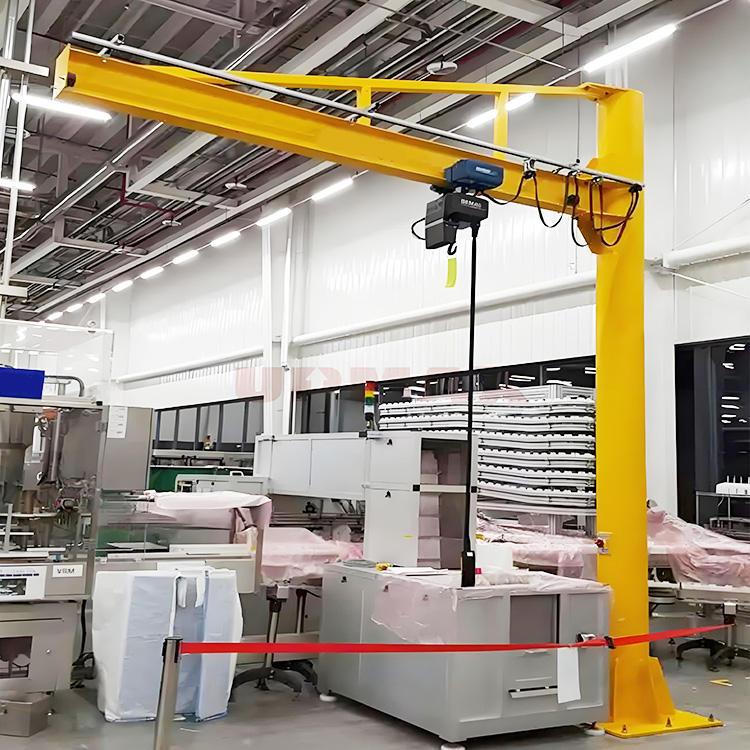
The annual inspection must be performed by a qualified person — someone with thorough knowledge of jib crane design, construction, and inspection through training or experience. This is a higher qualification than the “competent person” who performs monthly inspections.
Annual inspection scope — all monthly items plus:
Structural NDT (When Indicated)
Visual inspection of all primary structural welds: mast-to-base plate junction, mast-to-slewing bearing connection, boom-to-slewing bearing connection, and all welded stiffeners.
If any visual indication is found: commission magnetic particle testing (MPI) or dye penetrant testing (PT) at the indicated location before returning to service.
Gearbox Oil Analysis
Drain a 100ml oil sample. Send for laboratory analysis: viscosity, total acid number (TAN), water content, and iron particle count.
Pass: all parameters within the lubricant manufacturer’s acceptable range.
Action: oil showing TAN above 2.0 mg KOH/g, water above 0.1%, or iron count doubled from baseline — change oil and investigate source.
Electrical Insulation Test
Test the motor winding insulation resistance with a megohmmeter (500V test voltage).
Pass: insulation resistance above 10 MΩ.
Plan motor service: 1 to 10 MΩ — motor should be serviced within the next 12 months.
Tag out motor: below 1 MΩ — motor winding failure is imminent.
Load Test Requirement
ASME B30.12 requires a load test at rated capacity before any jib crane is placed in service after:
New installation.
Reinstallation at a new location.
Any significant structural or mechanical repair.
When periodic inspection reveals a condition requiring structural verification.
Load test procedure: raise rated capacity load to approximately 300mm above floor. Travel through full rotation arc. Hold for 10 minutes. Verify no structural deformation and zero brake drift.
Document and retain: date, load, test scope, inspector name and qualifications, and result.
Part 5: ASME B30.12 Rejection Criteria Quick Reference
Wire rope: tag out when any of these conditions is present:
- 2+ broken wires in any section equal to 6 rope diameters in length
- 4+ broken wires in any section equal to 30 rope diameters in length
- Rope diameter reduced to 93% of nominal or below
- Any kinking, birdcaging, or crushing visible
- Heat damage visible (discolouration, fused wires)
Load chain: tag out when any of these conditions is present:
- Any visible crack in any link
- Link bar diameter worn to 90% of nominal or below
- 11-link length increased by 2% or more above nominal (measured with calibrated gauge)
- Any link showing visible deformation
Hook: tag out when any of these conditions is present:
- Throat opening increased 15% or more above the nominal dimension
- Any visible crack in any location
- Safety latch missing, non-functional, or fails to close
- Any visible twisting of the hook shank
Hoist brake: tag out when:
- Any downward drift of hook or load when hoist control is released, at any load
Upper limit switch: tag out when:
- Hoist does not cut power before hook block contacts hoist body
Part 6: Eight Operator Safety Rules
Rule 1: Never Exceed the Rated Capacity
The rated capacity is the maximum total suspended weight — hook, rigging, below-hook hardware, and load combined. Calculate the total weight before every lift. Do not estimate. When the total approaches the rated capacity: weigh it.
Rule 2: No Personnel Under Suspended Loads
This rule has no exceptions. No “just for a second.” No “it’s only 50 kilograms.” A suspended load of any weight can fall without warning. OSHA 1910.179 explicitly prohibits personnel under suspended loads.
Rule 3: Apply Load Smoothly — No Snatch Lifts
Accelerating the hoist suddenly from rest to full speed while the rope is slack — “snatching” the load — applies an impact force of 2 to 4 times the load’s static weight. Snatching accelerates rope and structural fatigue dramatically. Apply the hoist control gradually. Bring the rope to tension before accelerating.
Rule 4: Clear the Area Before Traveling
Before traveling the crane with a load: confirm no personnel are in the travel arc below the load. Confirm no obstacles are within the load swing zone. Call a verbal warning if the travel area is not fully visible.
Rule 5: Tag Out on Any Abnormal Condition
Unusual sounds. Increased rotation resistance. A brake test that passes but feels different from normal. Any of these is a signal. Tag out. Investigate. Do not continue operating a crane with a condition you cannot explain.
Rule 6: Observe the Wind Speed Limit for Outdoor Cranes
Check the posted wind speed limit at the crane. If the wind feels above that limit: check an anemometer or weather station. When wind speed is at or above the operating limit: lower the load immediately. Travel to the parking position. Engage the rail clamps or tie-down provisions.
Rule 7: Verify Qualification Before Operating
ASME B30.12 requires that operators be trained and designated as qualified by the employer before operating in production service. Do not operate a crane you have not been specifically trained on, regardless of experience with other crane types.
Rule 8: Never Bypass Safety Devices
Safety devices exist because failures are possible. The upper limit switch prevents two-blocking. The overload protection prevents structural failure from overloading. The brake provides the last defense against a dropped load. Bypassing any safety device removes a layer of protection that was specifically designed to prevent a specific category of incident. Never bypass, jumper, or defeat any safety device for any reason.
Part 7: LOTO Procedure When Tagging Out
When any pre-shift or monthly inspection item fails: the crane must be taken out of service immediately.
Step 1: attach an out-of-service tag to the pendant control. The tag must state: the reason for tagging out, the date and time, and the name of the person who placed the tag.
Step 2: isolate electrical power to the crane at the main disconnect. Lock the disconnect with a personal lock per OSHA 29 CFR 1910.147 LOTO requirements.
Step 3: notify the maintenance supervisor of the fault condition and the crane’s out-of-service status.
Step 4: only a qualified maintenance person may investigate the fault and carry out repairs.
Step 5: after repair and verification: the qualified maintenance person performs a functional test. Only after the functional test confirms correct operation can the tag and lock be removed.
Step 6: for any repair involving the hoist mechanism, structural members, or safety devices: a load test at rated capacity is required before returning to production service.
Frequently Asked Questions
Q: Is the annual inspection required even if the crane has not been used much during the year?
A: ASME B30.12 annual periodic inspection is required regardless of use frequency. The annual inspection addresses: potential corrosion during idle periods, lubricant degradation from inactivity, seal condition, and structural condition from any loads applied during the year. A crane that has not been used for an extended period (30 days or more) also requires a pre-service inspection equivalent to the monthly scope before returning to production use.
Q: Can the same person perform both the monthly and annual inspection?
A: The monthly inspection requires a “competent person” — one who is capable of identifying existing and predictable hazards in the surroundings or working conditions which are unsanitary, hazardous, or dangerous. The annual inspection requires a “qualified person” — one with thorough knowledge of crane design, construction, maintenance, and inspection. The same person can perform both if they meet the qualified person standard. A person who meets only the competent person standard should not perform the annual inspection.
Q: After replacing the wire rope, do I need to repeat the annual inspection before returning to service?
A: Wire rope replacement requires a functional test at rated capacity (not a full annual inspection) before returning to service. The functional test confirms the rope is correctly reeved, the drum winding is correct, and the brake holds under rated load. The annual inspection date is not reset by a rope replacement — it is based on the calendar anniversary of the last annual inspection.