


Jib Crane for Outdoor & Industrial Environments: IP Ratings, Corrosion Protection & Foundation Design
Introduction
A distribution center in a coastal region ordered a batch of jib cranes for its loading docks. The cranes were solid units — right capacity, right reach, correctly duty-rated. The buyer had done the specification work from Part 1 of this series properly. There was just one line item that got copied straight off the indoor workstation quote: the environmental spec. IP54 electrical protection, standard interior coating, plated fasteners.
Eighteen months later, the maintenance log told the story. The hoist pendants were failing intermittently after wet-weather shifts. The mast bases had bloomed with rust where the salt-laden air met unprotected steel. Two anchor bolt sets had corroded enough that a structural engineer flagged them. The cranes hadn’t failed catastrophically — but they were aging at three times the rate anyone had budgeted for, and the “savings” on the environmental spec had already been erased by the first round of repairs.
That’s the trap with outdoor and industrial-environment jib cranes: the mechanical specification looks identical to an indoor unit, so buyers assume the environmental side is a minor upgrade. It isn’t. The environment attacks the crane on four fronts at once — water and dust get into the electrics, corrosion eats the steel, forklift traffic threatens physical damage, and the foundation or host structure has to carry real forces without the forgiving conditions of a clean, dry shop floor.
This is Part 2 of our three-part jib crane series. Part 1 covered the fundamentals — workstation geometry, boom reach, column-versus-wall mounting, and duty class. Here we tackle everything that changes when the crane leaves the protected indoor cell: the environmental protection that keeps it running through weather, the foundation and structural verification that keeps it standing, the impact protection that keeps forklifts from wrecking it, and the capacity math that so many outdoor specs get quietly wrong.
What you’ll take away:
- Why IP65 — not IP54 — is the floor for outdoor and dock service, and what each rating actually blocks
- The coating and hardware specification that survives wet and coastal exposure
- Cold-climate additions that stop condensation and lubricant failure below −10°C
- How to size a column-mounted foundation against the overturning moment — with a worked example
- How to verify a wall or building column can carry 30–40 kN of bracket force before you mount to it
- Impact protection that stops forklift damage before it happens
- Capacity math that includes the rigging and below-hook tooling most specs forget
- 2026 pricing so the outdoor premium doesn’t ambush your budget
Part 1: IP Ratings — Why IP54 Fails Outdoors and IP65 Is the Floor
The single most common environmental specification error is carrying an indoor IP rating onto an outdoor crane. It looks like a small difference on paper. In service, it’s the difference between a pendant that lasts a decade and one that starts throwing intermittent faults after the first wet winter.
What the IP Rating Actually Tells You
The Ingress Protection (IP) rating is a two-digit code defined by IEC 60529. The first digit rates protection against solids and dust; the second digit rates protection against water. Higher numbers mean better sealing. For jib crane electrical components — the hoist motor, the controls, the limit switches, the pendant — that second digit is what decides whether the unit survives outdoor exposure.
Here’s how the relevant ratings compare:
| IP Rating | Dust Protection | Water Protection | Suitable For |
|---|---|---|---|
| IP54 | Limited dust ingress | Splashing water from any direction | Clean, dry indoor workstations |
| IP65 | Dust-tight | Low-pressure water jets from any direction | Outdoor, dock, and wash-down areas |
| IP66 | Dust-tight | Powerful water jets | Heavy wash-down, high-pressure spray |
Why IP54 Isn’t Enough at a Dock or Outdoors
IP54 protects against splashing — the incidental spray you get indoors near a wash bay. It does not protect against directed rain. At an open dock door in wet weather, or on a fully exposed outdoor crane, driving rain hits the electrical enclosures head-on. Wind pushes water into any gap IP54 leaves open. Over a season or two, moisture works into the pendant and the control gear, and you get the intermittent faults that plagued the coastal facility in the introduction.
IP65 is the practical floor for any outdoor or semi-outdoor jib crane. The “6” makes the enclosure fully dust-tight, and the “5” resists low-pressure water jets from any direction — which covers directed rain and the routine spray of a dock environment. Specify IP65 on every electrical component: motor, hoist controls, limit switches, and pendant. If the crane will be pressure-washed regularly, step up to IP66.
Here’s what to remember: the IP rating is cheap insurance on the most failure-prone part of an outdoor crane. Copying an indoor IP54 spec onto an outdoor unit isn’t a saving — it’s a deferred repair bill with interest.
Part 2: Corrosion Protection — Coatings and Hardware That Survive the Weather
If the IP rating protects the electrics, the coating and hardware protect the steel. Outdoor jib cranes live in a corrosion environment that a clean indoor shop never sees, and a standard interior coating simply isn’t built to last there.
Why Standard Coatings Blister
Interior coatings are formulated for dry, stable conditions. Put them outdoors — where they face UV, temperature cycling, humidity, and directed rain — and they blister and peel, often within two to three seasons at a wet-weather site. Once the coating fails, water reaches bare steel, and corrosion runs unchecked under the remaining paint film, where you can’t see it until it’s advanced.
Coastal and industrial atmospheres accelerate this. Salt-laden air, chemical vapors, and acidic condensation all push the corrosion rate higher, moving the site into a more aggressive corrosivity category under ISO 12944 — the standard that classifies atmospheric corrosion from C1 (interior, dry) up through C5 and CX (coastal, industrial, offshore).
The Outdoor Coating Specification
For a jib crane in outdoor or dock service, specify a multi-coat protective system rather than a single interior finish:
- Two-coat system: epoxy primer plus polyurethane topcoat, at a minimum dry film thickness (DFT) of 160 µm. The epoxy bonds to the steel and resists corrosion; the polyurethane topcoat resists UV and weathering.
- Match the coating to the corrosivity category. A general outdoor site is typically C4; a coastal or heavily industrial site pushes to C5, which calls for a thicker, more robust system. Confirm the site category with your supplier and specify accordingly.
Hardware — Where Corrosion Starts
Fasteners are small, easy to overlook, and among the first things to corrode outdoors. Once an anchor bolt or a boom connection bolt starts rusting, you have a structural concern, not a cosmetic one. Specify hot-dip galvanized hardware for all external fasteners:
- Anchor bolts
- Boom connection bolts
- Trolley axle hardware
In severe coastal or chemical atmospheres, consider stainless steel for the most exposed fasteners. The premium is small against the cost of a corroded anchor bolt set that a structural engineer flags — exactly the situation that put two of the coastal facility’s cranes out of service.
The takeaway: the coating and hardware spec is what determines whether your outdoor crane looks — and performs — like new at year five or like a rust bucket. Specify to the site’s real corrosivity category, not to whatever the indoor quote listed.
Part 3: Cold Climate and Wet Environment Additions
Beyond the baseline outdoor spec, cold and persistently wet environments demand a few targeted additions. These aren’t expensive, but leaving them out causes failures that look mysterious until you trace them back to temperature and moisture.
The Condensation Problem
Any crane that sits idle in a cold, humid environment develops condensation inside its motor and control enclosures. Warm, moist air cools overnight, water forms on the windings and contacts, and over time that moisture degrades insulation and corrodes electrical connections. The failures show up as insulation breakdown and intermittent electrical faults — often blamed on the electrics when the real culprit is the environment.
The fix is a motor winding heater (also called an anti-condensation heater). It’s a small heating element that keeps the motor and enclosure a few degrees above ambient during idle periods, so moisture never condenses. For any crane that sits idle in a cold or humid climate — which describes most outdoor docks in temperate and cold regions — it’s a low-cost, high-return addition.
Lubricant Failure in the Cold
Standard mineral-oil lubricants thicken as temperature drops. Below roughly −10°C, that thickening becomes a problem: bearings and gearboxes see higher drag, the hoist works harder, and cold-start wear accelerates. In sustained sub-zero conditions, standard lubricant is a slow-acting failure mechanism.
Specify synthetic low-temperature lubricants for all hoist bearings and gearboxes on any crane operating in sustained cold below −10°C. Synthetics keep their flow properties across a far wider temperature range, so the mechanism runs freely on a cold morning and wears at its designed rate rather than an accelerated one.
The Cold-Climate Package
Bundled together, the cold-climate additions are straightforward:
- Motor winding heaters on all motors, to prevent condensation during idle periods
- Synthetic low-temperature lubricants in all bearings and gearboxes
- (For extreme sites) low-temperature-rated seals and cable insulation, which stay flexible instead of cracking in the cold
Here’s what to remember: cold and wet environments fail cranes quietly, through condensation and lubricant drag rather than dramatic breakage. The cold-climate package is cheap prevention against expensive, hard-to-diagnose downtime.
Part 4: Foundation Design for Column-Mounted Outdoor Jibs
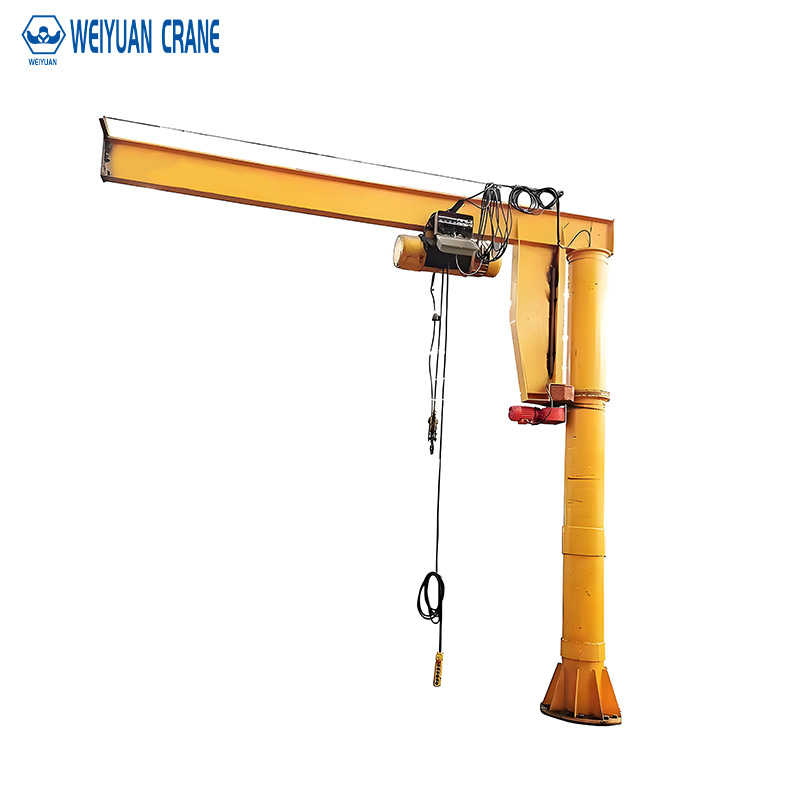
A column-mounted (free-standing) jib crane stands on its own foundation, and that foundation does one demanding job: it resists the crane’s tendency to tip over. Get the foundation right and the crane is rock-solid for its whole life. Get it wrong and the crane rocks, the anchor bolts work loose, and the whole installation becomes unsafe. Outdoors, the stakes rise because the ground itself is less forgiving.
The Overturning Moment — What the Foundation Fights
When a jib crane holds a load at the end of its boom, that load doesn’t just press down — it tries to rotate the entire crane about the base of its column. Engineers call this the overturning moment, and it’s the governing force in foundation design.
The moment is simple to understand:
Overturning moment (M) = Load (P) × Reach (R)
A 1-tonne load at 4 metres of reach generates roughly 40 kN·m of overturning moment (10 kN load × 4 m). That’s the turning force the foundation must resist without tipping, without lifting on one edge, and without letting the column rock. The longer the reach and the heavier the load, the larger the moment — and the bigger the foundation has to be.
Sizing the Concrete Block
A free-standing jib foundation is typically a deep reinforced concrete block sized so its own weight and its bearing footprint resist the overturning moment with a safe margin. Three factors set its dimensions:
- The overturning moment — load times reach, as above. This is the demand.
- The soil bearing capacity — how much load the ground can carry per square metre, established by a geotechnical assessment. Weaker soil needs a wider footprint to spread the load.
- The required safety factor against overturning — the foundation must resist tipping with a defined margin, not just barely balance the moment.
The heavier and deeper the block, and the wider its footprint, the more overturning resistance it provides. This is why a long-reach, heavy-capacity jib can need a surprisingly large foundation — the block is doing real structural work, not just holding the column upright.
Why Outdoor Foundations Need Extra Attention
Indoors, the foundation sits on a stable, dry, temperature-controlled slab. Outdoors, it faces conditions that can undermine it:
- Frost heave. In cold climates, water in the soil freezes and expands, lifting and cracking foundations that don’t extend below the frost line. Outdoor jib foundations must reach below the local frost depth.
- Drainage. Water pooling around the foundation softens the supporting soil and accelerates settlement. Designed drainage keeps water away from the base.
- Soil variability. Outdoor sites — especially yards and dock aprons — often have variable or disturbed soil. A geotechnical check is not optional; it’s the basis for the whole foundation design.
The takeaway: the foundation is where an outdoor column-mounted jib either becomes a fifteen-year asset or a rocking, unsafe liability. Get the overturning moment from your supplier, hand it to a structural engineer with a soil assessment, and design the block to resist tipping with margin — accounting for frost and drainage before you pour.
Part 5: Structural Verification for Wall-Mounted Jibs
Wall-mounted jibs skip the foundation, which makes them cheaper and floor-clearing — but they transfer their forces into the building instead of into the ground. That trade means the host structure has to be verified, and outdoors, the forces are the same demanding numbers whether the wall is inside or out.
How the Bracket Forces Work
A wall-mounted jib bolts to a building column or structural wall through two brackets — an upper and a lower — set a fixed vertical distance apart. The overturning moment that a foundation would resist is instead carried by these two brackets working as a push-pull couple:
- The upper bracket is pulled away from the wall — it’s in tension.
- The lower bracket is pushed into the wall — it’s in compression.
The size of those forces follows a simple relationship:
Bracket force ≈ (Load × Reach) ÷ (vertical distance between brackets)
The critical insight for buyers: the closer together the brackets sit, the higher the forces, because you’re dividing the same moment by a smaller lever arm. A 1-tonne crane on a 4-metre boom can generate an upper-bracket tension force in the range of 30 to 40 kN — a substantial outward pull that tries to rip the upper bracket off the wall.
Why Verification Is Non-Negotiable
Thirty to forty kilonewtons is not a force you can assume an ordinary masonry wall or a light steel column can absorb. This is where wall-mounted jibs fail dangerously: a crane bolted to an inadequate structure can tear its upper bracket loose under load and drop everything.
Before specifying a wall-mounted jib, have a structural engineer confirm the wall or column can carry the bracket forces. The engineer needs the crane’s bracket reaction forces (your supplier provides these) and the details of the host structure. If the structure checks out, wall-mounting is a sound, economical choice. If it doesn’t, the answer is a column-mounted crane on its own foundation — never a hope that the wall holds.
Common Mistakes in Wall Mounting
Three errors show up repeatedly, and all are avoidable:
- Assuming the wall is adequate because it “looks solid.” Appearance tells you nothing about tension capacity. Verify with calculations.
- Ignoring the bracket spacing. Mounting the brackets close together to fit a short column multiplies the forces — sometimes past what the structure can take.
- Skipping the engineer to save time. The structural check costs a fraction of one dropped load, and it’s the whole basis of a safe wall-mounted installation.
Here’s what to remember: a wall-mounted jib is only as strong as the structure behind it. Verify the host can carry 30–40 kN of bracket force before you commit — or switch to a column-mounted unit on a dedicated foundation.
Part 6: Physical Impact Protection — Guarding Against Forklift Damage
Environmental protection keeps weather out of the crane. Impact protection keeps forklifts from destroying it. In any dock or industrial yard where lift trucks share the space, the crane’s mast and its pendant cable are directly in harm’s way — and a single hard hit can bend a mast or shear a cable in a way that no coating spec prevents.
The Mast Is in the Traffic Path
A forklift turning to line up on a trailer, or maneuvering in a tight yard, swings a wide arc. That arc frequently passes right by the jib crane’s mast column. One misjudged turn and the truck contacts the mast — at best a dent, at worst a bent column that throws the whole crane out of true.
The protection is straightforward: steel impact guards around the mast base, either bollards or an angle-iron frame. Position them at a radius of 500 to 700 mm from the mast face — far enough out to clear the crane’s rotation mechanism, close enough to stop a forklift before it reaches the mast itself. Set the bollards in concrete and, outdoors, galvanize them so they don’t become their own corrosion problem.
The Pendant Cable Is Vulnerable Too
A free-hanging pendant control cable is an easy casualty. It dangles into the working space, and a forklift can drive straight through it, tearing the cable or ripping the pendant from its connection. The result is downtime and a repair, every time.
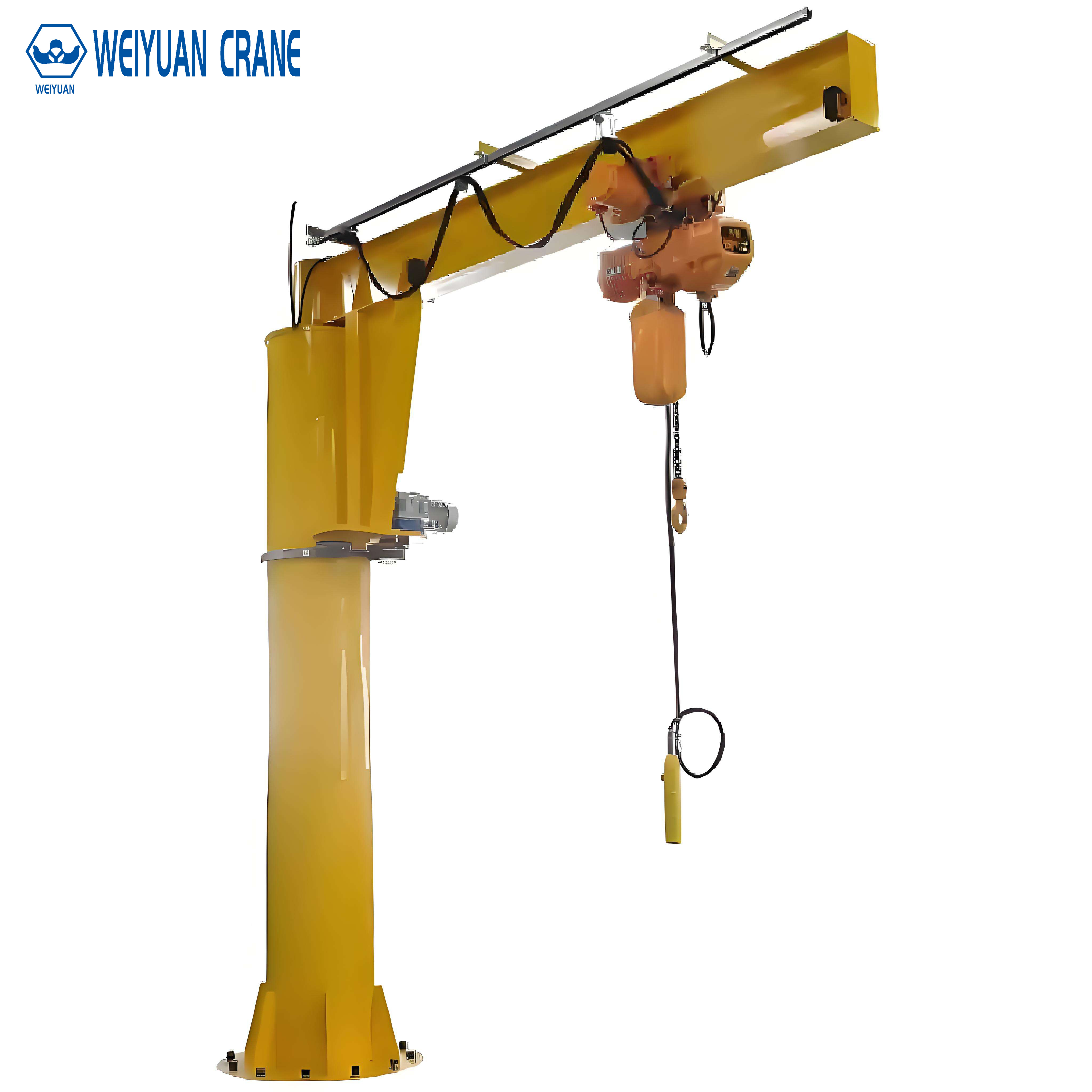
The solution is a festoon cable system on the boom. Instead of hanging free, the pendant cable runs along the boom length in a series of loops, each supported by a festoon trolley that slides as the hoist moves. The cable stays up on the boom, out of the traffic path, and moves with the hoist without ever dangling into the working zone. For any crane sharing space with forklifts, a festoon system pays for itself the first time it prevents a torn cable.
The Impact Protection Package
For a dock or industrial-yard jib, the impact package is simple and worth specifying up front:
- Mast bollards or guard frame at 500–700 mm radius, set in concrete and galvanized
- Festoon cable system on the boom to keep the pendant cable off the traffic path
- Clear floor marking around the crane’s working zone to keep foot traffic and trucks aware of the swing arc
The takeaway: weather protection and impact protection are separate problems, and outdoor cranes in forklift traffic need both. Bollards and a festoon system are cheap compared to a bent mast or a repeated cable failure.
Part 7: Capacity Calculation — Include Everything That Hangs Below the Hook
Capacity looks like the simplest number in the whole specification: weigh the heaviest thing you’ll lift, pick a hoist that lifts it, done. It’s also where outdoor and dock jibs get quietly under-rated — because the calculation counted the load and forgot the hardware holding it.
Rated Capacity Is the Whole Suspended Load
The hoist doesn’t just lift the product. It lifts the product plus every piece of rigging and below-hook tooling in the load path. The correct calculation:
Total suspended load = Product weight + Rigging weight + Below-hook fixture weight
The individual pieces are easy to underestimate:
- A standard 2-leg synthetic sling plus two shackles adds roughly 8 to 15 kg.
- A specialized lifting frame, cargo bar, spreader beam, or vacuum tool can add tens of kilograms — sometimes over a hundred on a substantial fixture.
Leave the tooling out and a “500 kg” jib lifting a 500 kg load on a 40 kg lifting frame is actually being asked for 540 kg — overloaded on the exact task it was bought for.
Size for the Heaviest Lift, Not the Average
A related error is specifying for the typical load rather than the heaviest one. A dock that mostly handles 300 kg pallets but occasionally receives an 800 kg machine component needs an 800 kg or 1-tonne rated hoist — not a 300 kg unit that’s fine ninety-five percent of the time and dangerously overloaded the other five.
Always specify capacity against the single heaviest item the crane will ever lift, tooling included.
Build In Working Margin
Don’t run a hoist at its exact rated capacity in normal service. A common guideline is to work it at no more than about 80% of rated capacity — which protects against the inevitable heavier-than-planned lift and extends component life by keeping the mechanism off its limit.
Put the steps together:
- Add up the total suspended load: heaviest product + rigging + below-hook tooling.
- Divide by 0.8 to apply the working margin.
- Round up to the next standard hoist step (250, 500 kg, 1 tonne, 2 tonne, and so on).
Standard capacity steps keep you on catalog components — lower cost, faster delivery, easier spares — where an odd in-between figure means a custom quote and a longer wait.
Here’s what to remember: the hoist lifts the whole suspended load, not just the product. Count the rigging and tooling, size for the heaviest lift, add working margin, and round up. Skip any of those and you’ll overload the crane on its core job.
Part 8: 2026 Price Reference for Outdoor-Spec Jib Cranes
Use these as planning figures to build a defensible budget before you approach suppliers. Actual pricing moves with capacity, reach, duty class, and — for column-mounted units — the foundation, which is often quoted separately. All figures are installed unless noted.
| Configuration | Capacity / Reach | 2026 Price Range (installed) |
|---|---|---|
| Standard indoor workstation jib (for comparison) | 500 kg / 3 m | $2,500 – $5,500 |
| Outdoor-spec dock jib (IP65, C4 coating, galvanized hardware, bollards) | 500 kg / 4 m | $5,500 – $11,000 |
| Outdoor-spec column-mounted jib, full spec | 1 t / 5 m | $8,000 – $16,000 |
| Outdoor-spec jib, low-headroom hoist + festoon system | 2 t / 5 m | $12,000 – $24,000 |
Option and premium reference:
| Item | 2026 Cost |
|---|---|
| Outdoor specification premium over equivalent indoor crane | +40% to +60% |
| Impact bollard package (4 bollards, hot-dip galvanized) | $600 – $1,500 |
| Cold-climate package (motor heater + synthetic low-temp lubricants) | $400 – $900 per hoist |
| Festoon cable system | priced per boom length |
| Column-mounted foundation | quoted separately — confirm inclusion |
Two budget realities worth flagging:
- The outdoor premium is real and unavoidable. Expect to pay 40–60% more than an equivalent indoor crane for the IP65 electrics, the multi-coat corrosion system, and the galvanized hardware. That premium buys a crane that lasts its full 15-to-20-year service life outdoors instead of aging out in three or four — exactly the difference the coastal facility in our introduction learned the hard way.
- The foundation is frequently excluded from a column-mounted quote. A price that looks competitive may not include the reinforced concrete foundation, which is a genuine civil cost. Confirm what’s in and what’s out before you compare.
Procurement tip: normalize every quote to the same environmental spec, capacity, reach, and — for column-mounted units — the same foundation scope. A quote that looks cheaper often reflects a lower IP rating, a thinner coating, or an excluded foundation, not a genuine saving. That single check separates a real comparison from a costly one.
Frequently Asked Questions
Q: Why isn’t IP54 good enough for a jib crane at an outdoor loading dock?
A: IP54 protects against splashing water — the incidental spray you get indoors — but not against directed rain. At an open dock door or on a fully exposed crane, driving rain and wind push water straight into the electrical enclosures, and IP54’s sealing can’t keep it out. Over a season or two, moisture works into the pendant and control gear and causes the intermittent electrical faults that plague under-specified outdoor cranes. IP65 is the practical floor: the “6” makes the enclosure dust-tight and the “5” resists low-pressure water jets from any direction, which covers directed rain and routine dock spray. Step up to IP66 if the crane will be pressure-washed regularly.
Q: How big does the foundation need to be for a column-mounted outdoor jib?
A: It depends on three things: the overturning moment (load × reach), the soil bearing capacity, and the required safety factor against tipping. A 1-tonne load at 4 metres of reach generates about 40 kN·m of overturning moment, and the foundation — typically a deep reinforced concrete block — must resist that with margin without rocking or lifting on one edge. Weaker soil needs a wider footprint. Outdoors, the block must also extend below the frost line and have drainage to keep water away from the base. Get the overturning moment from your supplier, commission a geotechnical assessment, and let a structural engineer size the block — this isn’t a figure to estimate.
Q: Can I bolt a jib crane to an existing wall or building column outdoors?
A: Only after a structural engineer confirms the structure can carry the bracket forces. A wall-mounted jib transfers its overturning moment into two brackets as a push-pull couple: the upper bracket in tension (pulling off the wall), the lower in compression. A 1-tonne crane on a 4-metre boom can generate 30 to 40 kN of upper-bracket tension — a serious outward pull that an ordinary masonry wall or light steel column cannot be assumed to handle. The closer the two brackets sit vertically, the higher those forces climb. Give the engineer the supplier’s bracket reaction figures and the structure details. If it doesn’t verify, use a column-mounted crane on its own foundation instead.
Q: What extra protection does a jib crane need in a cold climate?
A: Two additions handle most cold-climate failures. First, motor winding heaters (anti-condensation heaters) keep the motor and enclosures a few degrees above ambient during idle periods, preventing the condensation that degrades insulation and corrodes contacts in cold, humid conditions. Second, synthetic low-temperature lubricants in all bearings and gearboxes stay fluid below −10°C, where standard mineral oils thicken and cause drag and cold-start wear. For extreme sites, add low-temperature-rated seals and cable insulation so they stay flexible instead of cracking. The whole package is inexpensive relative to the hard-to-diagnose downtime it prevents.
Q: Do I really need bollards and a festoon system if the crane already has an outdoor coating?
A: Yes — they solve a completely different problem. The coating and IP rating protect against weather and corrosion; they do nothing against physical impact. In any dock or yard where forklifts operate, a wide turn can drive a truck into the mast, and a free-hanging pendant cable is easy to snag and tear. Mast bollards set at a 500–700 mm radius stop a forklift before it reaches the mast, and a festoon system keeps the pendant cable up on the boom and out of the traffic path. Both are cheap compared to a bent mast or repeated cable failures, and both belong on any outdoor crane sharing space with lift trucks.