


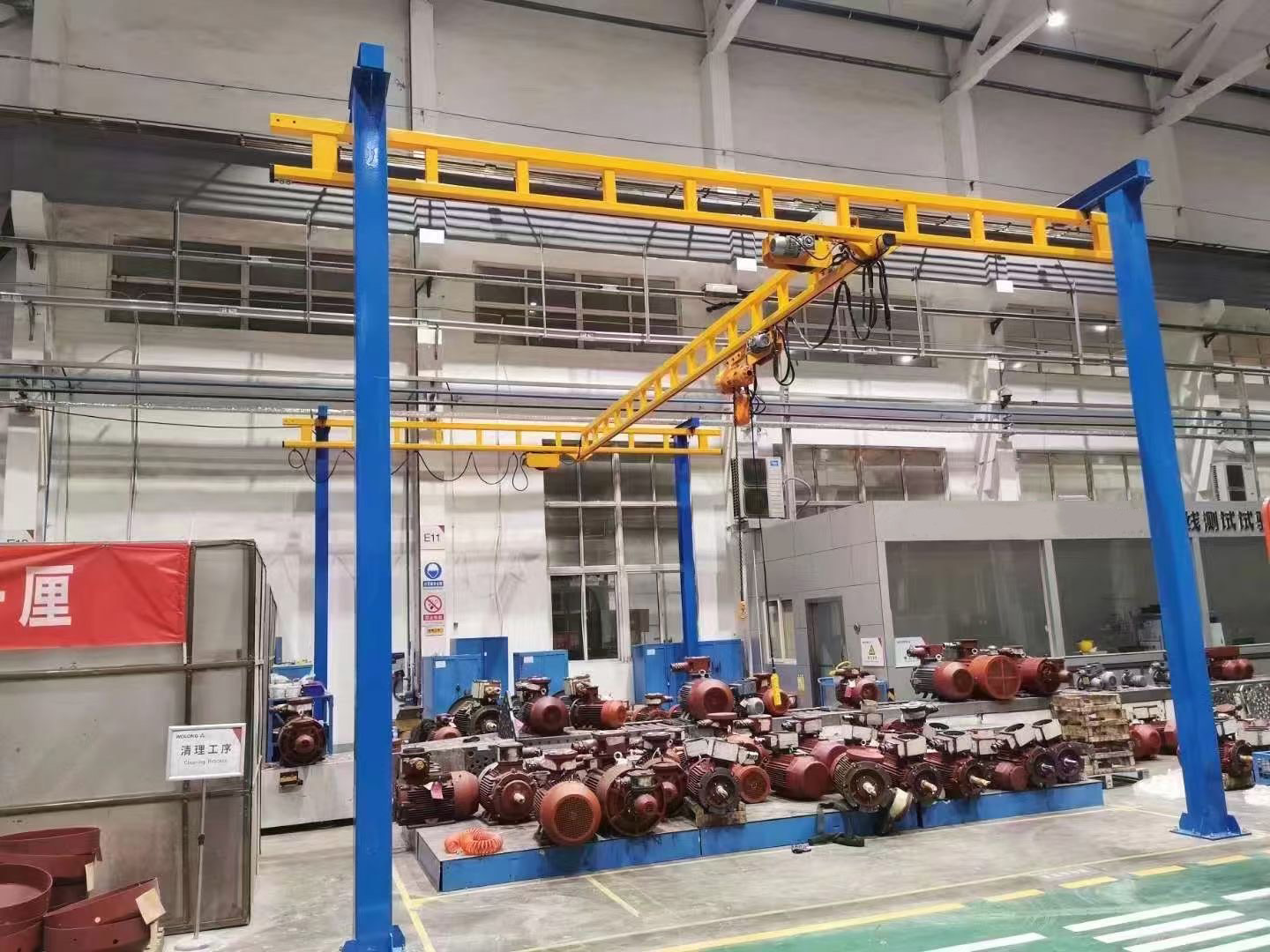
KBK light crane system
KBK Workstation Jib Crane for Sale: Ergonomic Lifting Built Around One Operator
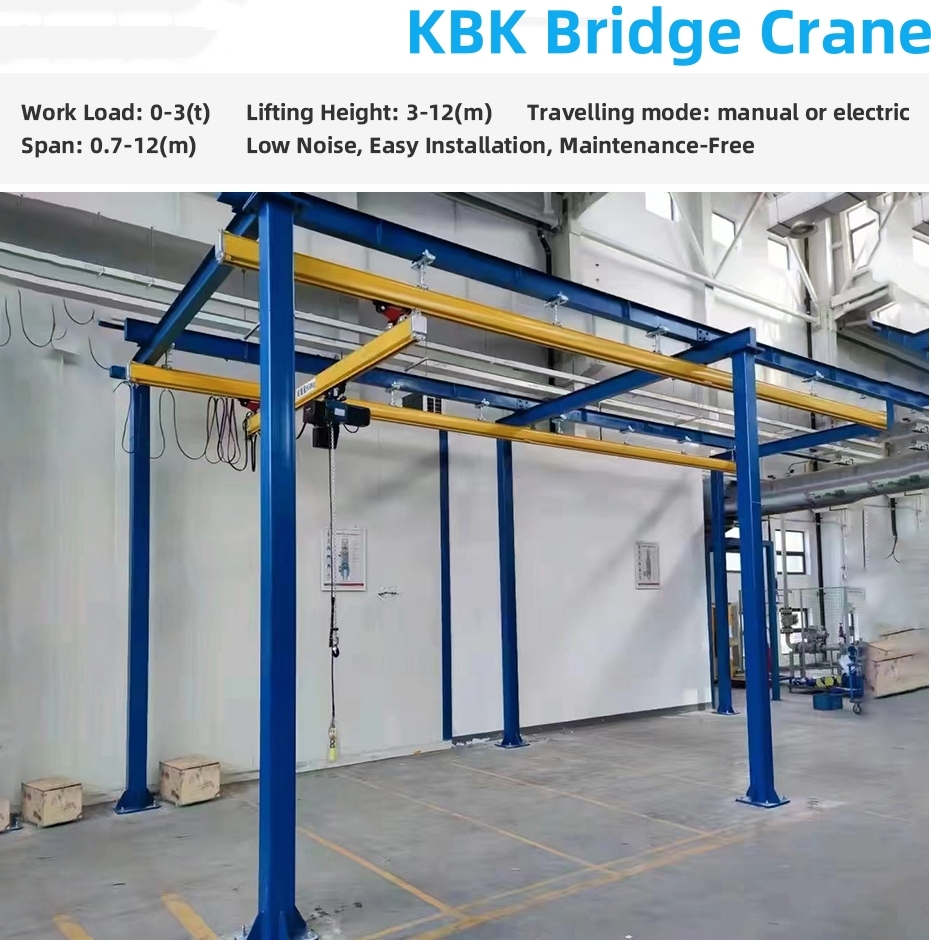
A KBK workstation jib crane answers a need neither a straight monorail nor a full suspension crane is built for: dedicated, ergonomic lifting support for a single operator at one bench or machine, where the load needs to be picked, swung, and set down repeatedly within arm’s reach. Combining a short KBK track section with a swivel (jib-style) arm, it’s engineered around the operator’s actual working envelope rather than a general room-coverage layout.
Weiyuan’s KBK workstation jib crane range covers 80 kg to 1 ton, sized to single-operator lifting cycles rather than bulk material transfer.
What Makes a KBK Workstation Jib Crane Different
Unlike a KBK monorail or suspension crane, which are laid out to cover a path or an area shared across a cell, a KBK workstation jib crane is built around one specific workstation. It typically combines a short section of KBK enclosed track — sometimes wall- or column-mounted, sometimes free-standing — with a rotating jib arm at the working end, giving the operator a swing-and-lift motion similar to a standard jib crane but built on the lighter, more compact KBK modular profile.
This makes it particularly well suited to repetitive, high-frequency lifting cycles at a fixed bench, CNC machine, or inspection station, where a full monorail or suspension layout would be unnecessary infrastructure for a lifting need that never actually leaves one operator’s immediate work envelope.
Series and Capacity Range
Series name: WY-KBK-J Series | Category: KBK workstation jib crane, swivel arm on wall, column, or free-standing mount
| Model | Capacity | Reach (Swivel Arm) | Typical Applications | Control | Hoist Type |
|---|---|---|---|---|---|
| WY-KBK-J08 | 80–125 kg | 1.5–2.5 m | Precision bench assembly, inspection stations | Pendant | Chain hoist |
| WY-KBK-J25 | 125–250 kg | 2–3 m | CNC machine loading, single-operator fabrication support | Pendant | Chain hoist |
| WY-KBK-J50 | 250–500 kg | 2–3.5 m | General workstation lifting, tool and fixture handling | Pendant/remote | Chain hoist |
| WY-KBK-J10 | 0.5–1 ton | 2.5–4 m | Upper limit of workstation jib range — heavier bench-side lifting | Remote | Chain hoist |
Technical Parameters (Reference Range)
| Parameter | Typical Range / Description |
|---|---|
| Mounting type | Wall, column, or free-standing base |
| Swivel rotation | Up to 180°–270°, mount-dependent |
| Duty class | M3–M5 |
| Power supply | 380V/50Hz (customizable) |
| Track section | Short KBK enclosed profile section at the arm’s base |
| Structural verification required | Wall/column rating or foundation, matching standard jib crane requirements |
Featured Product: Weiyuan WY-KBK-J50 Workstation Jib Crane
[Product image placeholder]
The WY-KBK-J50 is a 250–500 kg unit with a 2–3.5 m swivel arm, Weiyuan’s most common workstation jib configuration for general bench-side lifting and tool or fixture handling at a single operator position.
[View Product / Get Quote →]
How to Choose the Right KBK Workstation Jib Crane
- Confirm the lift genuinely stays within one operator’s work envelope — if the load needs to travel between multiple stations, a KBK monorail or suspension crane is the better fit.
- Measure the actual reach needed from the mounting point to every position the operator lifts to or from.
- Size capacity to your heaviest actual bench-side lift, including tooling, using the series table above as a reference.
- Choose wall, column, or free-standing mount based on the same structural verification logic as a standard jib crane.
- Confirm swivel rotation range needed to cover the operator’s full working positions without obstruction.
Red Flags When Shopping for a KBK Workstation Jib Crane
- No structural verification of the wall, column, or foundation — a KBK workstation jib crane carries the same mounting-structure requirements as a standard jib crane, and this shouldn’t be skipped because the unit is lighter-duty.
- Reach specified without mapping the operator’s actual working positions — the arm should be sized to the real workstation layout, not a generic default length.
- No distinction between wall, column, and free-standing mounting options — these suit different site conditions and should be discussed based on what structure is actually available.
- Capacity quoted without confirming duty cycle — a high-frequency lifting station has different component wear considerations than an occasional-use one.
Frequently Asked Questions
Q: What’s the difference between a KBK workstation jib crane and a standard jib crane? A KBK workstation jib crane is built on the lighter, modular KBK profile with a short track section feeding a swivel arm, generally suited to lighter capacities than a standard fabricated jib crane (see the WY-KBK-J series table above), and is often more economical for single-operator, lighter-duty bench applications.
Q: Can a KBK workstation jib crane be combined with a KBK monorail or suspension system? Yes — this is one of the advantages of the modular KBK profile. A workstation jib section can connect into a larger monorail or suspension layout, letting a load be handed off between a shared transfer system and a dedicated single-operator lifting point.
Q: How much weight can a KBK workstation jib crane lift? KBK workstation jib cranes typically range from 80 kg up to about 1 ton (see the series table above), sized for single-operator bench and machine-loading tasks rather than heavier area-wide or point-to-point transfer.
Q: Does a KBK workstation jib crane need the same wall or column assessment as a standard jib crane? Yes — the same structural verification requirement applies regardless of the lighter KBK profile, since the mounting point still needs to carry the moment loading created by a rated load through the arm’s rotation range.
Q: Is a KBK workstation jib crane a good fit for high-frequency lifting cycles? Generally yes — this is one of the configuration’s main strengths, since it’s built around one operator’s repetitive lift-and-place cycle at a fixed station, rather than infrequent or variable-location lifting.
