


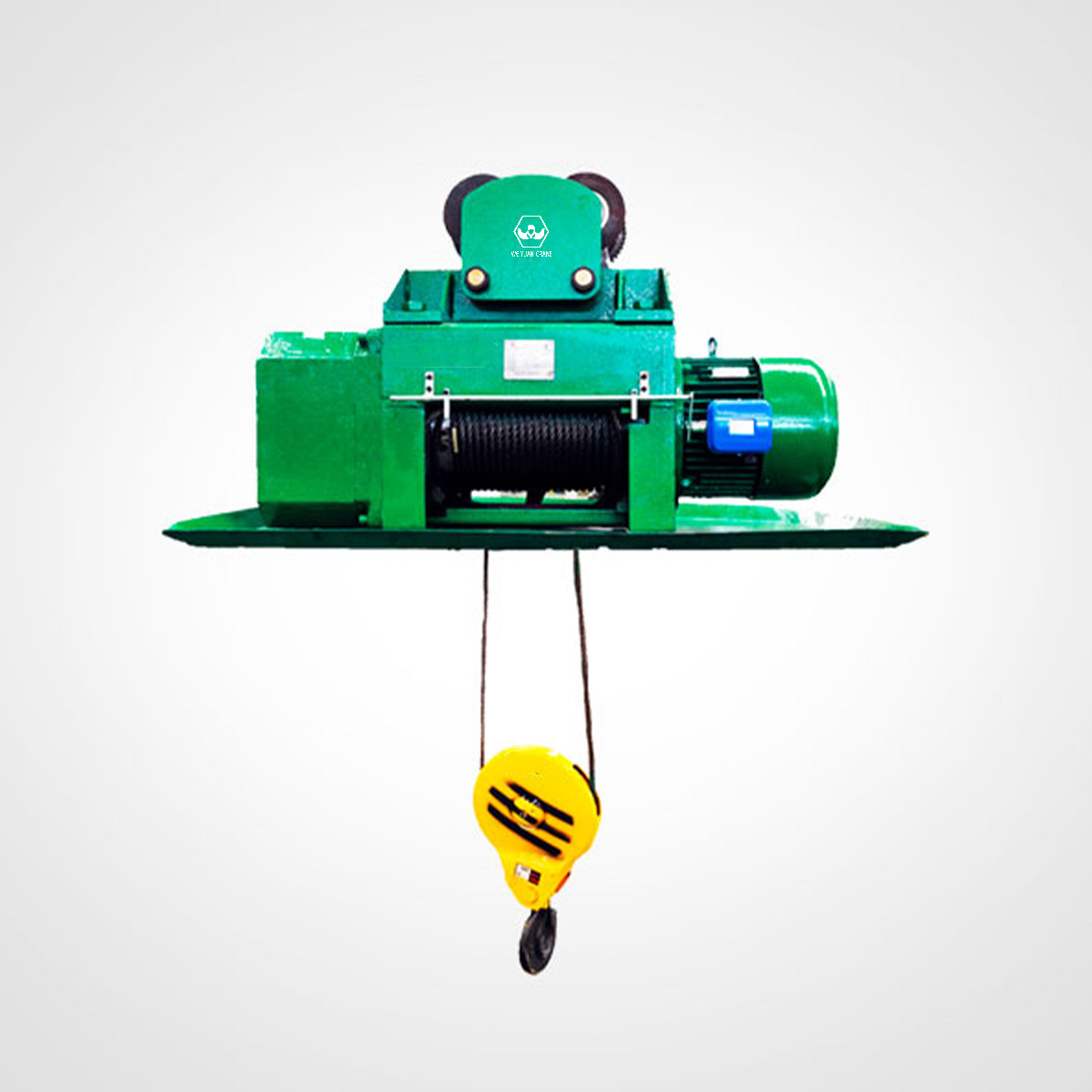
Universal electric hoist
Low-Headroom Electric Hoist for Sale: Maximum Lift Height in a Limited-Clearance Building
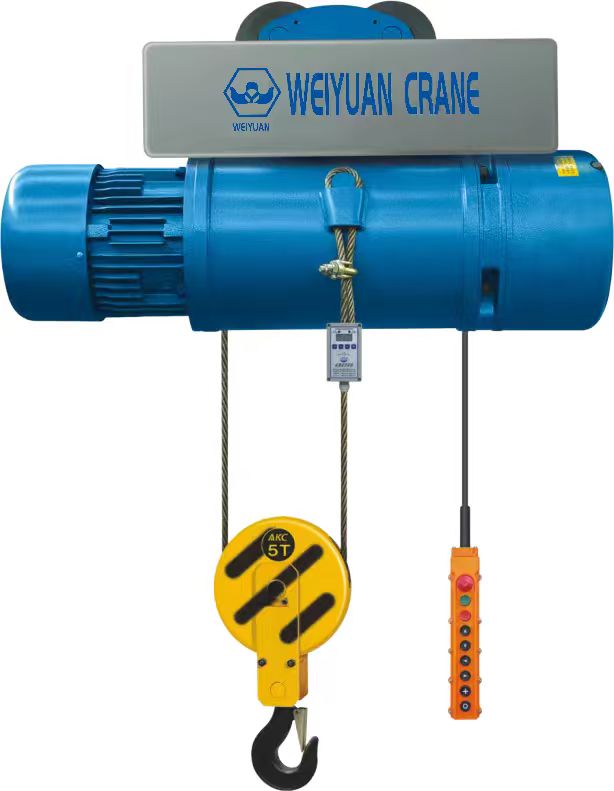
A low-headroom electric hoist solves a problem no standard-headroom unit can: an older building, a low-roof warehouse, or a retrofit installation where the distance between the supporting beam and the highest point the load needs to reach is simply too tight for a conventional hoist’s drum and trolley arrangement. By compacting the drum and trolley into a lower profile, a low-headroom hoist reclaims usable lift height that would otherwise be lost.
Weiyuan’s low-headroom electric hoist range covers 1 to 20 tons, engineered around the customer’s confirmed available clearance.
What Makes a Low-Headroom Electric Hoist Different
A standard-headroom electric wire rope hoist mounts its drum and trolley in a configuration that leaves a certain fixed distance between the supporting beam and the hook’s highest travel position. A low-headroom electric hoist rearranges that drum and trolley assembly — often splitting the drum to sit beside rather than above the load path — into a more compact profile, reducing that distance and reclaiming usable lift height for the same building clearance.
The trade-off is a modest reduction in maximum lift height compared to an equivalent-capacity standard-headroom unit at the same beam height, and in some cases a small capacity de-rating versus the equivalent standard model — a trade worth making wherever clearance is genuinely the binding constraint.
Series and Capacity Range
Series name: WY-EH-LH Series | Category: Low-headroom electric wire rope hoist, compact drum/trolley design
| Model | Capacity | Reduced Headroom Dimension | Typical Applications | Control | Hoist Type |
|---|---|---|---|---|---|
| WY-EH-LH03 | 1–3 tons | Compact profile, single girder mount | Older buildings, retrofit installations with limited clearance | Pendant/remote | Low-headroom wire rope hoist |
| WY-EH-LH05 | 3–5 tons | Compact profile, single or double girder mount | Low-roof warehouses, general workshop lifting | Remote | Low-headroom wire rope hoist |
| WY-EH-LH10 | 5–10 tons | Compact profile, double girder mount | Medium-duty fabrication in headroom-constrained buildings | Remote | Low-headroom wire rope hoist |
| WY-EH-LH20 | 10–20 tons | Compact profile, double girder mount | Upper limit of low-headroom range — heavier constrained-clearance lifting | Remote | Low-headroom wire rope hoist |
Technical Parameters (Reference Range)
| Parameter | Typical Range / Description |
|---|---|
| Duty class | M5–M7 |
| Power supply | 380V/50Hz (customizable) |
| Headroom reduction vs. standard | Typically 15–30% less than an equivalent-capacity standard-headroom unit |
| Drum configuration | Compact or split-drum arrangement, mount-dependent |
| Control options | Pendant, wireless remote, or variable-frequency control |
| Overload and limit protection | Overload protection plus upper/lower limit switches, standard on all models |
Featured Product: Weiyuan WY-EH-LH05 Low-Headroom Electric Hoist
[Product image placeholder]
The WY-EH-LH05 is a 3–5 ton compact-profile unit for single or double girder mount, Weiyuan’s most common low-headroom configuration for low-roof warehouses and general workshop lifting where clearance is the binding constraint.
[View Product / Get Quote →]
How to Choose the Right Low-Headroom Electric Hoist
- Measure your actual available clearance first — the case for a low-headroom unit rests entirely on this figure, not an assumption about the building’s age or appearance.
- Compare that clearance against both standard and low-headroom model dimensions at your required capacity, using the series table above as a reference.
- Confirm your heaviest actual lift, since some low-headroom models carry a modest capacity de-rating versus their standard-headroom equivalent.
- Verify your girder or runway rating matches the mounting configuration (single or double girder) the selected model requires.
- Confirm your duty cycle to guide the duty class specification alongside the headroom decision.
Red Flags When Shopping for a Low-Headroom Electric Hoist
- No side-by-side headroom comparison against a standard unit at the same capacity — the whole justification for choosing low-headroom rests on this comparison, and a supplier should provide it.
- A capacity quote that doesn’t disclose any de-rating versus the standard-headroom equivalent — some low-headroom designs carry a modest capacity trade-off, and this should be stated up front, not discovered later.
- No confirmation of single vs. double girder mounting compatibility — this affects which specific models are actually available at your required capacity.
- Headroom dimensions quoted without reference to your specific measured clearance — a generic “low-headroom” label isn’t a substitute for confirming the actual numbers fit your building.
Frequently Asked Questions
Q: How much headroom does a low-headroom electric hoist actually save? Typically 15–30% less than an equivalent-capacity standard-headroom unit (see the technical parameters table above), though the exact figure varies by model and capacity — always compare the specific model’s dimensions against your measured clearance.
Q: Does a low-headroom electric hoist lift less than a standard hoist of the same capacity rating? In some cases, a low-headroom design carries a modest capacity de-rating compared to its standard-headroom equivalent — this should be disclosed by the supplier and factored into your capacity sizing, not assumed to be identical.
Q: When do I need a low-headroom electric hoist instead of a standard one? When your measured available clearance — the distance between the supporting beam and the highest point the load needs to reach — is too tight for a standard-headroom unit’s drum and trolley dimensions at your required capacity. This is a measurement-driven decision, not a default upgrade.
Q: What capacity range is available in low-headroom electric hoists? Weiyuan’s low-headroom range covers 1 to 20 tons (see the series table above); very heavy or very light capacities are more commonly served by standard-headroom wire rope or chain hoist configurations respectively.
Q: Can a low-headroom electric hoist be retrofitted into an existing crane system? Often yes, provided the existing girder or runway is compatible with the selected model’s mounting configuration — this should be confirmed against your existing structure before ordering, since not every retrofit is a straightforward swap.