


Overhead Crane Applications: Industry Use Cases and Selection Guide
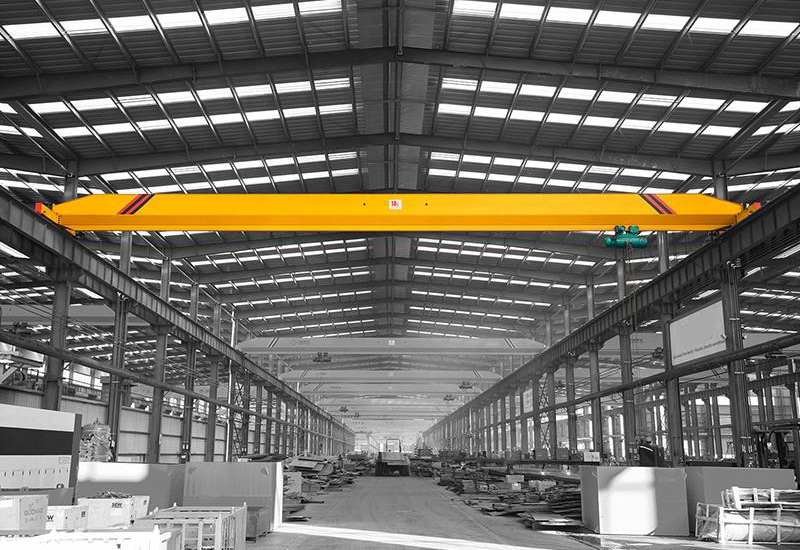
TL;DR: Overhead cranes serve six very different industrial worlds—manufacturing and heavy fabrication, steel and foundry, automotive, aerospace, warehousing and logistics, and energy and power plants. Each sector shapes the crane around its own priorities: capacity, duty cycle, precision, hook height, and environment. Choosing the right specification starts from your industry’s real demands, not a generic catalog. Resolve load, duty cycle, environment, span, and total cost of ownership in order, and the right configuration follows.
An overhead crane in a foundry and one in an aerospace assembly hangar share the same core idea—a bridge girder traveling elevated runways—yet almost nothing else about them matches. One shuttles white-hot ladles through heat, dust, and molten splash. The other places a fuselage section with millimeter precision in a spotless, climate-controlled bay.
That difference matters the moment you make a purchase decision. Buy a crane built for one industry’s demands and force it into another, and you inherit the wrong capacity, the wrong duty class, and the wrong operating cost—for the next 20 to 30 years.
This guide walks through how six major industries use overhead cranes. For each, you will see the typical load types, the performance factors that matter most, and the specification choices that follow. By the end, you will have a clear framework for matching an overhead crane to the real demands of your sector—and avoiding the costly mismatches that quietly drain budget and uptime.
Why Industry Context Drives Overhead Crane Specification
Overhead cranes earn their place across so many sectors for one core reason: they keep lifting equipment overhead, freeing the entire floor for movement, storage, and production. A trolley and hoist cover a full rectangular work area while the floor below stays clear.
But that shared advantage plays out very differently from one industry to the next. What each sector actually demands from a crane varies enormously:
- Capacity and duty cycle — a foundry lifting molten metal dozens of times per shift needs a far higher duty class than a warehouse making occasional lifts.
- Positioning precision — aerospace and automotive assembly demand fine, jolt-free control that a bulk steel yard never requires.
- Environmental protection — heat, dust, moisture, and corrosive air each call for specific enclosures, coatings, and ingress ratings.
- Hook height and span — some bays need maximum lift height in a fixed clear height; others need to cover a wide open floor.
Get the specification right and the crane disappears into your workflow—reliable, safe, and efficient for decades. Get it wrong and it becomes a bottleneck, a safety liability, or a maintenance sink. The smart approach starts from your industry’s priorities, then works toward the configuration.
Overhead Crane Applications by Industry
1. Manufacturing and Heavy Fabrication
Manufacturing plants and fabrication shops rely on overhead cranes to move raw stock, sub-assemblies, and finished products between workstations. In steel fabrication, they handle plate, beams, and welded assemblies. In heavy machinery production, they lift engine blocks, castings, and completed units onto transport.
Typical load types: steel plate and sections, castings, weldments, machine assemblies—commonly 5 to 100 tonnes.
Key performance considerations:
- Duty cycle — production lines run continuously, so the crane needs a CMAA classification matched to frequent lifting. Under-classifying here guarantees premature wear.
- Positioning precision — assembly and welding work demand fine control for accurate, repeatable placement.
- Span and floor clearance — the crane must cover workstations and material lanes without blocking floor traffic.
For most fabrication settings, a top running crane on dedicated runway beams delivers the open working span and capacity range these operations need. Single girder suits lighter bays; double girder handles heavier loads and recovers hook height.
2. Steel and Foundry
Steel mills and foundries run some of the most punishing crane applications anywhere. Cranes handle ladles of molten metal, hot ingots, coils, and slabs in an environment of extreme heat, dust, and constant heavy cycling. This is where crane engineering is tested hardest.
Typical load types: molten metal ladles, hot ingots and slabs, steel coils, scrap charging buckets—commonly 20 to several hundred tonnes.
Key performance considerations:
- Extreme duty class — near-continuous, heavy-cycle service demands the highest CMAA duty classifications (Class E or F) built for fatigue resistance.
- Heat protection — radiant heat from molten loads requires heat shields, insulated components, and thermally rated ropes and controls.
- Redundant braking and safety — carrying molten metal over a working floor leaves zero margin for a failed brake or dropped load.
- Rugged structure — reinforced double girder box construction stands up to dust, heat, and years of severe use.
Foundry-duty cranes are purpose-engineered equipment. Specifying a general-purpose crane for ladle handling is a serious and dangerous mistake.
3. Automotive
Automotive plants use overhead cranes throughout the production chain—in stamping, powertrain assembly, body shops, and die handling. Speed, precision, and repeatability define success on a line where thousands of units move through every day.
Typical load types: stamping dies, engine and transmission assemblies, body panels, tooling and fixtures—commonly 5 to 50 tonnes, with heavy dies at the upper end.
Key performance considerations:
- Cycle speed and repeatability — high-volume lines need fast, consistent lifts, so hoist and travel speeds matter directly to throughput.
- Precise positioning — VFD smooth control delivers jolt-free starts and stops that protect sensitive assemblies and dies.
- Die handling capacity — stamping die changes involve heavy, awkward loads that demand reliable capacity and secure lifting.
- Automation readiness — many automotive cranes integrate with production control systems for programmed, repeatable movements.
For die handling and heavy assembly work, double girder top running cranes with VFD controls are the standard choice.
4. Aerospace
Aerospace manufacturing places cranes in a category of their own—not for weight, but for precision, cleanliness, and the extraordinary value of the components being lifted. A single misstep can damage a part worth millions.
Typical load types: fuselage sections, wing assemblies, engines, large composite structures—loads are often lighter than heavy industry but exceptionally large, delicate, and high-value.
Key performance considerations:
- Ultra-fine positioning — micro-speed control and multi-axis adjustment place large structures with millimeter accuracy.
- Anti-sway and smooth control — VFD drives and anti-sway technology eliminate load pendulum motion that could damage components or misalign a join.
- Twin-hoist coordination — long fuselage and wing sections often need synchronized hoists to lift and level as a single unit.
- Clean-environment build — controls and components must suit climate-controlled, contamination-sensitive assembly halls.
In aerospace, the crane is a precision instrument. Positioning capability, not raw capacity, drives the specification.
5. Warehousing and Logistics
Warehousing and distribution operations use overhead cranes to move palletized goods, bulky items, and heavy inventory that forklifts handle slowly or unsafely. The priority here is throughput, floor efficiency, and reducing manual handling.
Typical load types: palletized goods, bulk containers, coils, machinery, and oversized inventory—commonly 1 to 20 tonnes.
Key performance considerations:
- Floor space efficiency — keeping lifting overhead frees aisles and storage lanes for stock and vehicle movement.
- Moderate duty cycle — most warehouse lifting is light to medium frequency, so single girder cranes often serve well at lower cost.
- Precise placement — accurate positioning onto racks, staging areas, and transport reduces product damage.
- Flexible coverage — the crane should reach receiving, staging, and dispatch zones without creating bottlenecks.
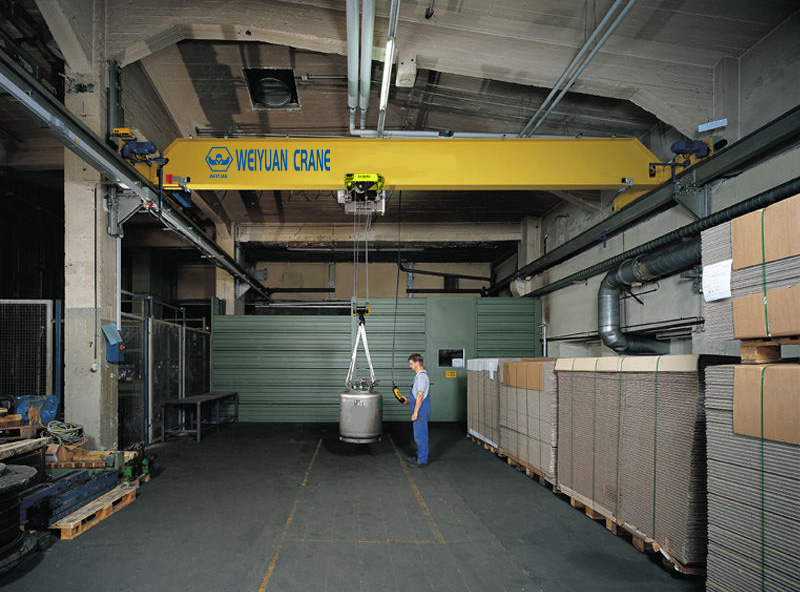
Single girder cranes—top running or under running depending on capacity and building structure—are the common, cost-effective choice for most warehouse and logistics settings.
6. Energy and Power Plants
Power generation facilities—thermal, hydro, nuclear, and renewable—use overhead cranes for equipment installation and periodic maintenance. They lift turbines, generators, transformers, and heavy components during construction and major overhauls, often after long idle periods.
Typical load types: turbine rotors, generators, transformers, boiler components, reactor parts—commonly 50 to several hundred tonnes.
Key performance considerations:
- Reliability and high safety margins — lifts near critical or hazardous equipment demand the highest reliability and redundancy.
- Precise low-speed control — installing sensitive components requires smooth, creep-speed positioning.
- Long service intervals — plant cranes may sit idle between overhauls, then perform critical heavy lifts, so dependable readiness matters.
- Specialized compliance — nuclear and other regulated settings carry strict single-failure-proof and certification requirements.
Power plant cranes are typically heavy-duty double girder systems, engineered for maximum capacity, precision, and long-term reliability over decades of service.
How to Match Overhead Crane Specifications to Your Industry
Every sector above points toward different specification priorities. Use this framework to translate your industry’s demands into the right crane configuration.
1. Start with load and duty cycle
Define the heaviest load, the average load, and how often lifts occur. Add the weight of spreaders, lifting frames, and rigging, plus a safety margin. Then match the CMAA duty class to your real lifting frequency—a foundry’s near-continuous cycling needs Class E or F, while an occasional-use plant crane can sit lower. Under-classifying a high-cycle crane guarantees early failure.
2. Define the operating environment
Clean aerospace and automotive bays favor precise electric drives and contamination-sensitive builds. Foundries need heat protection. Outdoor or humid settings need corrosion-resistant coatings and appropriate ingress ratings. Specify the environmental protection your sector actually demands—not a generic finish.
3. Set span, hook height, and reach
Measure the bay width the crane must cover and the maximum hook height you need. Tight headroom points toward double girder top running designs that recover lift height, since the trolley sits on top of the girders. Confirm hook height using the actual beam depths from your structural design.
4. Weigh precision requirements
Bulk steel and warehouse handling tolerate standard control. Automotive, aerospace, and power installation demand VFD smooth control, micro-speed positioning, and sometimes anti-sway technology. The higher your placement accuracy needs, the more the control system drives the specification.
5. Calculate total cost of ownership
Look past the purchase price to installation, runway steel, power supply, maintenance, and a service life of 20 to 30 years. A high-utilization line may justify premium drives that pay back through uptime and energy savings, while an occasional-use crane prioritizes reliability over speed.
In short: load, duty cycle, environment, span and hook height, precision, and lifetime cost—resolve these factors in order, and the right specification emerges from your industry’s demands rather than from guesswork.
Frequently Asked Questions
Q: Which industries use overhead cranes the most?
Overhead cranes are widely used in manufacturing and heavy fabrication, steel and foundry work, automotive production, aerospace assembly, warehousing and logistics, and energy and power generation. Each sector values a different mix of capacity, duty cycle, precision, and environmental protection, which is why overhead crane designs vary so widely across industries.
Q: What is the most demanding overhead crane application?
Steel and foundry work is among the most demanding. These cranes handle molten metal and hot loads in extreme heat, dust, and near-continuous heavy cycling, requiring the highest CMAA duty classes (E or F), heat protection, redundant braking, and reinforced structures. Nuclear power applications are equally demanding for different reasons—strict single-failure-proof and certification requirements.
Q: How do I choose the right overhead crane capacity for my industry?
Start with the heaviest single load your operation will lift, then add the weight of spreaders, lifting frames, and rigging, plus a safety margin. Factor in how often you lift at or near that maximum. High-frequency heavy lifting—common in foundries and heavy fabrication—requires a higher duty classification, while occasional peak lifts allow a different design balance.
Q: Why do aerospace cranes need such precise control if the loads are relatively light?
In aerospace, the challenge is not weight but precision and value. Fuselage sections, wings, and engines are large, delicate, and worth millions, requiring millimeter-accurate placement. VFD micro-speed control, anti-sway technology, and synchronized twin hoists eliminate the jolts and load swing that could damage components or misalign a critical join.
Q: Can one overhead crane design serve multiple industries?
Some general-purpose top running cranes serve fabrication and warehouse settings across sectors. But most demanding or specialized applications require industry-specific engineering. Capacity, duty cycle, environmental protection, and precision differ enough between foundries, aerospace bays, and power plants that a purpose-matched design almost always outperforms a generic one over its service life.
Q: What environmental protection does my industry require?
It depends on your setting. Foundries need heat shields and thermally rated components. Outdoor, humid, or coastal facilities need corrosion-resistant coatings and higher ingress-protection ratings. Aerospace and pharmaceutical-grade bays need clean, contamination-sensitive builds. Specifying the correct protection for your sector is essential to achieving the expected 20-to-30-year service life.