


Jib Crane Types and Selection Guide: Choosing the Right Configuration for Your Facility
Introduction
A jib crane looks simple: a boom that swings around a pivot, carrying a hoist that lifts and positions loads. But that simplicity hides a real range of configurations, each built for a very different job.
Pick the wrong one, and the cost shows up fast. A wall-mounted jib crane bolted to a wall that can’t carry the load becomes a safety hazard. A freestanding column crane planted in the middle of a tight bay wastes floor space you can’t spare. An undersized boom that can’t reach the far edge of a workstation turns into a daily frustration for the very operators it was meant to help.
For procurement managers and facility owners, matching the jib crane type to the actual work is the decision that shapes cost, safety, and productivity for years. This guide breaks down the four main jib crane types, explains how their structures differ, and lays out a practical framework for choosing the right one. Whether you are equipping a new workstation or replacing an aging unit, you will finish with a clear way to narrow the field.
What Is a Jib Crane?
A jib crane is a lifting system built around a horizontal boom (the jib) that rotates about a vertical axis. A hoist and trolley run along the boom to lift loads and move them in and out, while the boom itself swings through an arc to cover a circular or semicircular working area.
That rotating-boom design makes jib cranes ideal for localized, repetitive lifting at a single workstation or along a defined zone. They handle the kind of lifting that would be overkill for a full bridge crane but too heavy or too frequent for manual handling. You will find them in machine shops, assembly cells, loading docks, and maintenance bays across nearly every industry.
Within that category, four main types serve very different coverage patterns, capacity ranges, and building conditions. The right choice depends on how much area you need to cover, how much weight you lift, and what your building can actually support.
The 4 Main Types of Jib Cranes
1. Wall-Mounted Jib Crane
A wall-mounted jib crane bolts directly to a building wall or to a structural steel column. The boom projects horizontally from the wall bracket and swings through an arc, typically up to 180 degrees, since the wall blocks rotation behind the mounting point.
Structural profile: Boom and support arm fixed to wall brackets, no floor mounting, no supporting column.
Practical capacity and reach: Commonly 250 kg to 5 tonnes, with boom lengths from 2 to 6 metres. Heavier configurations are possible where the wall structure allows.
Ideal use cases: Workstations along a load-bearing wall, machine tending, and any setting where floor space must stay completely clear. Common in machine shops and assembly lines built against a solid wall.
Key advantage: Zero floor footprint. Because nothing stands on the ground, the full floor area below the boom stays usable for equipment, traffic, and storage. It also costs less than freestanding designs, since it borrows the building structure for support.
2. Freestanding (Floor-Mounted) Jib Crane
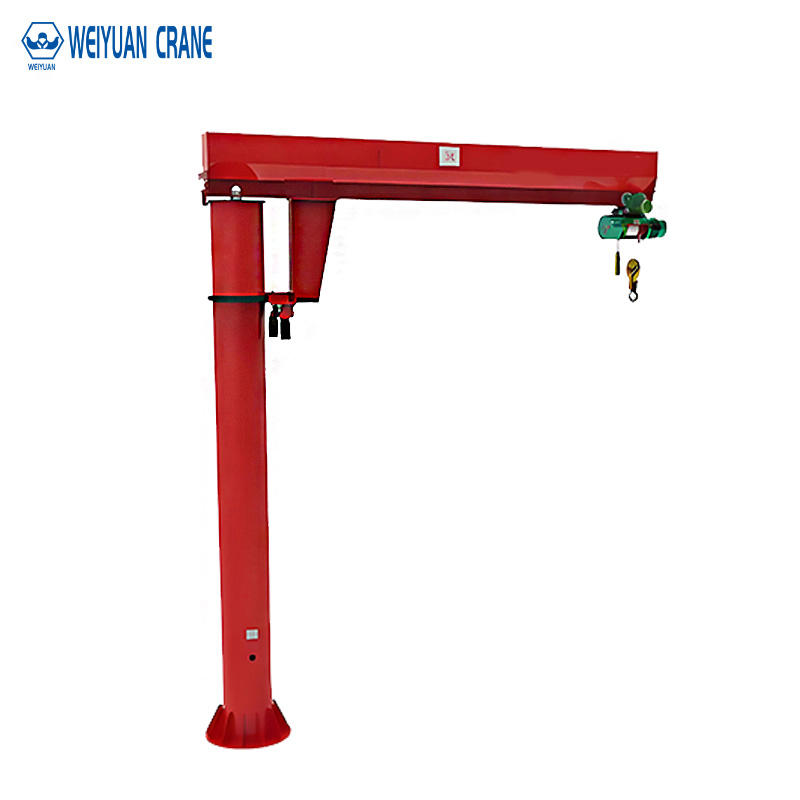
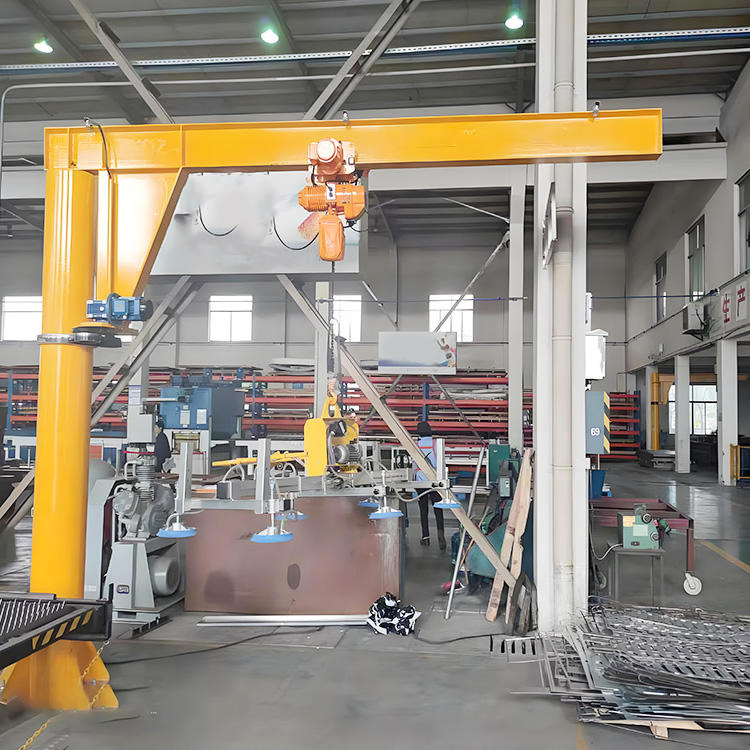
A freestanding jib crane stands on its own foundation. A vertical column is anchored into a reinforced concrete footing, and the boom rotates around that column, usually through a full 360 degrees.
Structural profile: Self-supporting column on a dedicated foundation, with the boom pivoting at the top or along the column.
Practical capacity and reach: The widest range of any jib type, from around 125 kg to 15 tonnes or more, with booms reaching 3 to 8 metres and beyond.
Ideal use cases: Open floor areas where no wall is available, standalone workstations, and heavy-duty lifting that needs full-circle coverage. Common in fabrication shops, foundries, and outdoor yards.
Key advantage: Full 360-degree rotation and the highest capacity range. Because it does not depend on the building, you can place it anywhere the foundation allows, and it handles heavier loads than any wall-supported design.
3. Mast-Type Jib Crane
A mast-type jib crane uses a vertical mast supported at both the floor and the roof structure (or an overhead beam). The boom pivots around this mast, which is held top and bottom rather than cantilevered from a single point.
Structural profile: Mast fixed at floor level and braced at the top to the building’s roof or an overhead member, with the boom rotating around it.
Practical capacity and reach: Roughly 250 kg to 10 tonnes, with booms from 3 to 8 metres. Because the mast is supported at both ends, it often achieves longer reach and full rotation without a massive foundation.
Ideal use cases: Facilities that need 360-degree coverage but cannot pour the heavy foundation a freestanding crane requires, or where an existing roof structure can carry the top load.
Key advantage: Full-circle rotation with a lighter foundation. By transferring load to the building roof at the top, the mast-type design avoids the large, deep footing a freestanding column needs, saving on civil work when the building can take the top reaction.
4. Wall Traveling Jib Crane
A wall traveling jib crane mounts on a horizontal rail that runs along a wall. The whole boom-and-mast assembly travels laterally along that rail, adding a third axis of movement on top of the boom’s swing and the hoist’s lift.
Structural profile: Traveling carriage on a wall-mounted rail, carrying the mast and boom, with manual or motorized travel along the wall.
Practical capacity and reach: Typically 250 kg to 5 tonnes, with booms of 2 to 6 metres, running along rails that can extend tens of metres.
Ideal use cases: Rows of workstations arranged linearly along one wall, where a single crane needs to serve every position along that line.
Key advantage: Line coverage from a single crane. Instead of covering one fixed semicircle, it reaches any point along the full length of the rail, replacing several fixed cranes with one flexible unit while keeping the floor clear.
How to Select the Right Jib Crane
The right type emerges when you resolve a handful of factors in order. Work through these before committing to any configuration.
Load capacity and duty cycle
Start with your heaviest lift, then add the weight of any spreader beams, lifting frames, and rigging, plus a sensible safety margin. Next, factor in frequency. A crane making occasional light lifts can run at a lower duty class than one cycling heavy loads all shift. Heavy, frequent lifting points toward freestanding designs built for the load and the cycle rate, while light, intermittent work opens up the lighter wall-mounted and mast-type options.
Coverage area needed
Map out the shape of the area the crane must serve. A single fixed workstation calls for the semicircle of a wall-mounted crane or the full circle of a freestanding or mast-type unit. A long row of stations along a wall points straight to a wall traveling crane. Match the coverage pattern to how your work is actually laid out, not to a generic footprint.
Building structure compatibility
Ask what your building can physically support. A load-bearing concrete wall or steel column can carry a wall-mounted or wall traveling crane. A roof structure rated for the top reaction can support a mast-type crane. If the building can carry nothing, a freestanding crane on its own foundation is the answer. Never assume a wall or roof is adequate. A structural assessment is essential before any wall- or roof-supported installation.
Floor space constraints
Decide how much floor you can give up. Wall-mounted and wall traveling cranes take zero floor space, which is decisive in tight bays and busy aisles. A mast-type crane needs only a modest floor connection. A freestanding crane requires both floor space for the column and a substantial foundation below it. When every square metre counts, the wall-supported types win.
Total cost of ownership
Look past the purchase price. Factor in foundation and civil work, installation, any structural reinforcement, maintenance, and expected service life. A freestanding crane carries higher upfront foundation cost but delivers capacity and full rotation no wall type can match. A wall traveling crane costs more than one fixed crane but often less than the four or five fixed cranes it replaces, giving a lower cost per metre of coverage.
Selection framework at a glance:
- Fixed workstation against a wall, floor must stay clear → wall-mounted
- Open floor, heavy loads, full rotation → freestanding
- Full rotation needed, but foundation must stay light → mast-type
- Row of stations along one wall → wall traveling
Frequently Asked Questions
Q: What is the difference between a wall-mounted and a freestanding jib crane?
A wall-mounted jib crane bolts to a wall or column and swings through an arc of up to 180 degrees, using no floor space. A freestanding jib crane stands on its own foundation, rotates a full 360 degrees, and handles far heavier loads. Choose wall-mounted when you have a strong wall and need to keep the floor clear, and freestanding when you need full rotation, higher capacity, or have no wall to use.
Q: How much floor space does a jib crane need?
It depends on the type. Wall-mounted and wall traveling cranes use zero floor space because they attach to the wall. A mast-type crane needs only a small floor connection point. A freestanding crane requires floor space for its column plus a reinforced concrete foundation sized to the load and boom length. In tight facilities, the wall-supported types are usually the better fit.
Q: What capacity range do jib cranes cover?
Most jib cranes fall between 125 kg and 15 tonnes. Wall-mounted and wall traveling cranes commonly handle 250 kg to 5 tonnes. Mast-type cranes reach around 10 tonnes. Freestanding cranes cover the widest range and handle the heaviest loads. Always include rigging weight and a safety margin when setting your required capacity.
Q: Can a jib crane rotate a full 360 degrees?
Freestanding and mast-type jib cranes typically rotate a full 360 degrees around their column or mast. Wall-mounted and wall traveling cranes are limited to roughly 180 degrees, because the wall blocks rotation behind the mounting point. If full-circle coverage is essential, a freestanding or mast-type design is the right choice.
Q: Do I need a special foundation for a jib crane?
Freestanding jib cranes require a dedicated reinforced concrete foundation engineered for the load and overturning moment. Mast-type cranes need a lighter floor connection because the roof carries the top reaction. Wall-mounted and wall traveling cranes rely on the wall structure and need no floor foundation, though the wall must be assessed and often reinforced. A structural engineer should confirm every installation.