


Jib Crane Applications: Industry Use Cases and Selection Guide
Introduction
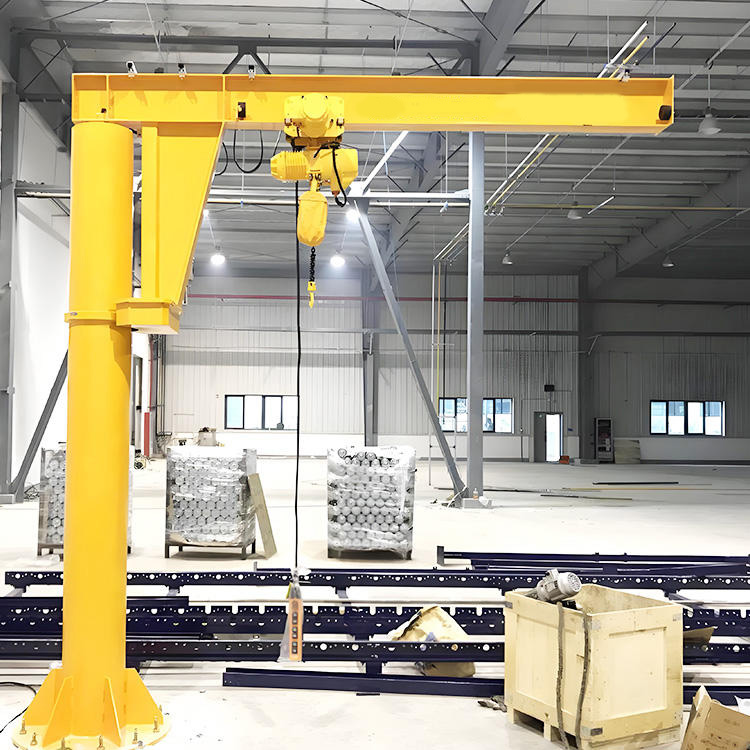
A jib crane in a machine shop and a jib crane in an aerospace assembly hall share the same basic idea — a boom that swings around a pivot, carrying a hoist that lifts and positions loads. Yet almost nothing else about them matches. One swings a 2-tonne casting onto a lathe dozens of times a shift. The other places a delicate composite panel with millimeter precision in a spotless, climate-controlled bay.
That difference matters the moment you make a purchase decision. Buy a jib crane built for one industry’s demands and force it into another, and you inherit the wrong capacity, the wrong duty class, and the wrong operating cost — for the next 15 to 25 years.
This guide walks through how six major industries use jib cranes: machine shops and metalworking, automotive assembly, aerospace, warehousing and logistics, oil and gas maintenance, and shipbuilding and heavy fabrication. For each, you will see the typical load types, the performance factors that matter most, and which jib crane type fits best. By the end, you will have a clear framework for matching a jib crane to the real demands of your sector — and avoiding the costly mismatches that quietly drain budget and uptime.
Why Industry Context Drives Jib Crane Specification
Jib cranes earn their place across so many sectors for one core reason: they deliver fast, localized lifting at a single workstation or along a defined zone, without the cost or footprint of a full bridge crane. A boom swings, a hoist lifts, and a heavy or awkward load moves under smooth control — right where the work happens.
But that shared advantage plays out very differently from one industry to the next. What each sector actually demands from a jib crane varies enormously:
- Capacity and duty cycle — a metalworking shop cycling castings all shift needs a far higher duty class than a maintenance bay making occasional lifts.
- Positioning precision — aerospace and automotive assembly demand fine, jolt-free control that a bulk warehouse never requires.
- Environmental protection — heat, dust, moisture, salt air, and explosive atmospheres each call for specific coatings, seals, and equipment ratings.
- Coverage pattern — some work sits at one fixed station, while other work runs along a wall or needs full 360-degree reach.
Get the specification right and the crane disappears into your workflow — reliable, safe, and efficient for years. Get it wrong and it becomes a bottleneck, a safety liability, or a maintenance sink. The smart approach starts from your industry’s priorities, then works toward the configuration.
Jib Crane Applications by Industry
1. Machine Shops and Metalworking
Machine shops rely on jib cranes to load and unload heavy workpieces at individual machine tools — lathes, mills, grinders, and boring machines. The crane lifts raw stock into the chuck, removes finished parts, and shuttles castings, dies, and fixtures between the machine and staging areas. This is the classic jib crane application, and one of the most common.
Typical load types: raw billets and bar stock, castings, forgings, machined components, dies, and tooling — commonly 250 kg to 5 tonnes.
Key performance considerations:
- Duty cycle — a busy shop cycles loads all shift, so the crane needs a duty class matched to frequent lifting rather than occasional use.
- Precise positioning — loading a workpiece into a chuck or onto a table demands fine control and steady, drift-free hoist braking.
- Clear-floor operation — machine bays are tight, so keeping lifting equipment off the floor preserves working space around the tool.
Best-fit type: A wall-mounted jib crane suits a machine set against a load-bearing wall, keeping the floor completely clear. Where a tool sits in the open, a freestanding or mast-type crane with 360-degree rotation lets the operator swing parts in from any direction.
2. Automotive Assembly
Automotive plants use jib cranes throughout the production chain — in engine and transmission assembly, body shops, and component sub-assembly cells. Speed, repeatability, and ergonomics define success on a line where the same lift repeats thousands of times a day.
Typical load types: engine and transmission units, axle assemblies, body panels, tooling, and fixtures — commonly 250 kg to 3 tonnes.
Key performance considerations:
- High duty cycle — repetitive line work demands a robust duty class and components built for constant cycling.
- Smooth, jolt-free control — variable-speed hoist and rotation protect sensitive assemblies and reduce operator strain.
- Ergonomic assist — motorized travel or articulating booms help operators guide loads precisely with minimal physical effort.
Best-fit type: Articulating (dual-arm) jib cranes shine in assembly cells, reaching around obstacles and into confined spaces. Wall traveling jib cranes serve a row of assembly stations along one wall, letting a single crane cover the full line.
3. Aerospace
Aerospace manufacturing places jib cranes in a category of their own — not for weight, but for precision, cleanliness, and the extraordinary value of the parts being handled. A single misstep can damage a component worth a fortune.
Typical load types: engine components, landing gear, composite panels, structural sub-assemblies, and precision tooling — often lighter than heavy industry, but large, delicate, and high-value.
Key performance considerations:
- Ultra-fine positioning — micro-speed hoist control and smooth rotation place components with millimeter accuracy.
- Anti-sway control — eliminating load pendulum motion protects fragile parts and prevents misalignment during a join.
- Clean-environment build — controls and components must suit climate-controlled, contamination-sensitive assembly halls.
- Repeatable accuracy — consistent placement supports tight aerospace quality and traceability standards.
Best-fit type: Freestanding or mast-type jib cranes with full 360-degree rotation and variable-frequency-drive control deliver the precision and repeatability these bays need. Articulating designs help operators thread large assemblies into tight positions.
4. Warehousing and Logistics
Warehousing and distribution operations use jib cranes to handle bulky or heavy items that forklifts move slowly or unsafely — at loading docks, transfer points, and packaging stations. The priority here is throughput, floor efficiency, and reducing manual handling injuries.
Typical load types: palletized goods, drums, coils, machinery, and oversized inventory — commonly 250 kg to 5 tonnes.
Key performance considerations:
- Moderate duty cycle — most warehouse lifting is light to medium frequency, so lighter, lower-cost configurations often serve well.
- Dock and transfer coverage — the crane must reach truck beds, staging areas, and conveyor lines without blocking traffic.
- Simple, reliable operation — a broad pool of operators means controls should be intuitive and forgiving.
- Floor clearance — keeping aisles open for forklifts and foot traffic is essential.
Best-fit type: Wall-mounted jib cranes handle fixed dock and station work with zero floor footprint. Where loads move along a row of docks or bays, a wall traveling jib crane provides line coverage from a single unit.
5. Oil and Gas Maintenance Facilities
Oil and gas operations use jib cranes for equipment maintenance at pumps, valves, compressors, and wellhead assemblies — often in harsh outdoor or offshore conditions. Reliability and environmental protection dominate the specification here, because downtime and hazards both carry steep costs.
Typical load types: valves, pump and motor components, pipe spools, compressor parts, and heavy fittings — commonly 500 kg to 10 tonnes.
Key performance considerations:
- Hazardous-area protection — many locations require explosion-proof (ATEX or equivalent) motors, controls, and hoists rated for flammable atmospheres.
- Corrosion resistance — salt air, humidity, and chemical exposure demand heavy coatings, galvanizing, or stainless components.
- High reliability — maintenance often happens during critical shutdown windows, so the crane must perform on demand after long idle periods.
- Rugged construction — dust, vibration, and weather call for sealed, durable equipment.
Best-fit type: Freestanding jib cranes on their own foundation suit outdoor equipment pads, specified with explosion-proof drives and corrosion-resistant finishes. Wall-mounted units serve maintenance bays and enclosed process areas where a structure can carry the load.
6. Shipbuilding and Heavy Fabrication
Shipyards and heavy fabrication shops use jib cranes for welding stations, plate handling, and component assembly — often as a supplement to the large gantry and bridge cranes that move major sections. The jib crane handles the localized, repetitive lifting at each work cell.
Typical load types: steel plate, weldments, pipe sections, brackets, and sub-assemblies — commonly 1 to 15 tonnes.
Key performance considerations:
- Higher capacity range — heavy fabrication pushes toward the upper end of jib crane capacity, favoring robust structures.
- Heavy-duty cycle — constant welding and fitting work demands a high duty class and fatigue-resistant welds.
- Weather and marine protection — outdoor and coastal yards need aggressive corrosion protection.
- Reach and rotation — full-circle coverage lets a welder position plate and components from any angle at the station.
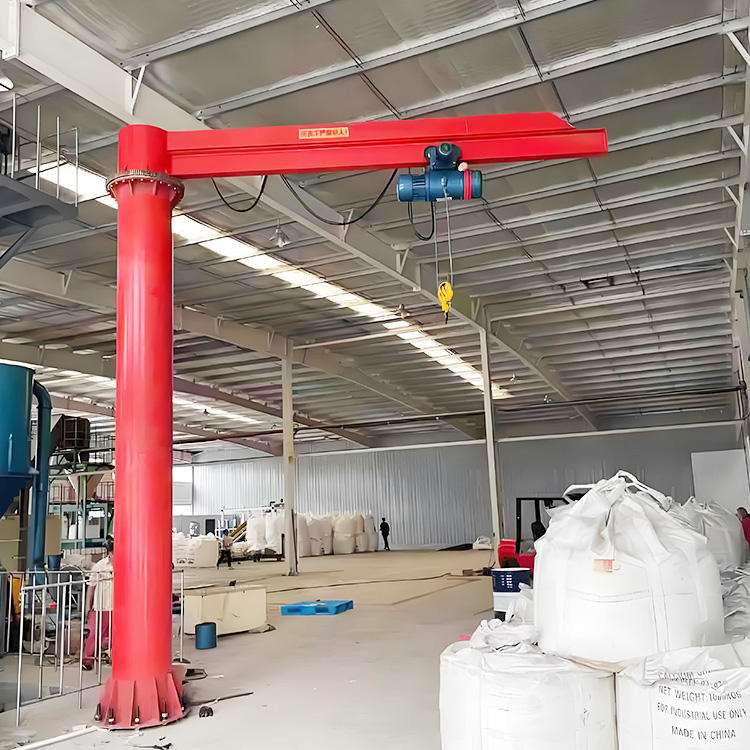
Best-fit type: Freestanding jib cranes deliver the capacity and 360-degree rotation these stations demand. Mast-type cranes work well where an existing roof or overhead structure can carry the top reaction, saving on foundation cost.
How to Match Jib Crane Specifications to Your Industry
Every sector above points toward different specification priorities. Use this framework to translate your industry’s demands into the right jib crane configuration.
1. Start with load and duty cycle
Define the heaviest load, the average load, and how often lifts occur. Add the weight of any spreaders, lifting frames, and rigging, plus a safety margin. Then match the duty class to your real lifting frequency — a metalworking shop or automotive line cycling all shift needs a robust class, while an occasional-use maintenance crane can sit lower. Under-classifying a high-cycle crane guarantees early failure.
2. Define the operating environment
Clean aerospace and automotive bays favor precise electric drives and contamination-sensitive builds. Oil and gas sites need explosion-proof equipment and heavy corrosion protection. Shipyards and coastal fabrication demand aggressive coatings and sealed components. Specify the environmental protection your sector actually requires — not a generic finish.
3. Set coverage pattern and reach
Map the shape of the area the crane must serve. A fixed workstation calls for the semicircle of a wall-mounted crane or the full circle of a freestanding or mast-type unit. A row of stations along a wall points to a wall traveling crane. Assembly cells with obstacles favor articulating designs. Match the coverage to how your work is actually laid out.
4. Weigh precision requirements
Bulk warehouse and heavy plate handling tolerate standard control. Automotive, aerospace, and precision assembly demand variable-frequency-drive smooth control, micro-speed positioning, and sometimes anti-sway technology. The higher your placement accuracy needs, the more the control system drives the specification.
5. Confirm what the building can support
Ask what your structure can physically carry. A load-bearing wall or steel column supports wall-mounted or wall traveling cranes. A rated roof structure supports a mast-type crane. If the building can carry nothing, a freestanding crane on its own foundation is the answer. A structural assessment is essential before any wall- or roof-supported installation.
6. Calculate total cost of ownership
Look past the purchase price to foundation and civil work, installation, structural reinforcement, maintenance, and a service life of 15 to 25 years. A freestanding crane carries higher upfront foundation cost but delivers capacity and full rotation no wall type can match. A wall traveling crane costs more than one fixed unit but often less than the several fixed cranes it replaces.
In short: load, duty cycle, environment, coverage, precision, building structure, and lifetime cost — resolve these factors in order, and the right specification emerges from your industry’s demands rather than from guesswork.
Frequently Asked Questions
Q: Which industries use jib cranes the most?
Jib cranes are widely used in machine shops and metalworking, automotive assembly, aerospace manufacturing, warehousing and logistics, oil and gas maintenance, and shipbuilding and heavy fabrication. Each sector values a different mix of capacity, duty cycle, precision, and environmental protection, which is why jib crane types and specifications vary so widely across industries.
Q: What is the most demanding jib crane application?
Oil and gas maintenance and shipbuilding rank among the most demanding, but for different reasons. Oil and gas often requires explosion-proof equipment and heavy corrosion protection for hazardous, outdoor, or offshore conditions. Shipbuilding and heavy fabrication push capacity and duty cycle to the upper end, with constant heavy work in marine environments. Aerospace is demanding in another way — extreme precision rather than weight.
Q: How do I choose the right jib crane capacity for my industry?
Start with the heaviest single load your operation will lift, then add the weight of spreaders, lifting frames, and rigging, plus a safety margin. Factor in how often you lift at or near that maximum. High-frequency heavy lifting — common in metalworking and heavy fabrication — requires a higher duty classification, while occasional peak lifts in a maintenance bay allow a different design balance.
Q: Why do aerospace jib cranes need such precise control if the loads are relatively light?
In aerospace, the challenge is precision and value, not weight. Engine components, landing gear, and composite structures are delicate and extremely valuable, requiring millimeter-accurate placement. Variable-frequency-drive micro-speed control, anti-sway technology, and smooth rotation eliminate the jolts and load swing that could damage components or misalign a critical join.
Q: Which jib crane type is best for handling loads along a production wall?
A wall traveling jib crane is the best fit for work arranged linearly along one wall. Instead of covering a single fixed semicircle, its boom-and-mast assembly travels along a wall-mounted rail, reaching any position across the full rail length. One wall traveling crane can replace several fixed cranes while keeping the floor completely clear — ideal for rows of assembly, dock, or machining stations.
Q: What environmental protection does my industry require?
It depends on your setting. Oil and gas sites need explosion-proof motors and controls plus heavy corrosion protection. Shipyards and coastal fabrication need aggressive coatings and sealed components against salt air. Aerospace bays need clean, contamination-sensitive builds. Machine shops and warehouses usually run standard indoor finishes. Specifying the correct protection for your sector is essential to achieving the expected service life.
Q: Can one jib crane design serve multiple industries?
Some general-purpose wall-mounted and freestanding cranes serve machine shops and warehouses across sectors. But most specialized applications require industry-specific engineering. Capacity, duty cycle, environmental protection, and precision differ enough between an aerospace bay, an oil and gas platform, and a shipyard that a purpose-matched design almost always outperforms a generic one over its service life.