


KBK Crane Types and Selection Guide: Choosing the Right Modular Light Crane System for Your Facility
Introduction
Not every lifting job needs a heavy overhead crane. Many workstations move loads under two tonnes, over short spans, dozens of times a shift. For that work, a full bridge crane is overkill—and a modular light crane system fits far better.
KBK cranes fill exactly this gap. They are light, modular, and easy to reconfigure, built for repetitive, ergonomic handling right at the point of work. Yet the same modularity that makes them flexible also makes selection tricky. Choose the wrong track profile, span, or configuration and you end up with a system that binds under load, wastes headroom, or can’t grow with your line.
This guide breaks down what a KBK crane is, how it differs from conventional cranes, the main configurations available, and the practical factors that should drive your choice. Whether you are equipping a new assembly cell or upgrading a manual handling station, you will finish with a clear framework for matching the right modular system to your work.
What Is a KBK Crane?
A KBK crane is a modular light crane system built from standardized, prefabricated track profiles that bolt or suspend together into a complete lifting solution. The name comes from the German “Kranbausystem in Baukastenbauweise”—roughly, a crane construction system built from a kit of parts. That kit concept is the heart of the design.
Instead of a heavy welded girder engineered for one fixed layout, a KBK system uses light enclosed-profile track sections, suspension components, trolleys, and end connectors that assemble into single tracks, bridges, and full grids. The track is typically cold-rolled steel with an enclosed lower flange that keeps the trolley wheels clean and running smoothly.
The result is a lifting system that stays light, hangs from the building roof structure, and covers a workstation or production zone with precise, low-effort movement.
How KBK Differs From Conventional Cranes
Conventional overhead and bridge cranes are built around heavy structural girders, ground-mounted columns, or wall-supported runways engineered for a specific capacity and span. They excel at heavy loads and wide bays. But they are fixed, costly to relocate, and often oversized for light, repetitive tasks.
KBK systems flip that logic. The key differences:
- Modularity over permanence. KBK track assembles from standard components, so a system can be extended, rerouted, or relocated without cutting and rewelding structural steel.
- Light capacity, light weight. KBK handles loads up to roughly 2,000 kg, and its own low dead weight means it suspends directly from the roof structure rather than demanding heavy columns or brackets.
- Ergonomics first. The enclosed profile and free-running trolleys let an operator move a load by hand with minimal effort—ideal for high-cycle workstation lifting.
- Fast, clean installation. Bolted and suspended connections go up quickly, with far less site work than a welded runway.
In short, conventional cranes are built for heavy, fixed duty. KBK cranes are built for light, flexible, ergonomic duty at the workstation.
The Main Types of KBK Crane Configurations
KBK’s kit-of-parts approach supports several standard configurations. Each covers a different work pattern, from a single straight line of travel to a full-area grid.
1. Monorail (Single-Track) System
The simplest KBK configuration is a single track fixed overhead, with a trolley and hoist running along its length. The load moves back and forth in one straight line.
Structural profile: One suspended enclosed-profile track; no bridge, no cross travel.
Ideal use cases: Moving parts along a fixed path—between two machines, along an assembly sequence, or from a delivery point to a workstation. Also common for feeding curved track around corners and through door openings.
Key advantage: Lowest cost and simplest install. Where the work follows one line, a monorail delivers smooth, guided movement without paying for coverage you don’t need. KBK monorail can also include curves, switches, and turntables for more complex single-path routing.
2. Single-Girder Suspension Bridge Crane
A single-girder KBK bridge crane uses one bridge track suspended from two parallel runway tracks. The bridge travels along the runways while the hoist trolley traverses the bridge—giving full coverage of a rectangular area.
Structural profile: One bridge girder on two runways, suspended from the roof structure.
Practical capacity: Typically up to around 1,000 kg, depending on span and track profile.
Ideal use cases: Workstations and assembly cells that need area coverage for light loads—electronics assembly, small-parts machining, packaging lines.
Key advantage: Full-area coverage at low weight and low cost. The single-girder design keeps dead weight down, which matters when the system hangs from an existing roof.
3. Double-Girder Suspension Bridge Crane
A double-girder KBK bridge crane uses two parallel bridge tracks instead of one, with the hoist trolley running between or below them. The twin-girder layout carries higher loads and spans wider bays than a single-girder system.
Structural profile: Two bridge girders on two (or more) runways.
Practical capacity: Up to the top of the KBK range—around 2,000 kg—with longer bridge spans than single-girder allows.
Ideal use cases: Heavier workstation lifting and wider production cells that still fall within light-crane territory—automotive sub-assembly, heavier component handling.
Key advantage: Higher capacity and wider span within the modular system. When a single girder would deflect too much or fall short on capacity, the double-girder configuration extends KBK’s reach without jumping to a full overhead crane.
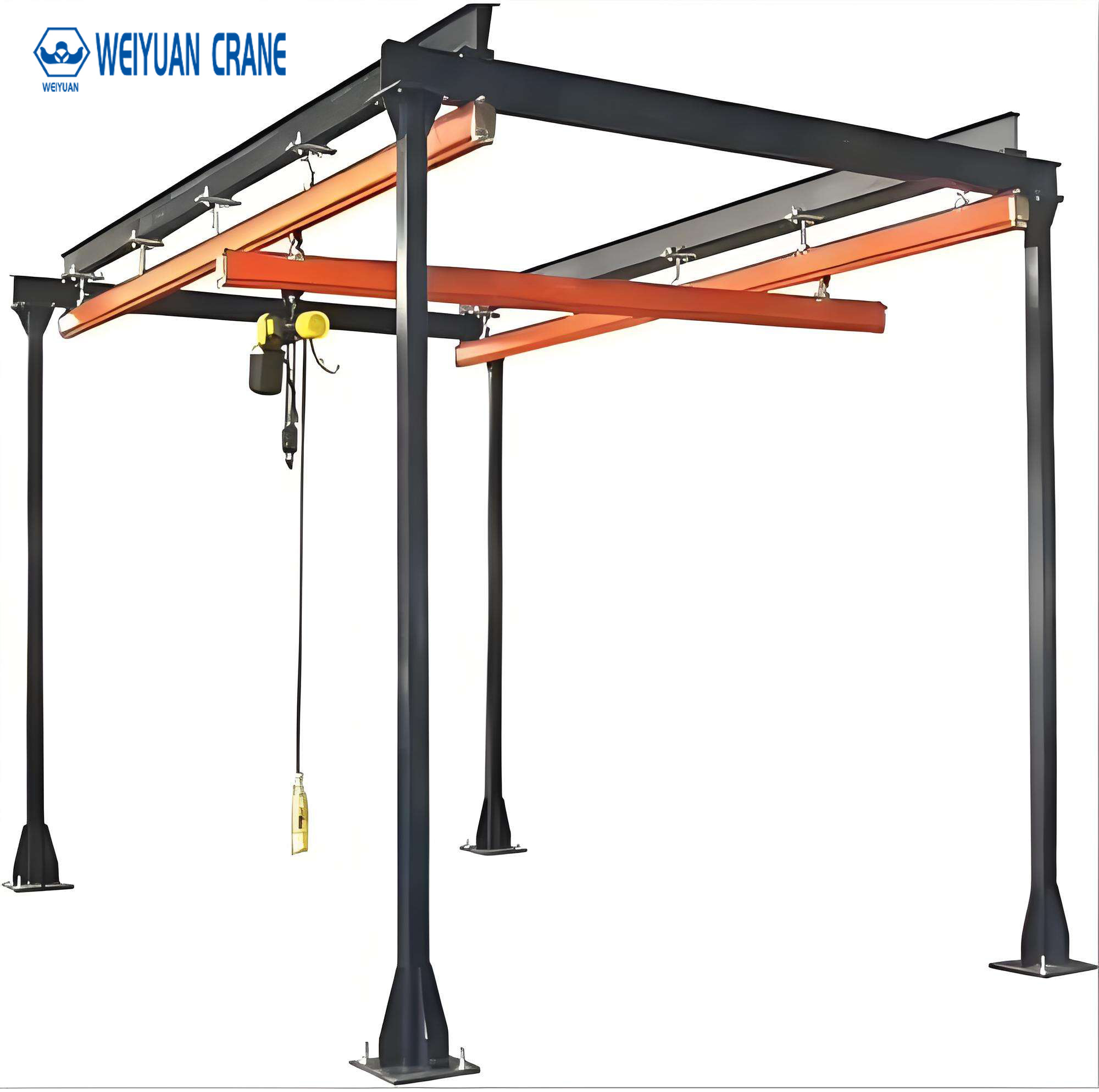
4. Workstation Bridge Crane (Multi-Bridge Grid)
For larger areas, multiple KBK bridges can share a common runway system, or several independent systems can cover adjacent zones. This creates a flexible grid that serves a whole production area with light, ergonomic lifting.
Structural profile: One or more bridges across a shared runway grid, suspended overhead.
Ideal use cases: Multi-station assembly lines, larger production halls, and layouts where several operators need independent lifting within one coverage zone.
Key advantage: Scalable coverage. Because everything is modular, the grid can be extended or reconfigured as the production layout changes—adding bridges, extending runways, or rerouting track as the line evolves.
Practical Capacity and Span Ranges
KBK is a light crane system by design, and its capacity range reflects that. Understanding where the practical limits sit keeps your selection realistic.
Capacity: Standard KBK systems handle from around 50 kg up to approximately 2,000 kg. Light monorail and single-girder systems typically cover the lower end, while double-girder configurations reach the top of the range. Beyond roughly 2,000 kg, the application usually calls for a conventional overhead or bridge crane rather than a modular light system.
Span: KBK spans are modest compared with heavy bridge cranes—commonly up to around 8 metres for bridge configurations, with runway lengths extending much further through added track sections. Longer spans increase track deflection, so the profile size and support spacing must be matched to the span to keep the trolley running smoothly.
Support spacing: Because KBK suspends from the roof, hanger spacing along the runway is a key design variable. Closer suspension points allow lighter track profiles; wider spacing needs a heavier profile to control deflection.
Always size the track profile to the combined load, span, and support spacing together—not to any single factor in isolation.
Key Advantages of KBK Modular Light Crane Systems
KBK earns its place in modern facilities for a specific set of reasons. These are the advantages that matter most when you compare it against fixed conventional cranes.
- Modularity and easy reconfiguration. The kit-of-parts design lets you extend, reroute, or relocate a system using standard components. When production lines change, the crane changes with them—no structural rework required.
- Low headroom. The compact suspended profile and low-headroom trolley options recover valuable lift height in buildings with limited clearance—a frequent constraint in older or multi-use facilities.
- Lightweight track. Light steel enclosed profiles (and aluminium options for the lightest duty) keep dead weight low, so the system hangs from the existing roof structure instead of demanding heavy columns and foundations.
- Ergonomic, low-effort movement. Enclosed track and free-running trolleys let operators move loads by hand with minimal force, cutting strain, reducing injury risk, and speeding up repetitive cycles.
- Fast, clean installation. Bolted and suspended connections install quickly with limited disruption, and the same connections make future changes straightforward.
- Precise positioning. Smooth trolley travel and controlled hoisting place loads accurately at the workstation, protecting both parts and equipment.
Taken together, these advantages make KBK the natural choice wherever light loads, high cycle rates, tight headroom, and changing layouts define the work.
How to Select the Right KBK Crane
The right configuration emerges when you work through a handful of factors in order. Resolve these before committing to any design.
1. Load capacity and duty cycle
Start with your heaviest lift, then add the weight of any lifting device, spreader, or tooling, plus a sensible safety margin. Next, factor in frequency. A workstation cycling loads all shift needs a track profile and components rated for high duty, while occasional lifts allow a lighter build. Confirm your peak load sits comfortably within KBK’s practical ceiling of around 2,000 kg.
2. Span and coverage pattern
Map the shape of the area the crane must serve. A straight, fixed path points to a monorail. A rectangular work zone calls for a single- or double-girder bridge. A larger hall points toward a multi-bridge grid. Match the coverage to how the work actually flows, and keep spans within the range that your chosen track profile can support without excessive deflection.
3. Hook height and headroom
Measure your building’s clear height and the maximum hook height you need. KBK’s low-headroom design is a genuine advantage in tight buildings, but you still need to calculate available hook height from the actual track depth, suspension drop, and hoist headroom. Where clearance is critical, specify low-headroom trolleys and hoists.
4. Building structure compatibility
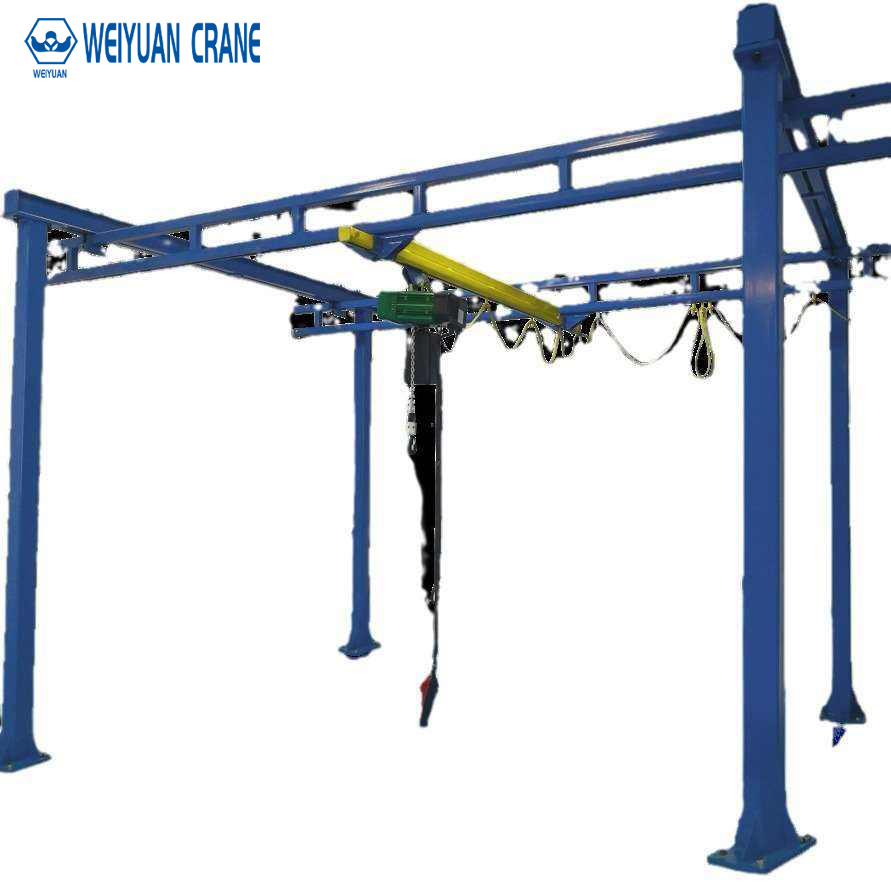
Because KBK suspends from the roof, the roof structure must carry the system’s dead weight plus the rated load at each suspension point. Confirm the roof beams, purlins, or supporting steel can take the hanger loads at the required spacing. Where the roof cannot, a freestanding KBK support structure carries the load independently. A structural assessment is essential before installation.
5. Total cost of ownership
Look past the purchase price. Factor in installation, suspension or support steel, maintenance, and—critically—the value of future flexibility. KBK’s modularity often pays back over time: a system that can be extended or reconfigured as your line evolves avoids the cost of replacing a fixed crane when layouts change.
Selection framework at a glance:
- Straight, fixed path → monorail
- Light load, rectangular cell → single-girder bridge
- Heavier load or wider span, still under 2,000 kg → double-girder bridge
- Large area, multiple stations → multi-bridge grid
Frequently Asked Questions
Q: What is a KBK crane and what does the name mean?
A KBK crane is a modular light crane system assembled from standardized, prefabricated track profiles and components. The name derives from a German term describing a crane construction system built from a kit of parts. Rather than a heavy welded girder, it uses light enclosed-profile track that bolts and suspends together into monorails, bridge cranes, and full grids, making it ideal for light, repetitive, ergonomic lifting at the workstation.
Q: What is the maximum capacity of a KBK crane?
Standard KBK systems handle loads from around 50 kg up to approximately 2,000 kg. Lighter monorail and single-girder configurations cover the lower end, while double-girder systems reach the top of the range. For loads above roughly 2,000 kg, a conventional overhead or bridge crane is usually the better choice than a modular light system.
Q: How is a KBK crane different from a standard overhead crane?
A standard overhead crane uses a heavy structural girder engineered for a fixed, higher-capacity application. A KBK crane uses light modular track that suspends from the roof and assembles from standard parts. KBK is lighter, faster to install, easy to reconfigure or relocate, and designed for ergonomic light-duty lifting—while overhead cranes handle heavier loads and wider spans in fixed installations.
Q: Can a KBK crane system be extended or reconfigured later?
Yes—this is one of KBK’s core advantages. Because the system is built from standardized components with bolted and suspended connections, you can extend runways, add bridges, reroute track, or relocate the system as your production layout changes. This modularity makes KBK well suited to facilities that expect their lines or workstations to evolve over time.
Q: Does a KBK crane need special foundations or building support?
KBK systems typically suspend from the building’s roof structure rather than requiring heavy foundations, so the roof must be able to carry the dead weight plus rated load at each suspension point. Where the roof cannot support these loads, a freestanding KBK support structure carries the system independently. A structural assessment should confirm the building or support structure is adequate before installation.
Q: What are the main KBK crane configurations?
The main configurations are the monorail (a single track for straight-line travel), the single-girder suspension bridge crane (one bridge on two runways for area coverage), the double-girder suspension bridge crane (two bridges for higher capacity and wider spans), and the multi-bridge workstation grid (several bridges sharing a runway system for larger areas). Each suits a different coverage pattern and load range.