


Electric Hoist Types and Selection Guide
Introduction
The hoist is the part of your lifting system that actually does the lifting. The crane structure positions it. The runway moves it. But the hoist is what raises and lowers the load, cycle after cycle, often thousands of times a year. Choose the wrong one and you feel it every shift — slow lifts, overheating motors, premature wear, or a unit that simply cannot handle the environment it works in.
For procurement managers and facility owners, the electric hoist decision carries more weight than its size suggests. It sets your practical lift capacity, your cycle speed, your maintenance burden, and whether the equipment survives the heat, dust, or explosive atmosphere of your specific site. Get it right and the hoist quietly does its job for 15 years. Get it wrong and it becomes a recurring cost and a safety concern.
This guide breaks down what an electric hoist is and how it works, the four main types you will choose between, the real differences that matter, and the practical capacity and lift height ranges for each. You will get a clear selection framework built around load, duty cycle, environment, headroom, and mounting type — plus an FAQ that answers the questions buyers ask most. By the end, you will know exactly how to match an electric hoist to your lifting application.
What Is an Electric Hoist and How Does It Work?
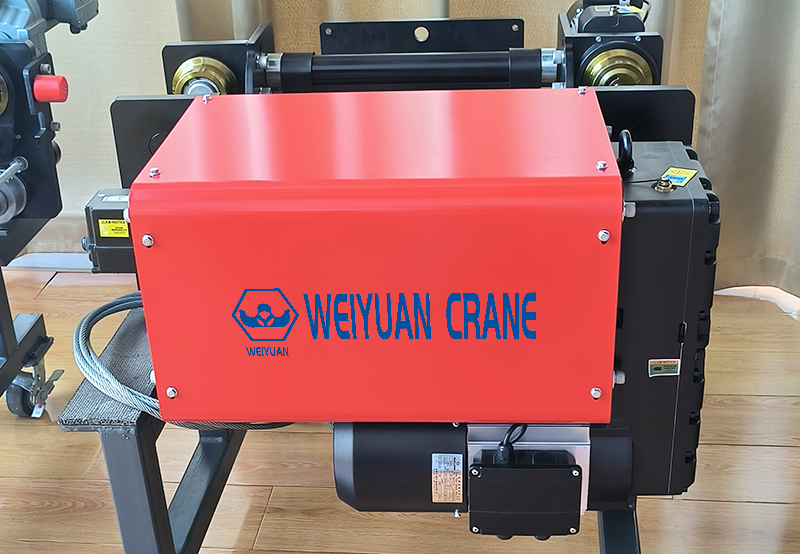
An electric hoist is a motor-driven lifting device that raises and lowers a load using either a wire rope wound on a drum or a chain pulled through a lifting mechanism. It is the powered core of most overhead lifting systems, whether mounted to a monorail trolley, a jib crane boom, or the bridge of an overhead crane.
At its simplest, an electric hoist combines four working parts: an electric motor, a gear reducer, a drum or chain sprocket, and a brake. The motor drives the reducer, which turns the drum or sprocket at a controlled speed. As the drum rotates, it winds the wire rope, raising the hook. The brake holds the load securely whenever the motor stops, so the load never drifts down under its own weight.
Modern electric hoists add several layers of control and protection. A limit switch stops travel at the top and bottom of the lift. An overload device prevents lifting beyond the rated capacity. Many units now use variable frequency drive (VFD) control for smooth, jolt-free starts and stops, plus slow-speed positioning for accurate placement.
Takeaway: An electric hoist turns motor power into controlled, repeatable vertical lifting — and the type of lifting medium and mounting drives every other choice you make.
The 4 Main Types of Electric Hoists
Electric hoists fall into four main categories, each built for a different balance of capacity, environment, and headroom. Understanding where each fits is the foundation of a good selection.
1. Wire Rope Electric Hoist
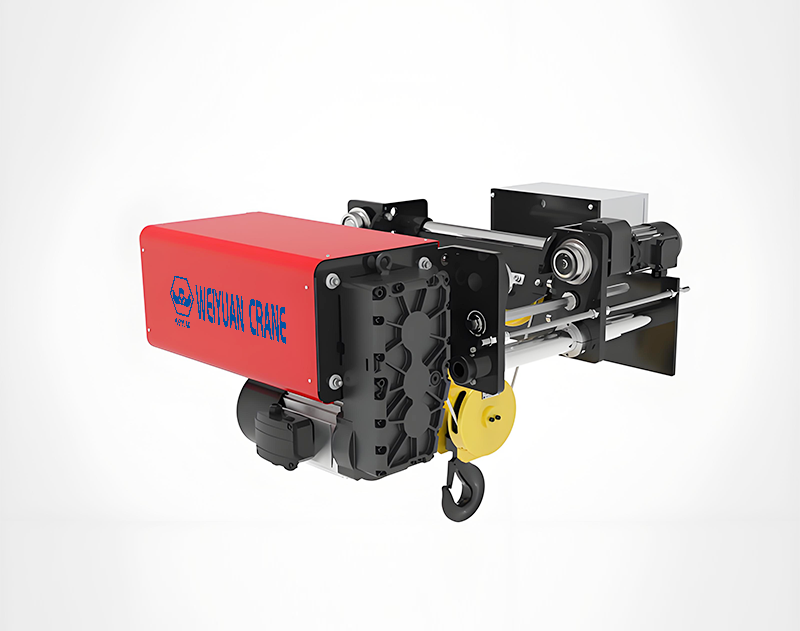
A wire rope hoist lifts using steel wire rope wound onto a grooved drum. This is the workhorse of medium and heavy lifting, favored wherever capacity, lift height, and duty cycle push beyond what a chain hoist can comfortably handle.
Structural profile: Motor, gearbox, and rope drum in a compact housing, with the rope spooling evenly across the drum grooves.
Practical capacity: Commonly 1 to 80 tonnes, with specialized units reaching well beyond for heavy industry.
Practical lift height: Excellent — typically 6 to 30 metres as standard, and much higher with larger drums, since the drum simply holds more rope.
Best for: Overhead bridge cranes, gantry cranes, and heavy-duty monorails in manufacturing, steel handling, and fabrication.
Key advantage: High capacity, long lift height, and durability under frequent, heavy cycling. The rope-and-drum design handles demanding duty classes that would overwork a chain hoist. It also delivers smoother, faster lifting at higher capacities.
2. Electric Chain Hoist
An electric chain hoist lifts using a load chain pulled over a pocketed wheel called a lift wheel. It is the go-to choice for lighter loads, compact installations, and cost-sensitive applications.
Structural profile: Motor, gearing, and lift wheel in a small, self-contained body, with the chain feeding into a fabric or steel chain container.
Practical capacity: Commonly 60 kg to 5 tonnes, with some models reaching around 10 to 20 tonnes in twin-chain configurations.
Practical lift height: Moderate — typically up to around 6 to 12 metres, since longer chains add weight and require larger containers.
Best for: Workstation cranes, jib cranes, KBK systems, maintenance bays, and assembly lines with lighter, intermittent lifting.
Key advantage: Compact, lightweight, and economical. A chain hoist installs easily on light crane systems, costs less than a wire rope unit at low capacities, and needs minimal supporting structure. For most sub-5-tonne workstation lifting, it is the natural fit.
3. Low-Headroom Electric Hoist
A low-headroom hoist is a design variation — available in both wire rope and chain versions — engineered to minimize the vertical space the hoist and trolley occupy. It maximizes hook height in buildings with limited clearance.
Structural profile: The hoist body and trolley are configured to sit as close to the runway beam as possible, often with the motor mounted alongside the drum rather than in line with it.
Practical capacity: Matches the underlying hoist type — commonly 1 to 50 tonnes for wire rope low-headroom designs.
Practical lift height: Determined by the hoist type, but the key benefit is recovering hook height within a fixed building clear height.
Best for: Older buildings, basements, multi-level facilities, and any bay where the roof structure sits low and every centimetre of lift height counts.
Key advantage: Maximum hook height in tight buildings. Where a standard hoist would sacrifice valuable lift height to its own bulk, a low-headroom design claws that height back — often the deciding factor when a building’s clear height is fixed and cannot be changed.
4. Explosion-Proof Electric Hoist
An explosion-proof hoist is a specialized unit built to operate safely in atmospheres containing flammable gases, vapors, or dust. It is engineered so that no spark or hot surface can ignite the surrounding environment.
Structural profile: Sealed, spark-resistant components, specially rated motors and controls, and often bronze or non-sparking hardware at contact points.
Practical capacity: Available across chain and wire rope ranges, typically matched to the hazardous application’s needs.
Practical lift height: Matches the underlying hoist type.
Best for: Oil and gas facilities, chemical plants, paint and coating lines, grain handling, and any location classified as a hazardous (explosive) atmosphere.
Key advantage: Safe operation where a standard hoist would be a serious ignition risk. In a classified area, this is not an upgrade — it is a legal and safety requirement. Specifying a standard hoist for a hazardous zone is a dangerous and non-compliant mistake.
Takeaway: Wire rope hoists carry the heavy, high-cycle work; chain hoists handle light, compact lifting; low-headroom designs recover height; and explosion-proof units make hazardous areas safe.
Key Differences Between Electric Hoist Types
Choosing well starts with understanding how these types actually differ in the ways that affect your operation. Here are the differences that matter most.
Lifting Medium: Rope vs Chain
Wire rope hoists use steel rope on a drum, which suits higher capacities, longer lifts, and faster speeds. Chain hoists use a load chain over a lift wheel, which is simpler and cheaper at light capacities but adds weight and bulk as lift height grows. As a rule, rope wins above roughly 5 tonnes or long lift heights; chain wins below that in compact settings.
Capacity Range
Chain hoists dominate the light end (under 5 tonnes). Wire rope hoists cover the medium-to-heavy range (1 to 80 tonnes and beyond). Where your peak load sits is often the single fastest way to narrow the field.
Lift Height
Wire rope hoists handle long lifts easily, because a larger drum simply holds more rope. Chain hoists are practical for shorter lifts, since a long chain adds dead weight and needs a bigger container. If you lift high, lean toward wire rope.
Duty Cycle
Wire rope hoists are built for frequent, heavy cycling and higher duty classifications. Chain hoists suit intermittent, lighter-duty work. Matching the hoist’s duty class to your real lifting frequency is critical — an under-classified hoist overheats and wears out fast.
Headroom and Environment
Low-headroom designs address tight buildings; explosion-proof designs address hazardous atmospheres. Both are specification overlays on the core rope-or-chain choice, driven by your building and your environment rather than by load alone.
Takeaway: Lifting medium, capacity, lift height, and duty cycle sort the core type — then headroom and environment refine it to your specific site.
Practical Capacity and Lift Height Ranges
Knowing where each type sits keeps your selection realistic. Use these ranges as a starting map, then confirm the exact specification with your supplier.
Electric chain hoist: Capacity from around 60 kg to 5 tonnes (up to ~20 tonnes in twin-chain builds), with lift heights commonly up to 6 to 12 metres. Best for light, compact, intermittent lifting.
Wire rope electric hoist: Capacity from 1 to 80 tonnes and beyond, with lift heights from 6 to 30 metres as standard and much higher with larger drums. Best for medium-to-heavy, frequent, or high-lift work.
Low-headroom hoist: Capacity matches the underlying type — typically 1 to 50 tonnes for wire rope versions — with the benefit measured in recovered hook height rather than raw range.
Explosion-proof hoist: Available across both chain and wire rope ranges, sized to the hazardous application, with capacity and lift height following the base hoist type.
Watch out for: Always size to your peak load plus the weight of any spreader beam, lifting frame, or rigging, then add a sensible safety margin. Selecting a hoist at the very top of its range with no headroom leaves you no room for heavier loads or higher cycle rates later.
Takeaway: Let peak load and lift height set the type, then confirm the exact model against your real duty cycle.
How to Select the Right Electric Hoist
The right hoist emerges when you work through a handful of factors in order. Resolve these before committing to any model.
1. Load Capacity
Start with your heaviest lift, then add the weight of any spreader beam, lifting frame, or rigging. Add a safety margin on top. This gives your required rated capacity. Loads under about 5 tonnes open up chain hoists; heavier loads point firmly toward wire rope.
Reader checkpoint: If your heaviest routine lift is close to a hoist’s rated capacity, size up. Running a hoist near its limit every cycle shortens its life fast.
2. Duty Cycle and Lifting Frequency
How often you lift matters as much as how heavy. Hoists carry a duty classification (such as FEM or ISO ratings) that reflects how many cycles and how much load they are built to handle over their life. A hoist cycling heavy loads all shift needs a high duty class; occasional lifting allows a lighter, cheaper build.
Watch out for: Under-classifying is the most common and most expensive hoist mistake. It leads to overheating motors, brake wear, and early failure — often within a year or two.
3. Operating Environment
Match the hoist to where it works. A clean indoor bay allows a standard hoist. Dusty, humid, or outdoor settings need higher ingress protection (IP rating) and corrosion-resistant finishes. A hazardous, explosive atmosphere legally requires an explosion-proof hoist rated for that specific zone — there is no shortcut here.
4. Headroom and Building Clearance
Measure your building’s clear height and the maximum hook height you need. If clearance is tight and every centimetre of lift counts, a low-headroom hoist recovers height that a standard unit would waste on its own bulk. Where clearance is generous, a standard hoist is simpler and often cheaper.
5. Mounting Type — Monorail vs Bridge Crane
How the hoist mounts shapes your choice, especially the trolley.
- Fixed mounting: The hoist is bolted in one position — common on simple lifting points and some jib cranes. No trolley required.
- Monorail (single-beam) mounting: The hoist rides a trolley along a single fixed beam, moving loads in a straight line. Common on monorails, jib cranes, and KBK systems.
- Bridge crane mounting: The hoist rides a trolley across the bridge girder, while the bridge travels the runway — giving full rectangular area coverage. Standard on overhead and gantry cranes.
Confirm the trolley type (plain/push, geared, or motorized) and the beam flange width the trolley must fit. On a bridge crane, also confirm whether a low-headroom trolley is needed to protect hook height.
6. Total Cost of Ownership
Look past the purchase price to installation, energy use, maintenance, spare parts availability, and expected service life. A slightly more expensive hoist with the right duty class and VFD control often costs far less over 15 years than a cheap, under-specified unit that fails early and stops production.
Selection framework at a glance:
- Light load, compact, intermittent → electric chain hoist
- Medium-to-heavy load, frequent or high lift → wire rope electric hoist
- Tight building clearance → low-headroom hoist (rope or chain)
- Hazardous/explosive atmosphere → explosion-proof hoist (mandatory)
Common Mistakes to Avoid
Even experienced buyers slip on a few recurring points. Knowing them upfront saves money and downtime.
- Sizing on load alone, ignoring duty cycle. A 5-tonne hoist rated for light duty will not survive 5-tonne lifts all shift. Match the duty class to your real frequency.
- Forgetting rigging weight. The spreader beam, lifting frame, and slings all count against capacity. Leaving them out quietly overloads the hoist.
- Overlooking headroom until installation. Discovering you have lost a metre of hook height after the crane is built is an expensive surprise. Calculate hook height with the actual hoist and trolley dimensions early.
- Specifying a standard hoist for a hazardous area. This is a compliance failure and a genuine ignition risk. Classified atmospheres require an explosion-proof unit, no exceptions.
- Buying on purchase price alone. The cheapest hoist is rarely the cheapest to own. Under-specified units fail early and take production with them.
Takeaway: Most hoist failures trace back to a specification shortcut — duty cycle, rigging weight, headroom, or environment. Resolve all five factors and you avoid nearly all of them.
Example Scenarios
Seeing the framework applied makes the choice concrete. Here are three common situations.
Scenario 1 — Assembly line workstation, 500 kg, frequent light lifts, tight headroom. A low-headroom electric chain hoist on a monorail or KBK trolley fits perfectly. It is compact, economical, ergonomic for repetitive lifts, and recovers hook height in a low building.
Scenario 2 — Steel fabrication bay, 20 tonnes, heavy cycling all shift, high lift. A wire rope electric hoist on a double-girder bridge crane is the clear answer. It delivers the capacity, lift height, duty class, and speed the work demands, with VFD control for smooth, accurate placement.
Scenario 3 — Chemical plant process area, 3 tonnes, classified hazardous zone. An explosion-proof hoist rated for that specific zone is mandatory. Capacity is modest, but the environment dictates the specification — a standard hoist is simply not an option here.
Takeaway: In each case, the dominant constraint — headroom, duty cycle, or environment — drives the choice once capacity is settled.
Frequently Asked Questions
Q: What is the difference between a wire rope hoist and a chain hoist?
A wire rope hoist lifts using steel rope wound on a drum, making it ideal for higher capacities (1 to 80 tonnes and beyond), longer lift heights, and frequent, heavy cycling. A chain hoist lifts using a load chain over a lift wheel, making it compact, lightweight, and economical for lighter loads (typically under 5 tonnes) and shorter lifts. As a rule, choose wire rope for heavy or high-lift work and chain for light, compact, cost-sensitive applications.
Q: How do I choose the right electric hoist capacity?
Start with your heaviest single lift, then add the weight of any spreader beam, lifting frame, or rigging, plus a safety margin. That total sets your required rated capacity. Avoid selecting a hoist at the very top of its range with no margin — running near maximum capacity every cycle shortens its service life. If future loads may grow, size up from the outset.
Q: What is a low-headroom hoist and when do I need one?
A low-headroom hoist is designed to sit as close to the runway beam as possible, minimizing the vertical space the hoist and trolley occupy. This recovers valuable hook height in buildings with limited clearance. You need one when your building’s clear height is fixed and low, and you must maximize the lift height available — common in older buildings, basements, and multi-level facilities.
Q: When is an explosion-proof hoist required?
An explosion-proof hoist is required in any area classified as a hazardous (explosive) atmosphere — where flammable gases, vapors, or dust may be present. This includes oil and gas facilities, chemical plants, paint lines, and grain handling. In these zones, an explosion-proof unit is a legal and safety requirement, not an upgrade. Specifying a standard hoist in a classified area is both non-compliant and dangerous.
Q: What does hoist duty cycle mean, and why does it matter?
Duty cycle describes how often and how heavily a hoist is used over its life, expressed through classifications such as FEM or ISO ratings. It matters because a hoist under-rated for your lifting frequency will overheat, wear its brakes, and fail early — often within a year or two. Matching the duty class to your real usage is one of the most important and most overlooked selection factors.
Q: What is the difference between monorail and bridge crane hoist mounting?
On a monorail, the hoist rides a trolley along a single fixed beam, moving loads in a straight line. On a bridge crane, the hoist rides a trolley across the bridge girder while the bridge travels the runway, giving full coverage of a rectangular area. Choose monorail mounting for fixed-path lifting and bridge crane mounting when loads must move anywhere across a bay.
Q: Should I choose a hoist with variable frequency drive (VFD) control?
VFD control is worth it for most applications where positioning accuracy, load protection, or high cycle rates matter. It delivers jolt-free starts and stops, slow-speed final positioning, and reduced mechanical stress on both the hoist and the load. For light, occasional lifting, a standard single- or two-speed hoist may be sufficient, but VFD typically pays back through smoother operation and longer equipment life.