


KBK Crane System: What It Is, How It Works, and Why It’s Used in Modern Manufacturing
Introduction
Most lifting equipment is designed around the crane. The building bends to fit the runway, the workstation forms around the hoist, and once installed, nothing moves again. A KBK crane system flips that logic. It is a modular light crane system built to fit the way people actually work — and to change when the work changes.
For plant engineers and production managers, that flexibility matters more than raw capacity. A busy assembly line does not need a 50-tonne bridge crane over every station. It needs light, precise, ergonomic lifting exactly where hands meet parts — and the freedom to move that lifting when the line gets rebalanced next quarter.
This guide is article 1 of 3 in the Weiyuan Crane KBK series. Here is what you will learn:
- What a KBK crane system is and how the modular design works
- The core components that make up every KBK system
- The key advantages that suit it to modern manufacturing
- Typical load capacities and the industries it serves best
Part 1: What a KBK Crane System Is
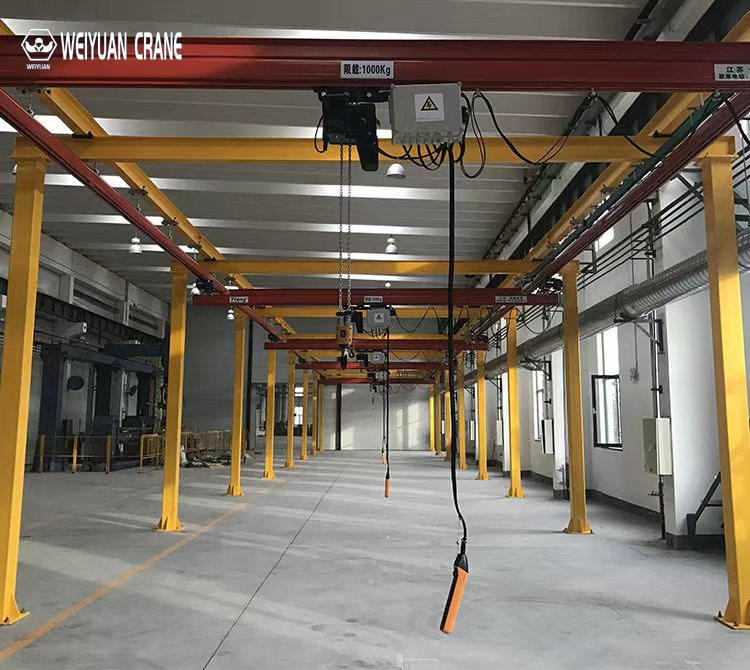
KBK is a modular light crane system built from standardized track profiles, connectors, and running gear that bolt together into a custom overhead lifting layout. The name refers to a modular construction concept rather than a single product — think of it as a kit of interchangeable parts you assemble into the exact crane your workspace needs.
Unlike a traditional overhead crane, which is engineered as one large fixed structure, a KBK system is built from repeating modules. Straight track sections, curves, switches, suspension brackets, and trolleys combine into monorails, single-girder cranes, or full area-coverage grids. Because every joint is bolted rather than welded, the whole layout can be extended, shortened, or relocated later.
Where KBK Fits in the Lifting Family
KBK sits at the light-duty end of the crane spectrum, below standard overhead and gantry cranes. It is the tool for moving parts, tools, and sub-assemblies at a workstation — not for lifting steel plate across a fabrication bay. Its strength is precision, repeatability, and ergonomics for lighter loads, close to where the operator stands.
Takeaway: A KBK crane system is a modular kit of standardized components that assembles into a light, flexible overhead crane — built to fit the workstation and change when the work does.
Part 2: Core Components of a KBK System
Every KBK layout, however complex, is built from the same family of parts. Understanding them is the fastest way to understand the whole system.
Track Profiles (Aluminum and Steel)
The track profile is the backbone. It is the enclosed rail the trolley runs inside, and it comes in two materials:
- Steel profiles: cold-rolled enclosed sections offering higher capacity and longer unsupported spans. The standard choice for heavier KBK loads and longer bridges.
- Aluminum profiles: lightweight extruded sections with very low rolling resistance, ideal for ergonomic, hand-pushed lifting where an operator moves the load by hand all shift.
Both use an enclosed track design, which keeps the running surface clean and protects the trolley wheels from dust and debris.
Trolleys
The trolley is the wheeled carriage that rides inside the track profile, carrying the hoist or the bridge connection. Low rolling resistance is the priority — a well-matched trolley lets an operator move a load with a light push, reducing fatigue over a full shift.
Hoists
A hoist mounts to the trolley to raise and lower the load. KBK systems typically pair with light electric chain hoists, air hoists, or simple manual units, sized to the modest capacities the system handles. The hoist choice follows the duty and the environment of the workstation.
Connectors and Suspension
Bolted connectors join track sections end to end, while suspension brackets hang the whole system from the building roof, an existing structure, or a freestanding steel support frame. Because the connections are bolted, the layout stays reconfigurable — a defining KBK trait.
Switches, Curves, and End Stops
For more advanced layouts, switches route trolleys between tracks, curved sections turn corners, and end stops limit travel safely at each track end. These components turn a simple monorail into a routed, multi-station transfer system.
Takeaway: Track profiles, trolleys, hoists, connectors, and switches are the standard building blocks. Mix and match them, and one kit covers everything from a single monorail to a full area-coverage grid.
Part 3: How the Modular Rail System Works
The genius of KBK is not any single part — it is how the standardized parts combine and, crucially, come apart again.
Standardized, Bolted Construction
Every component is built to a common interface, so parts connect predictably without custom fabrication. Track sections bolt to connectors, connectors hang from suspension brackets, and trolleys drop into the enclosed profile. Nothing is welded in place, which means nothing is permanent.
From Monorail to Area Coverage
The same components scale across three common layouts:
- Monorail: a single track profile along which a trolley and hoist travel in a straight line — the simplest KBK system, ideal for feeding one machine or moving parts along a bench.
- Single-girder suspension crane: a bridge track runs across two parallel runway tracks, letting the hoist reach any point within a rectangular area — workstation coverage without a heavy overhead crane.
- Grid / multi-bridge systems: several bridges and switches combine to cover large areas or transfer loads between zones.
Built to Be Reconfigured
This is where KBK separates itself. When a production line is rebalanced, a workstation is added, or the plant layout changes, the bolted modules can be extended, shortened, or moved to a new position. You reuse the same components rather than scrapping a fixed crane and buying a new one — a direct saving in both capital and downtime.
Takeaway: Standardized bolted modules let one KBK system scale from a straight monorail to a full grid — and be reconfigured later instead of replaced.
Part 4: Key Advantages for Modern Manufacturing
KBK earns its place on the factory floor through a specific set of strengths that fixed cranes struggle to match.
Flexibility and Easy Reconfiguration
The bolted, modular design means the system adapts as your production does. Add a station, extend a run, or relocate a bridge without a major structural project. For manufacturers whose lines change often, this is the single biggest advantage.
Low Headroom
The enclosed profiles and compact trolleys sit tight against the suspension, consuming little vertical space. In buildings with limited clear height, a KBK system preserves valuable hook height that a bulkier crane would waste.
Lightweight Construction
Aluminum and slim steel profiles keep the whole system light. That lower dead weight means less demanding suspension requirements, easier installation, and — with aluminum — genuinely effortless manual movement of the load.
Ergonomic Operation
Low rolling resistance and smooth travel let operators position loads by hand with minimal effort. Over thousands of cycles a shift, that ergonomic ease reduces operator fatigue and injury risk — a real productivity and safety gain at repetitive workstations.
Cost-Effective Coverage
Because you build only the layout you need from standard parts, you avoid paying for the capacity and structure of a full overhead crane where light-duty lifting is all the work requires.
Takeaway: Flexibility, low headroom, light weight, and ergonomics make KBK the natural fit wherever light lifting happens close to the operator and the layout may change.
Part 5: Typical Load Capacity Range
KBK is deliberately a light-duty system, and matching its capacity to the work is central to specifying it correctly.
Most KBK systems handle loads up to around 2,000 kg (2 tonnes), with the practical figure depending on the profile material, the track span, and the layout type. Lighter aluminum profiles suit the lower end for hand-pushed ergonomic lifting, while heavier steel profiles carry the upper range over longer spans.
Two points shape the real working capacity:
- Span matters as much as load. A longer unsupported track section deflects more, so a given profile carries less over a wide bridge than over a short monorail. Suspension spacing is sized around this.
- The hoist and rigging count. As with any crane, the weight of the hoist, below-the-hook tooling, and rigging reduces the load available at the hook.
If your routine loads sit comfortably below 2 tonnes and the work is repetitive and station-based, KBK is squarely in its element. Loads consistently above that range point toward a standard overhead or jib crane instead.
Takeaway: KBK suits loads up to roughly 2,000 kg. Size the profile to both the load and the span, and confirm the hook capacity after rigging.
Part 6: Industries and Applications
KBK shines wherever light, precise, repetitive lifting happens at defined points — and where the work may shift over time.
Automotive Assembly
Automotive lines are the classic KBK application. The system feeds parts to assembly stations, handles sub-assemblies, and supports ergonomic tools along the line. When the line is rebalanced for a new model, the modular track moves with it.
General Manufacturing
Across machine shops, electronics, appliance, and metalworking plants, KBK moves components between processes, loads and unloads machines, and serves individual work cells with light overhead lifting.
Workstation Lifting
At the single-station level, KBK provides ergonomic assistance for repetitive lifts — positioning parts, tools, or fixtures precisely and effortlessly, reducing strain on operators doing the same motion hundreds of times a day.
Warehousing and Logistics
For light order-picking, kitting, and packing stations, KBK monorails and area systems bring flexible overhead lifting to zones that do not justify a full overhead crane.
Takeaway: Automotive assembly, general manufacturing, and dedicated workstations are KBK’s home ground — anywhere light, repetitive, precise lifting meets a layout that may change.
Common Mistakes to Avoid
Even a flexible system fails when specified carelessly. Watch for these:
- Over-spanning the profile. Stretching a track too far between supports causes deflection and rough travel. Size the suspension spacing to the load and profile.
- Ignoring the building structure. A KBK system still imposes real loads on the roof or support frame. Confirm the structure can carry it, or specify a freestanding frame.
- Choosing capacity without headroom for growth. Selecting a profile at the very top of its range leaves no margin. Size up if loads or cycles may grow.
- Overlooking ergonomics. Picking a heavy profile where an aluminum one would let operators push loads by hand wastes the system’s biggest advantage.
Takeaway: Most KBK problems trace back to over-spanning, an unchecked structure, or a mismatched profile. Resolve those upfront and the system delivers for years.
Frequently Asked Questions
Q: What is a KBK crane system?
A KBK crane system is a modular light crane built from standardized track profiles, trolleys, hoists, connectors, and switches that bolt together into a custom overhead lifting layout. Because the connections are bolted rather than welded, the system can be extended, shortened, or relocated as production changes. It suits light, precise, repetitive lifting at workstations, typically handling loads up to around 2,000 kg.
Q: How much weight can a KBK crane lift?
Most KBK systems handle loads up to roughly 2,000 kg (2 tonnes). The exact working capacity depends on the track profile material, the span between supports, and the layout — a shorter monorail carries more than a long bridge with the same profile. Remember to subtract the weight of the hoist and any rigging from the rated figure to find the load available at the hook. Loads consistently above 2 tonnes are better served by an overhead or jib crane.
Q: What is the difference between aluminum and steel KBK track profiles?
Steel profiles offer higher capacity and longer unsupported spans, making them the choice for heavier KBK loads and longer bridges. Aluminum profiles are lighter with very low rolling resistance, ideal for ergonomic, hand-pushed lifting where operators move loads by hand throughout a shift. Both use an enclosed track design that keeps the running surface clean. The right choice depends on your load, span, and how much manual movement the work involves.
Q: Can a KBK system be reconfigured or expanded later?
Yes — this is one of its defining advantages. Because every joint is bolted rather than welded, track sections, bridges, and stations can be added, shortened, or relocated as your line changes. You reuse the same standardized components instead of scrapping a fixed crane and buying new, which saves both capital and downtime when a production layout is rebalanced.
Q: What industries use KBK crane systems?
KBK systems are widely used in automotive assembly, general manufacturing, and dedicated workstations, plus light warehousing and logistics tasks. They excel wherever light, precise, repetitive lifting happens at defined points and the layout may shift over time — feeding assembly lines, serving work cells, loading machines, and providing ergonomic assistance at individual stations.
Q: Why choose a KBK system over a standard overhead crane?
Choose KBK when your lifting is light-duty, repetitive, station-based, and your layout may change. It offers flexibility, low headroom, light weight, and ergonomic operation at a lower cost than a full overhead crane — without paying for capacity and structure you do not need. For heavy loads, wide spans, or bay-wide coverage, a standard overhead crane remains the better fit.