


Gantry Crane Buying Guide: How to Choose the Right Gantry Crane for Your Facility
Introduction
Buying a gantry crane is a decision you live with for decades. Unlike a forklift you can trade in next year, a gantry crane becomes part of how your yard or bay operates — its rails set into the floor, its structure sized to your loads and your building. Choose well and it quietly earns its keep for 20 or 30 years. Choose poorly and you inherit a crane too light for the tonnage you grow into, too tall for your outdoor clearance, or too costly to keep running.
The trap is that most buying decisions get rushed. A yard needs lifting capacity, a budget window opens, and the specification gets written under pressure. Corners get cut on the parts nobody sees at purchase time — the duty class, the supplier’s engineering support, the true cost of running the crane over its life. Those corners come back as downtime, early wear, and repair bills that dwarf whatever the shortcut saved.
This guide walks you through the specification and purchasing process from a procurement manager’s point of view. You will learn:
- The difference between single and double girder gantry cranes, and full-leg versus semi-gantry designs
- When top-running beats underhung
- The six specification factors that drive every quote
- Why total cost of ownership matters more than the sticker price
- How to separate a strong supplier from a weak one, and the mistakes that cost facilities the most
This is article 2 of 3 in the Weiyuan Crane gantry crane series. Where article 1 covered safety and OSHA compliance, this one covers how to buy the right crane in the first place.
Single Girder vs Double Girder Gantry Cranes
The first structural decision you face is how many bridge girders the crane needs. This single choice ripples through your capacity, your lift height, your cost, and how hard the crane can work over its life.
Single Girder Gantry Cranes
A single girder gantry crane uses one bridge beam spanning between the two support legs, with the hoist and trolley usually running underneath it. It is the lighter, simpler, more economical design.
- Capacity range: commonly up to around 20 tonnes, with most units in the 3 to 10 tonne band.
- Span range: practical up to roughly 20 to 30 metres before beam deflection pushes toward a double girder.
- Strengths: lower purchase price, lighter dead weight, simpler installation, and a compact profile for light-to-moderate duty.
- Best for: general fabrication, workshops, storage yards, and loading operations where loads are moderate and lift height is not pushed to the limit.
Double Girder Gantry Cranes
A double girder gantry crane uses two bridge beams, with the hoist and trolley riding on top of them. The twin-beam design carries heavier loads, spans wider bays, cycles harder, and lifts higher.
- Capacity range: from around 5 tonnes to several hundred tonnes.
- Span range: comfortably beyond 30 metres with the right girder design.
- Strengths: higher capacity, longer spans, greater rigidity, and better hook height — because the trolley sits on top of the girders rather than below them, the hook can rise closer to the underside of the bridge. Double girder designs also carry walkways, larger hoists, and higher travel speeds more easily.
- Best for: heavy fabrication, shipyards, precast concrete yards, ports, and any operation demanding heavy loads, wide spans, or high duty cycles.
How to Choose Between Them
The decision usually comes down to four questions:
- How heavy? Loads comfortably under 10 to 20 tonnes lean single girder. Heavier loads point to double girder.
- How high? If you need maximum hook height, the top-running trolley of a double girder recovers lift a single girder underhung design gives away.
- How wide? Wide spans deflect a single beam too much; a double girder carries the span with less sag.
- How hard? High duty cycles and high speeds favor the rigidity and durability of a double girder.
Takeaway: single girder wins on cost and simplicity for light-to-moderate duty; double girder wins on capacity, span, hook height, and heavy-duty durability. Do not pay for capacity you will never use — but do not starve a busy yard of the rigidity it needs.
Full Gantry vs Semi-Gantry Leg Configurations
A gantry crane carries its own supports, and how those legs are arranged is a distinctly gantry decision that overhead cranes never face. Two arrangements cover almost all installations.
Full Gantry (Double-Leg)
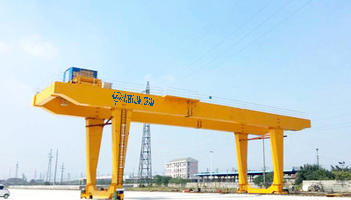
A full gantry crane stands on two legs, one at each end of the bridge, each running on its own ground-level rail. The crane is fully self-supporting and needs no building structure at all — it simply travels along two parallel rails set into the floor or yard.
- Strengths: complete independence from the building, ideal for open yards and outdoor storage, and free to travel long distances along the rails.
- Best for: outdoor yards, precast and steel storage, container handling, and any site with no suitable building structure to support a crane.
Semi-Gantry (Single-Leg)
A semi-gantry crane stands on one leg on the ground and rests its other end on an elevated runway beam mounted to the building wall or columns. One side travels on a floor rail; the other travels on a wall-mounted rail.
- Strengths: frees the floor along the wall side, works well where a building edge is available, and can share a runway with an overhead crane in the same bay.
- Trade-off: the building wall or columns must be verified to carry the elevated-rail loads. The design depends on having a suitable structure on one side.
- Best for: indoor bays where you want floor coverage on one side without full building support, or where floor space along a wall is at a premium.
Making the Call
If your operation is outdoors or your building cannot support any crane load, a full gantry is the natural fit. If you work indoors along a building edge that can carry an elevated rail, a semi-gantry saves floor space and cost on one side.
Takeaway: full gantry stands entirely on its own two legs for open-yard independence; semi-gantry leans one side on the building to free floor space where a wall can carry the load.
Top-Running vs Underhung Configurations
Beyond girder count and leg type, you decide how the crane sits on its rails. This top-running versus underhung question changes both capacity and hook height.
Top-Running
A top-running gantry crane’s wheels ride on top of the rails — the standard for the vast majority of gantry cranes. On a double girder, the trolley also runs on top of the girders.
- Capacity: the standard for medium and heavy loads, from a few tonnes to several hundred tonnes.
- Strengths: carries the highest capacities, spans the widest bays, and gives the best hook height. The load path runs straight down through the legs into the foundation, which is structurally efficient.
- Best for: almost all gantry cranes, especially heavy and outdoor duty.
Underhung
An underhung configuration hangs the hoist below the bridge flange, typically on lighter single girder designs. It maximizes the crane’s transverse coverage but reduces available hook height and caps capacity.
- Capacity: typically light to moderate.
- Strengths: the hoist can run close to the legs, giving good edge-to-edge coverage across the span.
- Trade-off: reduced hook height and lower capacity ceiling than top-running.
Takeaway: top-running carries the heavy work and gives the best hook height, and it suits nearly every gantry crane. Underhung maximizes transverse coverage on lighter cranes at the cost of hook height and capacity.
The Six Key Specification Factors
Every quote you receive is built from a handful of specification inputs. Get these right and the quotes you compare are accurate and comparable. Get them wrong and you are comparing cranes that will never perform the same way.
1. Rated Capacity (With Rigging)
Start with your heaviest single lift, then add the weight of any lifting device — spreader beam, lifting frame, magnet, grab, or below-the-hook tooling — plus a safety margin. This total, not the bare load, is your required rated capacity. If your loads may grow, size up now; adding capacity to an installed gantry crane usually means replacing it.
2. Span
The span is the distance between the two rails — the width the crane covers. Measure it from the actual rail centres you plan to install, not a rough estimate. Span drives the girder size: a wider span needs a deeper, stronger girder to control deflection, which affects both cost and the crane’s overall height.
3. CMAA Duty Class
This is the single most under-appreciated factor in the whole specification. The CMAA classification (Class A through F) defines how hard the crane works — how many lifts per hour, how close to capacity, over how many years.
- Class A to B: standby or light service.
- Class C: moderate service — general fabrication.
- Class D: heavy service — high-volume yard or production work.
- Class E to F: severe to continuous service, often near capacity.
Two cranes with identical capacity and span can cost very differently because one is built for Class C and the other for Class E. Specify the class from your real duty cycle. Under-classify and the crane wears out years early; over-classify and you pay for durability you never use.
4. Hook Height (Lift Height)
Hook height is the vertical hook travel from lowest to highest point. On a gantry crane it is set by the overall gantry height minus the space the bridge, trolley, and hoist occupy. This is exactly where the girder and configuration choices pay off — a top-running double girder recovers hook height an underhung design gives away. Specify the hook height you actually need, and confirm it against your real clearance, especially outdoors where power lines or building overhangs may cap the crane’s total height.
5. Travel Speed
Bridge (gantry) travel, trolley travel, and hoist speeds all shape your cycle time. Faster is not always better — higher speeds add cost and, without smooth control, cause load swing on a crane that travels through open space. Variable frequency drive (VFD) control on the travel and hoist motions delivers soft starts and stops, slow-speed positioning, and reduced wear, and is worth specifying wherever positioning accuracy or cycle rate matters.
6. Building or Outdoor Structure Requirements
A gantry crane’s loads land on its rails and foundations, but the surrounding conditions still shape the design:
- Full gantry, outdoor: needs engineered ground-level rail foundations sized for the wheel loads and the ground bearing capacity, plus wind stability provisions (rail clamps or storm anchors) for a parked crane.
- Semi-gantry, indoor: needs the building wall or columns verified to carry the elevated-rail loads.
- Outdoor duty generally: demands higher-IP electrical enclosures, corrosion-resistant finishes, and drainage in the rail path.
Confirm these before you finalize anything, because rail foundations and wind provisions belong in the buying decision, not as a surprise at installation.
Takeaway: capacity (with rigging), span, CMAA duty class, hook height, travel speed, and structure requirements are the six inputs behind every quote. Nail them down before you ask for pricing, and every quote becomes genuinely comparable.
Total Cost of Ownership vs Purchase Price
The most expensive gantry crane mistake is buying on the sticker price alone. The purchase price is only the first — and often the smallest — part of what a crane costs you over its life.
What the Purchase Price Hides
A cheap crane is easy to sell and easy to buy. What the low number often hides is a lighter duty class than your work demands, thinner engineering support, generic components that are hard to source spares for, and no real after-sales presence. Every one of those gaps becomes a cost later — and on an outdoor crane, an under-specified finish becomes corrosion within a few seasons.
The Full Cost Picture
Total cost of ownership (TCO) adds up everything the crane costs across its service life:
- Purchase and installation: the crane, plus delivery, erection, commissioning, and rail foundation work.
- Energy: motors running many hours a day for decades. Right-sized drives save real money over 20 years.
- Maintenance and spares: routine service, wear parts (travel wheels, brakes, rope, contactors), and the availability and price of replacements.
- Downtime: the biggest hidden cost. When the crane stops, the yard or bay that depends on it stops too.
- Service life: a correctly specified crane runs for decades; an under-specified one may need major rebuilding in a fraction of that time.
The Real Comparison
The right comparison is not “which crane is cheaper to buy” but “which crane is cheaper to own.” A crane that costs 15% more up front but is correctly classified, well supported, and built from serviceable components almost always wins over 20 years — because it avoids the downtime and early replacement that quietly drain the budget.
Takeaway: buy on total cost of ownership, not purchase price. The cheapest crane to buy is rarely the cheapest to own, and downtime is the cost that dwarfs all the others.
How to Evaluate Gantry Crane Suppliers
Two suppliers can quote the same specification and deliver wildly different value. The crane is only as good as the company behind it — before, during, and long after the sale.
Certifications and Standards Compliance
A credible supplier designs and builds to recognized standards. Look for compliance with CMAA classification and design guidance, ASME B30.2 for gantry crane safety, and quality management certification such as ISO 9001. For international suppliers, confirm the design meets the standards that apply in your country. Certifications are evidence the supplier engineers to a defined, verifiable practice — not marketing badges.
Engineering Support
The best value shows up before you buy. A strong supplier assigns engineers who assess your loads, duty cycle, span, hook height, and site conditions, then design the crane around your operation rather than pushing a catalog model. Ask whether they provide structural calculations, whether they will design the rail foundations, and whether they can engineer a custom solution — outdoor wind provisions, semi-gantry building interfaces — when a standard one does not fit. Thin engineering support at the quote stage predicts thin support later.
After-Sales and Spare Parts
A crane lives for decades and will need service and spares across that whole life. Evaluate:
- Spare parts availability and how quickly they ship.
- Technical support for troubleshooting and maintenance.
- Installation and commissioning support, direct or through a partner.
- Warranty terms and what they actually cover.
- Service reach in your region — a supplier with no presence near you is slow help when a crane is down.
Track Record
Ask for references in your industry and for cranes of similar duty, capacity, and environment. A supplier who has delivered heavy outdoor Class E gantry cranes to storage yards understands demands a light indoor workshop supplier does not. Proven experience with your kind of application is worth more than a lower price from an untested source.
Takeaway: judge a supplier on certifications, upfront engineering, after-sales reach, and a relevant track record — not on price alone. The company behind the crane determines whether it stays reliable for 20 years.
Common Gantry Crane Buying Mistakes
Even experienced buyers repeat a handful of costly errors. Knowing them upfront is the cheapest insurance in this process.
Mistake 1: Ignoring Duty Class
The most expensive specification shortcut. A crane sized correctly for capacity but under-classified for its real cycle rate overheats, wears its brakes, motors, and travel wheels, and fails years early.
Prevention: specify the CMAA class from your true duty cycle, not a hopeful estimate. Match durability to how hard the crane actually works.
Mistake 2: Forgetting Rigging Weight
Buyers size the crane to the bare load and forget the spreader beam, slings, and shackles, so the crane ends up quietly overloaded on every lift.
Prevention: size to the heaviest load plus all below-the-hook tooling plus a safety margin.
Mistake 3: Skipping the Structure and Foundation Check
The crane is ordered before anyone confirms the rail foundations, the ground bearing capacity, or (for a semi-gantry) the building wall can carry it. Installation then reveals unbudgeted foundation or reinforcement work.
Prevention: commission a structural and geotechnical assessment as part of the buying process, and put any foundation or reinforcement cost into the decision from the start.
Mistake 4: Buying on Price Alone
The lowest quote wins, and the hidden gaps — light duty class, thin support, hard-to-source spares, inadequate outdoor protection — surface as downtime and early failure.
Prevention: evaluate on total cost of ownership and supplier strength, not the sticker price.
Mistake 5: Overlooking Outdoor and Hook Height Constraints
Buyers focus on capacity and span and discover too late that the crane’s total height exceeds an overhang or that no wind provisions were specified for an exposed yard.
Prevention: confirm total gantry height against real clearances, and specify corrosion protection and wind stability devices for any outdoor crane early.
Mistake 6: Writing a Vague Specification
An incomplete specification produces quotes that cannot be compared, because each supplier fills the gaps differently.
Prevention: write a complete specification — capacity with rigging, span, duty class, hook height, travel speeds, controls, and environment — so every quote answers the same question.
Takeaway: almost every buying mistake traces back to an incomplete specification, an ignored duty class, or a price-first decision. Close those gaps and you avoid the errors that cost the most.
Frequently Asked Questions
Q: What is the difference between a single girder and double girder gantry crane?
A single girder gantry crane uses one bridge beam with the hoist usually running underneath it, making it lighter, cheaper, and ideal for loads up to around 20 tonnes on moderate spans. A double girder gantry crane uses two bridge beams with the hoist running on top, allowing higher capacities (into hundreds of tonnes), wider spans, greater rigidity, and more hook height. Choose single girder for light-to-moderate duty on cost grounds, and double girder for heavy loads, wide spans, high duty cycles, or maximum lift height.
Q: What is the difference between a full gantry and a semi-gantry crane?
A full gantry crane stands on two legs, each running on its own ground-level rail, and is completely self-supporting — ideal for outdoor yards with no building structure. A semi-gantry crane stands on one leg on the ground and rests its other end on an elevated runway beam mounted to a building wall or columns. The semi-gantry frees floor space along the wall side but requires the building structure to be verified for the elevated-rail loads.
Q: Should I choose a top-running or underhung gantry crane?
Top-running is the standard for nearly all gantry cranes: the wheels ride on top of the rails, carrying the heaviest loads, widest spans, and best hook heights, with an efficient load path down through the legs. Underhung configurations hang the hoist below the bridge on lighter cranes, maximizing transverse coverage but reducing hook height and capping capacity. For most gantry cranes — especially heavy or outdoor duty — top-running is the right choice.
Q: What is CMAA duty class and why does it matter?
CMAA duty class (A through F) defines how hard a crane works — the number of lifts per hour, how close to capacity, and over how many years. Two cranes with the same capacity and span can be built very differently and cost very differently depending on their class. Specifying the class from your real duty cycle is critical: under-classifying causes early wear and failure, while over-classifying means paying for durability you will not use. It is the most commonly overlooked specification factor.
Q: How do I determine the right gantry crane capacity?
Start with your heaviest single lift, then add the weight of any below-the-hook equipment — spreader beam, lifting frame, magnet, grab, or slings — plus a safety margin. That total is your required rated capacity, not the bare load. If your loads are likely to grow, size up at purchase, because adding capacity to an installed gantry crane usually means replacing it. Never specify capacity on the load alone; forgotten rigging weight quietly overloads the crane on every lift.
Q: Why is total cost of ownership more important than purchase price?
Because the purchase price is often the smallest part of what a crane costs over 20 to 30 years. Total cost of ownership adds installation and foundations, energy, maintenance, spare parts, and — above all — downtime, which is the biggest hidden cost when a crane stops the operation that depends on it. A correctly specified, well-supported crane that costs more up front usually wins over its life by avoiding the failures and early replacement that plague a cheap, under-specified unit.
Q: What extra factors apply to an outdoor gantry crane?
Outdoor gantry cranes need engineered ground-level rail foundations sized to the wheel loads and ground bearing capacity, wind stability provisions such as rail clamps or storm anchors for a parked crane, higher-IP electrical enclosures to keep out water and dust, corrosion-resistant finishes for the structure and hardware, and drainage in the rail path. Confirm the crane’s total height against any overhead clearances too. Build all of these into the specification and the budget from the start.
Q: How do I evaluate a gantry crane supplier?
Look at four things beyond price. First, certifications and standards compliance — CMAA and ASME B30.2 design, plus ISO 9001 quality management. Second, upfront engineering support — do they design around your loads, site, and foundations, or push a catalog model? Third, after-sales strength — spare parts availability, technical support, installation, warranty, and service reach in your region. Fourth, a relevant track record with cranes of similar duty, capacity, and environment. The company behind the crane determines whether it stays reliable for decades.