


Jib Crane Buying Guide: How to Choose and Specify the Right Jib Crane
Introduction
Two quotes for the same jib crane can differ by half — and both claim to lift your load. One carries a duty class your work will chew through in a year. One lists an IP rating the salesperson cannot explain. And the cheapest is almost never the cheapest to own once it starts costing you downtime. So which one is right?
The trap is that capacity is the easiest number to compare and the least likely to tell you whether the crane will last. A jib crane rated for 2 tonnes might be built for occasional workshop lifting or constant, heavy cycling — and the two behave nothing alike in service.
This guide walks you through specifying and buying a jib crane from a procurement manager’s and plant engineer’s point of view. This is article 2 of 3 in the Weiyuan Crane jib crane series. Where article 1 covered jib crane types and applications, this one covers how to buy the right one.
Here is what you will learn:
- The key specification factors behind every quote
- When to choose each mounting type and hoist
- How to weigh control, environment, suppliers, and total cost — and dodge the common mistakes
The Key Specification Factors
Every quote you receive is built from a handful of specification inputs. Get these right and the quotes you compare are accurate and genuinely comparable. Get them wrong and you are comparing cranes that will never perform the same way.
Rated Capacity (Including Rigging)
Your required capacity is not your heaviest load. It is that load plus everything hanging beneath the hook — the hoist, spreader beam or lifting tooling, slings, and shackles — plus a safety margin.
A crane sized to the bare load is quietly overloaded the moment you attach a 150 kg lifting frame. Add it all up, then leave headroom for growth: a jib crane sized at the very top of its range gives you no room when a heavier job arrives.
Boom Length and Reach
The boom length sets how far the hook reaches from the mount. Specify it against your real work area, not the maximum available.
Here is the catch: a longer boom carrying the same load creates a larger overturning moment on the mount and foundation. Reach costs you in structure. Size the boom to the work, not to “just in case.”
Rotation Arc
How far the boom swings decides your coverage. Floor-mounted and mast-mounted cranes rotate up to 360°; wall-mounted cranes cover roughly 180° to 200°. Match the arc to the area the work actually spans — do not pay for a full circle you will never use.
Duty Class (CMAA / FEM)
This is the most under-appreciated line on a jib crane quote. Capacity tells you how heavy a single lift can be. Duty class tells you how many lifts the crane and its hoist survive over their life.
- FEM groups such as 1Am, 2m, 3m
- ISO groups such as M3, M4, M5, M6
- CMAA service classes A through F
Higher figures mean heavier duty. Under-classify and the hoist overheats and fails early; over-classify and you pay for durability you never use. Specify the class from a real estimate of lifts per hour and typical load.
Mounting Type
The mount drives capacity, rotation, foundation, and cost all at once. It deserves its own section — next.
Takeaway: Capacity with rigging, boom reach, rotation arc, duty class, and mounting are the five inputs behind every quote. Nail them down before you ask for pricing.
Choosing the Right Mounting Type
The four mounting types each fit a different combination of load, coverage, and building structure. Here is when to choose each.
Floor-Mounted (Freestanding)
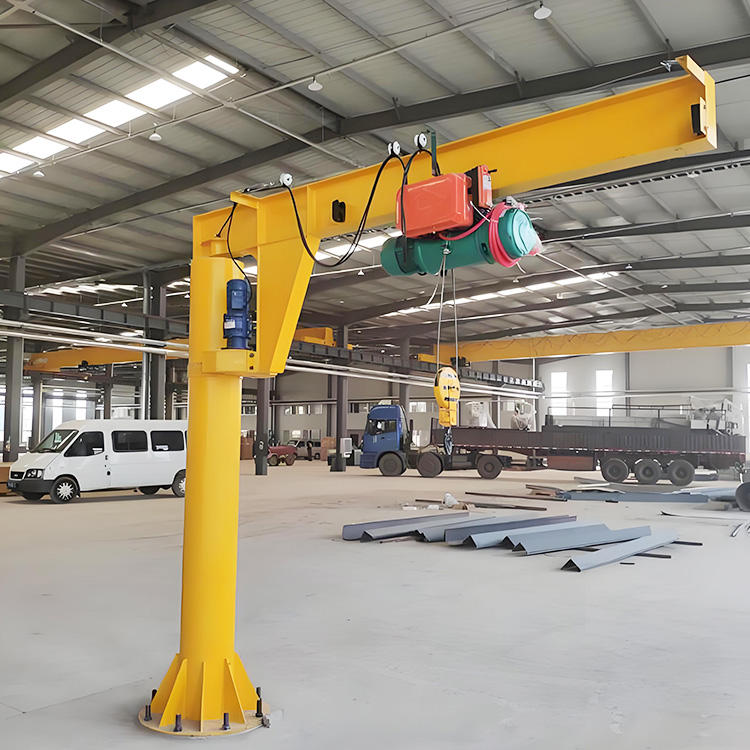
Choose this when you need full 360° rotation and have no suitable wall or roof to lean on. It bolts to its own concrete foundation and stands independent of the building — the most flexible option, at the cost of an engineered foundation sized for the overturning moment.
Best for: standalone workstations, open floors, and older buildings.
Wall-Mounted
Choose this to save floor space where a verified wall or column can carry the load. It needs no floor foundation, but the overturning moment becomes a strong pull-out force on the upper anchors — so the structure must be confirmed first, never light masonry.
Best for: perimeter work and supplementing a bridge crane along a bay edge.
Mast-Mounted
Choose this when you want 360° rotation with a smaller base and have a solid roof beam to tie into. Two-point support splits the moment between top and bottom, shrinking the foundation.
Best for: full rotation where a large freestanding foundation is impractical.
Articulating
Choose this when the load path curves around obstacles or into machines. The two-section boom with a pivoting elbow reaches where a rigid boom cannot — trading capacity (typically up to ~2 tonnes) for maneuverability.
Best for: machine loading, packaging around fixtures, and confined stations.
Takeaway: Full rotation with no wall points to floor-mounted; save floor space with wall-mounted; get 360° on a lighter base with mast-mounted; reach around obstacles with articulating.
Hoist Type Selection
The jib crane is only the structure — the hoist does the lifting, and matching it to the work matters as much as the boom itself.
Electric Chain Hoist
The default for most jib cranes. Chain hoists suit lighter loads (typically under 5 tonnes), shorter lifts, and intermittent duty. They are compact, economical, and simple to maintain — a natural fit for the light-to-moderate loads jib cranes handle.
Choose when: loads are modest, lift height is limited, and the budget is tight.
Wire Rope Hoist
Choose wire rope for heavier loads, longer lifts, or frequent, heavy cycling. A larger drum handles long lift heights easily and tolerates hard duty better than chain. On a high-capacity floor-mounted jib doing constant work, wire rope is the durable choice.
Choose when: loads climb toward the top of the range, lifts are long, or cycling is heavy.
Air Hoist
Choose an air (pneumatic) hoist where spark-free operation, continuous duty, or precise inching matters. Air hoists shine in hazardous atmospheres, wet environments, and applications demanding infinitely variable speed control — provided you have the compressed-air supply to feed them.
Choose when: the environment is hazardous or damp, or you need fine, continuous positioning.
Takeaway: Chain for light, intermittent lifting; wire rope for heavy, high, or high-cycle work; air where spark-free operation or fine control is essential.
VFD vs Standard Control
How the crane and hoist start, stop, and position the load comes down to the control type — and it affects wear and accuracy on every single lift.
Standard (contactor) control switches the motor between fixed speeds. It is simple, proven, and cheaper. The trade-off is abruptness: each start and stop jolts the load, swings it, and stresses the boom, brake, and mount over thousands of cycles.
Variable frequency drive (VFD) control ramps the motor speed smoothly instead of switching it. The benefits are concrete:
- Jolt-free starts and stops that reduce shock on the crane and load
- Slow-speed positioning for accurate placement on the final approach
- Reduced mechanical wear on the brake, gearbox, and boom
- Lower peak starting current, easing the load on your supply
Specify VFD where positioning accuracy matters, cycle rates are high, or you lift valuable or delicate loads — especially on the slew (rotation) motion, where smooth swing control is a real ergonomic and safety gain. Reserve standard control for genuinely light, occasional lifting where precision brings no return.
Takeaway: VFD delivers smooth, accurate, lower-wear lifting and suits most jib cranes; standard control is the economical choice only for light, occasional work.
Environment and IP Rating
A jib crane sized perfectly for the load will still fail early if it is wrong for its environment. This is one of the most overlooked lines in a specification.
The IP rating tells you how well the hoist and electrics resist dust and water. Match it honestly to the site:
- Clean, dry indoor bay: a standard rating such as IP54 is adequate.
- Dusty, humid, or washdown areas: step up to IP55 or IP65.
- Outdoor or harsh conditions: IP66 or higher, plus corrosion-resistant finishes for the boom, column, and hardware.
Under-rate the enclosure and dust or moisture reaches the electrics, causing corrosion and the intermittent faults that are maddening to trace.
Where flammable gases, vapors, or dust may be present — chemical plants, paint lines, grain handling — a standard crane is a serious ignition risk. These classified areas legally require an explosion-proof hoist with spark-resistant components, and an air hoist is often the natural fit. Confirm your area’s classification early, because it dictates the whole specification.
Takeaway: Match the IP rating and corrosion protection to the real site, and specify explosion-proof (or air) hoists wherever the area is classified as hazardous.
How to Evaluate Jib Crane Suppliers
Two suppliers can quote the same specification and deliver very different value. The crane lives for years and occasionally needs support, so the company behind it matters as much as the unit.
Certifications and Standards Compliance
A credible supplier builds to recognized standards. Look for FEM or ISO duty classification, ASME B30.11 for jib crane and monorail safety where you operate under US rules, and quality management certification such as ISO 9001. These are evidence the supplier engineers to a defined, verifiable practice — not marketing badges.
Engineering Support
The best value shows up before you buy. A strong supplier assigns engineers who assess your load, duty cycle, boom reach, environment, and — critically — your foundation or wall structure, then design the crane around your operation. Ask whether they provide the foundation loading data and calculations. Thin engineering at the quote stage predicts thin support later.
After-Sales and Spare Parts
A jib crane needs service and spares across its whole life. Evaluate spare parts availability and lead time, technical support for troubleshooting, warranty terms and what they actually cover, and service reach in your region. A supplier with no local presence is slow help when a crane is down.
Takeaway: Judge a supplier on certifications, upfront engineering (especially foundation data), and after-sales reach — not price alone.
Total Cost of Ownership vs Purchase Price
The most expensive jib crane mistake is buying on the sticker price. The purchase price is only the first — and often the smallest — part of what a crane costs over its life.
A cheap crane often hides a lighter duty class than your work demands, generic components that are hard to source spares for, and no real after-sales presence. Every one of those gaps becomes a cost later.
Total cost of ownership adds up everything across the crane’s service life:
- Purchase and installation: the crane, the hoist, delivery, the foundation, and commissioning
- Energy: an efficient, right-sized hoist saves real money over years of daily use
- Maintenance and spares: routine service plus wear parts and their availability
- Downtime: the biggest hidden cost — when the crane stops, the station it serves stops too
- Service life: a correctly classified crane runs for many years; an under-specified one fails in a fraction of that time
The right question is not “which is cheaper to buy” but “which is cheaper to own.” A crane that costs more up front but carries the right duty class, VFD control, and available spares almost always wins over its life.
Takeaway: Buy on total cost of ownership, not purchase price. The cheapest crane to buy is rarely the cheapest to own, and downtime dwarfs every other cost.
Common Jib Crane Buying Mistakes
Even experienced buyers repeat a handful of costly errors. Knowing them upfront is the cheapest insurance in this process.
- Sizing on load alone. Forgetting the hoist and rigging weight overloads the crane on every lift. Fix: size to the load plus all rigging plus a margin.
- Ignoring duty class. A crane correct for capacity but under-classified for its cycle rate fails years early. Fix: specify the FEM, ISO, or CMAA class from a real duty estimate.
- Mounting to an unverified structure. A wall-mounted jib imposes high pull-out forces light masonry cannot carry. Fix: verify the wall or column — and the foundation moment — before committing.
- Overlooking the environment. A standard hoist in a dusty, wet, or hazardous area corrodes or becomes an ignition risk. Fix: match the IP rating and specify explosion-proof where classified.
- Choosing a boom longer than the work needs. Extra reach increases the overturning moment and the foundation cost. Fix: size the boom to the real work area.
- Buying on price alone. Hidden gaps surface as downtime and early failure. Fix: evaluate on total cost of ownership and supplier strength.
Getting the foundation and mounting right at the buying stage sets up a clean install — the detail is covered in our jib crane installation guide.
Takeaway: Almost every buying mistake traces back to forgotten rigging, an ignored duty class, an unverified mount, or a price-first decision. Close those gaps and you avoid the errors that cost the most.
Frequently Asked Questions
Q: How do I calculate the right jib crane capacity?
Start with your heaviest single load, then add the weight of everything below the mount — the hoist, spreader beam or tooling, slings, and shackles — plus a safety margin. That total, not the bare load, is your required rated capacity. Selecting a crane at the very top of its range leaves no headroom, so if your loads may grow, size up now. Forgotten rigging weight is the most common reason a jib crane ends up quietly overloaded on every lift.
Q: Why is duty class more important than capacity when buying a jib crane?
Capacity tells you how heavy a single lift can be; duty class tells you how many lifts the crane and hoist survive over their life. Two cranes with identical capacity but different duty classes are built to completely different standards inside. Under-classifying causes overheating and early failure, often within a year or two of heavy use, while over-classifying means paying for durability you never use. Specify the FEM, ISO, or CMAA class from a real estimate of your lifts per hour, typical load, and daily running hours.
Q: Which mounting type should I choose for my jib crane?
Choose floor-mounted (freestanding) for full 360° rotation where no suitable wall exists, at the cost of an engineered foundation. Choose wall-mounted to save floor space where a verified wall or column can carry the high pull-out loads, accepting roughly 180° to 200° rotation. Choose mast-mounted for 360° rotation with a smaller base where a solid roof beam is available. Choose articulating when the load must reach around obstacles or into machines, trading capacity for maneuverability. Match the type to your load, coverage, and building structure.
Q: Should I buy a chain, wire rope, or air hoist for my jib crane?
Choose an electric chain hoist for lighter loads (typically under 5 tonnes), shorter lifts, and intermittent duty — the default for most jib cranes. Choose a wire rope hoist for heavier loads, longer lifts, or frequent, heavy cycling, since the larger drum handles long lifts and hard duty better. Choose an air hoist where spark-free operation, continuous duty, or precise inching matters, such as hazardous or wet environments — provided you have the compressed-air supply to feed it.
Q: Is VFD control worth the extra cost on a jib crane?
For most applications, yes. VFD control delivers jolt-free starts and stops, slow-speed positioning for accurate placement, reduced wear on the brake and gearbox, and lower peak starting current. It matters most where positioning accuracy, high cycle rates, or valuable loads are involved, and it is especially valuable on the rotation motion for smooth swing control. Standard contactor control remains a reasonable, economical choice only for genuinely light, occasional lifting where the extra precision brings no return.
Q: What IP rating does my jib crane hoist need?
Match the IP rating to the real site. A clean, dry indoor bay is usually fine with a standard rating such as IP54. Dusty, humid, or washdown areas call for IP55 or IP65, and outdoor or harsh environments need IP66 or higher plus corrosion-resistant finishes. Where flammable gases, vapors, or dust may be present, the area is classified as hazardous and legally requires an explosion-proof hoist. Under-rating the enclosure lets dust and moisture reach the electrics, causing corrosion and intermittent faults.
Q: How do I evaluate a jib crane supplier?
Look beyond price at four things. First, certifications and standards compliance — FEM or ISO duty classification, ASME B30.11 where applicable, and ISO 9001 quality management. Second, upfront engineering support, especially whether they assess your structure and provide foundation loading data. Third, after-sales strength — spare parts availability, technical support, warranty, and service reach in your region. Fourth, a relevant track record with cranes of similar duty and capacity. The company behind the crane determines whether it stays reliable for years.
Q: Why does total cost of ownership matter more than purchase price?
Because the purchase price is often the smallest part of what a crane costs over its life. Total cost of ownership adds installation and the foundation, energy, maintenance, spare parts, and — above all — downtime, which is the biggest hidden cost when a stopped crane halts the station it serves. A correctly specified, well-supported crane that costs more up front usually wins over its service life by avoiding the failures and early replacement that plague a cheap, under-specified unit.