


Jib Crane Types and Applications: Which Jib Crane Is Right for Your Facility?
Introduction
A jib crane looks simple — one boom, one hoist, one point of rotation. But that simplicity hides a real decision. Choose the wrong type and you either bolt a heavy foundation into a floor where a wall bracket would have done the job, or you hang a crane on a wall that was never built to carry it. Choose the right type and you get precise, ergonomic lifting exactly where your work happens, for a fraction of the cost of a bridge crane.
For facility managers and procurement engineers, picking the right jib crane comes down to four things: how heavy the load is, how much area you need to cover, what your building can support, and how far the boom must reach.
This guide maps the four main jib crane types — floor-mounted, wall-mounted, mast-mounted, and articulating — side by side. This is article 1 of 3 in the Weiyuan Crane jib crane series. Here is what you will learn:
- How each jib crane type is built and where it mounts
- Capacity, reach, and rotation for each type
- A practical framework to match a jib crane to your facility
What a Jib Crane Is and How the Types Relate
A jib crane is a single horizontal boom that rotates around a fixed point — a column, a wall bracket, or a mast. A hoist rides a trolley along the boom, and the boom swings through an arc, covering a circular or pie-shaped area around one mount.
Unlike a bridge crane that covers a whole rectangular bay, a jib crane serves one spot exceptionally well. The entire load, plus the leverage of the boom, passes through that single support — which is why the mounting type and the overturning moment govern the whole design.
The four types differ mainly in how and where they mount. That single choice drives capacity, rotation arc, and what your building must carry.
Takeaway: A jib crane owns the workstation. The type you choose depends on load, coverage, building structure, and reach — in that order.
Type 1: Floor-Mounted (Freestanding) Jib Cranes
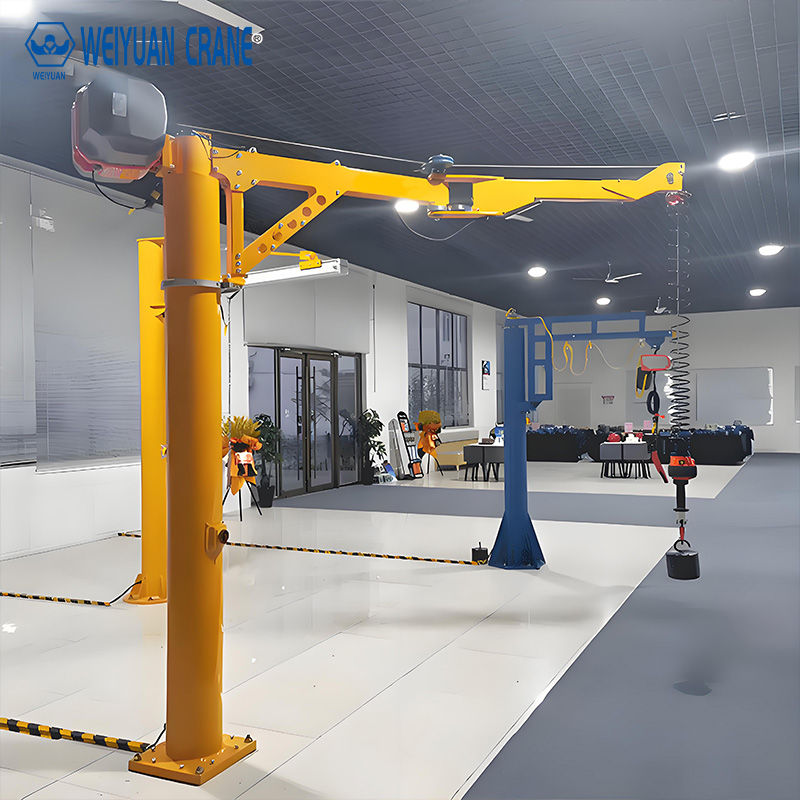
A floor-mounted jib crane bolts to a steel base plate anchored into a dedicated concrete foundation. The column stands alone, carrying the full vertical load and the entire overturning moment down into the foundation. It needs no building support at all.
Key Specifications
- Capacity: commonly 0.25 to 5 tonnes, with heavier models up to around 10 tonnes.
- Boom reach: commonly 2 to 8 metres.
- Rotation arc: up to full 360°, since nothing obstructs the boom.
- Foundation: a reinforced concrete pad sized for the overturning moment, usually far larger than the base plate.
Why It Matters
The freestanding design is the most flexible option. Because it stands independent of the building, you can place it anywhere the floor and foundation allow — ideal for open floors, older buildings, or spots with no suitable wall. The trade-off is the foundation: the entire load and moment pass through one pad, so it must be engineered correctly, as covered in our jib crane installation guide.
Ideal applications: machine shops feeding a single lathe or press, standalone assembly cells, and workstations where full rotation matters and no wall is available.
Takeaway: Floor-mounted jib cranes give full 360° rotation and total independence from the building — at the cost of a properly engineered foundation.
Type 2: Wall-Mounted Jib Cranes
A wall-mounted jib crane fixes its boom to brackets anchored to a building wall, column, or supporting steel. The building structure carries the load, so no floor foundation is needed — but the wall now takes the full vertical load plus a substantial pull-out force at the top bracket.
Key Specifications
- Capacity: commonly 0.25 to 5 tonnes.
- Boom reach: commonly 2 to 7 metres.
- Rotation arc: roughly 180° to 200°, limited by the wall.
- Mounting: high-strength anchors into verified structural concrete or steel — never light masonry.
Why It Matters
Wall mounting saves floor space entirely, which is its biggest draw in a crowded plant. It also works well running a boom along a wall or supplementing a bridge crane along the edge of a bay. The critical detail is the structure: the overturning moment becomes a strong outward pull on the upper anchors, so the wall or column must be verified for those forces before installation.
Ideal applications: lifting along a wall line, feeding stations near the building perimeter, and adding focused lifting under an existing overhead crane without taking floor space.
Takeaway: Wall-mounted jib cranes free the floor and suit perimeter work — provided the building structure can carry the high pull-out loads.
Type 3: Mast-Mounted Jib Cranes
A mast-mounted jib crane is supported at two points — a floor foundation at the base and a fixed point at the top, such as a roof beam or bracket. Because the load is shared between the top and bottom supports, the overturning moment resolves into a horizontal force couple rather than concentrating entirely at a single base.
Key Specifications
- Capacity: commonly 0.25 to 5 tonnes, with some models higher.
- Boom reach: commonly 3 to 8 metres.
- Rotation arc: up to full 360°, like a freestanding crane.
- Mounting: a smaller floor base plus a verified top support point.
Why It Matters
The two-point support is the clever part. Splitting the moment between top and bottom means the base foundation can be much smaller than a freestanding crane of the same capacity — a real saving where the building offers a solid roof beam or overhead structure to tie into. You get full rotation and high lift without the large foundation.
Ideal applications: facilities needing full 360° rotation and high lift where a strong roof structure is available, and sites where a large freestanding foundation is impractical.
Takeaway: Mast-mounted jib cranes deliver 360° rotation with a lighter base by leaning on a solid top support — a smart choice when the building offers one.
Type 4: Articulating Jib Cranes
An articulating jib crane uses two boom sections joined by a pivoting “elbow,” rather than one straight boom. The primary arm rotates at the mount, and the secondary arm rotates independently at the elbow — letting the hook reach around obstacles, into machines, and through doorways a single-boom crane cannot.
Key Specifications
- Capacity: typically lighter, commonly 0.125 to 2 tonnes.
- Reach: the two-arm design gives extended, flexible reach within a footprint.
- Rotation arc: the primary arm can rotate up to 360°, and the second arm adds its own independent swing.
- Mounting: available in floor-mounted, wall-mounted, and mast configurations.
Why It Matters
Articulating jib cranes trade some capacity for precision and reach into awkward spaces. The dual-pivot design lets an operator guide a load around a fixture, into a machine enclosure, or back under an obstruction — exactly the maneuvers a rigid boom struggles with. They excel at repetitive, ergonomic lifting where the load path is not a straight line.
Ideal applications: loading and unloading machine tools with enclosures, packaging and palletizing around obstacles, and confined workstations where the hook must reach into or around equipment.
Takeaway: Articulating jib cranes buy maneuverability — reaching around obstacles and into machines — at the cost of a lower capacity ceiling.
Comparing the Four Jib Crane Types
Use this quick comparison to narrow your options, then confirm the detail against your real loads and site.
| Type | Typical capacity | Boom reach | Rotation arc | Mounting / foundation | Best for |
|---|---|---|---|---|---|
| Floor-mounted (freestanding) | 0.25–10 t | 2–8 m | Up to 360° | Dedicated concrete foundation | Standalone stations, full rotation, no wall available |
| Wall-mounted | 0.25–5 t | 2–7 m | ~180°–200° | Verified wall or column | Saving floor space, perimeter work |
| Mast-mounted | 0.25–5 t | 3–8 m | Up to 360° | Small floor base + top support | Full rotation with a smaller base |
| Articulating | 0.125–2 t | Extended, flexible | 360°+ (dual pivot) | Floor, wall, or mast | Reaching around obstacles and into machines |
How to Read the Table
Start with capacity to eliminate any type that cannot carry your load. Then use rotation and reach to sort the rest: full coverage points to floor or mast-mounted, space-saving points to wall-mounted, and awkward load paths point to articulating. Finally, confirm what your building or foundation can support.
Takeaway: Capacity narrows the field, rotation and reach sort the survivors, and your building structure confirms the final choice.
A Practical Selection Framework
Here is how to reach the right jib crane type without guesswork. Work through these four steps in order.
Step 1: Weigh the Load
Start with your heaviest lift, then add the weight of the hoist, below-the-hook tooling, slings, and shackles, plus a safety margin. That total — not the bare load — is your required capacity. Loads under 2 tonnes keep articulating cranes in play; heavier loads point toward floor-mounted designs, which reach up to around 10 tonnes.
Step 2: Map the Coverage
Ask how much area the crane must serve. Full 360° rotation around one point favors a floor-mounted or mast-mounted crane. A半-circle along a wall suits a wall-mounted crane. A path that curves around obstacles or into a machine calls for an articulating crane.
Step 3: Confirm the Building Structure
Your structure often decides what is even possible:
- No suitable wall or roof support → floor-mounted freestanding on its own foundation.
- A strong, verified wall or column → wall-mounted to save floor space.
- A solid roof beam or overhead structure → mast-mounted for full rotation with a smaller base.
Never mount a jib crane to an unverified wall — the overturning moment creates high pull-out forces that light masonry cannot carry.
Step 4: Match the Boom Reach
Finally, confirm the boom length reaches every point the work requires, remembering that a longer boom with the same load creates a larger overturning moment on the mount. Size the reach to the real work area, not the maximum available. For turning this choice into a full specification, see our jib crane buying guide.
Takeaway: Load, coverage, building structure, then reach — work through them in order and the right jib crane type emerges from your real needs.
Common Selection Mistakes to Avoid
Even experienced buyers repeat a handful of costly errors. Knowing them upfront is cheap insurance.
- Sizing on load alone. Forgetting the hoist and rigging weight quietly overloads the crane on every lift. Size to the load plus all rigging plus a margin.
- Mounting to an unverified wall. A wall-mounted jib imposes high pull-out forces the structure may not carry. Verify it before you commit.
- Overpaying for rotation you never use. Specifying a 360° freestanding crane where a wall-mounted半-arc would serve the work better and cheaper.
- Ignoring the overturning moment. Choosing a long boom without confirming the foundation or mount can carry the resulting moment.
- Overlooking the load path. Picking a rigid boom where the work needs to reach around an obstacle — where an articulating crane belongs.
For the safety and compliance side of running any jib crane, see our jib crane safety and OSHA compliance guide.
Takeaway: Most selection mistakes trace back to forgotten rigging, an unverified mount, or a mismatched rotation and reach. Close those gaps and you avoid the errors that cost the most.
Frequently Asked Questions
Q: What are the main types of jib cranes?
The four main types are floor-mounted (freestanding), wall-mounted, mast-mounted, and articulating jib cranes. Floor-mounted cranes bolt to a dedicated foundation and rotate up to 360°; wall-mounted cranes fix to a building wall or column and rotate roughly 180° to 200°; mast-mounted cranes use both a floor base and a top support for full rotation with a smaller foundation; and articulating cranes use a two-section boom with a pivoting elbow to reach around obstacles. The right type depends on your load, coverage needs, building structure, and required reach.
Q: How much weight can a jib crane lift?
Jib cranes commonly handle 0.25 to 5 tonnes, with heavier floor-mounted models reaching around 10 tonnes. Articulating jib cranes typically sit lower, around 0.125 to 2 tonnes, trading capacity for reach and maneuverability. Always size to your heaviest load plus the weight of the hoist, tooling, and rigging, plus a safety margin — never the bare load alone, since forgotten rigging weight overloads the crane on every lift.
Q: What is the difference between a floor-mounted and wall-mounted jib crane?
A floor-mounted (freestanding) jib crane bolts to its own concrete foundation, stands independent of the building, and rotates up to a full 360°. A wall-mounted jib crane fixes to a building wall or column, needs no floor foundation, and rotates roughly 180° to 200° because the wall limits its arc. Choose floor-mounted for full rotation where no suitable wall exists, and wall-mounted to save floor space where a verified structure can carry the high pull-out loads.
Q: Which jib crane offers full 360-degree rotation?
Both floor-mounted (freestanding) and mast-mounted jib cranes offer up to full 360° rotation, since nothing obstructs the boom’s swing. Articulating jib cranes can also rotate 360° at the primary arm, with additional independent movement at the elbow. Wall-mounted jib cranes are the exception — the wall limits them to roughly 180° to 200°. If full rotation is essential and no wall support is needed, a floor-mounted or mast-mounted crane is the natural choice.
Q: When should I choose an articulating jib crane?
Choose an articulating jib crane when the load path is not a straight line — when the hook must reach around obstacles, into machine enclosures, or back under a fixture. The two-section boom with a pivoting elbow gives maneuverability a rigid boom cannot match, making it ideal for loading machine tools, packaging around obstacles, and confined workstations. The trade-off is a lower capacity ceiling, typically up to around 2 tonnes, so it suits lighter, repetitive, precise lifting.
Q: Does a mast-mounted jib crane need a smaller foundation?
Yes. Because a mast-mounted jib crane is supported at both a floor base and a top point, the overturning moment resolves into a horizontal force couple between the two supports rather than concentrating entirely at the base. This lets the floor foundation be much smaller than a freestanding crane of the same capacity. The trade-off is that you need a solid, verified top support — such as a roof beam or overhead structure — to tie the mast into.
Q: Can any building wall support a wall-mounted jib crane?
No. A wall-mounted jib crane imposes the full vertical load plus a substantial pull-out force on the upper anchors from the overturning moment, and only verified structural concrete or steel can carry it — never light masonry or an unverified wall. The wall or column effectively becomes the crane’s foundation and must be assessed for the imposed loads before installation. Where the structure cannot take the forces, a freestanding floor-mounted crane on its own foundation is the safer choice.
Q: How do I choose the right jib crane for my facility?
Work through four factors in order. First, weigh the heaviest load plus all rigging to eliminate types that cannot carry it. Second, map the coverage — full rotation favors floor or mast-mounted, a wall arc favors wall-mounted, and an awkward load path favors articulating. Third, confirm what your building or foundation can support. Fourth, match the boom reach to your real work area, remembering that a longer boom increases the overturning moment. That sequence points you to the right type based on your real needs.