


Jib Crane Maintenance Guide: Schedules, Wear Limits, and Failure Modes
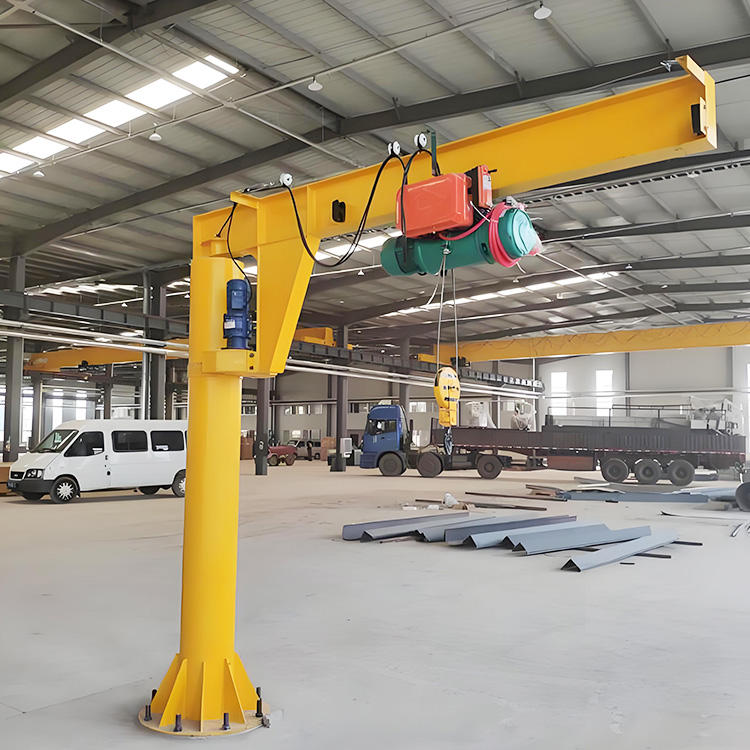
Introduction
A jib crane rarely fails on the day something breaks. It fails weeks earlier — when an anchor nut nobody checked started backing off, a rotation bearing nobody greased began to bind, or a wire rope nobody measured wore past its discard limit. The warning signs are quiet: a boom that swings a little rougher, a column that leans a few degrees more than last month, a load that creeps an inch when it should hold still. Then one shift the mount lets go, and a repair that would have cost a few hundred dollars in a planned window becomes an incident at a busy workstation.
A jib crane channels its entire load — plus the leverage of the boom — through a single mount. That one detail makes its maintenance less forgiving than a crane that spreads its load across two runways, and it puts the mount, the anchors, and the rotation bearing at the center of everything you do.
This guide walks through a complete jib crane maintenance and inspection program. This is article 2 of 3 in the Weiyuan Crane jib crane series. Here is what you will learn:
- Why preventive maintenance protects safety, uptime, and capital
- The tiered inspection program — pre-shift, frequent, and periodic — with checklists
- Lubrication schedules and wear-part discard criteria
- The failure modes unique to jib cranes, plus logs and common mistakes
Why Preventive Maintenance Matters for Jib Cranes
Preventive maintenance protects three things every operation answers for: people, production, and capital. On a jib crane, each carries extra weight because the crane concentrates its load through one mount and works right where people stand.
Safety first. A jib crane rotates its load in an arc through space operators share at the workstation. A worn hook, a corroded rope, a fading brake, or — worst of all — a loosening mount can drop a load or bring the whole boom down at close quarters. Preventive maintenance catches those failures while they are still measurements on a checklist, not incidents on the floor. It is also the backbone of compliance, since the same inspections that keep the crane safe are the ones an auditor expects documented, as covered in our jib crane safety and OSHA compliance guide.
Uptime second. Reactive maintenance is expensive maintenance. When a jib crane fails without warning, you pay for the emergency repair, the rushed parts, and the production that stops while the station it serves sits idle. Planned maintenance moves that work into scheduled windows, so the crane comes out of service once, deliberately.
Capital third. A well-maintained jib crane reaches its full service life of decades. A neglected one wears its rotation bearing, loosens its anchors, and fatigues its boom years early. The steady cost of a maintenance program is always cheaper than the early rebuild that neglect forces.
Takeaway: Preventive maintenance is the cheapest insurance you own. It turns an unpredictable mount or bearing failure into predictable, low-cost, scheduled work.
The Tiered Inspection Program
A sound jib crane maintenance program is built on a tiered inspection schedule. Each tier targets a different rate of wear — from faults that appear overnight to structural fatigue that builds over years. Match the depth of the inspection to the speed of the failure it hunts.
Pre-Shift (Daily) Inspection
Before each shift or first use, the operator performs a functional and visual check. These take minutes and catch the most common causes of sudden failure. Check:
- Hoist brake: confirm it holds the load without drift when the motor stops.
- Hook and latch: inspect for deformation, cracks, throat wear, or a damaged safety latch.
- Wire rope or load chain: look for broken wires, kinks, corrosion, flattening, or poor seating on the drum or sprocket.
- Upper limit switch: verify the hoist stops before two-blocking.
- Boom rotation: confirm the boom swings freely through its full arc with no stiff points, binding, or tendency to drift back to one spot.
- Trolley travel: confirm the trolley rolls the full boom length without binding and the end stop is in place.
- The mount: scan for a leaning column, cracked grout at the base plate, gaps or movement at wall brackets, or a loosened anchor nut.
Log every pre-shift check. Any sign of movement at the mount takes the crane out of service until a qualified person assesses it.
Frequent Inspection
Frequent inspections run at daily to monthly intervals, depending on service severity, and go deeper than the pre-shift check. Trained personnel examine the same critical systems with closer attention to wear that builds over weeks. Wire rope is measured against discard criteria here, not just glanced at. The rotation bearing is checked for play, roughness, and grease condition, and the boom is watched for any change in how level it sits.
Periodic Inspection
Periodic inspections run at one- to twelve-month intervals, scaled to how hard the crane works, and are comprehensive documented examinations by a qualified person. These cover:
- The column or mast, boom, and base plate for cracks, deformation, or corrosion.
- Anchor bolts and structural connections, checked for torque and any sign of pull-out or loosening — especially the upper wall anchors.
- The rotation (slew) bearing for wear, play, and smooth motion through the full arc.
- The boom-to-column connection and the boom for level and any deflection.
- Brake system parts, linings, and drum for wear and holding capacity.
- Wire rope, drum, and sheave wear against discard criteria.
- Motors, controls, festoon cabling, and wiring for deterioration.
Keep dated periodic reports on file, signed by the qualified person, with the condition of the mount, anchors, and rotation bearing recorded.
Takeaway: Run three tiers — daily checks for sudden faults, frequent inspections for developing wear, and periodic inspections for slow structural risks. Build a jib-specific mount, anchor, and rotation-bearing check into every tier.
Lubrication Schedules for Key Components
Lubrication is the cheapest, highest-return maintenance task there is — and on a jib crane the rotation bearing makes it more important than most crane types realize. Build lubrication into the schedule as a named task, not an afterthought.
Rotation (Slew) Bearing
The rotation bearing is the component that makes a jib crane a jib crane, and it lives or dies on grease. A dry slew bearing binds, wears its raceway and rolling elements, and eventually makes the boom stiff and hard to swing — the first sign operators notice. Grease it at the manufacturer’s interval through every fitting, working the grease around the full rotation so it reaches the whole raceway. Use the specified grease, and more frequent lubrication in dusty or humid environments where contamination reaches the bearing faster.
Wire Rope
Wire rope needs lubrication to reduce internal friction between strands and to resist corrosion. A dry rope wears from the inside out where you cannot see it, and corrodes in the valleys between wires. Clean and lubricate the rope with a compatible wire-rope dressing at the manufacturer’s interval — more often in wet, dusty, or coastal conditions.
Hoist and Trolley Gearboxes
Hoist and trolley gearboxes rely on oil for both lubrication and heat removal. Check the oil level at periodic intervals, look for leaks at the seals, and change the oil at the manufacturer’s specified hours. Watch for a milky appearance, which signals water contamination from a failed seal.
Trolley Wheels and Bearings
The trolley wheels and their bearings need attention so the trolley rolls freely along the boom. Grease the wheel bearings at their scheduled interval, keep the boom running surface clean of debris, and confirm the trolley does not bind or run into a stiff spot at any point across the boom.
Takeaway: Schedule lubrication as a named task for the rotation bearing, wire rope, gearboxes, and trolley — with the slew bearing first, since a dry bearing is the fastest way to ruin a jib crane’s defining motion.
Wear-Part Inspection Intervals and Discard Criteria
Wear parts do not last forever, and the whole point of inspection is to replace them at the right moment — before they fail, not after. The key is knowing each part’s discard criteria and never running past it.
Wire Rope
- Inspect: daily visually, measure at frequent and periodic intervals.
- Discard when: the rope shows the discard number of broken wires per ASME B30 criteria, significant corrosion or pitting, kinking, birdcaging, flattening, or a measured diameter reduction beyond the manufacturer’s limit.
Hook
- Inspect: daily for obvious damage, measure periodically.
- Discard when: the throat opening has spread beyond the manufacturer’s limit (commonly around 15%), the hook shows cracks, twisting beyond about 10 degrees, or excessive saddle wear. A missing or damaged safety latch is replaced immediately. Never repair a hook by welding or heating.
Rotation Bearing
- Inspect: for play and smoothness at frequent intervals, in depth at periodic intervals.
- Discard when: the bearing shows excessive play (measured against the manufacturer’s tilt or clearance limit), roughness or notchiness through the arc, metal particles in the grease, or a boom that no longer swings freely after re-greasing. A slew bearing that has reached its play limit is on borrowed time and should be replaced before it seizes or fails under load.
Brake Linings
- Inspect: at frequent to periodic intervals for wear and adjustment.
- Discard when: the lining reaches its minimum specified thickness, is contaminated with oil or grease, or the brake no longer holds the rated load without drift.
A practical rule: measure against the discard limit and replace at it — never past it. Running a rope, hook, bearing, or brake lining “a little longer” is exactly how a predictable replacement becomes an unpredictable failure at the workstation.
Takeaway: Every wear part has a discard limit. Inspect on schedule, measure against the criteria, and replace at the limit — the rotation bearing especially, since its wear is easy to ignore until the boom binds.
Failure Modes Unique to Jib Cranes
A jib crane has signature failure modes that flow directly from its single-mount, rotating design. Four deserve targeted attention, because they build slowly and cause the most expensive damage.
Mount Loosening
Every lift and every rotation cycles the mount, and over time that cyclic load can work the anchor bolts loose or crack the grout beneath the base plate. A loosening mount lets the column shift and lean, which then loads the anchors even more unevenly — a failure that accelerates once it starts. Check anchor torque at periodic intervals, watch for grout cracking and rust streaks at the base, and treat any movement as a stop-work condition.
Rotation Bearing Wear
The slew bearing takes the full radial and axial load plus the overturning moment, every time the boom rotates. Neglected lubrication, contamination, or simple high-cycle use wears the raceway until the bearing develops play, then roughness, then a boom that binds or swings unevenly. Caught early through grease condition and play checks, it is a scheduled replacement; missed, it becomes a seized bearing or a boom that drops.
Boom Deflection
A boom carrying its rated load at full reach deflects slightly by design, but a boom that sags more than it should — or no longer returns to level when unloaded — signals a problem. Overloading, fatigue at the boom-to-column connection, or a worn rotation bearing can all show up as excessive deflection. Watch the boom for any change in how level it sits, both loaded and empty, and investigate any new sag immediately.
Anchor Pull-Out
On a wall-mounted jib, the overturning moment becomes a strong pull-out force on the upper anchors — and this is the highest-consequence failure of all. If the wall was marginal, the anchors under-sized, or the structure never properly verified, the upper anchors can gradually pull out of the wall until the mount fails. Inspect the upper brackets and anchors closely at every periodic check for any gap, movement, cracking, or spalled concrete, since the upper anchors always fail first.
Takeaway: Mount loosening, rotation bearing wear, boom deflection, and anchor pull-out are the jib crane’s signature failures. All trace back to the single mount and rotating design, so target them at every inspection.
Building a Maintenance Log and Documentation System
Inspection and lubrication only pay off if they are recorded, tracked, and acted on. A maintenance log turns scattered checks into a system that proves compliance and reveals developing problems before they stop the crane.
What the Log Must Capture
- Crane identification: a unique ID, location, mounting type, rated capacity, boom reach, and duty class.
- Inspection records: date, tier (pre-shift, frequent, periodic), inspector, findings, and sign-off.
- Mount and anchor records: anchor torque checks, grout condition, and column plumb over time.
- Lubrication records: what was lubricated — rotation bearing especially — with what, and when.
- Wear-part measurements: rope diameter, hook throat, bearing play, and brake-lining thickness over time.
- Repairs and replacements: what failed, what was fitted, and the date.
- Load test certificates: filed with the crane’s history.
Why Trending Matters
A single measurement tells you a part is within tolerance today. A series of measurements tells you when it will reach its discard limit — which lets you order the part and schedule the swap before it becomes urgent. On a jib crane, trending the anchor torque and the rotation bearing play is especially valuable, because both fail slowly and give plenty of warning to anyone tracking the numbers.
Keep It Simple and Consistent
Whether you use a spreadsheet, a CMMS platform, or printed checklists in a binder, the system that gets used is the one that works. Standardize the checklists, assign clear responsibility for each tier, and make sign-off mandatory. An unsigned inspection is treated by an auditor as one that never happened.
Takeaway: Build a per-crane log capturing inspections, mount and anchor checks, lubrication, wear measurements, and repairs — and trend the numbers. The records prove compliance and turn maintenance from guesswork into a schedule.
Common Jib Crane Maintenance Mistakes
Most jib cranes that give trouble were let down by a handful of avoidable errors. Knowing them upfront is the cheapest protection you can buy.
Mistake 1: Running Reactive Instead of Preventive
The crane is only touched when it breaks, so every failure becomes an emergency at a busy workstation.
Fix: Build a tiered preventive schedule and stick to it. Planned work is always cheaper than the breakdown it prevents.
Mistake 2: Neglecting the Rotation Bearing
The slew bearing runs dry because lubrication was never scheduled, until the boom binds and the bearing is scrap.
Fix: Grease the rotation bearing on schedule through every fitting, and check its play and grease condition at each frequent inspection.
Mistake 3: Never Checking Anchor Torque
The anchors are assumed to be as tight as the day they were installed, so gradual loosening goes unnoticed until the mount shifts.
Fix: Check and record anchor torque at every periodic inspection, and treat the upper wall anchors as the highest priority.
Mistake 4: Ignoring Early Mount Movement
A slight lean or hairline grout crack is dismissed as cosmetic, and the mount keeps degrading under load.
Fix: Treat any sign of movement at the mount as a stop-work condition until a qualified person assesses it.
Mistake 5: Running Wear Parts Past Their Discard Limit
A rope, hook, bearing, or brake lining is measured over its limit but left “a little longer,” then fails under load.
Fix: Replace at the discard criteria, never past it. Measure, decide, and act on the same schedule.
Mistake 6: Poor or No Documentation
Inspections happen but nothing is recorded, so there is no compliance trail and no way to trend developing wear at the mount or bearing.
Fix: Keep a consistent, signed maintenance log per crane, and trend the anchor torque and bearing play over time.
Takeaway: Nearly every jib crane maintenance failure traces back to reactive habits, a neglected rotation bearing, unchecked anchors, or missing records. Close those gaps and you close most of your downtime and safety risk.
Frequently Asked Questions
Q: How often should a jib crane be inspected?
A jib crane needs a tiered program. The operator performs a functional and visual check before each shift, including a scan of the mount and anchors. Frequent inspections run at daily to monthly intervals depending on service severity, with the wire rope measured and the rotation bearing checked for play. Periodic inspections run at one- to twelve-month intervals, scaled to how hard the crane works, and are comprehensive documented examinations by a qualified person covering the column, boom, mount, anchors, rotation bearing, brakes, and electrics. A heavy, high-cycle jib needs more frequent attention than a light, occasional-use one.
Q: How do I know when the rotation bearing needs replacing?
Replace the slew bearing when it shows play beyond the manufacturer’s clearance or tilt limit, roughness or notchiness as the boom swings through its arc, metal particles in the grease, or a boom that still binds after being properly re-greased. Check play and smoothness at frequent intervals and measure in depth at periodic ones. A bearing at its play limit is on borrowed time — replace it before it seizes or fails under load, because a rotation bearing failure can drop the boom at the workstation.
Q: What lubrication does a jib crane need most?
The rotation bearing is the priority, because it is the component that defines a jib crane and it degrades fastest when neglected. Grease it at the manufacturer’s interval through every fitting, working the grease around the full rotation, and more often in dusty or humid conditions. Beyond that, lubricate the wire rope with a compatible dressing to slow internal wear and corrosion, check and change the hoist and trolley gearbox oil on schedule, and grease the trolley wheel bearings. A dry slew bearing is the single most common lubrication failure on jib cranes.
Q: Why do jib crane anchors loosen, and how do I catch it?
A jib crane cycles its mount on every lift and rotation, and that repeated loading can gradually back off anchor bolts or crack the grout beneath the base plate. On a wall-mounted jib, the overturning moment puts a strong pull-out force on the upper anchors, which loosen first. Catch it by checking and recording anchor torque at every periodic inspection, and by scanning the mount every shift for a leaning column, grout cracks, rust streaks, or any gap or movement at the wall brackets. Any movement takes the crane out of service until a qualified person assesses it.
Q: What are the signs a jib crane boom is deflecting too much?
A boom deflects slightly under its rated load by design, but watch for excessive sag under load, a boom that no longer returns to level when unloaded, or a change in how level it sits compared with previous inspections. These can signal overloading, fatigue at the boom-to-column connection, or a worn rotation bearing letting the boom tilt. Investigate any new or increasing deflection immediately, since it points to a structural or bearing problem that will worsen under continued use.
Q: Who is qualified to perform jib crane maintenance?
Pre-shift checks are performed by trained operators, and frequent inspections by trained maintenance personnel. Periodic inspections, anchor torque checks, rotation bearing assessments, and any measurement against discard criteria must be performed by a qualified person — someone with the training and experience to recognize a fatigue crack, a bearing at its wear limit, or an anchor beginning to pull out, and to judge whether the mount and crane are fit for service. Using untrained personnel for periodic inspections is a common and dangerous mistake on jib cranes, where the mount is the highest-consequence component.
Q: What records should I keep for jib crane maintenance?
Keep a per-crane log recording the crane’s identification, mounting type, rated capacity, and boom reach; every inspection (date, tier, inspector, findings, and sign-off); mount and anchor records including torque checks and grout condition; all lubrication tasks with the rotation bearing noted; wear-part measurements trended over time; all repairs and replacements; and the load test certificates. These records prove compliance in an audit and reveal developing wear at the mount or bearing so you can plan replacements in scheduled windows. An unsigned or missing record is treated by an inspector as work that never happened.
Q: Can I keep using a jib crane if the column leans slightly?
No. A leaning column is a warning that the mount is moving — anchors loosening, grout failing, or the foundation or wall giving way — and it worsens with every cycle because the lean loads the anchors more unevenly. Take the crane out of service and have a qualified person assess the mount, anchors, and foundation or wall before any further use. What looks like a minor cosmetic lean can be the early stage of an anchor pull-out or mount failure, which is the highest-consequence failure a jib crane can suffer.