


Jib Crane Applications by Industry: Where Jib Cranes Fit Best Across Manufacturing, Warehousing, and Heavy Industry
Introduction
The same 1-tonne jib crane that transforms an automotive assembly cell would be the wrong tool in a pharmaceutical cleanroom, a corrosion risk in a mine, and an obstruction in a low-headroom warehouse. Capacity alone tells you almost nothing about whether a jib crane fits a job. What decides it is the industry — the load it lifts, the space it works in, the environment it lives in, and the way people work around it.
That is the practical question most buyers actually face: not “which jib crane is best,” but “which jib crane is best for my kind of work.” A machine shop, a packing line, and a repair bay each pull the specification in a different direction, and matching the crane to the industry is what separates a workstation that flows from one that fights its operators.
This guide maps jib crane applications across six industries, from a plant engineer’s and procurement manager’s point of view. This is article 3 of 3 in the Weiyuan Crane jib crane series. Here is what you will learn:
- The specific lifting challenge a jib crane solves in each industry
- Which mounting type — floor, wall, mast, or articulating — fits each application
- The hoist and control configuration suited to each kind of work
Automotive Assembly
The automotive line is one of the most natural homes for a jib crane. Work happens at fixed stations, repeats hundreds of times a shift, and demands both speed and precise placement.
The Lifting Challenge
Operators position components — engine subassemblies, transmissions, seats, dashboards, and stamping dies — into the same spot over and over. Doing it by hand is slow, tiring, and imprecise, and doing it with a bridge crane ties up a bay-wide asset for a station-sized job. The jib crane gives each cell its own dedicated, repeatable lift.
Best Mounting Type
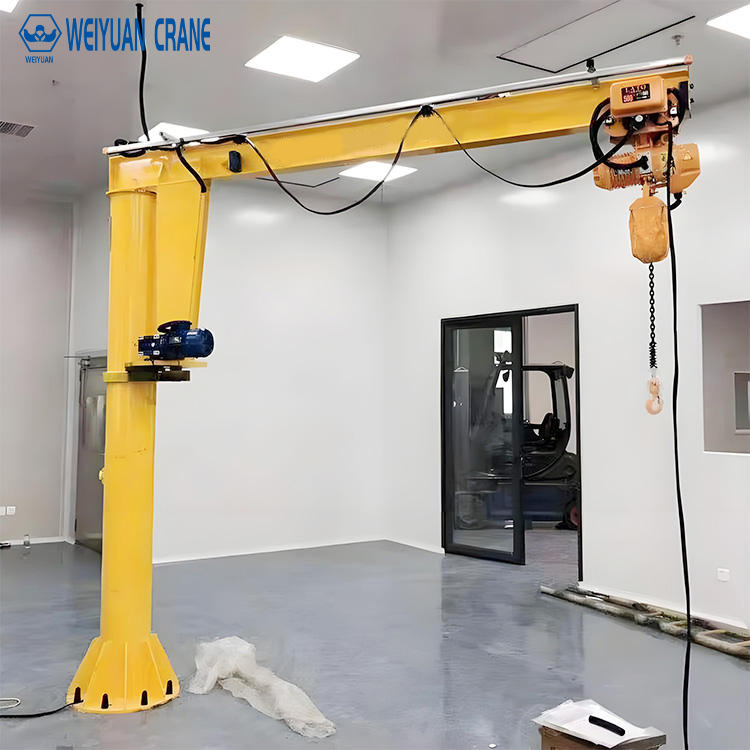
A floor-mounted (freestanding) jib is the usual choice, giving full 360° rotation to serve a complete workstation without depending on the building. Where cells sit tight against a wall or line the edge of a bay, a wall-mounted jib saves floor space. Where a load must reach around a fixture or into a machine, an articulating jib earns its place.
Hoist and Control Configuration
Specify VFD control on both the hoist and the slew motion — smooth, jolt-free positioning protects delicate dies and subassemblies and cuts load sway on every rotation. An electric chain hoist suits most automotive loads, and an air-balanced hoist is ideal for the highest-repetition, most ergonomic stations.
Takeaway: Automotive assembly wants a floor-mounted jib with VFD control for smooth, precise, repeatable station lifting — with wall-mounted or articulating options where space or reach demands.
Metalworking and Machine Shops
In fabrication cells and machine shops, a jib crane feeds machines, moves work between operations, and handles tooling and fixtures — all within a defined work zone.
The Lifting Challenge
Machinists load heavy billets, castings, and finished parts into and out of lathes, mills, and presses. The loads are often awkward and dense, the lifts frequent, and the space around a machine tight. Manual handling here is a real injury risk, and a bridge crane rarely reaches cleanly into a machine envelope.
Best Mounting Type
A floor-mounted jib serving a single machine or cell is the workhorse, with full rotation to move parts between the machine, the bench, and the pallet. An articulating jib is the standout choice for loading directly into a machine, since its pivoting elbow reaches around the guarding and into the work envelope a rigid boom cannot.
Hoist and Control Configuration
An electric chain hoist covers most machine-shop loads, stepping up to a wire rope hoist where parts climb toward the top of the jib range. VFD control helps place a heavy casting gently onto machine tables and fixtures without shock. In shops handling hot or spark-generating work, confirm the environment rating early.
Takeaway: Machine shops favor floor-mounted jibs for cell work and articulating jibs for machine loading, with a chain or wire rope hoist matched to the part weight.
Warehousing and Logistics
In packing, kitting, and order-fulfillment areas, jib cranes move cartons, containers, and light loads between conveyors, benches, and pack-out points — quickly and without strain.
The Lifting Challenge
Warehouse work is repetitive and space-constrained. Operators transfer loads short distances many times an hour, headroom is often limited under a warehouse roof, and layouts change as fulfillment needs evolve. The lift needs to be fast, light, and out of the way of foot and forklift traffic.
Best Mounting Type
A wall-mounted jib along a packing bench or conveyor line saves precious floor space and keeps the aisle clear. Where a workstation sits in the open, a floor-mounted jib with 360° rotation covers a full pack-out zone. Low-profile boom designs help where headroom is tight.
Hoist and Control Configuration
Loads here are usually light, so a compact electric chain hoist is the natural fit, with a manual hoist viable for the lightest, most occasional lifts. VFD or a smooth two-speed hoist keeps positioning quick and controlled at a busy pack station.
Takeaway: Warehousing leans on wall-mounted jibs to save floor space and floor-mounted jibs for open pack-out zones, both with light, compact chain hoists.
Maintenance and Repair Bays
A maintenance bay lifts a huge variety of loads occasionally rather than one load constantly — which changes the specification entirely.
The Lifting Challenge
Technicians pull motors, gearboxes, pumps, and components for service, often in a corner of a plant with no overhead crane coverage. The lifts are unpredictable in weight and position, infrequent, and need to happen wherever the equipment sits. Flexibility matters more than throughput.
Best Mounting Type
A floor-mounted jib gives a repair bay its own independent 360° coverage without relying on building steel. A mast-mounted jib delivers full rotation on a smaller base where a solid roof beam is available and floor space is at a premium.
Hoist and Control Configuration
An electric chain hoist suits the moderate, varied loads a maintenance bay handles. Because lifts are occasional rather than high-cycle, standard control is often acceptable here — one of the few applications where VFD is not essential, though it still helps when placing a heavy component precisely onto a bench or back into a machine.
Takeaway: Maintenance bays want a floor- or mast-mounted jib with a versatile chain hoist, prioritizing independent coverage and flexibility over high-cycle features.
Pharmaceutical and Cleanroom Environments
Pharmaceutical and cleanroom lifting adds a demand no other industry shares: the crane itself must not contaminate the space it works in.
The Lifting Challenge
Operators move process vessels, containers, sterile equipment, and mixing components in spaces where dust, particles, and shedding materials are strictly controlled. A standard crane’s flaking paint, exposed grease, and corroding hardware are unacceptable. Cleanliness and washdown resistance are as important as the lift.
Best Mounting Type
A floor-mounted jib serving a process station is common, and a wall-mounted jib suits cleanroom layouts where floor space and access must stay clear. The critical factor is the finish, not the mount: specify stainless steel or a cleanroom-grade coating, sealed components, and hardware that will not shed particles or corrode under regular washdown and sanitizing.
Hoist and Control Configuration
Choose a hoist with a high IP rating for washdown areas and a smooth VFD or air-balanced action for gentle, precise handling of sensitive vessels. Where the process involves flammable solvents or a classified atmosphere, an explosion-proof or air hoist is required — confirm the area classification early, since it drives the whole specification.
Takeaway: Cleanroom and pharmaceutical work needs a floor- or wall-mounted jib built from stainless or cleanroom-grade materials, with a high-IP, smooth hoist — and explosion-proofing where solvents are present.
Mining and Heavy Industry
Mining and heavy industry push a jib crane the hardest: heavy loads, punishing cycles, and an environment of dust, moisture, and corrosion.
The Lifting Challenge
Operators handle heavy pump housings, motors, valves, drill components, and maintenance loads in processing plants, workshops, and near underground or surface operations. The duty is heavy, the atmosphere is abrasive and often wet, and — critically — flammable gas or combustible dust may be present in coal mining and certain processing areas.
Best Mounting Type
A floor-mounted jib built for heavy duty is the standard, with a robust, engineered foundation sized for the overturning moment of a heavy load. Corrosion-resistant finishes and hardware are essential, not optional, in this environment.
Hoist and Control Configuration
A wire rope hoist in a higher duty class handles the heavy loads and hard cycling. Specify a high IP rating and corrosion protection for the dust and moisture. Where the area is classified as hazardous, an explosion-proof hoist matched to the zone is a legal requirement — this is the single most important specification decision in mining. Given the safety stakes, pair the crane with a disciplined inspection program; our jib crane safety and OSHA compliance guide and jib crane maintenance guide cover exactly what that involves.
Takeaway: Mining and heavy industry demand a heavy-duty floor-mounted jib with a wire rope hoist, high IP rating, corrosion protection, and explosion-proofing wherever the atmosphere is classified.
Comparing Jib Crane Types by Industry
Use this table to see at a glance which configuration fits each industry, then confirm the detail against your real loads and site.
| Industry | Recommended mounting | Typical hoist | Control | Key specification factor |
|---|---|---|---|---|
| Automotive assembly | Floor-mounted (or wall / articulating) | Electric chain or air-balanced | VFD | Smooth, repeatable positioning |
| Metalworking / machine shops | Floor-mounted or articulating | Chain or wire rope | VFD | Reach into machine envelope |
| Warehousing / logistics | Wall-mounted or floor-mounted | Electric chain (or manual) | VFD / two-speed | Floor space and headroom |
| Maintenance & repair bays | Floor-mounted or mast-mounted | Electric chain | Standard or VFD | Independent, flexible coverage |
| Pharmaceutical / cleanroom | Floor-mounted or wall-mounted | High-IP chain / air-balanced | VFD / air | Cleanroom-grade materials |
| Mining / heavy industry | Floor-mounted (heavy duty) | Wire rope | VFD | IP rating, corrosion, explosion-proofing |
How to Read the Table
Start with your industry row to get a strong default, then adjust for your specifics. Two factors override the defaults every time: environment — a hazardous atmosphere forces explosion-proofing regardless of industry — and reach — any job that must curve around an obstacle points to an articulating jib. Use the table to narrow the field, not to skip the sizing work.
Takeaway: Each industry has a sensible default configuration, but environment and reach can override it. Treat the table as a starting point, then confirm capacity, duty, and environment against your real work.
How to Match a Jib Crane to Your Industry
Beyond the industry defaults, a short framework gets you to the right crane. Work through it in order.
- Confirm the load with rigging. Add the hoist, tooling, and a margin to your heaviest load — the total decides capacity, and it must stay within the jib range.
- Map the coverage and reach. Full 360° points to floor or mast mounting; a wall arc points to wall mounting; reaching around obstacles points to articulating.
- Set the duty class. Count the lifts per hour — heavy, high-cycle industries like automotive and mining need a higher class than an occasional maintenance bay.
- Assess the environment. Match the IP rating to dust and moisture, specify corrosion protection or cleanroom materials where needed, and confirm explosion-proofing for any classified area.
- Choose the control. VFD for precision and high cycles; standard control only for genuinely light, occasional work.
For the full detail behind these decisions, our jib crane types and applications guide covers the configurations, and our jib crane buying guide turns the choice into a tight, comparable specification.
Takeaway: Load with rigging, coverage and reach, duty class, environment, then control — five steps that turn an industry default into a crane matched to your actual operation.
Frequently Asked Questions
Q: Which industries use jib cranes the most?
Jib cranes are used most heavily in automotive assembly, metalworking and machine shops, warehousing and logistics, maintenance and repair bays, pharmaceutical and cleanroom environments, and mining and heavy industry. What unites these applications is station-based lifting: a repetitive or varied lift that happens at a defined workstation rather than across a whole bay. Automotive lines rely on them for high-repetition component placement, machine shops for feeding machines, warehouses for pack-out work, maintenance bays for flexible coverage, pharma for clean handling, and mining for heavy, harsh-environment lifting.
Q: What is the best jib crane type for automotive assembly?
A floor-mounted (freestanding) jib crane with VFD control is the usual best fit for automotive assembly. The freestanding design gives each cell full 360° rotation without depending on the building, and VFD control on the hoist and slew motion delivers the smooth, jolt-free, precise positioning that protects delicate dies and subassemblies over hundreds of lifts a shift. Wall-mounted jibs work well where cells line a bay edge to save floor space, and articulating jibs suit stations where the load must reach around a fixture or into a machine.
Q: Which jib crane suits a machine shop best?
For general machine-shop cell work, a floor-mounted jib with full rotation handles moving parts between the machine, bench, and pallet. For loading directly into a machine, an articulating jib is the standout choice, because its pivoting elbow reaches around guarding and into the work envelope that a rigid boom cannot. Pair either with an electric chain hoist for typical loads, or a wire rope hoist for heavier castings and billets, and use VFD control to place dense parts gently onto tables and fixtures without shock.
Q: What jib crane do I need for a warehouse or packing area?
Warehousing and logistics usually favor a wall-mounted jib along a packing bench or conveyor line, since it saves valuable floor space and keeps aisles clear, or a floor-mounted jib for an open pack-out zone needing 360° coverage. Loads are typically light, so a compact electric chain hoist fits most work, with a manual hoist viable for the lightest, most occasional lifts. Because warehouse headroom is often limited, look at low-profile boom designs, and choose smooth two-speed or VFD control for quick, controlled positioning at busy stations.
Q: What makes a jib crane suitable for a cleanroom or pharmaceutical environment?
The defining requirement is that the crane must not contaminate the space. That means stainless steel or a cleanroom-grade coating, sealed components, and hardware that will not shed particles or corrode under regular washdown and sanitizing — the mount matters less than the materials. Choose a hoist with a high IP rating for washdown areas and smooth VFD or air-balanced action for gentle handling of sensitive vessels. Where the process involves flammable solvents or a classified atmosphere, an explosion-proof or air hoist is required, so confirm the area classification before specifying anything.
Q: Can jib cranes be used in mining and other harsh environments?
Yes, provided they are specified for the conditions. Mining and heavy industry demand a heavy-duty floor-mounted jib on a robust foundation, a wire rope hoist in a higher duty class for heavy loads and hard cycling, a high IP rating, and corrosion-resistant finishes and hardware for the dust and moisture. The critical factor is the atmosphere: where flammable gas or combustible dust may be present, such as in coal mining or certain processing areas, an explosion-proof hoist matched to the zone classification is a legal requirement and the single most important specification decision.
Q: Does the industry or the load decide the jib crane specification?
Both, working together. The industry gives you a strong default — mounting type, hoist, and control that suit the typical work — but the load, reach, duty cycle, and environment fine-tune it to your operation. Two factors override the industry default every time: a hazardous atmosphere forces explosion-proofing regardless of the sector, and any lift that must curve around an obstacle points to an articulating jib. Use the industry as a starting point, then confirm capacity with rigging, reach, duty class, and environment against your real work.
Q: When should I choose an articulating jib crane over a standard one?
Choose an articulating jib whenever the load path must curve around obstacles or reach into a confined space that a rigid boom cannot access. Its two-section boom with a pivoting elbow is ideal for loading directly into machines around their guarding, packaging around fixtures, and lifting at confined stations — situations common in metalworking and automotive work. The trade-off is capacity, since articulating jibs typically top out around 2 tonnes. If your load stays within that range and maneuverability matters more than raw capacity, the articulating design is the right call.