


KBK Crane vs Jib Crane: How to Choose the Right Workstation Lifting Solution
Introduction
Two of your cells need lifting help, and both quotes look reasonable. One recommends a KBK modular crane; the other a jib crane. On paper they seem interchangeable — light loads, station-based work, hand-guided motion. Choose wrong, though, and you either box a growing line into a fixed swing arc it will outgrow, or you build an overhead grid where a single pillar-mounted boom would have done the job for a fraction of the cost.
For procurement managers, plant engineers, and facility managers, the KBK-versus-jib decision comes down to one question most spec sheets skip: does the work happen at a point, or across an area? Get that right and everything else — capacity, coverage, headroom, and cost — falls into place.
This is article 1 of 3 in a new set of KBK crane deep-dive pieces. Here is what you will learn:
- How KBK and jib cranes differ in structure, coverage, and layout
- Where each one wins on capacity, headroom, modularity, and cost
- A practical framework to match the right system to your workstation
The Core Difference: Area Coverage vs Rotational Reach
Before comparing specs, understand the one structural difference that drives every other decision.
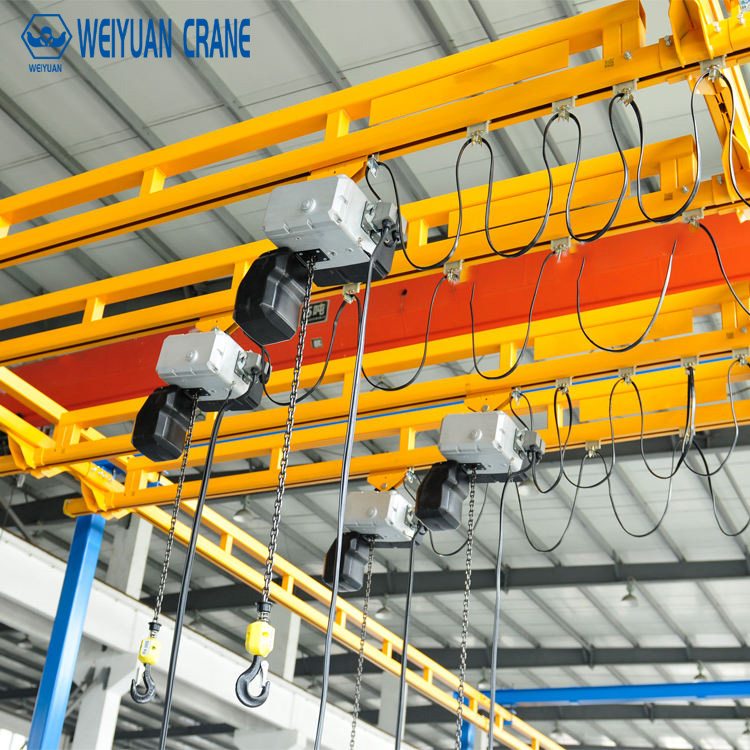
A KBK crane is a modular, suspended track system. Enclosed steel profiles hang from the roof or a support structure, and a hoist travels along a bridge that itself travels along runway tracks — covering a rectangular area or a straight line. It is the workstation cousin of an overhead crane, scaled down and built from bolt-together modules.
A jib crane is a rotating boom. A hoist runs along a horizontal arm that pivots around a fixed column or wall mount, sweeping a circular arc around a single point. The load travels in and out along the boom and around in rotation.
That difference — area versus arc — is the heart of the choice:
- KBK covers a defined rectangle or path with even, two-axis reach.
- A jib covers a circle (or part of one) centered on its mount.
Everything that follows flows from this. If your work spreads across a floor or follows a line, KBK fits the geometry. If it clusters around one point, a jib fits it more simply and cheaply.
Takeaway: KBK covers areas and paths; jib cranes cover an arc around a point. Match the system to how your work is laid out before comparing anything else.
Structure and Layout
The two systems mount and cover space in fundamentally different ways, and that shapes your whole installation.
How KBK Is Built and Mounted
A KBK system suspends from above — the enclosed track hangs from roof steel or a purpose-built support frame. It needs a sound overhead structure to carry it, but it uses no floor space for its supports. The modular track can form a monorail, a single-girder suspension crane over a rectangle, or a full grid across a whole bay. To confirm which layout suits your floor, see our KBK types guide.
How a Jib Is Built and Mounted
A jib crane stands on its own or ties to a wall:
- Floor-mounted (freestanding): a column bolted to an engineered foundation, giving full 360° rotation without any building support.
- Wall-mounted or mast-mounted: anchored to a wall or roof beam, saving floor space but limited to a partial arc or dependent on the structure.
A freestanding jib needs a robust foundation but no roof support; a KBK grid needs roof support but no foundation. That trade-off often decides the choice on its own — a building with weak roof steel points to a floor-mounted jib, while an open bay with strong overhead structure and no room for columns points to KBK. For jib mounting options in depth, see our jib crane types guide.
Takeaway: KBK hangs from the roof and uses no floor space; jib cranes stand on a foundation or a wall. Your building’s roof strength and floor space often make the call.
Capacity Ranges
Both systems live in the light-to-moderate range, but they don’t overlap perfectly.
- KBK crane: typically up to around 2,000 kg (2 tonnes). It is built for light, ergonomic, high-frequency lifting where effortless hand-guided motion matters more than raw capacity.
- Jib crane: typically 0.25 up to around 10 tonnes, with common workstation models in the 0.5–5 tonne range. A jib carries meaningfully heavier loads than a KBK system.
Why it matters: if your heaviest load with rigging climbs past roughly 2 tonnes, KBK is out and a jib (or an overhead crane) is your answer. Below that, both are candidates, and the decision shifts to coverage, layout, and cost.
Remember to size on the load plus all rigging — the hoist, spreader, slings, and shackles. On a light KBK system especially, forgotten rigging weight eats the capacity fast. Our KBK buying guide walks through this calculation in full.
Takeaway: KBK tops out near 2 tonnes; jib cranes reach 10. Above 2 tonnes, choose a jib; below it, let coverage and cost decide.
Coverage and Swing Arc
This is where the area-versus-arc difference becomes concrete on the floor.
KBK Coverage
A KBK system covers a rectangle or a straight path with even reach at every point. A single-girder suspension crane serves a defined work area corner to corner; a full grid covers an entire floor with multiple bridges, each operator working their own zone. There are no dead spots inside the covered rectangle.
Jib Coverage
A jib covers a circle (freestanding, 360°) or a partial arc (wall-mounted). Coverage is excellent near the mount and reaches its maximum at the boom tip — but the corners of any rectangular workspace fall outside the circle. Two jibs can overlap arcs to extend coverage, but managing the shared swing zone adds complexity.
The practical test: lay your real work path over each shape. If the load moves between several stations spread across a floor, KBK’s rectangle wins. If it stays within reach of one pivot point — feeding a machine, serving one bench — a jib’s arc is simpler and cheaper. For real-world examples of jib coverage by sector, see our jib crane applications guide.
Takeaway: KBK covers rectangles with no dead spots; a jib covers a circle strongest near its mount. Trace your work path onto each shape to see which fits.
Modularity and Reconfigurability
Here KBK holds a clear, decisive advantage.
A KBK system bolts together, extends, shortens, and reroutes. When your production line changes — a station moves, the layout shifts, the bay expands — the track adapts with it. You add bridges, lengthen runways, or relocate the whole system without cutting steel or starting over.
A jib crane is essentially fixed. Its coverage is set by the boom length and mount position the day it’s installed. Extending reach means a bigger boom (and often a stronger foundation); moving it means re-anchoring and re-testing. It is a permanent fixture, not a flexible one.
Why it matters: if your operation evolves — growing lines, seasonal reconfiguration, flexible manufacturing — KBK’s modularity pays back over years by following your floor plan instead of forcing a replacement. If the workstation is stable and unlikely to move, the jib’s fixed nature is no drawback at all.
One caution on KBK: every reconfiguration is an alteration to a load-bearing structure, so it resets the installation and load-test baseline and must be re-verified before use.
Takeaway: KBK reconfigures as your layout changes; a jib is fixed at install. Choose KBK for evolving operations, a jib for stable, permanent stations.
Headroom Requirements
Available hook height often decides the winner in a tight bay.
- KBK crane: the compact, low-profile enclosed track and light hoist tuck close to the roof, preserving hook height in height-constrained bays. This low-headroom advantage is one of KBK’s signature strengths.
- Jib crane: the boom and hoist hang below the mounting point, and a floor-mounted column consumes hook height beneath the boom. A jib generally needs more clearance than a KBK system for the same lift.
Why it matters: in a low-roof warehouse or a bay already crowded overhead, KBK often recovers the crucial extra centimetres of lift that a jib cannot. Where headroom is generous, the difference fades and other factors take over.
Takeaway: KBK is the low-headroom choice; jib cranes need more clearance. In tight bays, KBK’s compact profile often wins on hook height alone.
Duty Class and Cycle Frequency
Both systems handle repetitive work, but they’re built for slightly different rhythms.
KBK systems shine on high-frequency, light, ergonomic cycling — the hundreds of gentle hand-guided lifts a shift that define an assembly or electronics line. Their smooth, low-friction glide is designed for exactly that relentless, low-strain repetition.
Jib cranes handle frequent lifting too, but at the heavier, more deliberate end — pulling a motor, placing a casting, feeding a machine. The rotation adds a motion (and a swing hazard) that suits controlled, moderate-cycle work more than blistering high-repetition flow.
Whichever you choose, specify the duty class from your real lifts-per-hour count. Under-classify and components wear early; over-classify and you pay for durability you never use.
Takeaway: KBK suits light, high-frequency ergonomic cycling; jib cranes suit heavier, moderate-cycle lifts. Specify duty class from your actual cycle count either way.
Environmental Suitability
Both can be built for demanding conditions, with a few differences worth noting.
- Cleanrooms and pharma: both can be specified in stainless or cleanroom-grade finishes. KBK’s enclosed track resists debris ingress well, and its simple profile is easy to clean.
- Dust, humidity, washdown: both accept higher IP-rated hoists and corrosion-resistant finishes. A jib’s exposed rotation bearing needs diligent lubrication in dusty or wet settings.
- Mining and heavy industry: a jib’s higher capacity and robust column often suit heavy, harsh-environment maintenance lifting better, while KBK stays in the lighter, cleaner end.
- Hazardous atmospheres: both can carry explosion-proof hoists matched to the zone classification — confirm the classification early, because it drives the whole specification.
Takeaway: Both adapt to tough environments, but match the finish, IP rating, and any explosion-proofing to the site. Heavier, harsher duty leans jib; light, clean, high-frequency leans KBK.
Total Cost of Ownership
Look past the sticker price to what each system costs over its life.
Purchase and installation. A simple wall- or floor-mounted jib serving one point is often the lower up-front cost for a single station. A KBK grid covering a whole floor costs more initially but replaces several individual jibs — and can work out cheaper per covered square metre for area work.
Flexibility over time. This is where KBK earns back its cost. When the layout changes, KBK reconfigures; a jib must be replaced or relocated at real expense. For an operation that evolves, KBK’s adaptability is a genuine long-term saving.
Maintenance. A jib’s rotation bearing and mount anchors are its key wear and safety items. KBK’s trolleys, track joints, and suspension points are its equivalents. Both are modest to maintain when inspected on schedule.
The real comparison: for one fixed station, a jib is usually the cheaper, simpler answer. For multi-station area coverage or an evolving floor plan, KBK’s flexibility and even coverage often deliver the lower total cost of ownership.
Takeaway: For a single fixed point, a jib usually costs less to own. For area coverage or a changing layout, KBK’s flexibility wins on total cost.
KBK vs Jib Crane at a Glance
Use this table to narrow the choice, then confirm against your real loads and layout.
| Factor | KBK Crane | Jib Crane |
|---|---|---|
| Coverage shape | Rectangle or straight path | Circular arc around a point |
| Typical capacity | Up to ~2 tonnes | 0.25–10 tonnes |
| Mounting | Suspended from roof/structure | Floor, wall, or mast |
| Floor space used | None (overhead) | Column footprint (floor-mounted) |
| Headroom needed | Low (compact profile) | More clearance |
| Modularity | High — extends and reroutes | Fixed at installation |
| Best cycle type | Light, high-frequency, ergonomic | Moderate, heavier, deliberate |
| Best for | Multi-station area or path coverage | Single-point / one-machine lifting |
How to Read the Table
Start with capacity to rule either system in or out above 2 tonnes. Then let coverage shape decide: a rectangle or path points to KBK, a point or single machine points to a jib. Finally, weigh headroom, floor space, and future change to break any tie.
Takeaway: Capacity narrows the field, coverage shape decides the winner, and headroom, floor space, and flexibility settle close calls.
A Practical Selection Framework
Work through these five steps in order and the right system emerges from your real needs, not guesswork.
Step 1: Weigh the Load With Rigging
Add the hoist, tooling, slings, and a margin to your heaviest load. If the total climbs past ~2 tonnes, choose a jib (or overhead crane). Below that, both stay in play.
Step 2: Map the Coverage Shape
Sketch the real work path. Does the load move across a rectangular area or down a line? That’s KBK. Does it cluster around one point or one machine? That’s a jib.
Step 3: Check Headroom and Floor Space
Tight overhead clearance favors KBK’s compact profile. No spare floor for a column, but strong roof steel? KBK again. Weak roof but open floor? A freestanding jib.
Step 4: Factor in Future Change
Will the layout evolve? Growing lines and flexible cells reward KBK’s modularity. A stable, permanent station makes a jib’s fixed nature a non-issue.
Step 5: Set Duty Class and Environment
Count your lifts per hour to set the duty class, then match the finish, IP rating, and any explosion-proofing to the site — cleanroom materials, corrosion protection, or hazardous-area rating as needed.
Takeaway: Load, coverage shape, headroom and floor space, future change, then duty and environment — five steps that turn the choice into a clear answer.
Common Mistakes When Choosing Between KBK and Jib
A few avoidable errors cause most of the regret in this decision.
- Choosing on price alone for area work. A single cheap jib can’t cover a rectangle without dead corners — so you end up buying two or three. Fix: for multi-station work, price KBK against several jibs, not one.
- Ignoring future layout change. Installing a fixed jib on a line that’s about to be reconfigured means an early, costly replacement. Fix: if the floor will evolve, lean KBK.
- Forgetting rigging weight on a KBK system. An air balancer or vacuum lifter is a big share of a 2-tonne rating. Fix: size on load plus all rigging plus a margin.
- Overlooking roof strength for KBK. A suspended system needs sound overhead structure. Fix: verify the roof can carry it before specifying KBK.
- Skipping the duty-class calculation. Both systems fail early if under-classified for their real cycle rate. Fix: specify from actual lifts per hour.
Takeaway: Most mistakes trace back to pricing one jib for area work, ignoring future change, forgetting rigging, or skipping the roof and duty checks. Close those gaps upfront.
Frequently Asked Questions
Q: What is the main difference between a KBK crane and a jib crane?
The core difference is coverage geometry. A KBK crane is a suspended modular track system that covers a rectangular area or a straight path with even, two-axis reach — the workstation version of an overhead crane. A jib crane is a rotating boom that pivots around a fixed column or wall mount, covering a circular arc around a single point. In short, KBK covers areas and paths, while a jib covers an arc centered on its mount. This single difference drives most of the other trade-offs in capacity, layout, headroom, and cost.
Q: Which lifts heavier loads, a KBK crane or a jib crane?
A jib crane lifts heavier loads. KBK systems typically top out around 2,000 kg (2 tonnes), because they are built for light, ergonomic, high-frequency hand-guided lifting. Jib cranes commonly range from 0.25 up to around 10 tonnes, with most workstation models in the 0.5–5 tonne band. If your heaviest load plus all rigging climbs past roughly 2 tonnes, a KBK system is out and a jib crane — or a full overhead crane — is the right choice. Below 2 tonnes, both are candidates and coverage, headroom, and cost decide.
Q: When should I choose a KBK crane over a jib crane?
Choose a KBK crane when the work spreads across a rectangular area or follows a line rather than clustering around one point, when you need even coverage with no dead corners, when overhead headroom is tight, and when the layout is likely to change over time. KBK’s modular track extends and reroutes as your production evolves, and its compact profile preserves hook height in low-roof bays. It also uses no floor space for supports, since it hangs from the roof — ideal for open bays where floor-mounted columns would obstruct the work.
Q: When is a jib crane the better choice?
A jib crane is the better choice when lifting clusters around a single point — feeding one machine, serving one bench, or covering one workstation — when loads run heavier than a KBK system’s ~2-tonne limit, when your roof structure can’t carry a suspended system, and when the station is stable and unlikely to move. For a single fixed point, a floor- or wall-mounted jib is usually the simpler, lower-cost answer. Its circular arc fits point-based work naturally, and its higher capacity handles the heavier, more deliberate lifts common in machine shops and maintenance bays.
Q: Does a KBK crane or a jib crane need more headroom?
A jib crane generally needs more headroom. Its boom and hoist hang below the mounting point, and a floor-mounted column consumes hook height beneath the boom. A KBK crane’s compact, low-profile enclosed track and light hoist tuck close to the roof, preserving hook height in height-constrained bays. This low-headroom advantage is one of KBK’s signature strengths, and in a low-roof warehouse or a bay already crowded overhead, KBK often recovers the crucial extra lift a jib cannot. Where clearance is generous, the difference matters less.
Q: Which system is more cost-effective?
It depends on the coverage. For a single fixed workstation, a simple wall- or floor-mounted jib is usually the lower up-front and total cost. For multi-station area coverage or an evolving floor plan, a KBK system often wins on total cost of ownership: it delivers even coverage that would take several jibs to match, and its modular track reconfigures as the layout changes rather than needing costly replacement. The real comparison is not the sticker price of one unit, but the cost of covering your actual work area over the system’s full service life.
Q: Can both KBK and jib cranes be used in cleanrooms or hazardous areas?
Yes, both can be specified for demanding environments. For cleanrooms and pharmaceutical spaces, both accept stainless steel or cleanroom-grade finishes and sealed components; KBK’s enclosed track resists debris and cleans easily. For dusty, humid, or washdown areas, both take higher IP-rated hoists and corrosion-resistant finishes, though a jib’s exposed rotation bearing needs diligent lubrication. For classified hazardous atmospheres, both can carry explosion-proof hoists matched to the zone. In every case, confirm the cleanroom class or area classification early, because it drives the entire specification.
Q: Can a KBK system be expanded later, and can a jib crane?
A KBK system is designed to be expanded and reconfigured — the modular track bolts together, so you can add bridges, lengthen runways, or relocate the whole system as your operation grows. Just remember that each change is an alteration to a load-bearing structure and must be re-inspected and load-tested before returning to service. A jib crane, by contrast, is essentially fixed at installation: extending its reach means a larger boom and often a stronger foundation, and relocating it means re-anchoring and re-testing. If future flexibility matters, KBK holds a clear advantage.、