


KBK Crane for Assembly Line Workstations: Configuration, Layout, and Performance Guide
Introduction
An assembly line lives or dies on flow. When an operator has to muscle a component into place by hand, or wait for a shared bridge crane to finish a job three stations away, the whole line slows to the speed of that bottleneck. Multiply the delay across every cycle of a shift, and a few lost seconds per lift becomes hours of lost throughput a week.
A KBK crane is built to remove exactly that friction. Its modular, suspended track gives each workstation its own light, hand-guided lift that keeps pace with the line — no waiting, no strain, no shared asset to compete for. For automotive, electronics, and aerospace lines, it turns awkward manual handling into smooth, repeatable motion that operators barely feel.
This is article 2 of 3 in the Weiyuan Crane KBK crane deep-dive series. Here is what you will learn:
- Why KBK systems outperform fixed cranes for assembly line work
- The best track configurations for monorail, area, and full-grid line coverage
- How to design a multi-station layout, choose the right hoist and duty class, and integrate KBK into an existing bay
Why KBK Systems Suit Assembly Line Workstations
Assembly line lifting has a distinct rhythm: light loads, high frequency, fixed stations, and a hard demand for uptime. A KBK system answers all four better than a fixed crane does.
Dedicated Lift at Every Station
A shared overhead crane serves one operator at a time. On a busy line, that means queuing — one station waits while another lifts. KBK’s modular track lets you give each workstation its own bridge and hoist, so every operator lifts on demand without competing for a bay-wide asset. Flow stays continuous.
Effortless, Repeatable Motion
The enclosed KBK track runs on low-friction trolleys, so a hand-guided load glides with a light push. Over hundreds of cycles a shift, that effortless motion protects both throughput and the operator, turning a strenuous pick into a fingertip movement.
Flexibility as the Line Evolves
Assembly lines change — stations move, cells get added, layouts shift with new models. A fixed crane can’t follow that change, but KBK’s bolt-together track extends and reroutes to match. That adaptability is a decisive edge for any evolving line, and it’s covered in depth in our KBK vs Jib Crane article.
Takeaway: KBK suits assembly lines because it gives every station a dedicated, effortless, reconfigurable lift — exactly what light, high-frequency, evolving line work demands.
Optimal Layout Configurations for Line Work
KBK offers three core layouts, and each fits a different assembly pattern. Match the configuration to how work actually moves down your line.
Monorail for Point-to-Point Transfer
A monorail is a single track that carries a hoist along a straight path. It’s the simplest, lowest-cost layout, ideal for moving a component from one operation to the next in a straight line — feeding a station, passing a subassembly downstream, or loading a fixture.
Use a monorail where the workflow is genuinely linear and the load doesn’t need side-to-side reach.
Single-Girder Suspension Crane for Area Coverage
A single-girder suspension crane adds a bridge that travels along two runway tracks, covering a defined rectangle with two-axis reach. It suits a workstation or cell where the operator needs to reach anywhere within a bounded area — picking from a pallet on one side and placing into a fixture on the other.
This is the workhorse layout for individual assembly cells that need full coverage of their own footprint.
Full Grid for Whole-Line Coverage
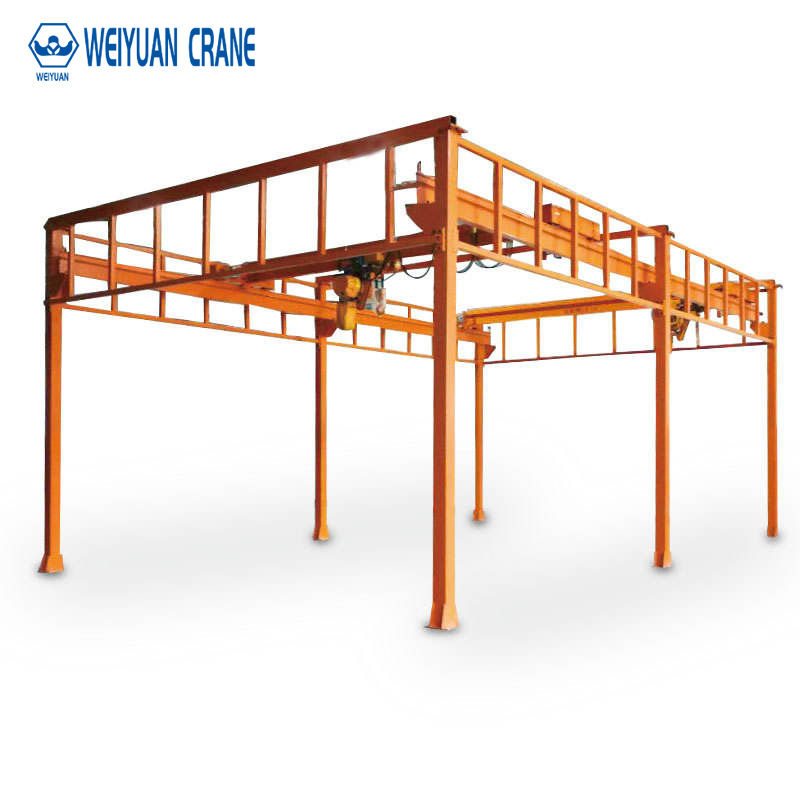
A full grid links multiple bridges across a shared runway system, covering an entire bay or line. Each operator works their own zone, and loads can hand off between adjacent areas. It’s the configuration for a large, multi-station assembly floor where every station needs coverage without dead spots.
To see how these configurations map to your floor plan, our KBK types guide breaks down each layout in detail.
Takeaway: Monorail for straight transfers, single-girder suspension for a bounded cell, full grid for a whole line — pick the layout that matches how work moves.
Track Layout Design Tips for Multi-Station Lines
Designing the track for a multi-station line is where a good system becomes a great one. A few principles keep the line flowing.
Map the Work Path First
Before drawing any track, walk the line and map where each load starts, travels, and lands. Design the track around that real sequence, not around a tidy grid. A layout that follows the workflow eliminates the awkward reaches and dead corners that slow operators down.
Size Zones to Avoid Interference
On a full grid, adjacent bridges can interfere if their zones overlap badly. Set each station’s coverage zone to reach its own work area cleanly, and plan hand-off points where a load passes between zones. Fit end stops so bridges can’t collide at shared boundaries.
Plan for Reach and Headroom Together
Confirm that the track height leaves enough hook height for the tallest lift at every station, while keeping the compact profile that preserves clearance under the roof. On a line with varying station heights, design to the tightest point.
Build in Room to Grow
Leave the runway able to extend and add bridges later. An assembly line rarely stays static, and designing the track with spare capacity means the next reconfiguration is an addition, not a rebuild. Getting the suspension and structure right from the start is covered in our KBK installation guide.
Takeaway: Design the track around the real work path, size zones to prevent interference, confirm reach and headroom at every station, and leave room to expand.
Choosing the Hoist for Assembly Duty
The hoist is where the operator meets the load, so its control quality shapes both ergonomics and cycle speed. Two options dominate assembly work.
Air-Balanced Hoists for High-Repetition Ergonomic Stations
An air-balanced hoist lets the operator float a load into place with fingertip pressure, holding it weightless at any height. It’s ideal for the highest-repetition stations — the ones where an operator handles the same part hundreds of times a shift and every gram of effort adds up. In automotive and aerospace precision work, it delivers unmatched control and the lowest operator strain.
VFD Electric Chain Hoists for Heavier Subassemblies
An electric chain hoist with VFD control gives smooth, jolt-free starts and stops plus slow-speed positioning, suited to heavier subassemblies where powered lifting makes sense. The VFD ramping protects delicate parts from shock and places loads gently onto fixtures.
Specialty Options
For flat panels and cartons, a vacuum lifter speeds handling; where a classified atmosphere is present, an explosion-proof or air hoist is required. Match the hoist to the part and the environment, and confirm the choice against our KBK buying guide.
Takeaway: Choose an air-balanced hoist for the highest-repetition ergonomic stations and a VFD chain hoist for heavier subassemblies — control quality drives both speed and safety.
Duty Class Selection for High-Frequency Cycling
Duty class is the most under-appreciated line on an assembly-line KBK spec, and the one that most affects how long the system lasts.
Capacity tells you how heavy a single lift can be. Duty class tells you how many lifts the system survives over its life. An assembly line cycles relentlessly — often hundreds of lifts per station per shift — so the trolleys, hoist, and track must be classified for that frequency.
Here’s the risk in both directions:
- Under-classify and the trolleys and hoist wear out early, forcing replacements that stop the line.
- Over-classify and you pay for durability the station never uses.
To specify it correctly, count your real lifts per hour, the typical load, and the daily running hours at the busiest station, then classify to that. A high-frequency automotive line needs a materially higher duty class than an occasional-use station, even at the same load.
Takeaway: Specify duty class from your real lifts-per-hour count at the busiest station, not from capacity alone — it decides how long the system runs before the line pays for early wear.
Ergonomics and Operator Safety Benefits
On an assembly line, ergonomics isn’t a soft benefit — it directly protects throughput and your people. KBK delivers on both.
Lower Injury Risk
Manual handling of the same load, cycle after cycle, is a leading cause of strain and repetitive-motion injury. A KBK lift removes the physical effort, so operators guide rather than heave. Fewer injuries mean fewer lost shifts and a steadier line.
Sustained Productivity Across the Shift
An operator who isn’t fatigued in hour six works as fast as they did in hour one. By keeping every lift effortless, KBK holds cycle time steady across the whole shift instead of letting it drift as the crew tires.
Precise, Controlled Placement
Smooth hoist control — especially air-balanced or VFD — lets operators place parts exactly, reducing rework and protecting high-value components from shock. For the full safety program that supports line operation, see our KBK safety and OSHA compliance guide.
Takeaway: KBK lowers injury risk, sustains productivity across the shift, and improves placement accuracy — ergonomics and output rise together.
How to Integrate KBK Into an Existing Assembly Bay
Adding KBK to a running line takes planning, because the bay is already working and the structure is already fixed. Work through these steps.
Step 1: Verify the Overhead Structure
KBK hangs from the roof or a support frame, so confirm the existing roof steel can carry the suspended loads at every mounting point. Where it can’t, a purpose-built support structure carries the system independently of the building.
Step 2: Map the Track Against the Live Layout
Overlay the proposed track on the current station positions, material flow, and any existing services — lighting, ductwork, other cranes. Route around obstructions and confirm the track clears everything through the full travel.
Step 3: Plan the Installation Around Line Uptime
An active line can rarely stop for long. Phase the installation into planned windows or shutdowns, station by station, so the line keeps running while the system goes up. Then commission and load test before each section carries work.
Step 4: Re-Verify After Any Reconfiguration
Every future track change is an alteration to a load-bearing structure, so it resets the installation and load-test baseline and must be re-verified. Keep this in your maintenance rhythm, detailed in our KBK maintenance and inspection guide.
Takeaway: Verify the roof, map the track against the live bay, phase the install around uptime, and re-verify after every change — integration succeeds on planning, not luck.
Comparing KBK Configurations by Assembly Line Type
Use this table to match a configuration to your line, then confirm against your real loads and layout.
| Line type | Recommended configuration | Typical hoist | Key design factor |
|---|---|---|---|
| Straight, linear transfer | Monorail | Chain / air-balanced | Simple point-to-point path |
| Single assembly cell | Single-girder suspension crane | VFD chain / air-balanced | Full-area two-axis reach |
| Large multi-station floor | Full grid | Air-balanced / VFD chain | Zone sizing, no dead spots |
| High-repetition ergonomic station | Monorail or suspension | Air-balanced | Fingertip control, low strain |
| Panel / carton handling line | Monorail or suspension | Vacuum lifter | Fast flat-load handling |
How to Read the Table
Start with your line type to get a strong default. Then let two factors adjust it: the coverage shape (a straight line points to monorail, an area to a suspension crane or grid) and the cycle intensity (the highest-repetition stations reward an air-balanced hoist). Use the table to narrow the field, not to skip the sizing work.
Takeaway: Line type sets the default configuration; coverage shape and cycle intensity fine-tune the hoist and layout to your actual work.
Common Mistakes When Specifying KBK for Assembly Lines
A handful of avoidable errors cause most of the regret in assembly-line KBK projects.
- Designing a grid before mapping the work path. A tidy grid that ignores real material flow forces awkward reaches. Fix: map the actual load path first, then design the track to it.
- Under-classifying the duty. A system correct for capacity but under-classified for a high-cycle line wears out early and stops the line. Fix: specify duty class from real lifts per hour.
- Forgetting rigging weight. An air balancer or vacuum lifter is a big share of a light KBK rating. Fix: size on load plus all rigging plus a margin.
- Overlooking roof strength. A suspended system needs sound overhead structure. Fix: verify the roof before specifying, or plan a support frame.
- Ignoring future line changes. Designing a rigid layout for a line that’s about to evolve wastes the system’s biggest advantage. Fix: leave the runway able to extend and add bridges.
Takeaway: Most mistakes trace back to skipping the work-path map, under-classifying duty, forgetting rigging, or ignoring the roof and future change. Close those gaps upfront.
Frequently Asked Questions
Q: Why is a KBK crane better than a fixed crane for an assembly line?
A KBK crane suits assembly lines because it matches their rhythm — light loads, high frequency, fixed stations, and a demand for uptime. Unlike a shared overhead crane that serves one operator at a time and creates queues, KBK’s modular track can give each workstation its own bridge and hoist, so every operator lifts on demand without competing for a bay-wide asset. Its low-friction trolleys make each lift effortless over hundreds of cycles, and its bolt-together track reconfigures as the line evolves. Together, that keeps flow continuous, protects operators, and adapts to change a fixed crane can’t follow.
Q: What is the best KBK configuration for an assembly line?
It depends on how work moves. A monorail suits a straight, point-to-point transfer between operations — the simplest, lowest-cost layout. A single-girder suspension crane covers a bounded assembly cell with two-axis reach, ideal when an operator needs to reach anywhere within their footprint. A full grid links multiple bridges across a whole bay so every station on a large multi-station floor has coverage with no dead spots. Match the configuration to your real workflow: linear paths point to monorails, bounded cells to suspension cranes, and whole lines to grids.
Q: Which hoist should I use for assembly line duty?
Choose an air-balanced hoist for the highest-repetition ergonomic stations, where the operator floats a load into place with fingertip pressure and every gram of effort matters over hundreds of cycles. Use a VFD electric chain hoist for heavier subassemblies, since its smooth ramping protects delicate parts and places loads gently onto fixtures. For flat panels and cartons, a vacuum lifter speeds handling, and where a classified atmosphere is present, an explosion-proof or air hoist is required. Match the hoist to the part weight, the cycle frequency, and the environment.
Q: How do I choose the duty class for a high-frequency assembly line?
Duty class reflects how many lifts the system survives over its life, so it must match the line’s real cycle rate. Count the lifts per hour, the typical load, and the daily running hours at the busiest station, then classify the system to that intensity. A high-frequency automotive line needs a materially higher duty class than an occasional-use station, even at the same load. Under-classifying causes the trolleys and hoist to wear out early and stop the line, while over-classifying means paying for durability you never use. Specify from real data, not a rough guess.
Q: Can a KBK system be added to an existing assembly bay?
Yes, with planning. First, verify the existing roof steel can carry the suspended loads at every mounting point, or plan a purpose-built support frame that carries the system independently. Next, map the proposed track against the live station positions, material flow, and existing services, routing around obstructions. Then phase the installation into planned windows or shutdowns, station by station, so the line keeps running while the system goes up, commissioning and load testing each section before it carries work. Finally, remember that any later reconfiguration resets the installation and load-test baseline and must be re-verified.
Q: How does a KBK crane improve assembly line ergonomics?
It removes the physical effort of repetitive lifting. Instead of heaving the same load cycle after cycle — a leading cause of strain and repetitive-motion injury — operators guide a weightless or powered load with light pressure. That lowers injury risk and the lost shifts that come with it, and it sustains productivity across the whole shift because a non-fatigued operator in hour six works as fast as in hour one. Smooth hoist control, especially air-balanced or VFD, also improves placement accuracy, reducing rework and protecting high-value components from shock.
Q: How many workstations can one KBK system serve?
There’s no fixed limit — it depends on the layout and the runway design. A full grid can link many bridges across a whole bay, with each operator working their own zone and loads handing off between adjacent areas. The practical limits are the overhead structure’s capacity, the runway length, and careful zone sizing so adjacent bridges don’t interfere. Design each station’s coverage zone to reach its work area cleanly, plan hand-off points between zones, and fit end stops at shared boundaries. Leaving room to add bridges later means the system grows with the line.
Q: Does adding stations or extending the track require re-testing?
Yes. Every extension, added bridge, or track reroute is an alteration to a load-bearing structure, so it resets the installation and load-test baseline. Before the reconfigured section returns to service, it must be re-inspected and load tested to confirm the suspension, track, and new components carry the rated load safely. This is one of KBK’s core strengths — the system reconfigures as your line evolves — but the flexibility comes with the responsibility to re-verify each change. Build that step into your maintenance rhythm so a reconfiguration is never put to work unproven.