


Electric Hoist Buying Guide: How to Choose the Right Hoist for Your Application
Published by: Weiyuan Crane Engineering Team | Last Updated: August 2026 | Reading Time: 10 min
Introduction
Buying an electric hoist looks simple from the outside — pick a tonnage, place an order. In practice, two hoists with the identical capacity number on the nameplate can be completely different machines once you account for duty class, lifting height, headroom, and the environment they’ll actually operate in. Get one of those wrong and a facility ends up with equipment that’s either underpowered for its heaviest lift or an expensive mismatch for the building it’s installed in.
This guide walks procurement and plant engineering teams through the actual buying decision, step by step — the questions to answer before requesting a quote, not just the spec sheet to skim afterward.
This is article 2 of 3 in the Weiyuan Crane electric hoist series. If you haven’t yet, our hoist types and components guide (article 1) is worth reading first — it covers the difference between chain and wire rope hoists in more depth than this guide will. Here is what you’ll learn in this one:
- The five factors that actually determine the right electric hoist
- How to size capacity correctly, including the mistake most buyers make
- How duty class, headroom, and environment change the specification
- A practical checklist to bring to your quotation conversation

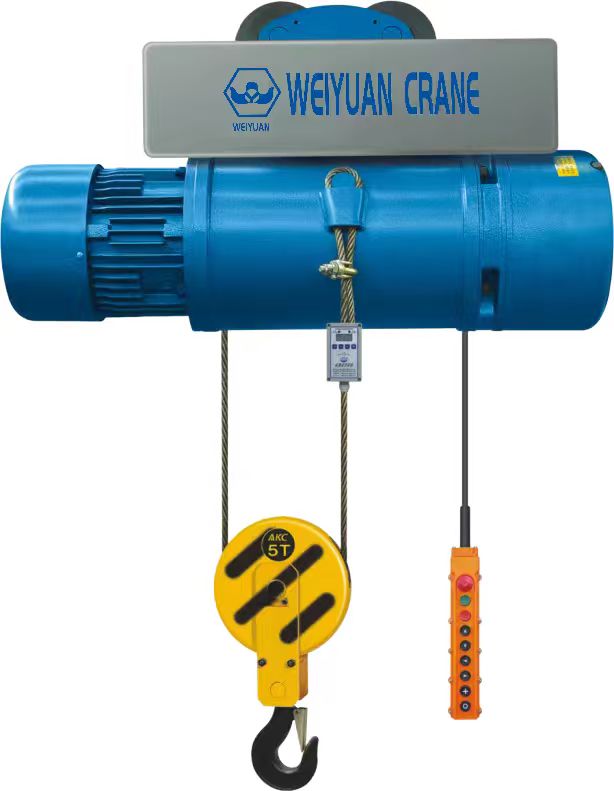
Weiyuan 2-Ton Ceiling Traveling Monorail Electric Hoist
The Weiyuan 2-Ton Ceiling Traveling Monorail Electric Hoist is a versatile single-phase lifting solution featuring an integrated electric trolley for smooth horizontal movement along a ceiling-mounted I-beam, ideal for workshops, garages and light industrial material handling. :contentReference
View Product / Get QuoteWhy Tonnage Alone Isn’t a Specification
The single most common mistake in hoist procurement is treating capacity as the whole spec. A “5-tonne electric hoist” can mean a light-duty chain hoist rated for occasional lifts, or a heavy-duty wire rope hoist built for three-shift continuous operation — same number, very different machines, very different price points.
A complete specification for a motorized hoist answers five questions, not one: how much weight, how often, how high, how much headroom is available, and what environment will it operate in. Skip any of these and you’re relying on the supplier to guess — or worse, you’re the one guessing when the quote comes back.
Takeaway: Capacity is the starting point for a hoist specification, not the whole thing — duty cycle, lift height, headroom, and environment all shape which hoist actually fits.
Step 1: Size the Capacity Correctly
Use Your Heaviest Lift, Not Your Average Lift
Add up your heaviest single load, the weight of any lifting attachment or rigging, and a safety margin — never specify to your typical or average lift. A hoist sized to the average will be undersized the first time your heaviest load comes through.
Decide Between a Chain Hoist and a Wire Rope Hoist
As a rough guide, electric chain hoists cover light-to-medium loads up to about 20 tonnes and suit precision, lower-speed work. Electric wire rope hoists take over from roughly 1 tonne up through 50+ tonnes, and are the standard choice once you’re in continuous or high-tonnage territory. If your calculated capacity sits near that crossover point, duty cycle (Step 2) often settles the decision.
Leave Room to Grow
If your facility’s lift requirements are trending upward — larger components, growing production volume — specifying a small capacity margin above today’s heaviest lift can avoid a premature replacement in a few years.
Takeaway: Size to your heaviest real lift plus rigging and a margin, and let duty cycle help decide chain vs. wire rope near the capacity crossover point.
Step 2: Match the Duty Class to Your Actual Usage
Duty class describes how hard a hoist works over its life — how many lifts per hour, at what percentage of rated capacity, for how many hours a day. A hoist rated for occasional, light use will wear out fast under continuous, heavy-cycle duty; a heavy-duty hoist bought for occasional light use is needless extra cost.
Light Duty
Occasional lifting, well below rated capacity most of the time — typical of small workshops and maintenance bays. A standard-duty electric chain hoist is usually the right fit here.
Medium Duty
Regular lifting through a normal shift, moderate load variation — typical of general manufacturing and assembly lines. Either a robust chain hoist or an entry-level wire rope hoist can fit, depending on tonnage.
Heavy Duty
Frequent lifting, often at or near rated capacity, across multiple shifts — typical of steel mills, shipyards, and continuous-process plants. This is wire rope hoist territory, usually specified with dual-brake systems for redundant safety.
Takeaway: Match duty class to your real lift frequency and load percentage, not just peak tonnage — under-speccing duty class is the fastest way to shorten a hoist’s service life.
Step 3: Confirm Lifting Height and Headroom
Lifting height is simply how far the hook needs to travel — measured from its lowest working position to its highest. Headroom is a different, often-overlooked constraint: the vertical space consumed by the hoist and trolley assembly itself, which reduces how close the hook can approach the beam.
In a building with generous overhead clearance, standard headroom is rarely an issue. In an older building, a mezzanine installation, or any site with a fixed, limited roof height, a standard hoist-and-trolley assembly may leave unacceptably little usable lift height — which is exactly the situation a low-headroom electric hoist is built to solve, minimizing the gap between beam and hook without reducing rated capacity.
Takeaway: Measure your actual building clearance before ordering — if it’s tight, a low-headroom hoist configuration recovers usable lift height that a standard unit would lose.
Step 4: Account for the Operating Environment
Two hoists at the same capacity can require completely different construction depending on where they’ll run.
- Standard indoor environments — a standard chain or wire rope hoist, no special rating needed.
- Outdoor or coastal sites — look for corrosion-resistant coatings and weatherproof electrical enclosures.
- Dusty or high-heat environments (metals processing, foundries) — sealed enclosures and components rated for the exposure.
- Classified hazardous areas (petrochemical, chemical) — a certified explosion-proof electric hoist, matched to your facility’s specific zone and gas-group classification. This isn’t optional in a zoned area; it’s a compliance requirement, and the exact rating should come from your site’s own hazardous-area documentation, not a generic “explosion-proof” label.
Takeaway: Confirm your operating environment before quoting — a hazardous-area classification in particular changes the required hoist certification, not just its finish.
Step 5: Choose Your Control and Speed Configuration
- Pendant push-button control — the standard, most cost-effective option for most applications.
- Radio remote control — adds operator mobility and line-of-sight flexibility, a common upgrade across both chain and wire rope hoists.
- Single-speed vs. two-speed vs. variable-frequency — single-speed is the simplest and most economical; two-speed and variable-frequency drives allow fine, low-speed positioning for delicate or high-value loads, at added cost.
Takeaway: Match control complexity to how precisely you need to position loads — don’t pay for variable-frequency precision you won’t use, but don’t skip it where fine positioning genuinely matters.
Electric Hoist Buying Checklist
Use this checklist in your quotation request to get a comparable, accurate quote the first time:
- Heaviest actual lift, plus rigging weight and safety margin
- Lifts per hour / duty cycle (light, medium, or heavy)
- Required lifting height
- Available headroom / building clearance
- Operating environment (standard, outdoor, dusty/hot, or classified hazardous area)
- Preferred lifting medium, if known (chain vs. wire rope)
- Control preference (pendant, radio remote, variable-speed)
- Supporting structure type (monorail, single/double-girder crane, jib, or KBK track)
Frequently Asked Questions
Q: What’s the biggest mistake buyers make when specifying an electric hoist? Sizing capacity to an average lift instead of the heaviest real lift, and skipping duty class entirely. Two hoists with the same tonnage rating can have very different service lives depending on how hard and how often they’re actually used.
Q: Is a wire rope hoist always better than a chain hoist? No — it depends on capacity and duty cycle, not which is “better.” Wire rope hoists suit heavier, more continuous-duty applications; chain hoists remain the more compact, cost-effective, and often more precise choice for lighter, less frequent lifting.
Q: How do I know if I need a low-headroom hoist? Measure the clearance between your supporting beam and the highest point your load needs to reach. If a standard hoist-and-trolley assembly would leave insufficient hook travel within that space, a low-headroom configuration is the right choice — this is especially common in retrofit and older-building projects.
Q: Do I need to know my facility’s hazardous-area classification before ordering an explosion-proof hoist? Yes. The required explosion-protection rating (zone/class and gas or dust group) comes from your site’s own safety zoning documentation, not a generic specification — confirm this with your facility’s safety engineer before requesting a quote.
Q: Can I upgrade a hoist’s control system later? Some control upgrades (such as adding radio remote control) can be retrofitted; others, like moving from single-speed to variable-frequency drive, may require a different hoist model. It’s more cost-effective to specify the control configuration correctly at the outset if you already know your precision requirements.
Q: How much does duty class affect price? Meaningfully — a heavy-duty hoist built for continuous multi-shift operation costs more than a light-duty unit of the same tonnage, reflecting the more robust motor, gearbox, and brake components needed to sustain that usage without premature wear.
Q: What information should I have ready before requesting a quote? The checklist above — heaviest lift, duty cycle, lifting height, headroom, environment, and control preference. Suppliers can quote faster and more accurately with this information up front than working backward from a bare capacity number.