


Gantry Cranes: Types, Components, and Applications Guide
Introduction
A gantry crane is what a facility reaches for when there’s a heavy lift to make and no building overhead to hang a crane from. Instead of relying on runway beams built into a structure, a gantry crane brings its own support legs, straddling the work area and traveling on rails or wheels at ground level. That single difference — a self-supporting structure instead of a building-mounted one — is why gantry cranes dominate outdoor yards, shipbuilding, precast concrete production, and ports, where a conventional overhead crane simply isn’t an option.
Our gantry crane systems are engineered for heavy-duty outdoor and workshop use, with lifting capacities from 3 to 500 tons. Whether you need a single girder gantry crane for light workshop tasks or a double girder gantry crane for steelmaking and shipyard operations, our modular design adapts to your span and headroom requirements.
For plant engineers and procurement teams, the challenge isn’t whether a gantry crane is the right category — it’s which type. Full gantry or semi-gantry? Rail-mounted or rubber-tyred? Single girder or double girder? This guide breaks down the main gantry crane types, their core components, and how they compare, so you walk into a specification conversation already knowing the right questions to ask.
This is article 1 of 3 in the Weiyuan Crane gantry crane series. Here is what you will learn:
- What a gantry crane is and how it differs from a bridge or overhead crane
- The main gantry crane types — full gantry, semi-gantry, RTG, and RMG
- The key components and how they work together
- Which applications each gantry crane type serves best
What a Gantry Crane Is

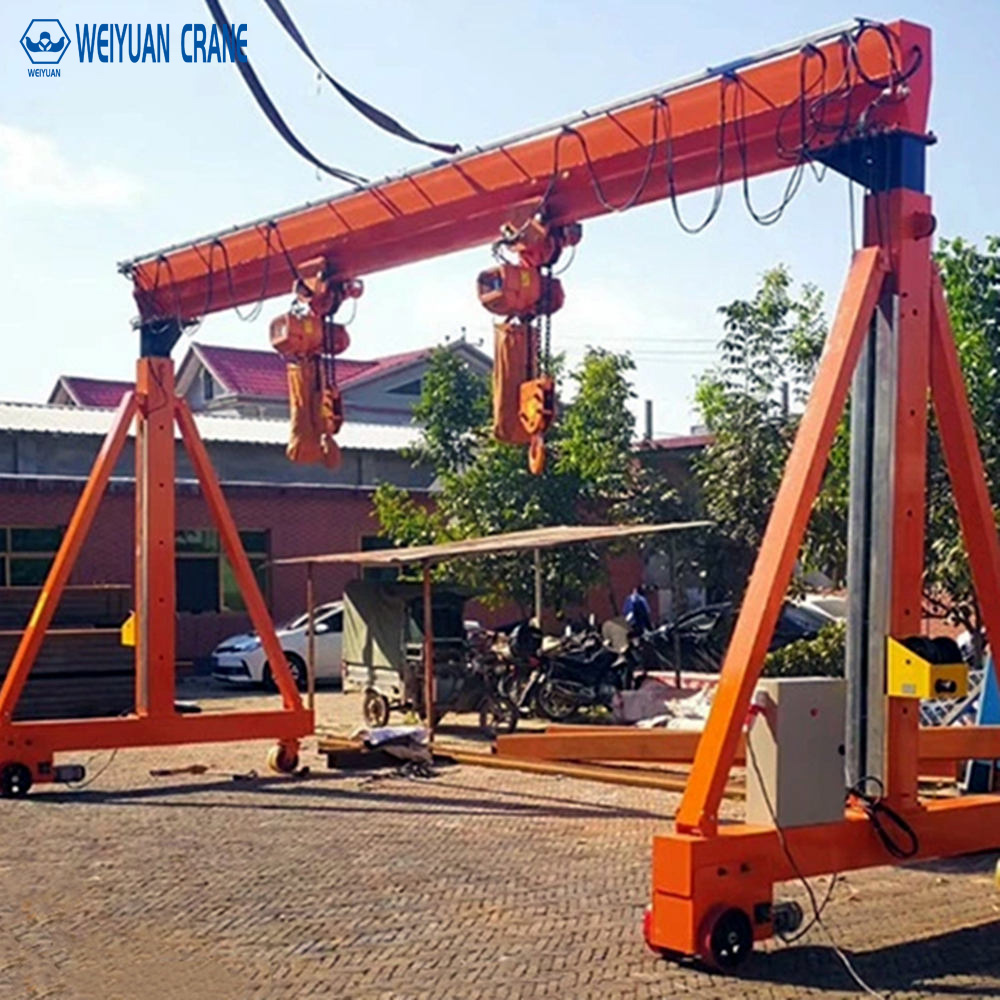
Weiyuan Heavy Duty MG Type Gantry Crane for Outside Lifting
The Weiyuan Heavy Duty MG Type Gantry Crane is a powerful and resilient outdoor lifting solution engineered for demanding outside lifting operations, combining a robust A-frame double-girder structure with weatherproof components for reliable performance in outdoor stockyards, construction and industrial environments. :contentReference
View Product / Get QuoteA gantry crane is a self-supporting lifting structure in which the main girder is carried by two (or more) legs that travel on rails or wheels at ground level, rather than on runway beams fixed to a building. The girder spans between the legs, with a hoist trolley running along it to move the load across the span — the same basic lifting principle as a bridge crane, but with the crane supplying its own structure instead of depending on one.
Because it doesn’t need an existing building, a gantry crane can be installed on open ground, a simple rail track, or a paved yard — anywhere a conventional overhead crane would require costly structural steel to support it.
Typical capacity range: 3–500 tonnes, depending on type and application. Signature strengths: no building dependency, outdoor durability, flexible span and leg configuration. Core purpose: heavy lifting in yards, shipbuilding halls, precast production, ports, and construction sites.
Takeaway: A gantry crane is a self-supporting lifting structure — legs and rails carry the load instead of a building — making it the standard choice anywhere overhead runway beams aren’t practical or available.
How a Gantry Crane Differs From an Overhead (Bridge) Crane
Before comparing gantry crane types, it’s worth understanding how the whole gantry category differs from its building-mounted cousin — the overhead crane, also called a bridge crane, EOT crane (Electric Overhead Traveling Crane), or overhead traveling crane.
Structure and Building Dependency
An overhead crane runs on runway beams fixed to a building’s structural steel — the building itself carries the load. A gantry crane carries its own load through its legs down to rails or wheels at ground level, so it needs no supporting building at all. This is the defining difference and the reason gantry cranes serve outdoor yards, ports, and construction sites where an overhead crane isn’t an option.
Installation Cost and Site Requirements
Installing an overhead crane in a building without existing runway-rated steel usually means a significant structural upgrade. A gantry crane needs only a rail foundation or, for rubber-tyred versions, a paved travel surface — often a lower-cost path to mechanized lifting on an open site.
Mobility
Rail-mounted gantry cranes cover a fixed travel path; rubber-tyred gantry (RTG) cranes can reposition across a yard without fixed rail infrastructure, giving a flexibility that neither a fixed overhead crane nor a rail-bound gantry can match.
Typical Environment
Overhead cranes are almost always indoor, workshop-based equipment. Gantry cranes are built for outdoor duty as standard — weatherproofed motors, control panels, and structural coatings — though indoor gantry installations exist in buildings without runway-rated steel.
Takeaway: An overhead crane depends on a building to carry its load; a gantry crane carries its own load to the ground through its legs, which is what makes it the standard choice for outdoor yards, ports, and sites without existing structural steel.
The Main Gantry Crane Types
Gantry cranes split first by leg configuration — full gantry vs. semi-gantry — and then by travel method. The right choice depends on your site layout, available structure, and how much mobility you need.
Full Gantry Crane
A full gantry crane has legs on both sides of the girder, with both ends traveling on rails or wheels at ground level. Neither end depends on a building at all.
- Coverage: fully independent of any building structure
- Typical capacity: 5–500 tonnes
- Strengths: complete flexibility of installation site, no structural building requirement
- Best for: open yards, shipbuilding halls, precast concrete production, ports
Semi-Gantry Crane
A semi-gantry crane has a leg on one side only; the other end runs on an elevated runway beam, typically along an existing building wall or structure. It’s a hybrid between a full gantry and a standard overhead crane.
- Coverage: bridges an open yard on one side and an existing building runway on the other
- Typical capacity: 5–200 tonnes
- Strengths: lower structural cost than a full gantry where one side can use existing building steel
- Best for: facilities with a building along one edge of the work area and open yard along the other
Rubber-Tyred Gantry Crane (RTG)
An RTG crane travels on rubber tyres rather than rails, giving it the ability to reposition across a yard or steer between rows — a design widely used in container-handling and general yard applications.
- Coverage: flexible, repositionable across a paved yard
- Typical capacity: 20–65 tonnes (container-handling RTGs); lower for general-duty yard RTGs
- Strengths: no fixed rail infrastructure required, can reposition or steer between work zones
- Best for: container terminals, general-cargo yards, and sites needing flexible crane positioning
Rail-Mounted Gantry Crane (RMG)
An RMG crane travels on a fixed rail track, offering precise, repeatable positioning along a defined path — the standard configuration for intermodal rail yards and high-throughput stacking operations.
- Coverage: a fixed travel path along rail track
- Typical capacity: 20–50 tonnes for intermodal/stacking use; higher for heavy-industrial rail-mounted units
- Strengths: precise positioning, higher achievable travel speed than rubber-tyred equivalents, lower per-cycle energy use
- Best for: intermodal rail yards, container stacking blocks, and heavy-industrial sites with a fixed layout
Takeaway: Full gantry and semi-gantry describe leg configuration; RTG and rubber tyres vs. RMG and rail describe travel method — and most real-world gantry cranes combine one choice from each category.
Key Components of a Gantry Crane
A gantry crane’s flexibility and capacity come from how its structural and lifting components work together.
Legs
The legs are what set a gantry crane apart from an overhead crane — they carry the full load down to the ground, whether on rails or wheels. Leg configuration (A-frame or box-column, rigid or with one flexible leg to accommodate rail-alignment tolerance) is engineered around the crane’s span and capacity.
Girder (Single or Double)
The girder is the horizontal structural member the hoist trolley travels along, spanning between the legs. A single girder gantry crane uses one main beam and suits light-to-medium capacity, cost-sensitive applications; a double girder gantry crane uses two parallel girders, enabling higher capacity and a lower hook approach — the same trade-off that applies to double girder overhead cranes.
Trolley and Hoist
The trolley rides along the girder, carrying the hoist that performs the actual lift. Trolley and hoist selection — chain hoist for lighter capacity, wire rope hoist for heavier or higher-cycle duty — follows the same logic used for overhead crane hoist selection, matched to the gantry crane’s rated lifting capacity.
Travel Mechanism (Rails or Tyres)
Rail-mounted gantry cranes use flanged wheels on a fixed steel rail; rubber-tyred versions use tyres on a paved surface, sometimes with steering capability for repositioning between rows. This choice determines both installation cost and long-term site flexibility.
Span and Outreach
Span is the distance between the crane’s legs, set by the width of the work area it needs to cover. Some gantry cranes also include a cantilevered outreach beyond the legs, extending coverage past the leg footprint — a common configuration in shipyard and stockyard applications.
Control System
Gantry cranes are controlled via pendant, cab, or radio remote control, with outdoor units commonly including wind-speed alarms and anti-collision end stops given their exposure to weather and open-yard operating conditions.
Takeaway: Legs and travel mechanism are what make a gantry crane self-supporting; girder configuration, trolley, and hoist follow the same capacity logic as an overhead crane, just carried on independent structure.
Comparing Gantry Crane Types at a Glance
| Gantry crane type | Leg configuration | Travel method | Typical capacity | Best for |
|---|---|---|---|---|
| Full gantry crane | Legs both sides | Rail or wheels | 5–500 t | Open yards, shipyards, precast production, ports |
| Semi-gantry crane | Leg one side, runway beam other side | Rail | 5–200 t | Sites with building on one edge, yard on the other |
| RTG (rubber-tyred gantry) | Full or semi | Rubber tyres | 20–65 t (container); lower for general yard use | Container terminals, flexible-position yards |
| RMG (rail-mounted gantry) | Full or semi | Fixed rail | 20–50 t (intermodal); higher for heavy industrial | Intermodal rail yards, stacking blocks, fixed-layout sites |
How to Read the Table
Start with leg configuration: if part of your work area already has a usable building runway, a semi-gantry crane can lower structural cost; if not, a full gantry crane gives complete site independence. Then choose travel method based on whether you need fixed, repeatable positioning (rail/RMG) or flexible repositioning across the yard (rubber tyres/RTG).
Takeaway: Leg configuration decides how much building dependency you keep; travel method decides how much positioning flexibility you get.
Typical Applications for Gantry Cranes
Shipbuilding and Marine Fabrication
Full gantry cranes are standard equipment in shipyard hull-assembly halls and offshore fabrication yards, where heavy steel sections need to be lifted and positioned across an open work area with no building overhead to rely on.
Ports and Container Terminals
RTG and RMG cranes handle container stacking and yard moves at ports and intermodal terminals, chosen specifically for their ability to cover long yard runs — RTGs where flexible repositioning matters, RMGs where fixed, high-throughput lanes are the priority.
Precast Concrete and Infrastructure Production
Full gantry cranes handle mould, curing-yard, and loading operations at precast concrete yards, often specified individually for each stage of the production line rather than a single generic span.
General Manufacturing and Steel Yards
Semi-gantry and single girder gantry crane configurations serve outdoor stockyards and material-handling areas at steel mills and general industrial sites, frequently working alongside indoor industrial overhead crane and bridge crane systems covering the connected workshop.
Takeaway: Full gantry cranes dominate shipbuilding, precast, and open-yard work; RTG and RMG cranes serve ports and intermodal yards; semi-gantry and single girder configurations bridge outdoor stockyards with existing building structure.
Frequently Asked Questions
Q: What is a gantry crane? A gantry crane is a self-supporting lifting structure in which the main girder is carried on legs that travel on rails or wheels at ground level, rather than on runway beams fixed to a building. It performs the same lifting function as an overhead crane or bridge crane but doesn’t depend on building structure to carry its load, making it the standard choice for outdoor yards, shipyards, ports, and sites without existing structural steel.
Q: What’s the difference between a full gantry crane and a semi-gantry crane? A full gantry crane has legs on both sides of the girder, with both ends traveling on rails or wheels, making it fully independent of any building. A semi-gantry crane has a leg on only one side; the other end runs on an elevated runway beam along an existing building structure, which can lower installation cost where usable building steel is already available on one edge of the work area.
Q: What’s the difference between an RTG and an RMG crane? An RTG (rubber-tyred gantry) crane travels on rubber tyres, allowing it to reposition or steer across a paved yard without fixed rail infrastructure. An RMG (rail-mounted gantry) crane travels on a fixed steel rail, offering more precise, repeatable positioning and typically higher travel speed, at the cost of flexibility to reposition outside its rail path.
Q: How is a gantry crane different from an overhead crane or bridge crane? An overhead crane (also called a bridge crane or EOT crane) runs on runway beams fixed to a building, so the building carries the load. A gantry crane carries its own load through support legs down to rails or wheels at ground level, requiring no building at all — which is why gantry cranes serve outdoor and site-based applications that overhead cranes cannot.
Q: Should I choose a single girder or double girder gantry crane? A single girder gantry crane suits light-to-medium capacity, cost-sensitive applications. A double girder gantry crane is engineered for higher capacity and offers a lower hook approach — the same trade-off used when choosing between a single girder overhead crane and a double girder overhead crane for an indoor bridge crane application.
Q: What capacity range do gantry cranes cover? Gantry cranes typically range from around 3 tonnes for light workshop or yard use up to 500 tonnes for heavy shipyard and industrial fabrication applications. Container-handling RTG and RMG cranes commonly fall in the 20–65 tonne range, matched to standard container weights.
Q: Can a gantry crane be used indoors? Yes — a gantry crane can be installed indoors, typically in a building without existing runway-rated structural steel, since it doesn’t depend on the building to carry its load. This is common in workshops being equipped for heavy lifting without a full structural upgrade.
Q: What determines a gantry crane’s span? Span is the distance between the crane’s legs, set by the width of the work area it needs to cover — the yard, berth, or production line width. Some gantry cranes also add a cantilevered outreach beyond the legs for extended coverage, common in shipyard and stockyard configurations.