


Gantry Crane Buying Guide: How to Choose the Right Crane for Your Site
Introduction
A gantry crane purchase looks straightforward from a distance — pick a tonnage, place an order. In practice, the same capacity number can describe very different machines once you account for span, leg configuration, travel method, and site conditions. Get one of those wrong and a facility ends up with a crane that can’t reach the far side of its own yard, or one whose foundation requirements blow the installation budget.
This guide walks procurement and plant engineering teams through the real buying decision for a gantry crane, step by step — the site questions to answer before requesting a quote, not just the tonnage to specify afterward.
This is article 2 of 3 in the Weiyuan Crane gantry crane series. If you haven’t yet, our gantry crane types and components guide (article 1) is worth reading first — it covers the difference between full gantry, semi-gantry, RTG, and RMG cranes in more depth than this guide will. Here is what you’ll learn in this one:
- The site factors that determine which gantry crane actually fits
- How to size capacity and span correctly
- How leg configuration and travel method change the specification
- A practical checklist to bring to your quotation conversation

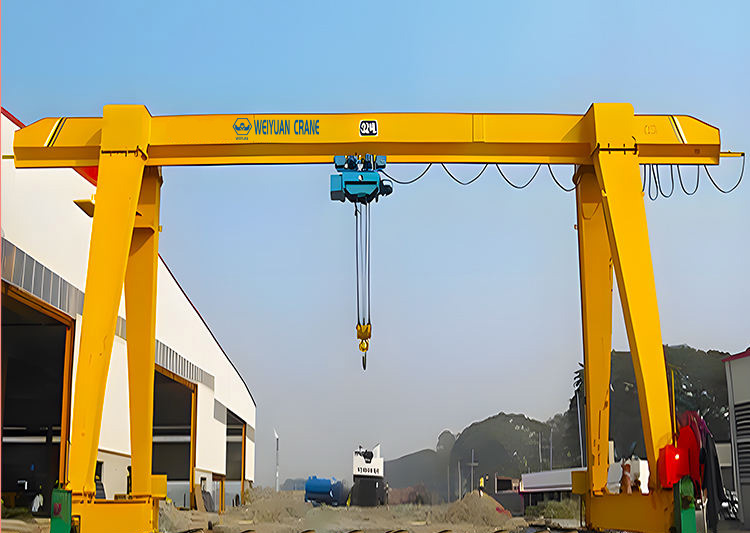
Weiyuan Heavy Duty MG Type Gantry Crane for Outside Lifting
The Weiyuan Heavy Duty MG Type Gantry Crane is a powerful and resilient outdoor lifting solution engineered for demanding outside lifting operations, combining a robust A-frame double-girder structure with weatherproof components for reliable performance in outdoor stockyards, construction and industrial environments. :contentReference
View Product / Get QuoteWhy Capacity Alone Isn’t a Specification
The most common mistake in gantry crane procurement is treating capacity as the entire spec. A “20-tonne gantry crane” could be a rail-mounted full gantry crane for a fixed yard lane, or a rubber-tyred unit built to reposition across an open site — same tonnage, very different structures, very different site requirements and price points.
A complete specification for an industrial gantry crane answers several questions beyond tonnage: how wide is the area it needs to span, what’s the site surface and foundation, does any part of the site have usable building structure, and how much positioning flexibility do you actually need. Skip these and you’re relying on the supplier to guess — or discovering the mismatch after installation.
Takeaway: Capacity is the starting point for a gantry crane specification, not the whole thing — span, site conditions, and travel requirements all shape which crane actually fits.
Step 1: Size the Capacity and Span Correctly
Use Your Heaviest Lift, Not Your Average Lift
Add up your heaviest single load, any lifting attachment or rigging weight, and a safety margin — never specify to your typical lift. This is the same rule that applies to sizing any overhead traveling crane, gantry or bridge alike.
Measure the Actual Width You Need to Cover
Span is the distance between the crane’s legs, and it’s set by your site — the width of the yard, berth, or production line — not chosen independently. Measure the actual area first; a crane proposal built backward from your site layout will always fit better than one built forward from a generic catalogue span.
Consider Outreach Beyond the Legs
If your work area extends beyond a natural leg placement — a stockyard wider than the ideal leg spacing, for example — a cantilevered outreach beyond the legs can extend coverage without widening the whole structure. This is common in shipyard and precast yard configurations.
Takeaway: Size capacity to your heaviest real lift plus margin, and measure your site’s actual width before specifying span — don’t let a catalogue number substitute for a site measurement.
Step 2: Decide Between Full Gantry and Semi-Gantry
If any edge of your work area already has usable, adequately rated building structure, a semi-gantry crane — with a leg on one side and a runway beam on the other — can lower your structural and foundation cost compared to a full gantry crane. If no part of the site has suitable building structure, or you need complete flexibility in where the crane operates, a full gantry crane is the right choice.
This decision is where a gantry crane buying process differs most from specifying an indoor industrial overhead crane — with a fixed building, the semi-gantry vs. full gantry question doesn’t exist at all; it only arises when part of your site sits outside any building’s structural footprint.
Takeaway: Usable building structure on one edge of the site points to semi-gantry; a fully open site points to full gantry.
Step 3: Choose Your Travel Method — Rail or Rubber Tyres
Rail-Mounted (RMG-Style)
Choose a fixed rail if your crane will operate along a defined, repeatable path — a stockyard lane, an intermodal rail yard, a container stacking block. Rail-mounted travel offers precise positioning and typically higher achievable speed, but locks the crane to its rail line.
Rubber-Tyred (RTG-Style)
Choose rubber tyres if your site needs the crane to reposition between zones, steer around obstacles, or if installing a rail foundation isn’t practical on your site. This flexibility comes with a trade-off in maximum travel speed and precision compared to rail-mounted equivalents.
Takeaway: Fixed, repeatable lanes favor rail; flexible, multi-zone positioning favors rubber tyres — match the travel method to how your site actually operates, not just to capacity.
Step 4: Choose Single or Double Girder
As with an indoor bridge crane, a single girder gantry crane suits light-to-medium capacity and cost-sensitive applications, while a double girder gantry crane delivers higher capacity and a lower hook approach — useful where maximizing usable lift height beneath the girder matters, such as shipyard hull-assembly halls with tight roof clearance even in an open bay.
Takeaway: The single vs. double girder decision follows the same capacity and hook-approach logic used for any EOT crane — apply it to your gantry crane the same way.
Step 5: Confirm Site Conditions and Foundation Requirements
- Rail-mounted units need a foundation and rail installed to the crane manufacturer’s load and alignment tolerances — get this confirmed with your civil contractor before finalizing crane specification.
- Rubber-tyred units need a paved, load-rated travel surface, but no rail infrastructure.
- Outdoor units generally need weatherproof electrical components, and sites in high-wind areas should confirm wind-speed alarm and structural wind-loading requirements with the crane manufacturer.
Takeaway: Confirm foundation and surface requirements with your civil contractor early — a rail-mounted crane’s site prep is a different project than a rubber-tyred crane’s.
Gantry Crane Buying Checklist
Use this checklist in your quotation request to get a comparable, accurate quote the first time:
- Heaviest actual lift, plus rigging weight and safety margin
- Measured span (actual site width, not a catalogue estimate)
- Any outreach needed beyond the leg footprint
- Usable building structure on any edge of the site (full vs. semi-gantry)
- Travel method preference and reasoning (fixed lane vs. flexible repositioning)
- Single or double girder, based on capacity and headroom needs
- Site surface and foundation status (existing rail, paved area, bare ground)
- Outdoor environmental factors (wind exposure, coastal corrosion, temperature range)
Frequently Asked Questions
Q: What’s the biggest mistake buyers make when specifying a gantry crane? Specifying span from a catalogue estimate instead of an actual site measurement, and not confirming whether any part of the site has usable building structure before choosing between a full gantry and semi-gantry crane — both decisions are much more expensive to correct after the crane is fabricated.
Q: Is an RTG crane always better than an RMG crane? No — it depends on how your site actually operates. RMG cranes suit fixed, repeatable lanes with higher speed and positioning precision; RTG cranes suit sites needing flexible repositioning across multiple zones. Neither is universally better.
Q: Do I need a full gantry crane, or can a semi-gantry crane work for my site? If any edge of your work area already has adequately rated building structure, a semi-gantry crane can lower your installation cost. If your site is fully open with no usable building structure, a full gantry crane is the right — and often only — option.
Q: How is choosing a gantry crane different from choosing an indoor overhead crane? The core lifting components — girder, trolley, hoist — follow the same logic as an indoor bridge crane or EOT crane. The difference is the gantry crane’s legs and travel method, and the site-level questions (foundation, rail vs. tyres, full vs. semi-gantry) that come with a structure that isn’t building-mounted.
Q: What site information should I have ready before requesting a quote? The checklist above — heaviest lift, measured span, any outreach requirement, available building structure, travel method preference, girder configuration, site surface status, and outdoor environmental factors. Suppliers can quote faster and more accurately with this information up front.
Q: Can an existing gantry crane be reconfigured later — for example, adding outreach or upgrading capacity? In many cases, yes — structural modifications such as capacity upgrades or added outreach can be engineered onto an existing gantry crane, similar to how an indoor overhead crane can sometimes be upgraded rather than replaced. This should be evaluated case by case against the existing structure’s design margin.