


Gantry Crane Installation Guide: Site Preparation, Erection, and Commissioning
Introduction
Gantry crane installation is a bigger undertaking than mounting an indoor hoist — because the crane supplies its own supporting structure, the site itself has to be prepared correctly before a single piece of steel goes up. A gantry crane specified perfectly for the job can still underperform, or become a safety hazard, if its foundation isn’t rated for the load, its rails aren’t aligned within tolerance, or it goes into service without proper commissioning.
This guide walks through the installation process for full gantry, semi-gantry, rail-mounted (RMG), and rubber-tyred (RTG) cranes, from site preparation through commissioning, so plant engineers and project managers know what a correct installation actually involves.
This is article 3 of 3 in the Weiyuan Crane gantry crane series. If you’re still choosing which crane to buy, our gantry crane types and components guide (article 1) and buying guide (article 2) cover that groundwork first. Here is what you’ll learn in this one:
- Site and foundation preparation before the crane arrives
- The erection sequence for rail-mounted and rubber-tyred gantry cranes
- Electrical and control setup basics
- Load testing and commissioning steps before the crane enters service
Before Installation: Site and Foundation Preparation

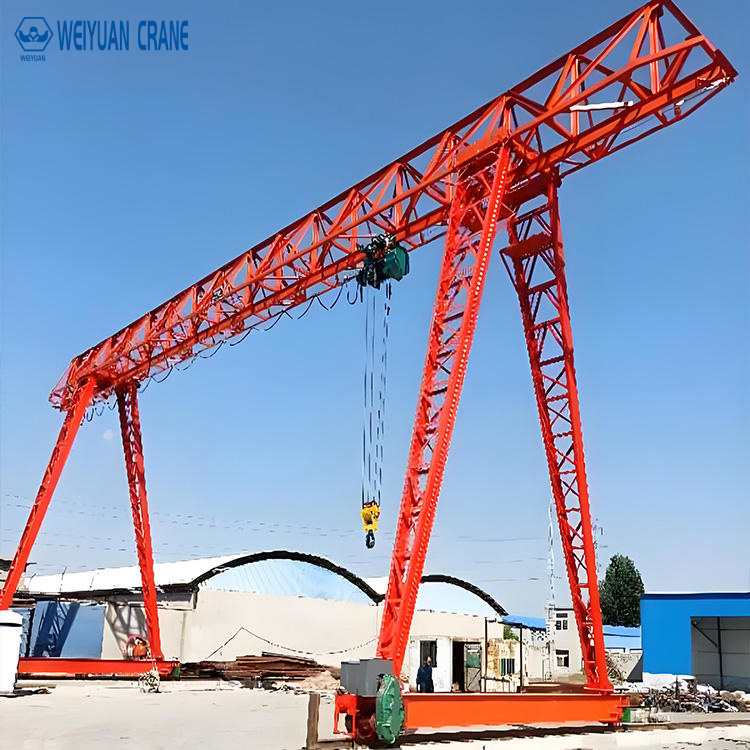
Weiyuan Heavy Duty MG Type Gantry Crane for Outside Lifting
The Weiyuan Heavy Duty MG Type Gantry Crane is a powerful and resilient outdoor lifting solution engineered for demanding outside lifting operations, combining a robust A-frame double-girder structure with weatherproof components for reliable performance in outdoor stockyards, construction and industrial environments. :contentReference
View Product / Get QuoteConfirm Foundation Design Matches the Crane’s Load
A gantry crane’s legs transmit its full working load — the structure plus the rated lift plus dynamic loading during operation — straight into the foundation beneath them. Confirm the foundation design with a civil engineer against the crane manufacturer’s leg-reaction loads before any concrete is poured; this is the single most consequential check in the entire installation.
For Rail-Mounted Cranes: Rail Installation and Alignment
Rail-mounted gantry crane and RMG crane installations require the rail to be installed to the manufacturer’s specified gauge (distance between rails) and level tolerance along its full length. Misaligned or out-of-tolerance rail is a leading cause of wheel wear, uneven loading, and travel problems after commissioning — it’s worth a dedicated survey check before the crane’s legs are ever set on the rail.
For Rubber-Tyred Cranes: Surface Preparation
RTG crane installations need a paved, load-rated travel surface across the full operating area, graded to avoid pooling water and rated for the tyre loading under full working capacity. Surface quality directly affects tyre wear and travel smoothness over the crane’s service life.
For Semi-Gantry Cranes: Verify the Building-Side Runway
Where one end of a semi-gantry crane will run on an existing building runway beam, confirm that runway is rated for the new crane’s load — not just the load of whatever crane (if any) previously used it. This verification should happen during the buying-guide stage (article 2), but must be re-confirmed on site before erection begins.
Takeaway: Foundation load rating, rail alignment or surface preparation, and (for semi-gantry cranes) building-side runway capacity are the checks that must be right before the crane structure goes up — correcting any of them after erection is far more costly than catching them beforehand.
Erection Sequence
Step 1: Position and Set the Legs
Legs are erected first, set onto their prepared foundation points (or onto the rail, for rail-mounted units) and temporarily braced before the girder is lifted into place.
Step 2: Lift and Connect the Girder
For a single girder gantry crane, the girder is lifted and connected between the two legs; for a double girder gantry crane, both girders are set and cross-braced per the structural design before proceeding. This step typically requires a mobile crane or, on larger installations, a temporary erection gantry.
Step 3: Install the Trolley and Hoist
With the girder connected, the trolley is installed onto the girder rail and the hoist mounted to the trolley, following the same installation-quality checks used for any wire rope or chain hoist — correct wire rope spooling, chain orientation, and torque on all structural fasteners.
Step 4: Install the Travel Mechanism
For rail-mounted cranes, the leg-mounted travel wheels are set onto the rail and checked for even loading across all wheels. For rubber-tyred cranes, tyre assemblies are mounted and, where fitted, steering mechanisms are installed and calibrated.
Step 5: Complete Electrical Installation
Main power connection — via cable reel, festoon system, or busbar depending on the crane’s travel method — is installed and connected, followed by pendant, cab, or radio remote control systems.
Step 6: Set Travel and Load Limits
Travel limit switches are set to the confirmed operating range at both ends of the rail or yard, anti-collision systems (where fitted) are calibrated, and overload protection is set to the crane’s rated capacity.
Takeaway: Legs and girder go up first, then trolley, hoist, and travel mechanism, then electrical systems — and every structural connection should be torqued and verified against the manufacturer’s specification before the crane carries any load.
Electrical and Control Setup Notes
- Grounding: confirm proper grounding of the crane structure and control systems before energizing, particularly important for outdoor, weather-exposed installations.
- Overload protection: verify overload protection is active and correctly calibrated to the crane’s rated lifting capacity before any load testing.
- Wind-speed monitoring: for outdoor gantry cranes, confirm wind-speed alarm thresholds are set correctly and that out-of-service wind-storage procedures (such as rail clamps) are understood by site operators.
- Anti-collision systems: where multiple gantry cranes share a rail or yard, confirm anti-collision end stops or sensors function correctly before both cranes are placed into service.
Takeaway: Grounding, overload protection, and — for outdoor gantry cranes specifically — wind-speed monitoring and anti-collision systems are checks unique to gantry crane commissioning that don’t apply the same way to an indoor overhead crane.
Load Testing and Commissioning
No-Load Function Test
Run the crane through a full hoist, trolley, and long-travel cycle with no load, confirming smooth operation across the full rail or yard travel range and correct function of all limit switches.
Rated-Load Test
Test the crane at its full rated capacity across representative points of its travel range — not just at one position — confirming consistent performance, correct brake holding, and no unexpected structural deflection.
Overload Protection Verification
Following the manufacturer’s documented commissioning procedure, confirm overload protection engages correctly at the specified threshold.
Wheel and Rail (or Tyre) Load Verification
For rail-mounted cranes, confirm loading is even across all travel wheels under rated load — uneven loading indicates a foundation or rail alignment issue that should be corrected before the crane enters regular service. For rubber-tyred cranes, confirm tyre loading and steering function under representative working conditions.
Documentation
Record all commissioning results — load test outcomes, limit switch settings, rail alignment survey data, and any adjustments made — as part of the facility’s equipment maintenance record.
Takeaway: A gantry crane isn’t ready for production use until it has passed a no-load test, a rated-load test across its full travel range, overload protection verification, and — for rail-mounted units — confirmed even wheel loading, all documented as a maintenance baseline.
Frequently Asked Questions
Q: What’s the most important pre-installation check for a gantry crane? Confirming the foundation design matches the crane manufacturer’s leg-reaction loads. Because a gantry crane carries its full working load through its own legs into the ground, an under-rated foundation is both the most serious and most expensive-to-correct installation error.
Q: How is gantry crane installation different from installing an indoor overhead crane? An overhead crane’s installation centers on the building’s existing runway beams. A gantry crane’s installation centers on preparing the crane’s own foundation and travel surface — rail alignment for rail-mounted units, paved surface rating for rubber-tyred units — since the crane supplies its own supporting structure rather than relying on a building.
Q: What causes uneven wheel loading on a rail-mounted gantry crane? Most commonly, rail misalignment or an out-of-tolerance foundation — this is why a rail survey check before erection, and a wheel-load verification during commissioning, are both essential steps rather than optional extras.
Q: Do outdoor gantry cranes need any commissioning steps that indoor cranes don’t? Yes — wind-speed alarm calibration and, where applicable, storm-anchor or rail-clamp procedures are specific to outdoor gantry crane commissioning, along with corrosion-protection verification on structural coatings, none of which typically apply to an indoor overhead crane installation.
Q: How long does a typical gantry crane installation take? This varies significantly by crane size and site readiness — foundation or rail work often takes longer than the crane erection itself. Site preparation should be scheduled and completed well ahead of crane delivery to avoid delays once the crane arrives.
Q: What documentation should we keep after installation? Commissioning test results (no-load and rated-load tests across the travel range), limit switch and overload protection settings, rail alignment or surface survey data, and the foundation design verification — this record supports both compliance requirements and future maintenance planning.