


Jib Crane Buying Guide: How to Choose the Right Crane for Your Workstation
Introduction
A jib crane purchase looks like a small decision compared to a full bridge or gantry crane — one workstation, one arm, one hoist. That simplicity is exactly why it’s easy to get wrong: buyers frequently specify capacity and arm length without confirming the mounting structure can actually carry the moment loading a rotating arm creates, or without checking whether an obstruction in the work area will block the crane’s swing before it ever reaches the far side of its rated radius.
This guide walks procurement and plant engineering teams through the real buying decision for a jib crane, step by step — the questions to answer before requesting a quote, not just the tonnage to specify afterward.
This is article 2 of 3 in the Weiyuan Crane jib crane series. If you haven’t yet, our jib crane types and components guide (article 1) is worth reading first — it covers the difference between wall-mounted, floor-mounted, mast-style, and articulating jib cranes in more depth than this guide will. Here is what you’ll learn in this one:
- The factors that actually determine the right jib crane
- How to size capacity and arm length correctly
- How mounting structure and rotation range change the specification
- A practical checklist to bring to your quotation conversation
Why Capacity Alone Isn’t a Specification

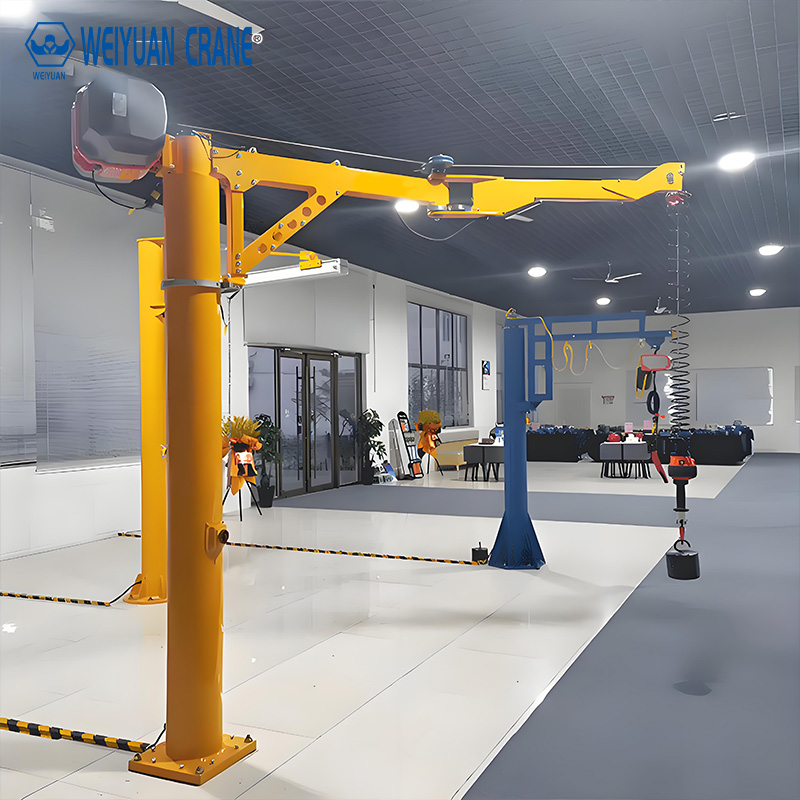
Weiyuan Column Jib Crane
The Weiyuan Column Jib Crane is a versatile and cost-effective freestanding lifting solution designed for precise material handling in workshops, assembly lines, and maintenance areas. With a full 360-degree slewing range and robust steel structure, this crane delivers smooth rotation, dependable performance and enhanced operational flexibility in confined workspaces. :contentReference
View Product / Get QuoteThe most common mistake in jib crane procurement is treating capacity as the entire spec. A “2-tonne jib crane” could be a wall-mounted unit with a short arm and limited rotation, or a floor-mounted pillar crane with full 360° coverage and a longer reach — same tonnage, very different coverage and mounting requirements.
A complete specification for a jib crane answers several questions beyond capacity: what mounting structure is actually available, how much rotation does the workstation need, how far does the arm need to reach, and are there any obstructions within the swing radius. Skip these and you’re relying on the supplier to guess — or discovering the mismatch after installation, when the arm can’t clear a nearby column.
Takeaway: Capacity is the starting point for a jib crane specification, not the whole thing — mounting structure, rotation range, and reach all shape which crane actually fits the workstation.
Step 1: Confirm Your Available Mounting Structure
Check for an Adequately Rated Wall or Column
If a suitably rated wall or building column exists near the workstation, a wall-mounted or mast-style jib crane is typically the more economical choice — but “suitably rated” needs to be confirmed by structural assessment, not assumed from how substantial the wall looks.
Consider a Floor-Mounted Unit Where No Wall Exists
If no adequately rated wall or column is available, or the workstation is in the middle of the floor plan, a floor-mounted (pillar) jib crane on its own foundation is generally the right path — and gives you full rotation range as a bonus.
Takeaway: Confirm your mounting structure with an actual assessment before choosing between wall-mounted and floor-mounted — don’t let wall availability alone make the decision without checking the rating.
Step 2: Size Capacity to Your Heaviest Real Lift
Add up your heaviest single load at this workstation, any lifting attachment or tooling weight, and a safety margin — never specify to your typical or average lift at the station. This is the same rule that applies to sizing any crane, jib, bridge, or gantry alike.
Takeaway: Size to your heaviest actual lift at the workstation plus margin, not the average job that station handles.
Step 3: Determine Your Required Rotation Range
Map how the workstation actually uses the crane: does the load need to move to just one or two fixed points (a machine and a staging area, for example), or does it need to reach anywhere around a full work cell? Limited, predictable movement often works fine with a wall-mounted unit’s up-to-180° range; full-cell coverage points toward a floor-mounted unit’s up-to-360° range.
Takeaway: Map your actual load movement pattern at the workstation before assuming you need full rotation — many applications need less than 180°.
Step 4: Check for Obstructions Within the Swing Radius
Walk the physical workstation and confirm nothing — a machine, a support column, another piece of equipment — sits within the arm’s planned swing radius at any rotation angle it will actually use. If an obstruction is unavoidable, an articulating jib crane may be necessary to route around it.
Takeaway: Confirm the swing radius is genuinely clear at every angle you’ll actually use — an obstruction discovered after installation is a costly and disruptive fix.
Step 5: Confirm Arm Length and Hook Height
Arm length sets your working radius — measure the actual distance the load needs to travel from the mounting point, not an assumed “typical” reach. Hook height (how low the hoist can lower a load) should be confirmed against your lowest working point, particularly in pit or below-floor-level applications.
Takeaway: Arm length and hook height should come from measured workstation dimensions, not a generic assumption about what a jib crane “usually” covers.
Jib Crane Buying Checklist
Use this checklist in your quotation request to get a comparable, accurate quote the first time:
- Heaviest actual lift at this workstation, plus tooling weight and safety margin
- Available mounting structure (wall/column rating, or foundation pad feasibility)
- Required rotation range (limited/predictable vs. full 360°)
- Confirmed clear swing radius, or identified obstructions requiring an articulating arm
- Measured arm length / working radius needed
- Required hook height, including any below-floor-level reach
- Control preference (pendant, radio remote)
- Duty cycle (lifts per hour at this workstation)
Frequently Asked Questions
Q: What’s the biggest mistake buyers make when specifying a jib crane? Assuming an existing wall is adequately rated without a structural assessment, and not walking the actual swing radius to check for obstructions before ordering — both are much more expensive to correct after the crane is installed than to catch during specification.
Q: Do I need a floor-mounted jib crane, or will wall-mounted work? If an adequately rated wall or column exists near the workstation and your rotation needs are limited (up to about 180°), wall-mounted is typically the more economical choice. If no suitable wall exists, or you need full rotation coverage of a work cell, a floor-mounted unit is the right — and often only — option.
Q: How do I know if I need an articulating jib crane? If a machine, column, or other obstruction sits within the working radius at any angle the crane needs to actually use, a straight-arm jib crane won’t be able to route around it — an articulating jib crane’s hinged second arm section is designed specifically for this situation.
Q: What information should I have ready before requesting a quote? The checklist above — heaviest lift, available mounting structure, required rotation range, confirmed clear swing radius, arm length, hook height, control preference, and duty cycle. Suppliers can quote faster and more accurately with this information up front.
Q: Can a jib crane be relocated to a different workstation later? A floor-mounted (pillar) unit can sometimes be relocated with a new foundation pad; a wall-mounted or mast-style unit is generally tied to its original mounting location, since relocation would require re-verifying a new wall or column’s rating from scratch.
Q: How does duty cycle affect jib crane specification? High-frequency, near-continuous use at a workstation calls for a more robust hoist and rotation bearing than occasional, light use — matching duty cycle to your actual usage pattern, not just peak capacity, is what determines the crane’s realistic service life at that station.