


Jib Crane Installation Guide: Mounting, Setup, and Commissioning
Introduction
Jib crane installation looks simple compared to a full bridge or gantry crane project — one mounting point, one arm — but that simplicity hides a structural detail that’s easy to get wrong: a rotating jib arm creates moment loading on its mast or wall bracket that a simple vertical-load calculation doesn’t capture. A jib crane specified perfectly for its workstation can still become a safety hazard if the wall it’s bolted to wasn’t actually rated for that rotational loading, or if the foundation pad beneath a floor-mounted unit wasn’t sized correctly.
This guide walks through the installation process for both wall-mounted and floor-mounted (pillar) jib cranes, from mounting verification through commissioning, so plant engineers and maintenance teams know what a correct installation actually involves.
This is article 3 of 3 in the Weiyuan Crane jib crane series. If you’re still choosing which crane to buy, our jib crane types and components guide (article 1) and buying guide (article 2) cover that groundwork first. Here is what you’ll learn in this one:
- Pre-installation checks unique to wall-mounted and floor-mounted jib cranes
- The installation sequence for both configurations
- Electrical and control setup basics
- Load testing and commissioning steps before the crane enters service

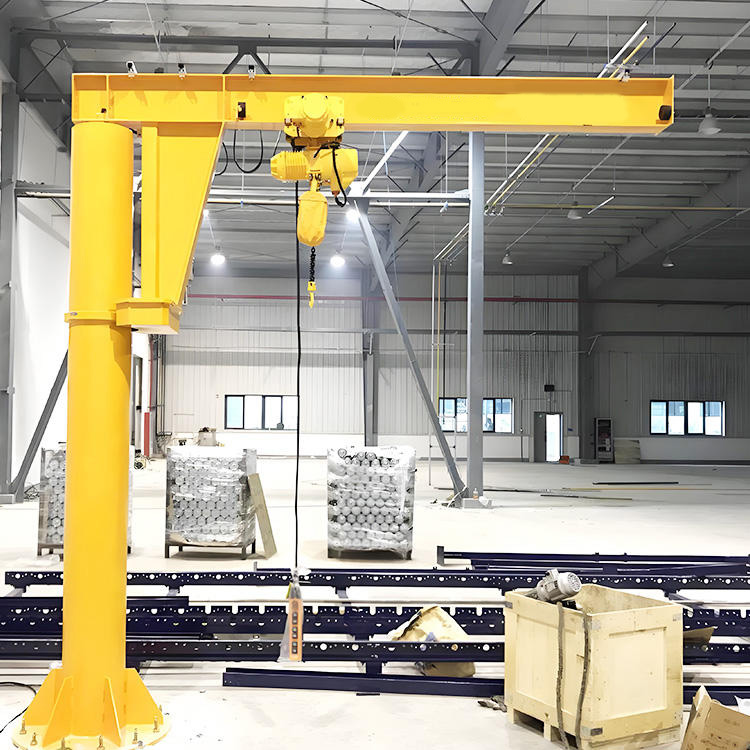
Weiyuan Column Jib Crane
The Weiyuan Column Jib Crane is a versatile and cost-effective freestanding lifting solution designed for precise material handling in workshops, assembly lines, and maintenance areas. With a full 360-degree slewing range and robust steel structure, this crane delivers smooth rotation, dependable performance and enhanced operational flexibility in confined workspaces. :contentReference
View Product / Get QuoteBefore Installation: Mounting Verification
For Wall-Mounted and Mast-Style Cranes: Verify Wall or Column Rating
Confirm the wall or building column is rated not just for the crane’s static weight, but for the moment loading created by a rated load at full arm extension through the crane’s full rotation range — this is a fundamentally different calculation than a simple vertical load check, and it’s the single most important verification for a wall-mounted or mast-style jib crane.
For Floor-Mounted Cranes: Verify Foundation Design
Confirm the foundation pad is sized and reinforced per the crane manufacturer’s base-plate loading and moment data, accounting for the same full-rotation, full-extension loading condition. An undersized foundation is the floor-mounted equivalent of an under-rated wall — a serious and hard-to-correct-after-the-fact error.
Confirm the Swing Radius Is Physically Clear
Before mounting, do a final physical walk of the full swing radius at every angle the crane will actually use, confirming nothing has changed since the buying-guide stage (article 2) — machinery gets moved, new equipment gets installed, and this is the last checkpoint to catch it.
Confirm Power Supply Matches the Hoist’s Electrical Rating
Voltage, phase, and frequency must match the hoist’s nameplate rating before any electrical connection work begins.
Takeaway: Wall/column or foundation rating against the crane’s full-rotation moment loading, and a final swing-radius clearance check, are the two verification steps most specific to jib crane installation — get both confirmed before any mounting hardware goes in.
Installation Sequence
Step 1: Install the Mounting Structure
For wall-mounted or mast-style units, install the mounting bracket to the verified wall or column per the manufacturer’s torque and anchor specifications. For floor-mounted units, the foundation pad is poured and cured to specification before the mast is set.
Step 2: Erect the Mast or Set the Bracket
For a floor-mounted unit, the mast is set onto the cured foundation and secured per the manufacturer’s base-plate bolt pattern and torque specification. For wall-mounted units, this step is largely complete once the bracket itself is installed.
Step 3: Attach the Jib Arm
The jib arm is connected to the mast or bracket at the rotation bearing, with the bearing’s smooth, free rotation confirmed before any load is applied.
Step 4: Install the Trolley and Hoist
The trolley is installed onto the jib arm, and the hoist is mounted to the trolley — following the same installation-quality checks used for any hoist, whether chain or wire rope: correct chain orientation or wire rope spooling, and torque on all structural fasteners.
Step 5: Install the Hook and Confirm Rotation Stops
Attach the hook, confirming the safety latch functions correctly, and verify the mechanical rotation stops are correctly positioned to limit the arm’s swing to its designed range at both ends.
Step 6: Complete Electrical Connections
Connect main power per the confirmed voltage and phase, then wire the pendant or remote control, confirming up/down and — where the trolley or rotation is powered — direction controls match actual crane motion before proceeding.
Takeaway: Mounting structure first, then mast or bracket, then jib arm at the rotation bearing, then trolley and hoist — with rotation stops and control direction confirmed before the crane carries any load.
Electrical and Control Setup Notes
- Grounding: confirm the crane structure and control station are properly grounded before energizing.
- Overload protection: verify the hoist’s overload protection is active and correctly calibrated to the crane’s rated capacity, not a higher threshold.
- Rotation stop verification: confirm mechanical rotation stops physically prevent over-rotation at both ends of the swing range — this is a safety-critical check unique to jib cranes.
- Emergency stop: confirm the emergency stop function halts all hoist and trolley motion immediately and holds the load, before any load testing begins.
Takeaway: Grounding, overload protection, and rotation stop verification are the checks that must be confirmed working correctly before any load is placed on the crane.
Load Testing and Commissioning
No-Load Function Test
Run the crane through a full hoist, trolley, and rotation cycle with no load, confirming smooth operation across the full swing radius and correct function at both rotation stops.
Rated-Load Test at Multiple Rotation Angles
Test the crane at its full rated capacity at several points across its rotation range — not just at one angle — confirming the brake holds the load without drift and that the mast, bracket, or foundation shows no unexpected movement under full-extension loading.
Overload Protection Verification
Following the manufacturer’s documented commissioning procedure, confirm overload protection engages correctly at the specified threshold.
Documentation
Record the commissioning results — load test outcomes at multiple rotation angles, rotation stop positions, and any adjustments made — as part of the facility’s equipment maintenance record.
Takeaway: A jib crane isn’t ready for production use until it has passed a no-load function test and a rated-load test performed at multiple points across its rotation range, not just one angle — and the results are documented, not just observed.
Frequently Asked Questions
Q: What’s the most important pre-installation check for a jib crane? Confirming the wall, column, or foundation is rated for the moment loading created by a rated load at full arm extension through the crane’s full rotation range — not just the crane’s static weight. This is the single most consequential and most commonly underestimated check in jib crane installation.
Q: Why does a jib crane need load testing at multiple rotation angles, not just one? Because the loading on the mast, bracket, or foundation changes as the arm rotates and extends — testing at only one angle can miss a structural issue that only appears at full extension or a particular point in the swing range.
Q: What causes a jib crane’s rotation to bind or feel rough? Most commonly, a rotation bearing installation issue or a mast/bracket alignment problem — this is why confirming smooth, free rotation before any load is applied (during Step 3 of the installation sequence) is an important checkpoint, not something to discover during commissioning.
Q: Can a floor-mounted jib crane be installed on any existing concrete floor? No — the foundation pad needs to be sized and reinforced specifically for the crane’s base-plate loading and moment data, which is a different (and usually more substantial) requirement than typical floor-slab loading. An existing floor slab is rarely adequate without a purpose-built foundation pad.
Q: How often should an installed jib crane be re-tested after commissioning? This depends on duty class and local regulatory requirements, but periodic re-inspection — typically annually at minimum for industrial use — is standard practice, along with a visual check of rotation stops and mounting hardware at more frequent intervals given the cyclical stress of repeated rotation.
Q: What documentation should we keep after installation? Commissioning test results (no-load and rated-load tests at multiple rotation angles), rotation stop position verification, and the wall, column, or foundation structural rating confirmation — this record supports both compliance requirements and future maintenance planning.