


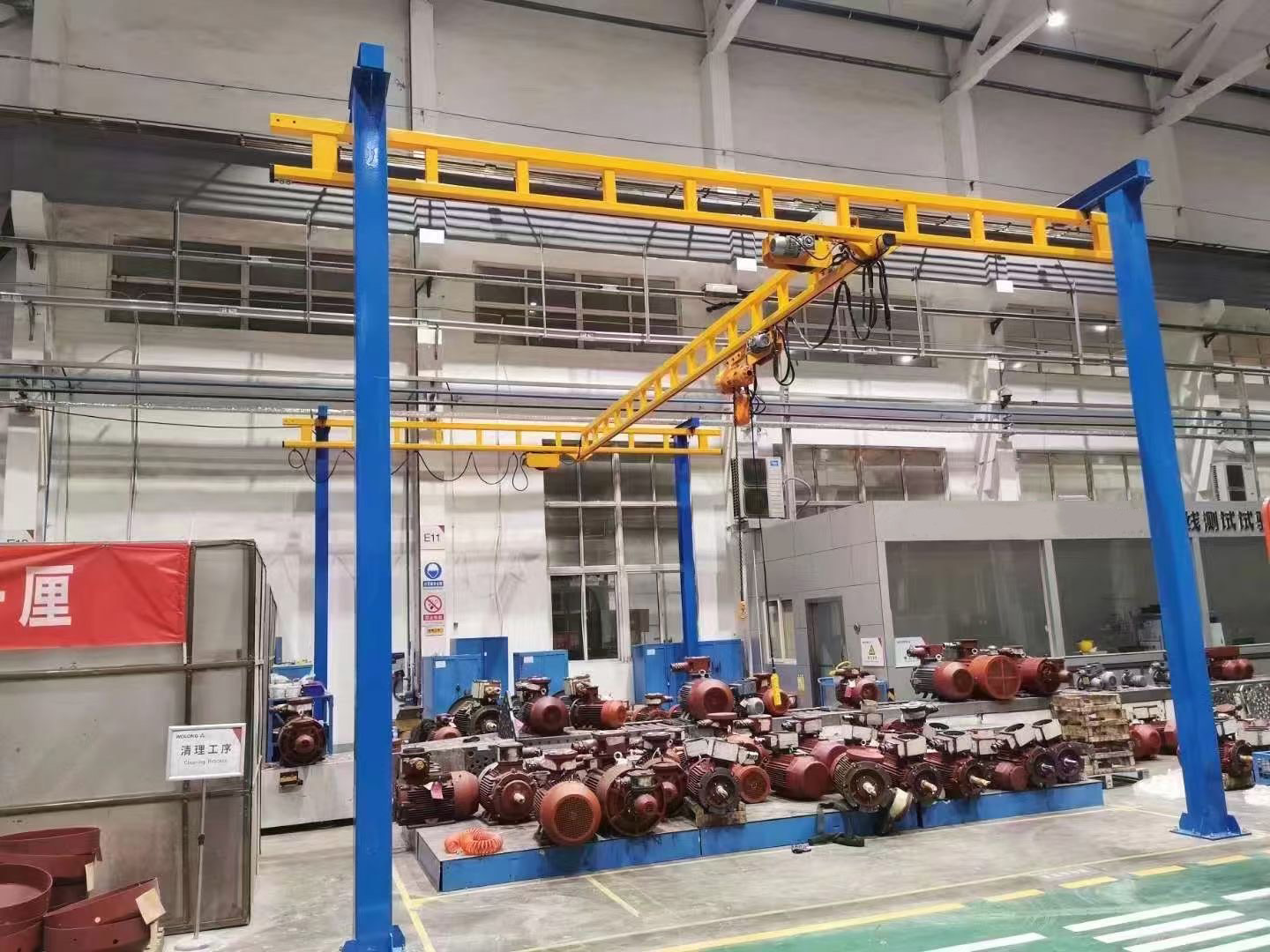
KBK light crane system
KBK Monorail Crane for Sale: Point-to-Point Lifting Along a Fixed Track
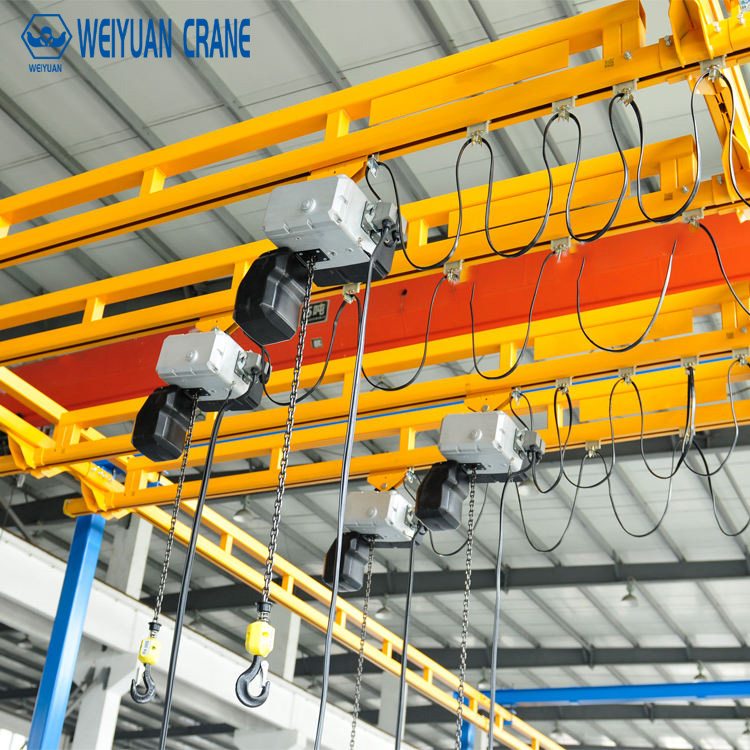
A KBK monorail crane solves a specific material-handling problem: moving a load repeatedly along the same fixed path — from a machine to a staging area, between two workstations, or along an assembly line — without the cost or footprint of a full bridge crane system. Built on Weiyuan’s KBK modular light crane profile, the monorail track can run straight, curved, or as a combination of both, following the actual production flow rather than forcing the layout to fit a rectangular crane runway.
Weiyuan’s KBK monorail crane range covers 80 kg to 2 tons, with track geometry engineered around the customer’s confirmed material flow path.
What Makes a KBK Monorail Crane Different
Unlike a bridge-mounted overhead crane, which covers a rectangular working area beneath two parallel runways, a KBK monorail crane runs a single hoist and trolley along one enclosed track suspended from the building structure. That track can be laid out as a straight run, a curve, or a switch-connected path between multiple production points — matching the crane’s coverage to the exact route a load actually travels, instead of leaving unused area outside the load path uncovered by capacity you paid for anyway.
The trade-off against a KBK suspension crane (bridge-style, covering a rectangular area) is coverage width: a monorail system serves only the path the track follows, not a full rectangular zone. Where the actual handling need is point-to-point rather than area coverage, that’s usually an advantage, not a limitation — a monorail track costs less per meter of coverage and threads around existing equipment more easily than a full bridge system.
Series and Capacity Range
Series name: WY-KBK-M Series | Category: KBK monorail crane, straight/curved enclosed track, single-track suspension
| Model | Capacity | Track Configuration | Typical Applications | Control | Hoist Type |
|---|---|---|---|---|---|
| WY-KBK-M08 | 80–125 kg | Straight or curved, single track | Small-parts transfer, electronics assembly line feed | Pendant | Chain hoist |
| WY-KBK-M25 | 125–250 kg | Straight, curved, or switch-connected | Machine-to-machine transfer, tool room to bench | Pendant | Chain hoist |
| WY-KBK-M50 | 250–500 kg | Straight or curved, single track | General workshop point-to-point handling | Pendant/remote | Chain hoist |
| WY-KBK-M10 | 0.5–1 ton | Curved or switch-connected, multi-point routing | Assembly-line material flow between stations | Pendant/remote | Chain hoist |
| WY-KBK-M20 | 1–2 tons | Straight run, reinforced track profile | Upper limit of monorail range — heavier point-to-point transfer | Remote | Chain or wire rope |
Technical Parameters (Reference Range)
| Parameter | Typical Range / Description |
|---|---|
| Track profile | KBK enclosed I-beam profile, single track |
| Track layout | Straight, curved, or switch-connected multi-point path |
| Curve radius | Engineered to the confirmed layout and load |
| Duty class | M3–M5 |
| Power supply | 380V/50Hz (customizable), or manual push-travel for lighter units |
| Suspension | Ceiling-hung or structural steel support, spaced to track load rating |
Featured Product: Weiyuan WY-KBK-M50 Monorail Crane
[Product image placeholder]
The WY-KBK-M50, drawn from the table above, is Weiyuan’s most commonly ordered monorail configuration — a 250–500 kg unit on a straight or curved single track, suited to general workshop point-to-point handling between fixed stations.
[View Product / Get Quote →]
How to Choose the Right KBK Monorail Crane
- Map the actual load path first — a monorail crane is only as useful as the route it follows, so confirm the real path between pickup and drop-off points before laying out track.
- Confirm your heaviest actual lift along that path, including any fixture or attachment weight, and match it against the series table above.
- Decide straight, curved, or switch-connected track based on how many fixed points the route needs to serve.
- Check ceiling or structural support at every point along the planned track run — suspension spacing depends on the track’s rated load.
- Confirm whether powered or manual travel fits your cycle rate — light, infrequent moves often don’t need a powered trolley.
Red Flags When Shopping for a KBK Monorail Crane
- Track layout proposed before the actual load path is confirmed — a monorail system should follow the real material flow, not a generic straight-line assumption.
- No structural support assessment along the full track run — every suspension point needs to be rated for the track’s load, not just the endpoints.
- Curve radius specified without reference to the load’s actual dimensions — an oversized load on too tight a curve is a common and avoidable design error.
- No distinction offered between manual push-travel and powered trolley options — these suit very different cycle rates and should be discussed, not defaulted.
Frequently Asked Questions
Q: What’s the difference between a KBK monorail crane and a KBK suspension crane? A KBK monorail crane runs on a single track following a point-to-point path — straight, curved, or switch-connected — while a KBK suspension crane uses a bridge girder spanning two parallel tracks to cover a full rectangular area. The right choice depends on whether your actual handling need is a fixed route or area coverage.
Q: Can a KBK monorail crane track include curves? Yes — see the WY-KBK-M series table above. Curved and switch-connected track layouts are one of the main advantages of the KBK monorail system, letting the path route around existing equipment or serve multiple fixed points along one line.
Q: How much weight can a KBK monorail crane lift? KBK monorail cranes typically range from 80 kg for light-parts handling up to about 2 tons for heavier point-to-point transfer (see the series table above), with the exact capacity also limited by the track profile and structural support along the run.
Q: Does a KBK monorail crane need a powered trolley? Not always — lighter units with infrequent moves are often specified with manual push-travel, while higher-capacity or higher-cycle-rate applications typically use a powered trolley. This should be matched to your actual usage pattern, not assumed by default.
Q: Can an existing KBK monorail track be extended later? Generally yes, since the KBK profile is modular — extending or reconfiguring a track layout is usually more straightforward than with a fixed bridge-crane runway, though any extension should be re-verified against the original structural support design.
