


Electric Hoist Buying Guide: How to Choose and Specify the Right Electric Hoist
Introduction
Two quotes land on your desk for the same electric hoist. One is 30% cheaper. Both claim to lift your load. So which one do you sign off on?
If you buy on the lower number alone, you may be buying a hoist built for a lighter duty than your line demands — one that overheats, wears out, and stops your production a year in. The cheapest hoist to buy is very often the most expensive to own once you count the downtime it causes.
For procurement managers, plant engineers, and facility managers in manufacturing and mining, the challenge is that capacity is the easiest number to compare and the least likely to tell you whether the hoist will last. A unit rated for 5 tonnes might be engineered for occasional maintenance lifting or relentless production cycling — and the two behave nothing alike on the floor.
This guide walks you through specifying and buying an electric hoist so your quotes are genuinely comparable and your money goes to reliability, not just a low sticker price. This is article 2 of 3 in the Weiyuan Crane electric hoist series. Where article 1 covered electric hoist types and applications, this one covers how to buy the right one, and article 3 covers how to install it.
Here is what you will learn:
- The key specification factors behind every quote
- How to choose between wire rope and chain hoists, and when VFD control pays back
- How to match the environment, evaluate suppliers, and weigh total cost of ownership — while dodging the mistakes that cost the most
The Key Specification Factors
Every quote you receive is built from a handful of specification inputs. Get these right and the quotes you compare are accurate and comparable. Get them wrong and you are comparing hoists that will never perform the same way — which makes a fair price comparison impossible.
Rated Capacity (Including Rigging Weight)
Your required capacity is not your heaviest load. It is that load plus everything hanging below the hook — the spreader beam, lifting frame, magnet or grab, slings, and shackles — plus a safety margin.
A hoist sized to the bare load is quietly overloaded the moment you attach a 200 kg lifting frame. That overload stresses the motor, brake, rope, and gearing on every single lift, seeding a failure that surfaces months later. Add the rigging weight, then leave headroom: if your loads may grow, size up now, because a hoist selected at the very top of its range gives you no room when a heavier job arrives.
Quick rule: Required capacity = heaviest load + all below-the-hook rigging + safety margin.
Lift Height
Measure the true vertical distance the hook must travel, from its lowest point to its highest. This is where hoist types diverge — wire rope handles long lifts easily, while chain suits shorter heights. Confirm the height against your real working range, not a rough estimate, because a hoist that falls short on lift is an expensive mistake to correct after installation.
Duty Class (FEM / ISO / CMAA)
This is the single most under-appreciated line on a hoist quote, and the one that most affects equipment uptime. Capacity tells you how heavy a single lift can be. Duty class tells you how many lifts the hoist survives over its life.
Duty is expressed in standard classifications that reflect how often the hoist runs, how close to capacity, and over how many hours:
- FEM groups such as 1Am, 2m, 3m, 4m
- ISO groups such as M3, M4, M5, M6
- CMAA service classes A through F
Higher figures mean heavier duty. Two hoists with identical capacity can be built to completely different internal standards — and cost very differently — because one is rated for light service and the other for constant cycling. Under-classify and the motor and brake overheat and fail years early; over-classify and you pay for durability you never use. Specify the class from a real estimate of lifts per hour, typical load, and daily running hours.
Hoist Type: Wire Rope vs Chain
The lifting medium — steel wire rope on a drum, or load chain over a sprocket — shapes capacity, lift height, and duty all at once. This choice deserves its own section, next.
Trolley Type
Most hoists mount on a trolley that traverses a beam or crane bridge. You have three options:
- Plain (push) trolley: moved by hand or by pushing the load. Lowest cost, best for light loads and occasional movement.
- Geared trolley: moved by pulling a hand chain. More control on moderate loads without power.
- Motorized trolley: powered traverse for heavy loads, long travel, or frequent cycling — the standard for production duty.
Match the trolley to the load weight and how often it travels. A motorized trolley on a busy line saves operator effort and speeds cycles; a plain trolley on a light, occasional job avoids paying for power you do not need.
Power Supply
Confirm what your site actually offers before you order. Mini and lower-capacity hoists often run on single-phase power, while larger wire rope and high-capacity chain hoists need three-phase. Match the hoist’s voltage, phase, and frequency to your supply exactly, or the motor will not run correctly. Getting this wrong is a common and entirely avoidable delay.
Takeaway: Capacity with rigging, lift height, duty class, hoist type, trolley type, and power supply are the six inputs behind every quote. Nail them down before you request pricing, and every quote becomes a fair, comparable answer to the same question.
Choosing Wire Rope vs Chain Hoist in Depth
The wire-rope-versus-chain decision is the structural heart of a hoist specification. Both lift loads reliably, but they suit very different work, and choosing wrong means either overpaying or under-buying.
When to Choose a Wire Rope Hoist
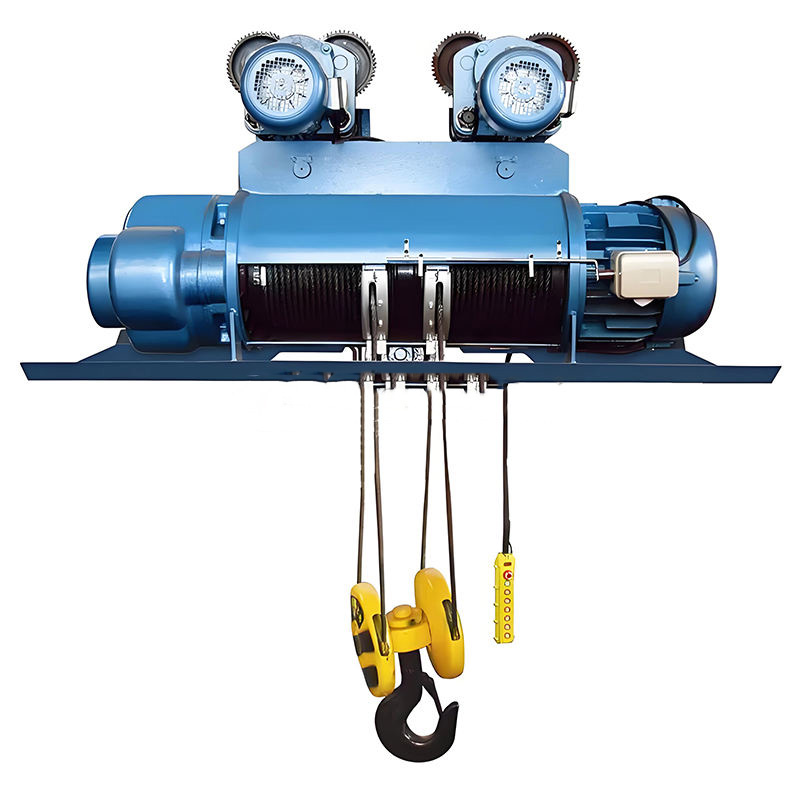
A wire rope hoist lifts with steel rope wound onto a grooved drum. It is the heavy-duty workhorse of the family.
- Capacity: commonly 1 to 80 tonnes, with larger custom units beyond.
- Lift height: long lifts are a core strength — the drum accommodates significant rope length, so lifts of tens of metres are routine.
- Duty: available in higher duty classes for frequent, heavy cycling.
- Best for: steel fabrication, heavy machining, foundries, mining, and any operation lifting several tonnes on a demanding daily cycle.
Choose wire rope when loads climb past a few tonnes, lifts are long, or the cycling is relentless. It is the standard lifting unit on double girder overhead cranes and heavy gantry cranes.
When to Choose an Electric Chain Hoist
An electric chain hoist lifts with a load chain over a pocketed sprocket, with slack chain gathering in a container below.
- Capacity: commonly 0.125 to 5 tonnes, with some models to around 10 tonnes.
- Lift height: best for shorter lifts, since chain is heavier per metre than rope.
- Duty: covers light to moderate duty comfortably.
- Best for: general manufacturing, assembly lines, workshops, maintenance bays, and warehousing.
Choose chain when loads sit in the light-to-moderate range and lifts are modest. It is lighter, cheaper, and simpler to maintain than wire rope, and its compact body fits tight, low-headroom spaces — the standard unit on single girder cranes, jib cranes, and KBK systems.
The Decision at a Glance
| Factor | Wire Rope Hoist | Electric Chain Hoist |
|---|---|---|
| Typical capacity | 1–80 t | 0.125–10 t |
| Lift height | Long | Short to moderate |
| Duty | Moderate to heavy | Light to moderate |
| Headroom | More | Compact / low |
| Cost | Higher | Lower |
| Maintenance | More involved | Simpler |
Ask yourself: Is my heaviest load (with rigging) above a few tonnes, or is my lift long? If yes, lean wire rope. If loads are light-to-moderate and lifts are short, chain is the economical, practical answer. For a full breakdown of both types and where they fit, see our electric hoist types and applications guide.
Takeaway: Wire rope for heavy, high, or high-cycle lifting; chain for lighter loads over modest heights in tighter spaces. Match the lifting medium to the load, the height, and the duty — not to the lowest quote.
VFD vs Standard Control and Why It Matters
How the hoist starts, stops, and positions the load comes down to the control type. It seems like a small line item, but it affects wear, accuracy, and load safety on every single lift.
Standard (contactor) control switches the motor between fixed speeds. It is simple, proven, and cheaper up front. The trade-off is abruptness: each start and stop jolts the load, swings it, and stresses the motor, brake, and gearing. Over thousands of cycles, that shock accelerates wear and shortens component life.
Variable frequency drive (VFD) control ramps the motor speed smoothly instead of switching it. The benefits are concrete and measurable:
- Jolt-free starts and stops that reduce shock on the hoist and the load
- Slow-speed positioning for accurate placement on the final approach
- Reduced mechanical wear on the brake, gearbox, and rope or chain — which directly extends service life and uptime
- Lower peak starting current, easing the load on your electrical supply and reducing energy spikes
Specify VFD where positioning accuracy matters, cycle rates are high, or you lift valuable, heavy, or delicate loads. The reduced wear alone often pays back the extra cost over the hoist’s life through fewer replacements and less downtime. Reserve standard control for genuinely light, occasional lifting where the precision and wear savings bring no meaningful return.
Takeaway: VFD delivers smooth, accurate, lower-wear lifting that improves both safety and equipment life; standard control is the economical choice only for light, occasional work. On production duty, VFD usually earns its cost back in reduced wear and downtime.
Environment and IP Rating Requirements
A hoist sized perfectly for the load will still fail early if it is wrong for its environment. This is one of the most overlooked lines in a specification — and one that hits mining and heavy-industry buyers hardest.
The IP rating (Ingress Protection) tells you how well the hoist’s motor and electrics resist dust and water. Match it honestly to the real conditions:
- Clean, dry indoor bay: a standard rating such as IP54 is adequate.
- Dusty, humid, or washdown areas: step up to IP55 or IP65.
- Outdoor or harsh conditions: IP66 or higher, plus corrosion-resistant finishes for the hardware.
Under-rate the enclosure and dust or moisture reaches the electrics, causing corrosion and the intermittent faults that are maddening to trace and costly to fix. In dusty mining and processing environments, a correctly rated enclosure is one of the highest-return specification decisions you can make for uptime.
When You Need an Explosion-Proof Hoist
Where flammable gases, vapors, or combustible dust may be present — coal mining, grain and flour handling, chemical plants, paint lines, oil and gas facilities — a standard electric hoist is a serious ignition risk. A single spark from a contactor or motor can trigger an explosion.
These classified hazardous areas legally require an explosion-proof hoist with spark-resistant components, sealed and flameproof enclosures, and controlled surface temperatures. The critical point for procurement: the hoist must be matched to the specific zone classification and gas or dust group of your site, per the applicable standard (such as ATEX or IECEx). A competent supplier will confirm this from your hazardous-area assessment. Confirm your area’s classification early, because it dictates the entire specification and cannot be added on later.
Takeaway: Match the IP rating and corrosion protection to the real site, and specify an explosion-proof hoist matched to the zone classification wherever the area is classified as hazardous. Getting this wrong risks corrosion, downtime, or a genuine safety incident.
How to Evaluate Electric Hoist Suppliers
Two suppliers can quote the same specification and deliver very different value. The hoist lives for years and occasionally needs support, so the company behind it matters as much as the unit itself. Judge suppliers on four things beyond price.
Certifications and Standards Compliance
A credible supplier builds to recognized standards. Look for FEM or ISO duty classification, CE and ISO 9001 quality management certification, and — where relevant — explosion-protection certification such as ATEX or IECEx. These are evidence the supplier engineers to a defined, verifiable practice, not marketing badges. For a procurement audit, documented compliance is also your proof of due diligence.
Engineering Support
The best value shows up before you buy. A strong supplier assigns engineers who assess your load, duty cycle, lift height, environment, and mounting, then match the hoist to your operation rather than pushing a catalog model. Ask whether they provide the duty and wheel-load data your crane or structural engineer will need. Thin engineering support at the quote stage reliably predicts thin support later.
Spare Parts Availability
A hoist that cannot get spares is a hoist that becomes scrap the day a part fails. Evaluate:
- Spare parts availability and typical lead time
- Component standardization — generic, sourceable parts versus locked-in proprietary ones
- Recommended spares the supplier suggests holding on site for critical wear items
Fast spare-parts access is one of the strongest levers on equipment uptime, so weigh it heavily.
Track Record
Ask for references in your industry and for hoists of similar duty, capacity, and environment. A supplier who has delivered heavy-duty or explosion-proof hoists into mining or processing understands demands a light-workshop supplier does not. Proven experience with your kind of application, plus reliable on-time delivery history, is worth more than a lower price from an untested source.
Takeaway: Judge a supplier on certifications, upfront engineering, spare-parts availability, and a relevant track record — not price alone. The company behind the hoist determines whether it stays reliable, and supported, for years.
Total Cost of Ownership vs Purchase Price
The most expensive electric hoist mistake is buying on the sticker price alone. The purchase price is only the first — and often the smallest — part of what a hoist costs over its life.
A cheap hoist often hides a lighter duty class than your work demands, generic-but-unsupported components, hard-to-source spares, and no real after-sales presence. Every one of those gaps becomes a cost later, usually as unplanned downtime.
Total cost of ownership (TCO) adds up everything the hoist costs across its service life:
- Purchase and installation: the hoist, the trolley, delivery, mounting, and commissioning
- Energy: a right-sized, efficient motor — especially with VFD — saves real money over years of daily running
- Maintenance and spares: routine service plus wear parts (rope, chain, brake linings, contactors) and their availability
- Downtime: the biggest hidden cost by far — when the hoist stops, the line or the crane it serves stops too
- Service life: a correctly classified hoist runs for many years; an under-specified one fails in a fraction of that time and needs early replacement
The real comparison is not “which hoist is cheaper to buy” but “which hoist is cheaper to own.” A hoist that costs 20% more up front but carries the right duty class, VFD control, available spares, and real support almost always wins over its life — because it avoids the downtime and early replacement that quietly drain a maintenance budget.
Here is a simple way to frame it for a purchasing decision: estimate the cost of a single day of unplanned downtime on the line the hoist serves. In most manufacturing and mining operations, one or two avoided downtime events pay for the entire difference between a cheap hoist and a properly specified one.
Takeaway: Buy on total cost of ownership, not purchase price. The cheapest hoist to buy is rarely the cheapest to own, and downtime is the cost that dwarfs all the others.
Common Electric Hoist Buying Mistakes
Even experienced buyers repeat a handful of costly errors. Knowing them upfront is the cheapest insurance in this process.
Mistake 1: Sizing on Load Alone
Forgetting the spreader beam, slings, and shackles quietly overloads the hoist on every lift, seeding early failure.
Fix: Size to the heaviest load plus all below-the-hook rigging plus a safety margin.
Mistake 2: Ignoring the Duty Class
A hoist correct for capacity but under-classified for its cycle rate overheats and fails years early — the most expensive shortcut in the whole process.
Fix: Specify the FEM or ISO class from a real estimate of your lifts per hour, typical load, and running hours.
Mistake 3: Underestimating the Lift Height
Choosing a chain hoist for a long lift, or a drum too small for the height needed, forces a costly change after installation.
Fix: Measure the true lift height and match the hoist type and drum to it.
Mistake 4: Overlooking the Environment
Fitting a standard hoist in a dusty, wet, or flammable area invites corrosion, faults, or an ignition risk.
Fix: Match the IP rating and corrosion protection to the site, and specify explosion-proof where the area is classified.
Mistake 5: Missing the Power Supply
Specifying a three-phase hoist for a single-phase site — or the reverse — stalls the installation entirely.
Fix: Confirm the available voltage, phase, and frequency before ordering.
Mistake 6: Buying on Price Alone
The lowest quote wins, and the hidden gaps — light duty, thin support, hard-to-source spares — surface as downtime and early failure.
Fix: Evaluate on total cost of ownership and supplier strength, not the sticker price.
Mistake 7: Writing a Vague Specification
An incomplete specification produces quotes that cannot be compared, because each supplier fills the gaps differently.
Fix: Write a complete specification — capacity with rigging, lift height, duty class, hoist type, trolley, environment, and power — so every quote answers the same question.
Takeaway: Almost every buying mistake traces back to forgotten rigging, an ignored duty class, an overlooked environment, or a price-first decision. Close those gaps and you avoid the errors that cost the most.
Frequently Asked Questions
Q: How do I calculate the right electric hoist capacity?
Start with your heaviest single load, then add the weight of everything below the hook — the spreader beam or lifting frame, magnet or grab, slings, and shackles — plus a safety margin. That total, not the bare load, is your required rated capacity. If your loads may grow, size up now, because a hoist selected at the very top of its range leaves no headroom. Forgotten rigging weight is the most common reason a hoist ends up quietly overloaded on every lift, which shortens its life and puts loads at risk.
Q: Why is duty class more important than capacity when buying a hoist?
Capacity tells you how heavy a single lift can be; duty class tells you how many lifts the hoist survives over its life. Two hoists with identical capacity but different duty classes are built to completely different internal standards and priced accordingly. Under-classifying causes the motor and brake to overheat and fail early, often within a year or two of heavy use, directly hurting your equipment uptime. Over-classifying means paying for durability you never use. Specify the FEM or ISO class from a real estimate of your lifts per hour, typical load, and daily running hours.
Q: Should I buy a wire rope or an electric chain hoist?
Choose a wire rope hoist for heavier loads (commonly 1 to 80 tonnes), long lifts, and frequent, heavy cycling, since the drum handles long lift heights and hard duty better. Choose an electric chain hoist for lighter loads (commonly 0.125 to 5 tonnes) over shorter heights, where its compact, economical, low-headroom design fits best. As a quick rule: if your heaviest load with rigging climbs past a few tonnes or your lift is long, lean wire rope; if loads are light-to-moderate and lifts are short, chain is the practical, lower-cost answer.
Q: Is VFD control worth the extra cost on an electric hoist?
For most production applications, yes. VFD control delivers jolt-free starts and stops, slow-speed positioning for accurate placement, reduced wear on the brake and gearing, and lower peak starting current. The reduced mechanical wear alone often pays back the extra cost over the hoist’s life through fewer part replacements and less downtime, while the smoother motion improves both load safety and positioning accuracy. Standard contactor control remains a reasonable, economical choice only for genuinely light, occasional lifting where the precision and wear savings bring no meaningful return.
Q: What IP rating does my electric hoist need?
Match the IP rating to the real site. A clean, dry indoor bay is usually fine with a standard rating such as IP54. Dusty, humid, or washdown areas call for IP55 or IP65, and outdoor or harsh conditions need IP66 or higher plus corrosion-resistant finishes. Under-rating the enclosure lets dust and moisture reach the electrics, causing corrosion and intermittent faults that hurt uptime. Where flammable gases, vapors, or combustible dust may be present, the area is classified as hazardous and legally requires an explosion-proof hoist matched to the zone.
Q: When do I need an explosion-proof electric hoist?
You need an explosion-proof hoist whenever it will operate where flammable gases, vapors, or combustible dust may be present — such as coal mining, grain and flour handling, chemical plants, paint lines, and oil and gas facilities. In these classified hazardous areas, a standard hoist is a serious ignition risk because a single spark can trigger an explosion. An explosion-proof hoist uses spark-resistant components and sealed, flameproof enclosures, and it must be matched to the specific zone classification and gas or dust group of your site, confirmed from your hazardous-area assessment.
Q: How do I evaluate an electric hoist supplier?
Look beyond price at four things. First, certifications and standards compliance — FEM or ISO duty classification, CE and ISO 9001, and explosion-protection certification where relevant. Second, upfront engineering support that matches the hoist to your load, duty, and environment. Third, spare parts availability and lead time, since fast access to spares is one of the strongest levers on uptime. Fourth, a relevant track record with hoists of similar duty, capacity, and environment, plus a reliable on-time delivery history. The company behind the hoist determines whether it stays reliable and supported for years.
Q: Why does total cost of ownership matter more than purchase price?
Because the purchase price is often the smallest part of what a hoist costs over its life. Total cost of ownership adds installation, energy, maintenance, spare parts, and — above all — downtime, which is the biggest hidden cost when a stopped hoist halts the line or crane it serves. A correctly specified, well-supported hoist that costs more up front usually wins over its service life by avoiding the failures and early replacement that plague a cheap, under-specified unit. A useful test: estimate the cost of one day of unplanned downtime, and you will often find one or two avoided events cover the entire price difference.