


Electric Hoist Types and Selection Guide: Choosing the Right Electric Hoist for Your Facility
TL;DR: Electric hoists come in four main types—wire rope, chain, low-headroom, and explosion-proof—each built for a different mix of capacity, lift height, headroom, and environment. Chain hoists suit lighter loads and shorter lifts at lower cost. Wire rope hoists handle heavier capacities and longer lifts with smoother control. Low-headroom variants recover valuable hook height in tight buildings, and explosion-proof models are mandatory in hazardous atmospheres. Choosing the right one means matching load, duty cycle, lift height, headroom, environment, and mounting type to how your facility actually works—before you buy.
Pick the wrong electric hoist and the cost follows you for years. An undersized chain hoist on a high-cycle production line burns out fast and stalls the whole station. An oversized wire rope hoist in a light assembly cell wastes capital and headroom you never needed. A standard hoist installed in a paint booth or grain facility is not just inefficient—it is a genuine safety hazard.
For procurement managers and facility owners, the hoist is a small component that carries an outsized share of your lifting risk and cost. Yet the decision often gets made on price alone, with little thought to duty cycle, lift height, or the environment the hoist will work in.
This guide fixes that. You will learn what an electric hoist is, how it differs from a manual one, the four main types and their practical ranges, and a clear selection framework that resolves the key factors in order. By the end, you will know exactly how to match the right hoist to your loads, your building, and your operation.
What Is an Electric Hoist?
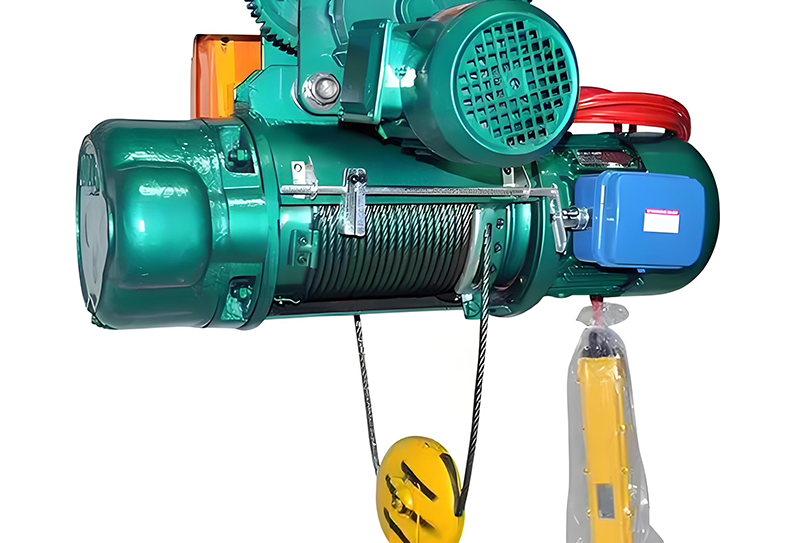
An electric hoist is a powered lifting device that raises and lowers loads using an electric motor, a gearbox, and either a wire rope wound on a drum or a load chain running over a sprocket. The operator controls it from a pendant, a wireless remote, or an integrated crane control—no manual cranking or pulling required.
The hoist is the working heart of most lifting systems. Mount it on a fixed hook or lug for point lifting, on a trolley for travel along a beam, or as the lifting unit on an overhead crane, gantry crane, jib crane, or KBK system. Whatever the structure above it, the hoist is what actually does the lifting.
Inside a typical electric hoist you will find the motor, a reduction gearbox, a brake that holds the load when power stops, the drum or sprocket that spools the rope or chain, and limit switches that stop travel at the top and bottom of the lift. Together these deliver controlled, repeatable lifting cycle after cycle.
How an Electric Hoist Differs From a Manual Hoist
Manual hoists—hand chain blocks and lever hoists—lift by human effort. They are cheap, portable, and need no power supply, which makes them ideal for occasional lifts, remote locations, and light maintenance work. But they are slow, physically demanding, and impractical for anything frequent or heavy.
Electric hoists change the equation the moment lifting becomes routine:
- Speed and productivity. An electric hoist lifts far faster than a hand chain block, cutting cycle times and keeping a busy line moving.
- Reduced operator strain. Powered lifting removes the physical effort, cutting fatigue and lowering the risk of manual-handling injury.
- Higher capacity, taller lifts. Electric hoists handle heavier loads and longer lift heights than manual units can practically manage.
- Precise, repeatable control. Variable-speed models place loads accurately and gently, protecting parts and equipment.
- Duty-cycle capability. Built to a rated duty class, an electric hoist sustains frequent cycling that would exhaust an operator using a manual block.
Takeaway: Manual hoists suit occasional, light, off-grid lifting. The moment lifting becomes frequent, heavy, or tall, an electric hoist pays back fast in speed, safety, and reliability.
The 4 Main Types of Electric Hoists
Electric hoists split into four main types, each built around a different lifting medium, capacity range, or operating condition. Matching the type to the job is the first real decision.
1. Electric Wire Rope Hoist
A wire rope hoist lifts using steel wire rope wound onto a grooved drum. The drum design gives smooth, controlled spooling and suits heavier loads and taller lifts.
Structural profile: Motor, gearbox, and grooved drum in a compact housing, with wire rope feeding over a sheave to the hook block.
Practical capacity: Commonly 1 to 80 tonnes, with larger custom builds beyond that for heavy crane duty.
Practical lift height: Long lifts are a core strength—commonly 6 to 30 metres and beyond, since the drum spools a long rope neatly.
Ideal use cases: Overhead and gantry cranes, heavy fabrication, steel handling, and any application combining heavy loads with tall lifts and frequent cycling.
Key advantage: Higher capacity, longer lift height, and smooth control. The drum-and-rope design carries heavier loads over greater heights than a chain hoist, and handles high duty cycles well. It is the standard choice for medium-to-heavy crane duty.
2. Electric Chain Hoist
A chain hoist lifts using a load chain that runs over a pocketed sprocket (the lift wheel), with the slack chain collected in a container below.
Structural profile: Motor, gearbox, sprocket, and a chain container, in a light, compact unit.
Practical capacity: Commonly 125 kg to 5 tonnes, with some models reaching around 10 tonnes.
Practical lift height: Best suited to shorter lifts—commonly up to 6 to 10 metres, since a long load chain becomes heavy and the chain container grows large.
Ideal use cases: Light-to-medium workstations, assembly cells, jib cranes, KBK systems, and maintenance bays where loads are moderate and lifts are short.
Key advantage: Low cost, light weight, and simple maintenance. For lighter loads over shorter lifts, a chain hoist is the most economical choice, and its compact size fits neatly onto jib and workstation cranes.
3. Low-Headroom Electric Hoist
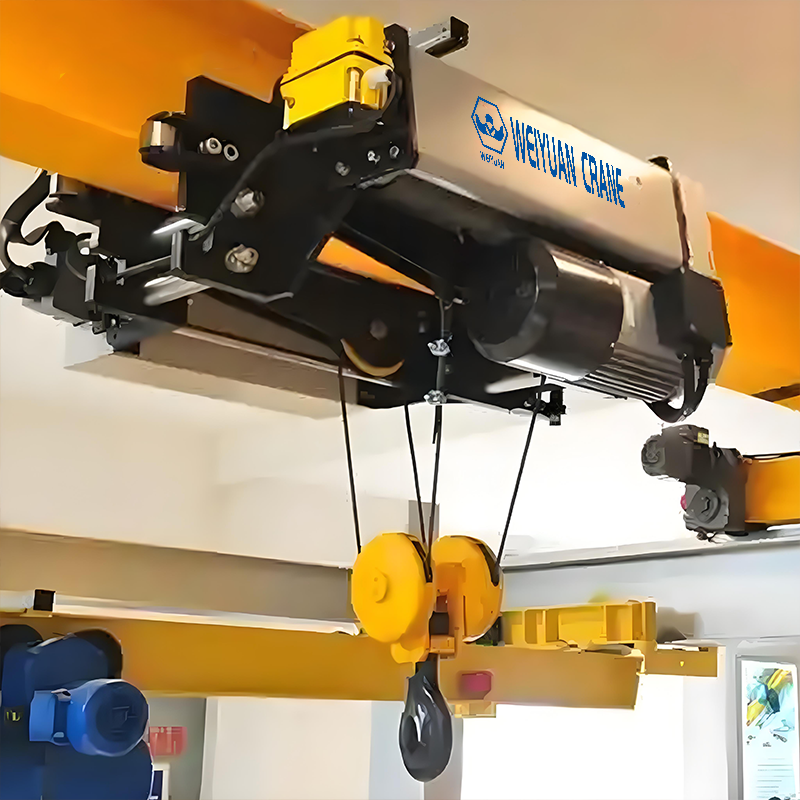
A low-headroom hoist is a wire rope or chain hoist built into a compact trolley that positions the hook block as close as possible to the beam it runs on. The design minimizes the space “lost” between the beam and the hook.
Structural profile: Hoist and trolley integrated into a single low-profile unit, with the hook block tucked up close to the running beam.
Practical capacity: Spans the light-to-heavy range, matching the wire rope or chain hoist it is built from—commonly 1 to 50 tonnes.
Practical lift height: The key benefit is recovered hook height. In a fixed building clear height, a low-headroom design gains lift height a standard hoist cannot.
Ideal use cases: Buildings with limited clearance, retrofits into existing structures, and any bay where maximum hook height must be squeezed from a fixed roof height.
Key advantage: Maximum hook height in tight buildings. Where clear height is the binding constraint, a low-headroom hoist recovers valuable lift that a standard configuration would waste—often the difference between a crane fitting a building or not.
4. Explosion-Proof Electric Hoist
An explosion-proof hoist is engineered so its motor, controls, and electrical components cannot ignite a surrounding flammable atmosphere. Enclosures, sealing, and spark-suppressing design meet the required hazardous-area rating.
Structural profile: A wire rope or chain hoist built with flameproof or increased-safety enclosures, sealed connections, and non-sparking components rated to the relevant zone.
Practical capacity: Matches the underlying hoist type—commonly 125 kg to 50 tonnes depending on wire rope or chain construction.
Practical lift height: Follows the base hoist type—shorter for chain, longer for wire rope.
Ideal use cases: Paint and coating facilities, chemical and petrochemical plants, oil and gas sites, grain and dust-prone environments, and any location with a classified hazardous atmosphere.
Key advantage: Safe operation in explosive atmospheres. In a classified area, an explosion-proof hoist is not an upgrade—it is a legal and safety requirement. Standard hoists must never be used where flammable gas, vapor, or dust may be present.
Takeaway: Start from the job—weight, lift height, headroom, and atmosphere point you straight to the right hoist type before you look at any single spec.
Practical Capacity and Lift Height Ranges
Knowing where each type sits keeps your selection realistic. Use these ranges as a starting frame, then confirm the exact model against your load and lift.
- Chain hoist: roughly 125 kg to 5 tonnes (some to 10 tonnes), lifts up to about 6 to 10 metres. Best for light loads over short lifts.
- Wire rope hoist: roughly 1 to 80 tonnes, lifts commonly 6 to 30 metres and beyond. Best for heavier loads and taller lifts.
- Low-headroom (either medium): matches the base hoist capacity, chosen specifically to recover hook height in tight buildings.
- Explosion-proof (either medium): matches the base hoist capacity and lift height, chosen for hazardous atmospheres.
Where chain and wire rope overlap—around 1 to 5 tonnes—the decision usually comes down to lift height, duty cycle, and cost. Short lifts and tight budgets favor chain; taller lifts and heavier cycling favor wire rope.
Takeaway: Size the hoist to your combined load and lift height together, not to capacity alone—a hoist rated for the weight but short on lift height will not do the job.
Key Structural and Mechanical Differences
Beyond type, a few mechanical factors shape how well a hoist suits your operation. These are the details worth confirming before you commit.
Lifting Medium: Rope vs Chain
Wire rope spools onto a drum and suits long, heavy, high-cycle lifting with smooth control. Load chain runs over a sprocket and suits shorter, lighter lifts at lower cost. The medium sets the practical capacity and lift height ceiling for the whole unit.
Duty Classification (FEM/ISO)
Every electric hoist carries a duty rating (such as FEM or ISO groups) that defines how much load, how often, and for how many cycles it can sustain over its life. A hoist under-rated for your cycle rate wears out early; one over-rated adds cost you do not need. Matching the duty class to your real usage is one of the most important—and most overlooked—decisions.
Lifting Speed and Control
Single-speed hoists lift at one fixed rate. Dual-speed and variable-frequency-drive (VFD) hoists add a slow speed for precise, gentle load placement. Precision applications benefit strongly from VFD control, which delivers jolt-free starts, stops, and positioning.
Mounting and Trolley Configuration
A hoist can be fixed (hook or lug suspension) for point lifting, or mounted on a manual or motorized trolley for travel along a beam. Low-headroom trolleys integrate the hoist to save clearance. The mounting type must match your structure and your coverage needs.
Takeaway: Two hoists with the same capacity can perform very differently—duty class, control type, and mounting decide whether the hoist truly fits your work.
How to Select the Right Electric Hoist
The right hoist emerges when you resolve a handful of factors in order. Work through these before committing to any model.
1. Load capacity and duty cycle
Start with your heaviest lift, then add the weight of any lifting device, spreader, or rigging, plus a sensible safety margin. Next, factor in frequency. A hoist cycling heavy loads all shift needs a higher duty classification than one making occasional lifts. Under-rating the duty class is the fastest route to premature failure.
2. Lift height
Measure the exact vertical distance the hook must travel, from lowest to highest position. Tall lifts favor wire rope hoists, which spool long rope neatly on the drum. Short lifts open up the lighter, cheaper chain option. Always confirm the model’s rated lift height covers your requirement with margin.
3. Headroom and clearance
Measure your building’s clear height and the space available between the running beam and the load. Where clearance is tight and every centimetre of hook height matters, a low-headroom hoist recovers lift a standard configuration would waste. Calculate available hook height from the actual hoist and trolley dimensions—not a rule of thumb.
4. Operating environment
Assess the atmosphere and conditions. A classified hazardous area—flammable gas, vapor, or dust—demands an explosion-proof hoist by law. Outdoor, humid, or corrosive settings need appropriate ingress protection and coatings. Dusty or dirty environments call for sealed components. Specify the protection your site actually requires.
5. Mounting type
Decide how the hoist connects to your structure. A fixed hook or lug suits point lifting at one position. A trolley—manual or motorized—suits travel along a beam. Match the mounting to your crane or beam and to how far the load must move.
6. Total cost of ownership
Look past the purchase price to installation, power supply, spare parts, maintenance, and expected service life. A chain hoist wins on upfront cost for light duty, but a wire rope hoist rated correctly for heavy cycling often costs less over its life through longer service and fewer failures. Under-specifying to save today usually costs more tomorrow.
Selection framework at a glance:
- Light load, short lift, tight budget → electric chain hoist
- Heavier load, taller lift, frequent cycling → electric wire rope hoist
- Limited building clear height → low-headroom hoist
- Classified hazardous atmosphere → explosion-proof hoist (non-negotiable)
Frequently Asked Questions
Q: What is the difference between a wire rope hoist and a chain hoist?
A wire rope hoist lifts using steel rope wound on a grooved drum, handling heavier loads (commonly 1 to 80 tonnes) over longer lift heights with smooth control. A chain hoist lifts using a load chain over a sprocket, suiting lighter loads (commonly 125 kg to 5 tonnes) over shorter lifts at lower cost. Choose wire rope for heavy, tall, high-cycle lifting and chain for light, short, budget-conscious applications.
Q: How do I choose the right electric hoist capacity?
Start with your heaviest single load, then add the weight of any spreader, lifting frame, or rigging, plus a safety margin. Factor in how often you lift at or near that maximum, since frequent heavy cycling requires a higher duty classification. Always confirm both the rated capacity and the rated lift height cover your requirement with margin to spare.
Q: What is a low-headroom electric hoist and when do I need one?
A low-headroom hoist integrates the hoist and trolley into a compact unit that positions the hook block close to the running beam, recovering hook height a standard hoist would lose. You need one when your building’s clear height is limited and you must squeeze maximum lift height from a fixed roof height—common in retrofits and older, height-constrained facilities.
Q: When is an explosion-proof electric hoist required?
An explosion-proof hoist is required in any classified hazardous area where flammable gas, vapor, or combustible dust may be present—paint booths, chemical and petrochemical plants, oil and gas sites, and grain or dust-prone facilities. In these locations it is a legal and safety requirement, not an option. A standard hoist must never be used where an explosive atmosphere can form.
Q: What does the duty classification of an electric hoist mean?
The duty classification (such as an FEM or ISO group) defines how much load, how often, and how many cycles a hoist can sustain over its service life. It reflects your real usage intensity. A hoist under-rated for your cycle rate wears out early, while an over-rated one adds unnecessary cost. Matching the duty class to your actual operation is essential for reliable, long-term performance.
Q: Can one electric hoist be used on different crane types?
Yes. The same electric hoist can serve as the lifting unit on overhead cranes, gantry cranes, jib cranes, and KBK systems, provided its capacity, lift height, duty class, and mounting suit that structure. Chain hoists commonly fit jib and workstation cranes, while wire rope hoists suit medium-to-heavy overhead and gantry duty. Always confirm the mounting and duty class match the crane and application.