


Electric Wire Rope Hoist vs. Electric Chain Hoist: Comprehensive Selection, Duty Cycle & Application Guide
Introduction
Selecting the correct electric hoist is one of the most critical machinery decisions for plant engineers, facility managers, and crane builders. The choice between an Electric Wire Rope Hoist and an Electric Chain Hoist directly impacts capital expenditure, structural building requirements, production throughput, and long-term maintenance costs.
While both hoist types perform the fundamental task of lifting loads vertically, they rely on distinctly different mechanical designs, load distribution physics, and duty cycle capabilities. Misapplying a chain hoist in a heavy, high-speed steel mill environment will result in premature chain wear and thermal tripping. Conversely, over-specifying a heavy wire rope hoist for a lightweight workstation assembly bay inflates capital costs unnecessarily and overburdens light support structures.
This engineering guide provides an unbiased, technical comparison between electric wire rope hoists and electric chain hoists, covering mechanical architecture, duty cycles (FEM/ISO/CMAA), lifting height physics, and total cost of ownership.
Part 1: Structural & Mechanical Differences
Electric Wire Rope Hoist Mechanism
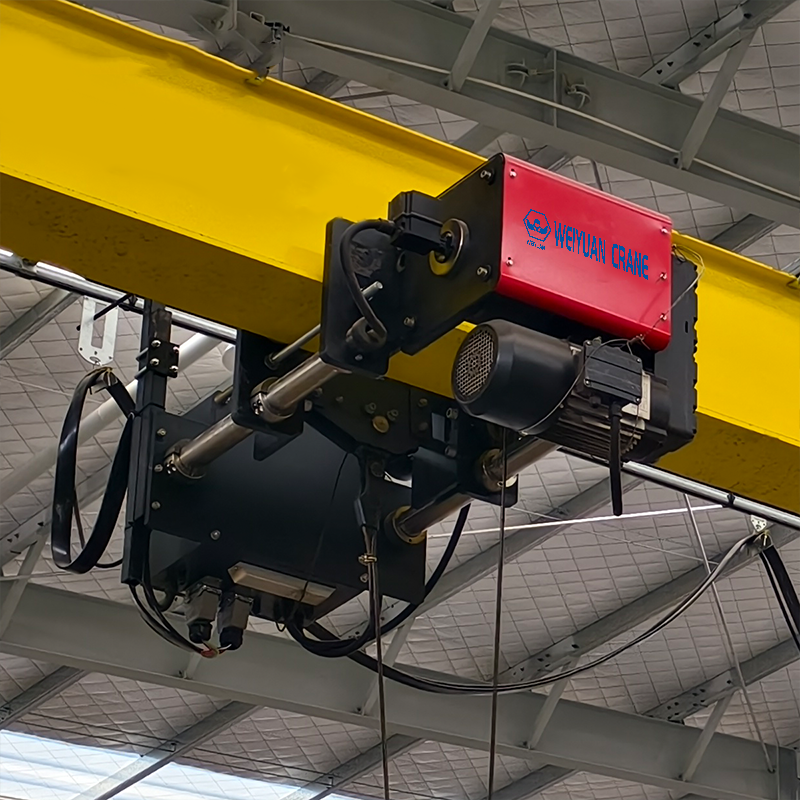
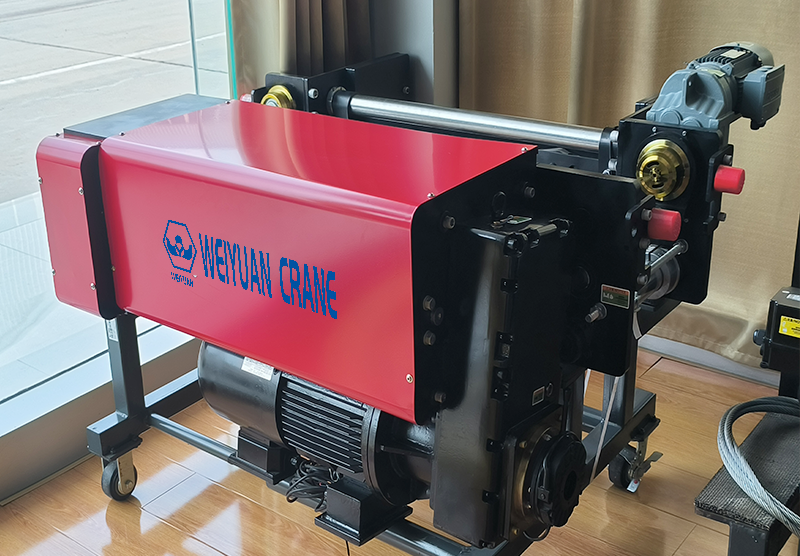
An electric wire rope hoist utilizes a grooved cylindrical drum around which a flexible steel wire rope is wound in single or multiple layers. Key mechanical features include:
- True Vertical Lift (Double Reeved): Wire rope hoists can be configured with double-grooved drums where two ends of the rope wind simultaneously, ensuring the hook block moves strictly vertically without lateral displacement.
- Enclosed Gearboxes & Winch Drums: Designed for higher tonnage and longer reeving lengths, utilizing planetary or helical gear reducers bathed in oil.
- Smooth, High-Speed Operation: Wire rope moves quietly through drum grooves and over large sheaves, allowing linear lifting speeds up to 12 m/min or higher.
Electric Chain Hoist Mechanism
An electric chain hoist relies on a pocketed drive wheel (sprocket) that engages calibrated high-tensile alloy steel chain links. Key mechanical features include:
- Compact Vertical Footprint: The chain falls vertically into a flexible fabric or plastic chain container, requiring minimal headroom and zero drum housing width.
- Hook Drift / Polygon Effect: As chain links engage the teeth of the pocket wheel, minor chordal speed variations (the polygon effect) occur, causing subtle micro-vibrations at high speeds.
- Modular Construction: Highly compact motor, gearbox, and brake housing, making it lightweight and easy to mount on jib cranes, gantry frames, or monorails.
Part 2: Duty Cycle Ratings — FEM / ISO / CMAA Comparison
Duty cycle capability determines how long and how frequently a hoist can operate under load without thermal or mechanical failure.
| Parameter / Standard | Electric Chain Hoist | Electric Wire Rope Hoist |
|---|---|---|
| Typical Tonnage Range | 0.25t to 5t (Max up to 10t–20t) | 2t to 100t+ (Customizable to 500t) |
| FEM Duty Rating | 1Am (M4) to 2m (M5) | 2m (M5) to 4m (M8) |
| CMAA Class | Class A, B, C (Light to Medium Duty) | Class C, D, E, F (Heavy to Severe Duty) |
| Starts per Hour (Starts/h) | 120 to 240 starts/hour | 240 to 600+ starts/hour |
| Max Lifting Height | Typically 3m to 12m (Chain weight accumulates) | 6m to 100m+ (Wire rope stays on drum) |
Part 3: Lifting Height, Speed & Precision Comparison
The Weight-Height Constraint
In an electric chain hoist, as lifting height increases, the suspended weight of the extra steel chain hangs directly from the sprocket. For extremely high lifts (e.g., 30 meters), the weight of a multi-fall chain consumes a significant portion of the hoist’s rated lifting capacity.
In contrast, a wire rope hoist stores the rope on the drum body. Increasing lifting height merely requires a longer drum or multi-layer spooling, leaving the rated hook capacity unaffected by lift height.
Speed and Positioning Accuracy
- Wire Rope Hoists: Superior for high-speed, long-distance lifts. When equipped with Variable Frequency Drives (VFDs), they achieve smooth, vibration-free positioning suitable for delicate assembly work.
- Chain Hoists: Excellent for short-stroke, high-frequency workstation lifting (e.g., loading CNC machines). However, at high lifting speeds over long distances, chain link articulation generates noise and polygon vibration.
Part 4: Environment & Application Suitability
Ideal Applications for Electric Chain Hoists
- Localized Workstations & Jib Cranes: Perfect for 250kg to 2,000kg repetitive lifting at assembly stations.
- Low-Headroom Industrial Workshops: Compact body profiles maximize vertical hook travel in low-ceiling buildings.
- Portable & Temporary Construction: Lightweight design allows easy movement between job sites.
- Harsh Cleanrooms & Food Processing: Available with stainless steel chains and food-grade lubricants where rope grease splatter cannot be tolerated.
Ideal Applications for Electric Wire Rope Hoists
- Heavy Manufacturing & Steel Mills: Built for 5t to 100t+ heavy billet, coil, and machinery handling under CMAA Class D/E service.
- High-Bay Double Girder Overhead Cranes: Operates as a heavy crab trolley running on top of bridge girders.
- High-Height Infrastructure Projects: Dam gates, power plant turbine halls, and deep shaft lifting.
- Foundry & High-Temperature Environments: Wire rope withstands ambient radiant heat better than alloy chain links subject to thermal fatigue.
Part 5: Total Cost of Ownership (TCO) & Maintenance
Initial Capital Expenditure (CAPEX)
- Below 5 Tons: Electric chain hoists offer a significantly lower initial purchase price (up to 30%–50% cheaper than a comparable wire rope hoist).
- Above 10 Tons: Wire rope hoists become more cost-effective due to structural efficiency and safety margins required for heavy tonnage.
Maintenance and Wear Components (OPEX)
- Chain Replacement: Chain wear is easy to inspect using a pitch gauge. Chain replacement is fast and low-cost.
- Rope & Guide Replacement: Wire rope hoists require periodic replacement of the wire rope guide and wire rope. While individual rope costs are higher, the service life under heavy duty cycles is significantly longer.
Frequently Asked Questions
Q: Can an electric chain hoist be used on a double girder overhead crane?
A: Yes, small capacity double-girder trolleys can mount chain hoists. However, for capacities above 5 tons or heavy CMAA Class D service, double-girder wire rope winch trolleys are industry standard.
Q: Why does wire rope require lubrication while some chains run dry?
A: Steel wire rope contains hundreds of individual wires sliding against each other during bending, requiring continuous internal lubrication. Hoist chains engage drive sprockets and require external lubrication to prevent link-on-link friction wear.