


Explosion-Proof Jib Crane Guide: Hazardous Location Specifications (ATEX / IECEx)
Introduction
In hazardous operating environments—such as chemical processing plants, oil refineries, pharmaceutical synthesis bays, and grain handling facilities—localized lifting tasks frequently take place near flammable gases or combustible dusts. A standard industrial jib crane used for machine loading or local component positioning presents immediate ignition risks. Friction sparks from trolley wheels, static electricity discharge along the hoisting medium, or arc sparks from unsealed switches can trigger catastrophic explosions.
Deploying a standard jib crane in a classified hazardous zone violates international safety standards and compromises plant integrity. Electrical enclosures admit explosive gas mixtures, standard forged hooks spark upon accidental impact with steel fixtures, and motor surface temperatures can easily exceed the auto-ignition threshold of surrounding vapors.
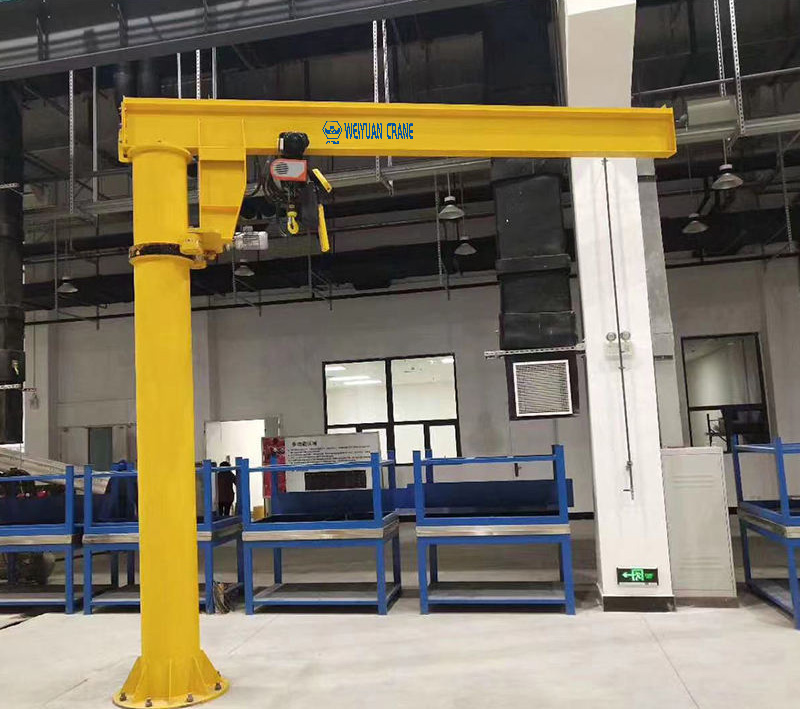
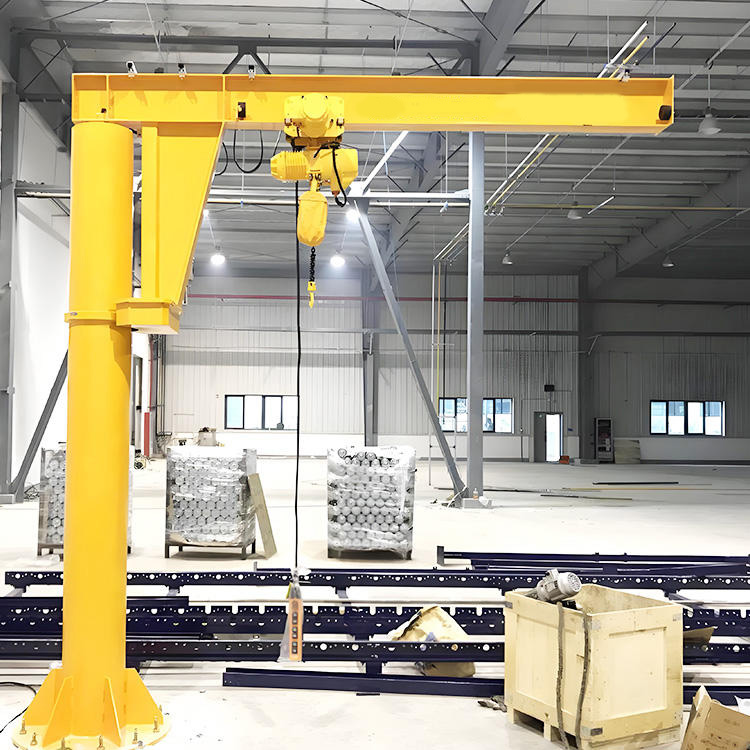
Explosion-proof jib cranes (both pillar-mounted freestanding and wall-mounted variants) are engineered ground-up to eliminate electrical, thermal, and mechanical ignition sources. Every sub-assembly—from explosion-proof slewing drives and flameproof hoist motors to solid bronze hook assemblies—is certified under international ATEX and IECEx directives.
This guide provides the complete specification framework for explosion-proof jib cranes operating in hazardous industrial environments.
Part 1: Hazardous Area Classifications (Gases & Dusts)
Category 1: Flammable Gas & Vapor Environments (Zone 1 and Zone 2)
Chemical, petrochemical, and paint manufacturing facilities classify lifting zones based on the frequency of explosive atmospheres:
- Zone 1 (Category 2G): Areas where an explosive gas-air mixture is likely to occur during normal daily operation (e.g., reactor loading ports, mixing vessel bays, solvent handling stations). Jib cranes in Zone 1 require high-integrity protection, including Ex d (flameproof) or Ex e (increased safety) construction for all electrical components.
- Zone 2 (Category 3G): Areas where explosive gas mixtures are unlikely under normal operation and persist only for short periods (e.g., drum storage warehouses, secondary chemical transfer lines). Non-sparking (Ex nA) electrical protection represents the minimum technical baseline.
Category 2: Combustible Dust Environments (Zone 21 and Zone 22)
Grain processing, sugar milling, flour handling, and metal powder sintering facilities present severe dust explosion risks:
- Zone 21 (Category 2D): Areas where combustible dust clouds occur frequently during normal material handling. Enclosures require IP6X dust-tight ratings (Ex tb) to prevent microscopic dust ingress.
- Zone 22 (Category 3D): Areas where combustible dust clouds are infrequent and short-lived. Minimum IP5X ingress protection is required to prevent dust accumulation on warm surfaces.
Part 2: Non-Sparking Mechanical Features (Spark-Proof Protection)
Preventing Mechanical Ignition Risks
Electrical certification alone does not make a jib crane explosion-proof. Physical friction, impact during slewing, or trolley movement along the cantilever boom can produce thermal sparks capable of igniting gas clouds.
Mechanical Protection Specifications
- Bronze-Plated or Solid Bronze Hooks: Crane hooks frequently make contact with rigging equipment. Standard steel hooks must feature solid bronze plating (copper-beryllium or aluminum-bronze alloy) with a minimum 3 mm thickness to guarantee spark-free impact.
- Solid Bronze Trolley Wheels & Guide Rollers: Trolley wheels running on the jib boom flange generate friction sparks during lateral flange contact. Wheels must be manufactured from solid bronze or feature press-fitted bronze tires over ductile iron cores.
- Stainless Steel Wire Rope or Spark-Proof Chain: Hoisting media running over sheaves generate friction. For Zone 1 applications, wire ropes must be grade 316 stainless steel, or hoists must utilize copper-plated / nickel-plated stainless load chains.
- Bronze Slewing Stop Bumpers: Physical rotation stops on the pillar or wall-mounting bracket must feature brass or non-sparking rubber bumpers to absorb slewing impacts safely.
Part 3: Electrical & Thermal Protection (ATEX / IECEx)
Complete Electrical Sub-System Specifications
All electrical equipment mounted on the jib boom and pillar must be certified for the applicable Gas Group (IIA, IIB, IIC) and Temperature Class (T1 through T6).
- Hoist & Slewing Motors: Ex d IIB/IIC T4 Gb — Flameproof enclosure designed to contain any internal explosion without igniting the external atmosphere. Temperature Class T4 ensures maximum external surface temperatures remain strictly below 135°C.
- Enclosed Power Supply Systems: C-track festoon systems or energy chains must utilize anti-static, flame-retardant cables with Ex e certified junction boxes and cable glands.
- Intrinsically Safe Pendant Control: Ex i (Intrinsically Safe) push-button pendants operating at low voltage (24V DC) and current levels incapable of generating sufficient energy to ignite surrounding gases.
- Equipotential Bonding & Static Grounding: Flexible copper grounding straps bridging the boom-to-pillar pivot, trolley-to-boom interface, and pillar-to-earth ground to discharge static electricity continuously.
Part 4: Technical Specification Comparison Matrix
| Feature / Requirement | Standard Industrial Jib Crane | Zone 2 / Zone 22 Jib Crane | Zone 1 / Zone 21 Explosion-Proof Jib Crane |
|---|---|---|---|
| Zone Classification | Safe / Non-Hazardous | Zone 2 (Gas) / Zone 22 (Dust) | Zone 1 (Gas) / Zone 21 (Dust) |
| Enclosure Rating | IP54 / Standard | Ex nA / Ex tc (IP65 Minimum) | Ex d / Ex e / Ex tb (IP66 Minimum) |
| Hook Construction | Forged Alloy Steel | Standard Steel with Brass Latch | Solid Bronze or Heavy Bronze Plated |
| Trolley Wheels | Cast Iron / Steel | Steel with Brass Bumpers | Solid Bronze or Heavy Bronze-Tired |
| Surface Temp Limit | Unrestricted | T3 (200°C) Maximum | T4 (135°C) or T5 (100°C) Maximum |
| Slewing Stop | Steel Stop Plate | Steel with Rubber Pad | Brass / Non-Sparking Bronze Buffer |
Part 5: 2026 Price Reference
Explosion-proof jib cranes require specialized non-sparking alloys, certified electrical components, and rigorous system-level ATEX/IECEx compliance testing:
- Zone 2 Pillar Jib Crane (1-tonne, 4m arm reach): $8,500 to $16,000
- Zone 1 Pillar Explosion-Proof Jib Crane (1-tonne, 4m arm reach): $18,000 to $34,000
- Zone 1 Wall-Mounted Explosion-Proof Jib Crane (2-tonne, 5m arm reach): $22,000 to $42,000
- Zone 1 Motorized Slewing Heavy Jib Crane (5-tonne, 6m arm reach): $45,000 to $95,000
Frequently Asked Questions
Q: Can I retrofit an existing standard jib crane for Zone 1 use by installing an explosion-proof electric hoist?
A: No. Explosion-proof certification covers the entire crane assembly. Replacing only the hoist leaves the trolley wheels, slewing pivot bearings, boom stops, and grounding systems non-compliant, leaving severe spark risks unmitigated.
Q: What is the difference between manual and motorized slewing in ATEX zones?
A: Manual slewing is common for capacities under 2 tonnes. However, the slewing action must still feature non-sparking bronze pivot bushings and static grounding straps. Motorized slewing requires an Ex d flameproof gearmotor with an integrated explosion-proof brake.
Q: How frequently must an explosion-proof jib crane undergo safety re-certification?
A: Under IEC 60079-17, explosion-proof lifting equipment requires a visual inspection every 6 months and a detailed physical/electrical inspection at least every 3 years to verify flamepath tolerances, earthing continuity, and bronze coating integrity.