


Gantry Crane Applications: Industry Use Cases and Selection Guide
Introduction
A gantry crane in a shipyard and a gantry crane in a container terminal share the same basic idea — a bridge girder carried on freestanding legs — yet almost nothing else about them matches. One lifts a 500-tonne hull block once a week. The other stacks containers around the clock in fast, repetitive cycles.
That difference matters for anyone making a purchase decision. Buy a crane built for one industry’s demands and force it into another, and you inherit the wrong capacity, the wrong duty cycle, and the wrong operating cost. Matching the machine to the sector is where smart procurement begins.
This guide walks through how six major industries use gantry cranes — manufacturing, shipbuilding, ports and container terminals, construction, energy and power plants, and mining. For each, you will see the typical load types, the performance factors that matter most, and the specification choices that follow. By the end, you will have a clear framework for aligning a gantry crane to the real demands of your sector.
Why Different Industries Choose Gantry Cranes
Gantry cranes earn their place across so many sectors for one core reason: structural independence. The load travels on freestanding legs running ground-level rails or wheels, so the building never has to carry runway loads. That single feature unlocks outdoor yards, open workshops, and heavy-capacity applications that overhead cranes cannot serve.
But the reasons each industry chooses a gantry differ:
- Capacity without a supporting structure — shipyards and heavy fabrication need hundreds of tonnes of lift over open ground where no building could bear the load.
- Outdoor operation — ports, construction sites, and storage yards need equipment built for weather, distance, and open-air handling.
- High-throughput repetition — container terminals need cranes that repeat the same cycle thousands of times with speed and precision.
- Mobility across a site — mining and construction need lifting capacity that can reposition as the work moves.
In short: every sector values a gantry for a different mix of capacity, mobility, environment, and cycle rate. Getting the specification right means starting from those priorities, not from the crane catalog.
Gantry Crane Applications by Industry
Manufacturing and Heavy Fabrication
Manufacturing plants and fabrication shops rely on gantry cranes to move raw stock, sub-assemblies, and finished products between workstations. In steel fabrication, they handle plate, beams, and welded assemblies. In heavy machinery production, they lift engine blocks, castings, and completed units onto transport.
Typical load types: steel plate and sections, castings, weldments, machine assemblies — commonly 5 to 100 tonnes.
Key performance considerations:
- Duty cycle — production lines run continuously, so the crane needs a classification matched to frequent lifting.
- Positioning precision — assembly work demands fine control for accurate placement.
- Span flexibility — the crane must clear workstations and material lanes without blocking floor traffic.
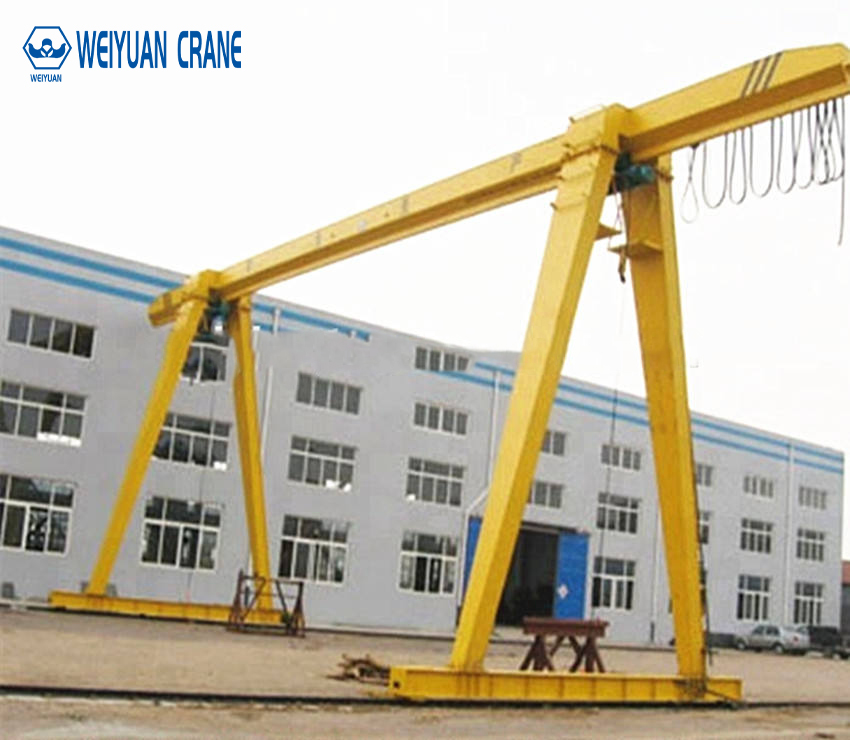
For most fabrication settings, a full gantry crane on ground rails delivers the open working span and capacity range these operations need.
Shipbuilding
Shipyards run some of the largest gantry cranes on earth. Goliath gantry cranes lift entire pre-assembled hull blocks — sometimes 500 to 1,500 tonnes — and position them within the building dock. This block-assembly method is only possible because a gantry can span an entire dry dock and lift massive sections in one move.
Typical load types: hull blocks, deck sections, engine modules, superstructure units — from tens to well over a thousand tonnes.
Key performance considerations:
- Extreme capacity — the crane must handle the heaviest single block plus rigging and dynamic margins.
- Wide span — spanning a full dry dock often means spans of 100 metres or more.
- Twin-hoist coordination — many shipyard gantries use two hoists to rotate and level large blocks during placement.
- Marine environment — salt air demands heavy corrosion protection.
Ports and Container Terminals
Container handling is the most cycle-intensive gantry application. Rubber-tyred gantry cranes (RTGs) and rail-mounted gantry cranes (RMGs) stack and retrieve containers in yards, while ship-to-shore gantries load and unload vessels. Speed and repeatability define success here.
Typical load types: standard and heavy containers — commonly 40 to 65 tonnes under the spreader.
Key performance considerations:
- Cycle speed — throughput is measured in moves per hour, so hoist and travel speeds are critical.
- Automation readiness — RMGs on fixed rails integrate with automated positioning and terminal control systems.
- Stacking height and reach — the crane must span multiple container rows and stack several tiers high.
- Energy efficiency — high-utilization cranes benefit from electric drives and energy recovery systems.
RTGs win where the crane must reposition across a paved yard; RMGs win where high-volume, precise, repetitive travel justifies fixed-rail infrastructure.
Construction and Infrastructure
Construction sites use gantry cranes for precast concrete handling, bridge segment placement, and heavy component installation. Specialized launching gantries erect viaduct spans, while yard gantries handle precast beams and segments before delivery. The common thread is heavy, repetitive lifting in outdoor, often remote, conditions.
Typical load types: precast beams and segments, structural steel, tunnel segments, heavy modules — 40 to 250 tonnes and beyond.
Key performance considerations:
- Mobility — many sites need cranes that relocate as the project advances.
- Precise placement — segment and beam positioning requires multi-axis fine control.
- Ruggedness — dust, weather, and uneven ground demand robust structures and protected controls.
- Transport and assembly — the crane must be practical to move between project sites.
Energy and Power Plants
Power generation facilities — thermal, hydro, nuclear, and renewable — use gantry cranes for equipment installation and maintenance. They lift turbines, generators, transformers, and reactor components during construction and periodic overhauls. In hydroelectric plants, gantries operate spillway gates and handle heavy mechanical equipment.
Typical load types: turbine rotors, generators, transformers, gate structures, boiler components — 50 to several hundred tonnes.
Key performance considerations:
- Reliability and safety margins — lifts near critical or hazardous equipment demand the highest reliability.
- Precise low-speed control — installing sensitive components requires smooth, creep-speed positioning.
- Long service intervals — plant cranes may sit idle between major overhauls, then perform critical heavy lifts.
- Environmental sealing — outdoor and specialized settings require appropriate ingress protection.
Mining and Bulk Handling
Mining operations use gantry cranes for equipment maintenance, material handling, and processing plant support. They lift crusher components, mill liners, pumps, and heavy machinery for repair and replacement. Grab-fitted gantries also handle bulk materials in some stockyard applications.
Typical load types: crusher and mill components, pumps, motors, bulk material via grab — 20 to 200 tonnes.
Key performance considerations:
- Harsh-environment durability — dust, abrasion, and vibration demand sealed components and rugged construction.
- Mobility across the site — maintenance needs often shift between locations.
- High reliability — downtime in mining carries steep production costs, so uptime is paramount.
- Overload protection — heavy, awkward loads make load limiters essential.
How to Match Gantry Crane Specifications to Industry Demands
Every sector above points toward different specification priorities. Use this framework to translate your industry’s demands into the right crane configuration.
Start with load and duty cycle
Define the heaviest load, the average load, and how often lifts occur. A shipyard’s occasional 800-tonne block calls for very different engineering than a container terminal’s constant 40-tonne cycles. Match the crane’s duty classification (light, medium, heavy, or severe) to your real lifting frequency — under-classifying a high-cycle crane guarantees premature wear.
Define the operating environment
Indoor fabrication favors clean electric drives and lighter structures. Outdoor ports, mines, and construction sites need weatherproofing, corrosion protection, and appropriate ingress ratings. Marine and mining settings demand the most aggressive protection specifications.
Set span, height, and reach
Measure the working area the crane must cover. Shipyards need vast spans; terminals need stacking height and row reach; fabrication shops need clear working spans that preserve floor traffic. These dimensions drive the structural design directly.
Decide the mobility model
- Fixed rails (RMG, full gantry): high-volume, repetitive, precise travel.
- Rubber tyres (RTG): free movement across paved yards.
- Relocatable units: construction and mining sites where the work moves.
Weigh total cost of ownership
Look past the purchase price to installation, foundations or rail, power supply, maintenance, and service life. A high-utilization terminal crane may justify premium electric drives that pay back through energy savings, while an occasional-use plant crane prioritizes reliability over cycle speed.
In short: load, duty cycle, environment, dimensions, mobility, and lifetime cost — resolve these six factors in order, and the right specification emerges from your industry’s demands rather than from guesswork.
Frequently Asked Questions
Q: Which industries use gantry cranes the most?
Gantry cranes are widely used in manufacturing and heavy fabrication, shipbuilding, ports and container terminals, construction and infrastructure, energy and power generation, and mining. Each sector values a different combination of capacity, outdoor capability, cycle speed, and mobility, which is why gantry designs vary so widely across industries.
Q: What is the largest gantry crane application?
Shipbuilding uses the largest gantry cranes. Goliath gantry cranes in major shipyards can lift pre-assembled hull blocks weighing 500 to over 1,500 tonnes, spanning an entire dry dock. These cranes make modern block-assembly shipbuilding possible by positioning massive sections that no other equipment could handle.
Q: What is the difference between an RTG and an RMG in port applications?
A rubber-tyred gantry crane (RTG) travels on wheeled tyres, giving it freedom to move across a paved container yard and serve multiple stacking blocks. A rail-mounted gantry crane (RMG) runs on fixed steel rails, offering higher precision, better energy efficiency, and readiness for automation in high-volume, repetitive terminal operations.
Q: How do I choose a gantry crane capacity for my industry?
Start with the heaviest single load your operation will lift, then add the weight of spreaders, lifting frames, and rigging, plus a safety margin. Factor in how often you lift at or near that maximum. High-frequency heavy lifting requires a higher duty classification, while occasional peak lifts allow a different design balance.
Q: Are gantry cranes suitable for harsh environments like mining and marine settings?
Yes. Gantry cranes for mining, ports, and shipyards are engineered with corrosion-resistant coatings, sealed components, and high ingress-protection ratings to withstand dust, abrasion, salt air, and weather. Specifying the correct environmental protection for your sector is essential to achieving the expected service life.
Q: Can one gantry crane design serve multiple industries?
Some general-purpose full gantry cranes serve fabrication and workshop settings across sectors, but most heavy or high-cycle applications demand industry-specific engineering. Capacity, duty cycle, span, and environmental protection differ enough between shipbuilding, port handling, and mining that a purpose-matched design almost always outperforms a generic one over its service life.