


Gantry Crane Runway and Rail Design Guide: Ground Rails, Foundations, and Alignment
Introduction
A gantry crane gets specified on its capacity and span, but it lives or dies on the rails it runs on. Unlike a bridge crane suspended from a building, a gantry stands on its own legs and travels on ground-level rails set into the earth — so the ground, the rail bed, and the alignment carry the whole weight of the machine and everything it lifts. Set the rails 5mm out of gauge, pour a rail bed the soil can’t support, or skip the drainage in an outdoor yard, and you inherit skew, uneven wheel wear, a crane that fights its own travel, and structural fatigue no maintenance program can reach.
For plant managers, heavy industry operators, and procurement engineers, the runway is the part of a gantry project most often underestimated — and the most expensive to fix after the crane is running.
This guide walks through gantry crane runway and rail design from the ground up. This is article 3 of 3 in the Weiyuan Crane gantry crane series. Here is what you will learn:
- How to select and support ground-level rails on a properly prepared bed
- How span, deflection, and structural loads shape the runway design
- The CMAA and ASME B30.2 alignment tolerances that govern the whole system
- Rail anchoring, end stops and buffers, and the outdoor factors — drainage, corrosion, and wind anchoring — that indoor cranes never face
What a Gantry Crane Runway Actually Is
Before designing anything, it helps to see the whole system and how ground-level rails differ from an elevated runway.
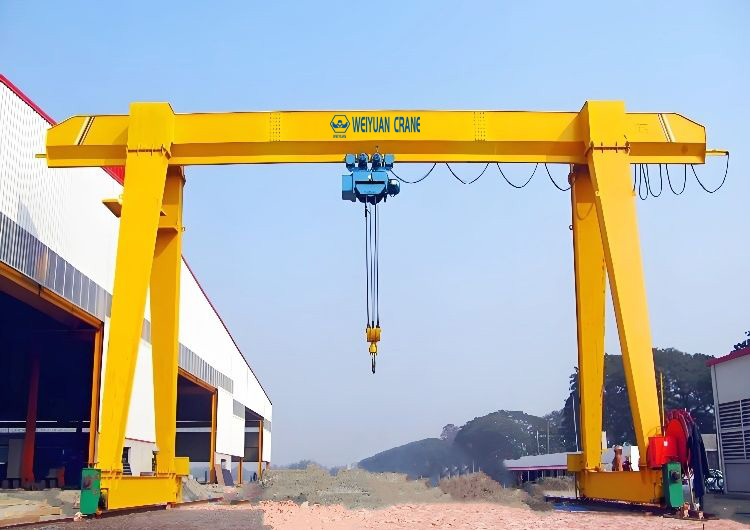
A gantry crane runway is the pair of parallel rails, set at or near ground level, that the crane’s legs travel along. Where a bridge crane runs on elevated beams carried by building columns, a gantry runway transfers every force straight down into a rail bed and the soil beneath it. That single difference — ground support instead of building support — reshapes the entire design.
The runway system is made of a handful of components, each with a specific job:
- Rails: the steel rails the crane wheels run on, carrying the full wheel loads.
- Rail bed / foundation: the concrete beam, sleepers, or ballast that supports the rails and spreads the load into the ground.
- Rail anchoring: the clips or fasteners holding the rail to the bed while allowing thermal movement.
- End stops and buffers: the devices that stop the crane safely at each end of travel.
- Drainage and protection (outdoor): the systems that keep water, corrosion, and wind from destroying the runway over time.
Takeaway: A gantry runway is a load path from the crane wheel straight into the ground. Because there is no building to lean on, the rail bed and the soil are the foundation — get them right first.
Ground-Level Rail Selection
The rail is the surface the wheels run on, and matching it to the wheel load is central to even wear and long service life.
Why the Rail Matters
Each crane wheel presses a concentrated contact force onto the rail head, and the rail spreads that force into the bed below. Too light a rail for the wheel load and the head wears rapidly, deforms, and transmits a rough ride into the structure. The right rail carries the wheel load comfortably, wears slowly, and keeps the crane tracking true.
Types of Rail
Three rail options appear on gantry runways:
- Crane rail (A-series / heavy rail): purpose-made rail with a wide head and foot, designed for high wheel loads and heavy duty. The standard for medium and heavy gantry cranes.
- Flat-bottom (train) rail: ASCE or similar profiles, sometimes used for lighter cranes, though the profile is optimized for railway wheels rather than crane wheels.
- Square or rectangular bar: economical for the lightest, low-wheel-load cranes on short runs.
Matching Rail to Wheel Load
Rail size follows the crane’s maximum wheel load and duty class, both of which the crane supplier provides. A heavy, high-cycle gantry needs a substantial crane rail with a wide head to spread contact stress; a light, occasional-use crane can run on a lighter section. Under-specify and you get rapid head wear and a rough-running crane; over-specify and you pay for steel you don’t need.
Takeaway: Match the rail to the maximum wheel load and duty class — crane rail for heavy duty, lighter sections for light duty — and always size it from the supplier’s real wheel-load figures.
Rail Bed and Foundation Preparation
The rail bed is where a gantry runway succeeds or fails, because it — not a building — carries the whole crane into the ground.
The Three Common Bed Types
- Continuous reinforced concrete beam: a poured concrete strip running the full length under each rail. The most robust option, ideal for heavy cranes and poor soil, spreading the load over a long footing.
- Concrete sleepers on ballast: individual concrete sleepers bedded in compacted ballast, similar to railway construction. Suited to lighter cranes and good ground.
- Steel sleepers or embedded rail: rail embedded into or fixed onto a concrete slab, common where the runway crosses a working floor or yard used by vehicles.
Soil and Bearing Capacity
Everything rests on the ground’s ability to carry the load. Before designing the bed:
- Commission a geotechnical assessment to confirm the soil bearing capacity along the full runway length.
- Size the foundation so the concentrated wheel loads stay within the soil’s safe bearing pressure without settling.
- Watch for variable ground — a runway that runs across soft and firm soil will settle unevenly, throwing the rails out of level over time.
Cure and Compaction
Let the concrete reach full design strength before any crane load is applied, and compact any ballast or sub-base to specification. Green concrete or poorly compacted ground settles under the first heavy lifts, and correcting a settled rail bed after installation is one of the costliest repairs in the whole project.
Takeaway: The rail bed replaces the building as the crane’s foundation. Confirm the soil bearing capacity first, size the bed to spread the wheel loads, and never load green concrete or uncompacted ground.
Span and Deflection Considerations
Span — the distance between the two rails — is set by the crane, but it shapes the whole runway design, because it drives the loads each rail delivers into the ground.
What Span Means for a Gantry Runway
On a gantry crane, the span is fixed by the width the crane must cover, and the two rails must be built to carry the wheel loads at that gauge. Unlike an elevated runway, the rails themselves don’t span between supports — they sit continuously on their bed. So “deflection” here is less about the rail bending in the air and more about the bed and soil deflecting under load.
Controlling Settlement and Deflection
The design goal is to keep the rails straight and level under load, which means controlling how much the bed and soil deflect:
- Design the bed to limit settlement to within the alignment tolerances the crane needs to run smoothly.
- Account for the moving wheel loads — the load travels along the rail, so every point of the bed must carry the peak wheel load in turn.
- Include dynamic effects from lifting, acceleration, and braking, which add impact beyond the static weight.
Where the ground is poor and settlement can’t be controlled with a standard bed, deepen or widen the foundation, improve the sub-base, or use a continuous reinforced beam that bridges soft spots.
Takeaway: On a gantry runway, span drives the wheel loads and the bed controls the deflection. Design the foundation to hold the rails straight and level under the peak moving load plus impact.
Structural Load Requirements
A gantry runway must carry three kinds of load, and a bed designed for vertical weight alone is under-designed.
The Three Load Directions
- Vertical load: the crane’s dead weight, the rated load, and all rigging, delivered through the wheels straight down into the bed and soil.
- Lateral load: side forces from travel, slight skew, and — outdoors — wind pushing on the structure, acting horizontally across the rail.
- Longitudinal load: acceleration and braking forces acting along the length of the runway.
Why Each One Matters
Vertical load sizes the bed and confirms the soil can carry it. Lateral load tries to push the rails sideways and skew the crane, so the anchoring and bed must resist it. Longitudinal load, from starting and stopping the whole traveling mass, tries to shift the rail along its length — which is exactly why the anchoring must hold firm while still allowing thermal movement.
For an outdoor gantry, wind is a major contributor to both lateral and longitudinal load, both in service and when the crane is parked. The runway and its anchoring must resist the wind forces the crane transmits into it.
Takeaway: Design the runway for vertical, lateral, and longitudinal loads together — not vertical alone. Outdoors, wind adds significantly to the horizontal forces the bed and anchoring must resist.
Alignment Tolerances: CMAA and ASME B30.2
Alignment is where a gantry runway succeeds or fails in service. Rails sized and bedded correctly still run badly if they aren’t straight, level, and parallel within tolerance.
The Governing Standards
- ASME B30.2 is the safety standard for overhead and gantry cranes, covering the runway as part of the crane system.
- CMAA Specification No. 70 defines crane classification, design, and the runway alignment criteria the installation must meet.
Build to both and you have a defensible, verifiable standard.
The Alignment Criteria
The critical runway tolerances, drawn from CMAA practice, are:
- Track gauge (span between rail centerlines): within ±3mm of nominal at any point along the runway.
- Elevation difference between the two rails at any cross-section: ±10mm maximum.
- Rail straightness (horizontal): within ±2mm in any 10-metre length.
- Rail waviness (vertical): within ±2mm in any 10-metre length.
- Rail joint step: no more than 0.5mm vertical step at any joint.
Why Each Tolerance Matters
Each targets a specific failure mode. Gauge error forces the wheel flanges against the rail, wearing them and skewing the crane. Elevation difference makes the crane run cross-level, loading one side harder. Straightness and waviness errors make the crane weave and bounce as it travels. And a rail joint step becomes a hammer blow on every wheel pass, wearing the wheel and cracking the bed over time.
These are acceptance criteria, not aspirations — survey and confirm them before the crane enters service, and re-check them periodically, since ground settlement can move them over time.
Takeaway: Design and build to the CMAA gauge, elevation, straightness, waviness, and joint-step tolerances. Survey them at installation and re-check them, because settling ground shifts a gantry runway in ways an elevated one never moves.
Rail Anchoring Methods
How the rail attaches to its bed decides whether it stays put, stays aligned, and survives thermal cycling.
The Two Demands on Anchoring
Rail anchoring must do two things that pull in opposite directions:
- Hold the rail firmly against vertical, lateral, and longitudinal movement, so it doesn’t creep or shift under wheel and travel loads.
- Allow thermal expansion and contraction along the rail’s length, without building up compressive stress — a bigger factor outdoors, where the rail bakes in the sun and cools at night.
Clip Anchoring Done Right
The correct method is a rail clip system, which grips the rail foot against movement while letting it slide longitudinally as it expands. For it to work over decades:
- Set the clip spacing to the design interval, closer where duty and lateral loads are heavy.
- Torque the clips to specification — too loose and the rail creeps, too tight and it can’t move thermally.
- Use the correct clip type for the rail profile and adjust for fine lateral alignment during installation.
Why Welding the Rail Solid Is Wrong
The most damaging anchoring mistake is welding the rail solid to a continuous bed. It locks in the thermal expansion the rail must accommodate. Over a few seasons — and especially outdoors, where temperature swings are large — the compressive stress builds until the rail buckles into humps and lifts. Always clamp with clips; never weld a running gantry rail solid.
Takeaway: Anchor with a clip system that grips the rail against movement while allowing thermal expansion. Set spacing and torque to spec, and never weld an outdoor gantry rail solid.
End Stops and Buffers
At each end of the runway, the crane must stop safely at the limit of travel. End stops and buffers are the last line of defense against a moving gantry running off its rails.
What They Do
- End stops are physical barriers fixed at each end of the runway that the crane cannot travel past — the hard limit of travel.
- Buffers are energy-absorbing devices on the crane or the end stop that cushion the impact, turning a potential crash into a controlled deceleration.
Both back up the crane’s electrical travel limit switches, which slow and stop the crane before it reaches the buffers in normal operation. The buffers and stops are the mechanical safety net for when the limit switches or the operator fail.
Sizing and Placement
Buffers must be sized for the crane’s weight and travel speed, because the kinetic energy they absorb grows with both — and a gantry crane is a heavy, fast-traveling machine. Common types include rubber, cellular polyurethane, and hydraulic units, chosen by the energy they must dissipate. Place the end stops so both legs reach their stops squarely at the same moment; a crane that hits one stop before the other skews hard at impact.
Takeaway: End stops halt the crane and buffers absorb the impact, backing up the travel limit switches. Size buffers to the gantry’s full weight and speed, and place stops for square, correctly-cleared stopping on both rails.
Outdoor-Specific Runway Considerations
An outdoor gantry runway faces three enemies an indoor one never meets: water, corrosion, and wind. Each demands its own design response.
Drainage
Standing water is the outdoor runway’s biggest long-term threat. It softens the sub-base, causes uneven settlement, freezes and heaves in cold climates, and accelerates corrosion of the rail and anchoring. Design drainage from the start:
- Slope the rail bed and surrounding yard so water runs away from the rails, never pools along them.
- Fit drainage channels or French drains alongside a continuous concrete beam.
- Keep the rail head and clips clear of debris and buildup that trap moisture.
Corrosion Protection
Rain, humidity, and salt air attack every exposed steel surface. Protect the runway with corrosion-resistant coatings on the rail web and foot, galvanized or coated clips and fasteners, and sealed connections. Inspect for rust at every periodic check and treat it before it spreads into the anchoring or the rail foot.
Wind Anchoring
Wind can push a parked gantry along its rails or, in extreme cases, destabilize it. The runway must include:
- Rail clamps or storm anchors that lock the parked crane to the rails against high wind.
- Anchor points built into the runway at parking positions, sized for the out-of-service wind load.
- Automatic rail brakes that engage if the crane starts to move under wind.
The runway and its anchor points must resist the same design wind the crane is built to survive, so coordinate the runway design with the crane’s wind ratings from the start.
Takeaway: Outdoors, design drainage to keep water off the rails, protect every steel surface against corrosion, and build in wind anchoring rated to the crane’s out-of-service wind speed. These are not extras — they are what keeps an outdoor runway alive.
Comparing the Rail Bed Options at a Glance
Use this table to narrow the bed type, then confirm the detail against your soil, loads, and environment.
| Bed type | Best for | Load spreading | Relative cost | Key consideration |
|---|---|---|---|---|
| Continuous reinforced concrete beam | Heavy cranes, poor or variable soil | Excellent — bridges soft spots | Higher | Requires full geotechnical design and cure time |
| Concrete sleepers on ballast | Light-to-moderate cranes, good ground | Good, point-by-point | Moderate | Needs well-compacted, well-drained ballast |
| Embedded / slab-mounted rail | Runways crossing a working yard or floor | Good, into the slab | Moderate to higher | Must suit vehicle traffic and flush finish |
How to Read the Table
Start with your soil and your load. Heavy cranes on poor or variable ground point to a continuous concrete beam that spreads the load and bridges weak spots. Lighter cranes on firm, well-drained ground can use sleepers on ballast. Where the runway shares space with forklifts or trucks, an embedded or slab-mounted rail keeps the surface flush and trafficable. Confirm the choice against the geotechnical report before committing.
Takeaway: Soil and load decide the bed. Continuous beam for heavy or poor ground, sleepers for light duty on good ground, embedded rail for shared traffic areas.
A Practical Runway Design Framework
Here is how to reach a sound gantry runway design without guesswork. Work through the steps in order.
Step 1: Get the Crane Data First
Start with the crane’s wheel loads, span, duty class, weight, travel speed, and wind ratings — all from the supplier. The runway can’t be designed until these are fixed, because they drive every decision downstream.
Step 2: Assess the Ground
Commission a geotechnical survey along the full runway length. Confirm the soil bearing capacity and flag any variable or soft ground that needs a stronger foundation.
Step 3: Design the Bed and Select the Rail
Choose the bed type for your soil and loads, size it to spread the wheel loads within the soil’s bearing capacity, and match the rail to the maximum wheel load and duty.
Step 4: Specify Alignment, Anchoring, and Stops
Set the CMAA and ASME B30.2 tolerances as acceptance criteria, specify a clip anchoring system that allows thermal movement, and size the end stops and buffers to the crane’s weight and speed.
Step 5: Add the Outdoor Systems
For an outdoor runway, design drainage, corrosion protection, and wind anchoring rated to the crane’s out-of-service wind speed — before finalizing anything.
Takeaway: Crane data, then ground, then bed and rail, then alignment and anchoring, then the outdoor systems. Work through them in order and the runway design emerges from real numbers rather than assumptions.
Frequently Asked Questions
Q: What is a gantry crane runway?
A gantry crane runway is the pair of parallel ground-level rails the crane’s legs travel along, together with the rail bed or foundation that supports them, the anchoring that holds the rails in place, and the end stops and buffers at each end. Unlike a bridge crane runway carried on building columns, a gantry runway transfers every force — the crane’s weight, the rated load, and travel forces — straight down into the rail bed and the soil beneath it. That ground support, rather than building support, is what makes the rail bed and soil the true foundation of the whole system.
Q: How do I choose the right rail for a gantry crane?
Match the rail to the crane’s maximum wheel load and duty class, both of which the crane supplier provides. Heavy, high-cycle gantry cranes need a purpose-made crane rail (A-series) with a wide head to spread the concentrated contact stress and wear slowly. Lighter cranes on short runs can use a flat-bottom rail or even bar stock. Under-specifying causes rapid head wear and a rough-running crane, while over-specifying wastes money on steel you don’t need. Always size the rail from the supplier’s real wheel-load figures rather than a rough estimate.
Q: What kind of foundation does a gantry crane runway need?
It depends on the soil and the crane loads. A continuous reinforced concrete beam under each rail is the most robust option, ideal for heavy cranes and poor or variable soil because it spreads the load and bridges soft spots. Concrete sleepers on compacted ballast suit lighter cranes on good ground, and embedded or slab-mounted rail works where the runway crosses a yard used by vehicles. In every case, commission a geotechnical assessment first to confirm the soil bearing capacity, size the bed to keep wheel loads within safe bearing pressure, and let the concrete cure fully before applying any load.
Q: What alignment tolerances apply to a gantry crane runway?
Per CMAA and ASME B30.2 practice: track gauge within ±3mm of nominal at any point, elevation difference between the two rails within ±10mm at any cross-section, rail straightness within ±2mm in any 10 metres, rail waviness within ±2mm in any 10 metres, and rail joint steps no greater than 0.5mm. These control flange wear, crane skew, ride smoothness, and structural fatigue. They must be surveyed and confirmed before the crane enters service — and re-checked periodically, because ground settlement can shift a ground-level runway out of tolerance in a way an elevated runway rarely moves.
Q: Why can’t a gantry crane rail be welded solid to its foundation?
Because the rail expands and contracts with temperature, and a solid weld leaves that movement nowhere to go. Outdoors especially, where the rail heats in the sun and cools at night through large swings, compressive stress builds until the rail buckles into humps and lifts off the bed, leaving a wavy, damaged rail that is expensive to correct. The right method is a rail clip system: the clips grip the rail foot firmly against vertical, lateral, and longitudinal movement while still allowing it to slide as it expands. Always clamp with clips, never weld a running gantry rail solid.
Q: How do I protect an outdoor gantry crane runway from the weather?
Address three threats. First, drainage: slope the rail bed and yard so water runs away from the rails, fit drainage channels alongside a concrete beam, and keep the rail head and clips clear of debris that traps moisture. Second, corrosion: use corrosion-resistant coatings on the rail web and foot, galvanized or coated clips and fasteners, and treat any rust promptly at periodic inspections. Third, wind: build in rail clamps, storm anchors, and anchor points at parking positions, sized to the crane’s out-of-service wind load, plus automatic rail brakes that engage if the parked crane starts to move.
Q: How are end stops and buffers sized for a gantry crane?
Buffers are sized to the kinetic energy of the moving crane, which grows with both its weight and its travel speed — and a gantry is a heavy, fast machine, so the energy can be substantial. Common buffer types include rubber, cellular polyurethane, and hydraulic units, selected by the energy they must dissipate. Under-size a buffer and it bottoms out, transferring a hard shock into the crane and the end stop. Place the end stops so both legs reach their stops squarely at the same moment, since a crane that hits one stop first skews hard at impact. Buffers and stops back up the travel limit switches, not replace them.
Q: Should the runway be designed together with the gantry crane?
Yes — the crane and its runway are a single system. The crane’s wheel loads, span, duty class, weight, travel speed, and wind ratings all drive the rail selection, bed design, alignment tolerances, anchoring, and buffer sizing. Designing the runway in isolation, or ordering the crane before assessing the ground and designing the bed, is a common and costly mistake, because a runway that can’t be built to the required tolerances on the available soil will undermine even the best crane. Confirm the crane specification and coordinate the runway design as one package from the start.